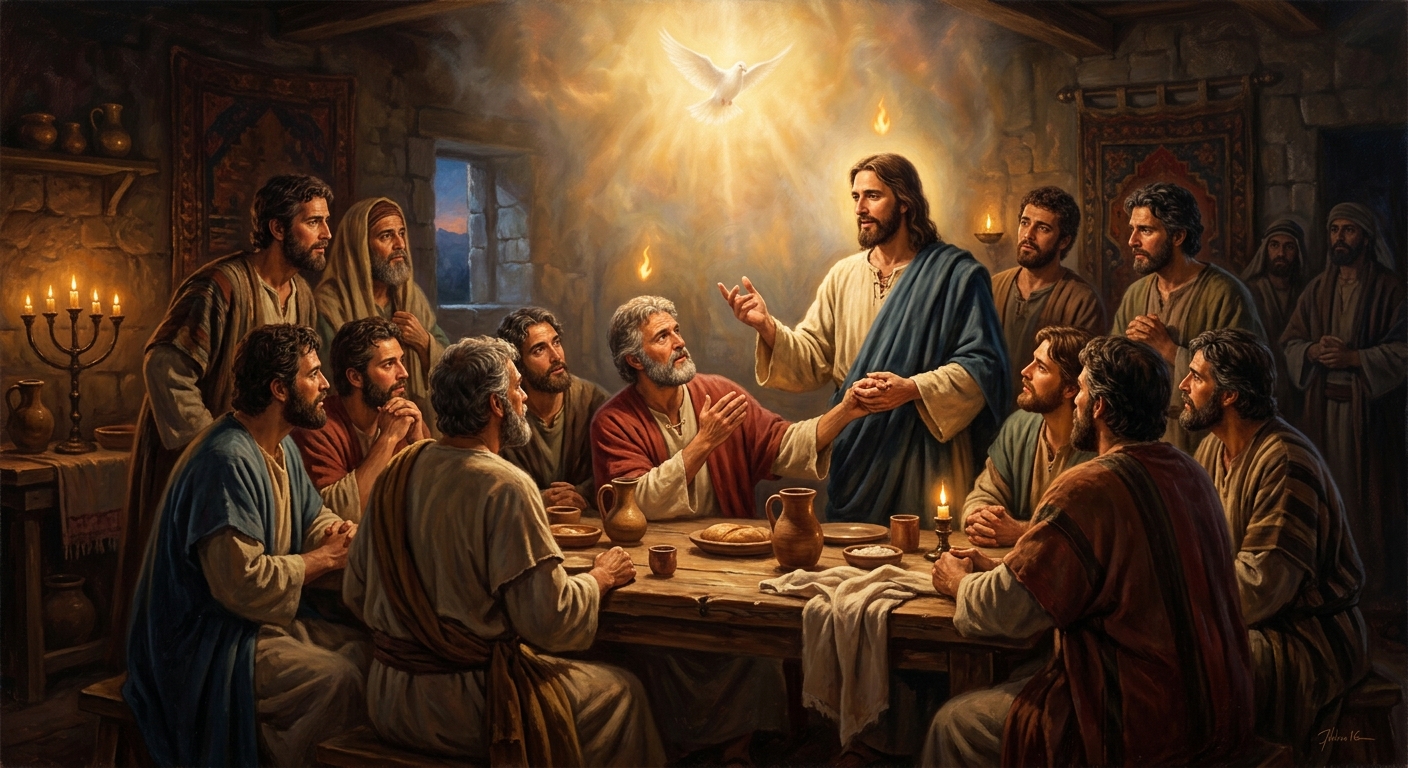
Illustration: Dramatic cinematic biblical illustration for John Chapter 16 showing Promise of the Holy Spirit (Comforter), photorealistic oil painting style.
🔊
Listen to Chapter
Grace Notes Journey Audio Narration
Author
John the Apostle
Written
~90 AD
Key Theme
Promise of the Holy Spirit (Comforter)
Setting
Upper Room - final discourse
Key Verse
John 16:33
Total Verses
33
Chapter Introduction
*Beloved friend, in this tender farewell of our Lord, we find the gentle promise that steadies the heart. Though trials loom and shadows gather, He assures us of a Helper who will guide us with divine love. Let this be a reminder that His presence is ever near, even in the darkest valleys of life. Trust in His promise, for He has overcome the world on our behalf.*
John — Chapter 16 — KJV
1
These things have I spoken unto you, that ye should not be offended.
Simply PutThe word "offended" (Greek: skandalizo, G374) means to be stumped or tripped up. Jesus is warning that his teachings might cause spiritual stumbling, not because they're wrong, but because the world often resists truth. For anyone feeling hurt by his words today, remember it's not personal rejection—it's the world's resistance to divine light.
2
They shall put you out of the synagogues: yea, the time cometh, that whosoever killeth you will think that he doeth God service.
Simply Put"Synagogues" (Greek: synagōgē, G4486) were places of worship and community. The Greek verb "killeth" (G2451) conveys the idea of cutting down or slaying. Jesus predicts that people will be expelled from their faith communities, and some will even think that murdering believers is a holy act. If you're feeling isolated or persecuted, know this is part of the cost of following Christ.
3
And these things will they do unto you, because they have not known the Father, nor me.
Simply PutThe "Father" (Greek: patēr, G3962) and "me" (Greek: egō, G3361) together refer to the unique relationship between God and Jesus. The lack of knowing them leads to hostile actions. When you're in doubt, remember that ignorance about the divine is what fuels fear and hatred.
4
But these things have I told you, that when the time shall come, ye may remember that I told you of them. And these things I said not unto you at the beginning, because I was with you.
Simply PutThe "time" (Greek: chronos, G1512) refers to the appointed moment of fulfillment. Jesus says he spoke these things later because he was physically present with his disciples at the beginning (Greek: archē, G558). For those yearning for deeper insight now, understand that Jesus has always been with us in spirit, even when we can't see him.
5
But now I go my way to him that sent me; and none of you asketh me, Whither goest thou?
Simply Put"I go my way to him that sent me" (Greek: apostellō, G649) shows Jesus returning to the Father. His disciples didn't ask him where he was headed because they were still attached to his physical presence. If you're yearning for Jesus' whereabouts, trust that he has a divine purpose beyond what the eyes can see.
6
But because I have said these things unto you, sorrow hath filled your heart.
Simply Put"Sorrow" (Greek: penthos, G5629) describes the deep grief that fills hearts when truth is revealed. The rawness of sorrow leads to awareness, which is essential for spiritual growth. For those in pain today, it's not a sign of weakness but a necessary step toward deeper reliance on God's comfort.
7
Nevertheless I tell you the truth; It is expedient for you that I go away: for if I go not away, the Comforter will not come unto you; but if I depart, I will send him unto you.
Simply PutThe "Comforter" (Greek: parakletos, G3885) means an advocate or helper. Jesus says his departure is "expedient" (Greek: eukairō, G1659); if he stays, the Comforter wouldn't come. The promise here is that after Jesus' ascent, a divine presence will dwell within the believer's heart.
8
And when he is come, he will reprove the world of sin, and of righteousness, and of judgment:
Simply Put"Reprove" (Greek: katagōgos, G3110) means to convict or convince. The Comforter will bring knowledge of sin (Greek: hamartia, G816), righteousness (Greek: dikaiosunē, G1340), and judgment (Greek: krisis, G2815). For those seeking truth, this is a divine awakening that will bring clarity to the spiritual condition.
9
Of sin, because they believe not on me;
Simply PutThe "sin" (Greek: hamartia, G816) is the root cause of unbelief. The Holy Spirit will expose why people trust falsehood rather than Christ. If you're wrestling with doubt, this verse assures you that the Spirit will reveal the deep-rooted reasons behind unbelief.
10
Of righteousness, because I go to my Father, and ye see me no more;
Simply Put"Righteousness" (Greek: dikaiosunē, G1340) is revealed through the departure of Jesus; believers will no longer see him physically. This teaches that spiritual sight must be turned inward, relying on the Spirit's illumination rather than outward signs.
11
Of judgment, because the prince of this world is judged.
Simply PutThe "prince of this world" (Greek: archōn tou kosmou, G4652) refers to Satan. His judgment is announced as a certainty. If you're feeling pressured by worldly powers, know that the ultimate judge—God—is already in motion.
12
I have yet many things to say unto you, but ye cannot bear them now.
Simply Put"Bear them now" (Greek: duno, G1390) indicates spiritual capacity. Jesus says the disciples can't yet handle the full depth of his teachings; they need to mature. For those feeling overwhelmed, understand that spiritual growth is a journey of gradual capacity.
13
Howbeit when he, the Spirit of truth, is come, he will guide you into all truth: for he shall not speak of himself; but whatsoever he shall hear, that shall he speak: and he will shew you things to come.
Simply PutThe "Spirit of truth" (Greek: pneumatikos alētheias, G4152) will "guide you into all truth" (Greek: katagēgē, G3110). He will not speak of himself but will relay only what he hears from the Father. This promised helper ensures that believers can anticipate future revelations with divine insight.
14
He shall glorify me: for he shall receive of mine, and shall shew it unto you.
Simply PutThe Comforter will "glorify" (Greek: doxazo, G1399) Jesus by receiving what belongs to Him (Greek: lambanō, G2998) and revealing it. This signifies that the Holy Spirit will magnify Christ's presence within believers, highlighting His divine attributes.
15
All things that the Father hath are mine: therefore said I, that he shall take of mine, and shall shew it unto you.
Simply PutAll that the Father has is Jesus' (Greek: egō, G3361). The Spirit will take from Jesus and reveal it to believers. This means that the Holy Spirit shares fully with us what belongs to Christ, ensuring a deep and intimate communion.
16
A little while, and ye shall not see me: and again, a little while, and ye shall see me, because I go to the Father.
Simply PutIn this verse, "little while" comes from the Greek oligos (G3615), meaning a brief moment. Jesus is telling His friends that He will be gone for just a short time, then He’ll appear again. Even though He’s going away to the Father, this departure is only temporary—His love for us keeps Him connected and He promises to return.
17
Then said some of his disciples among themselves, What is this that he saith unto us, A little while, and ye shall not see me: and again, a little while, and ye shall see me: and, Because I go to the Father?
Simply PutThe disciples heard the same phrase, "A little while," and asked among themselves what He meant. Their confusion shows how deeply they long for understanding. They’re trying to grasp the mystery of Jesus’ departure and return, feeling anxious about losing Him.
18
They said therefore, What is this that he saith, A little while? we cannot tell what he saith.
Simply PutHere the disciples openly admit that they can’t figure out Jesus’ words. The phrase "a little while" leaves them in doubt, and they feel a deep hunger for clarity. Their honesty reflects the frustration many of us feel when we can’t see God’s plan unfold.
19
Now Jesus knew that they were desirous to ask him, and said unto them, Do ye enquire among yourselves of that I said, A little while, and ye shall not see me: and again, a little while, and ye shall see me?
Simply PutJesus notices their yearning to ask Him directly. He gently invites them to bring their questions forward about His brief absence and return. This shows that He cares for their inner turmoil and wants to guide them through the confusion.
20
Verily, verily, I say unto you, That ye shall weep and lament, but the world shall rejoice: and ye shall be sorrowful, but your sorrow shall be turned into joy.
Simply PutJesus tells them they will weep and mourn, while the world rejoices. He promises that their sorrow will be turned into joy. This comfort reminds us that even in deep pain, God’s promise of future happiness is real and reliable.
21
A woman when she is in travail hath sorrow, because her hour is come: but as soon as she is delivered of the child, she remembereth no more the anguish, for joy that a man is born into the world.
Simply PutHe uses the image of a woman in labor, whose “little while” (Greek akragathia, G84) is the painful moment of birth. Once her child arrives, she forgets the pain and remembers only joy. This illustrates how God’s suffering is brief compared to the lasting happiness He brings.
22
And ye now therefore have sorrow: but I will see you again, and your heart shall rejoice, and your joy no man taketh from you.
Simply PutThough they now have sorrow, Jesus assures them He will return and their hearts will rejoice. Their joy cannot be taken away by anyone, because it is rooted in Christ’s love and His promise to come again.
23
And in that day ye shall ask me nothing. Verily, verily, I say unto you, Whatsoever ye shall ask the Father in my name, he will give it you.
Simply PutJesus says that when they ask the Father in His name, He will give them. The word "Father" (G3962) signifies a personal relationship, and "in my name" (G3686) means asking with the authority and trust that comes from Jesus’ identity.
24
Hitherto have ye asked nothing in my name: ask, and ye shall receive, that your joy may be full.
Simply PutHe encourages them to ask now, so they may receive what they need and have their joy made complete. This invitation shows that God wants to meet our deepest desires, especially when we seek Him by aligning with Jesus’ purpose.
25
These things have I spoken unto you in proverbs: but the time cometh, when I shall no more speak unto you in proverbs, but I shall shew you plainly of the Father.
Simply PutHe acknowledges that He has spoken in proverbs (Greek parabolē, G3992), which are simple stories with deeper meanings. He promises that soon He will no longer speak in riddles, but will reveal the Father plainly and clearly.
26
At that day ye shall ask in my name: and I say not unto you, that I will pray the Father for you:
Simply PutJesus clarifies that He won’t be praying for them on their behalf. Instead, He will teach them to approach the Father directly in His name, empowering them with personal faith.
27
For the Father himself loveth you, because ye have loved me, and have believed that I came out from God.
Simply PutHe reminds them that the Father loves them because they have loved Jesus and believed that He came from God. The love (Greek agape, G26) is unconditional and rooted in their genuine faith.
28
I came forth from the Father, and am come into the world: again, I leave the world, and go to the Father.
Simply PutJesus explains that He came from the Father, entered the world, and is now leaving it again to return home. This emphasizes that His mission on earth was purposeful and temporary, and He is always connected to the Father.
29
His disciples said unto him, Lo, now speakest thou plainly, and speakest no proverb.
Simply PutThe disciples recognize that Jesus now speaks plainly, without using parables. They are amazed by the clarity of His teaching about the Father.
30
Now are we sure that thou knowest all things, and needest not that any man should ask thee: by this we believe that thou camest forth from God.
Simply PutTheir belief in Jesus’ divine origin is deepened. They know He knows all things, and they see this as proof that He truly came from God, giving them a firm foundation for their faith.
31
Jesus answered them, Do ye now believe?
Simply Put"Jesus answered them, Do ye now believe?" The Greek word here is pisteuo (G4102), which goes beyond mere acknowledgment. It asks if the disciples have truly trusted Him with their hearts, especially in the midst of fear and confusion.
32
Behold, the hour cometh, yea, is now come, that ye shall be scattered, every man to his own, and shall leave me alone: and yet I am not alone, because the Father is with me.
Simply Put"Behold, the hour cometh, yea, is now come, that ye shall be scattered, every man to his own, and shall leave me alone: and yet I am not alone, because the Father is with me." The word "hour" (kairos, G2580) refers to a specific appointed moment of trial. Even though the disciples will be scattered and feel abandoned, Jesus reminds them that He is never truly alone—God the Father is always with Him.
33
These things I have spoken unto you, that in me ye might have peace. In the world ye shall have tribulation: but be of good cheer; I have overcome the world.
Simply Put"These things I have spoken unto you, that in me ye might have peace. In the world ye shall have tribulation: but be of good cheer; I have overcome the world." The Greek term for peace, eirēnē (G1519), means a deep inner wholeness that comes from Him. Though the world brings suffering, He assures them—they can be cheerful—because He has already won victory over all the world's chaos.
In moments when you feel stuck in a “little while” of waiting—uncertain about the next step or outcome—how do you find peace and trust that God is preparing something better for you?