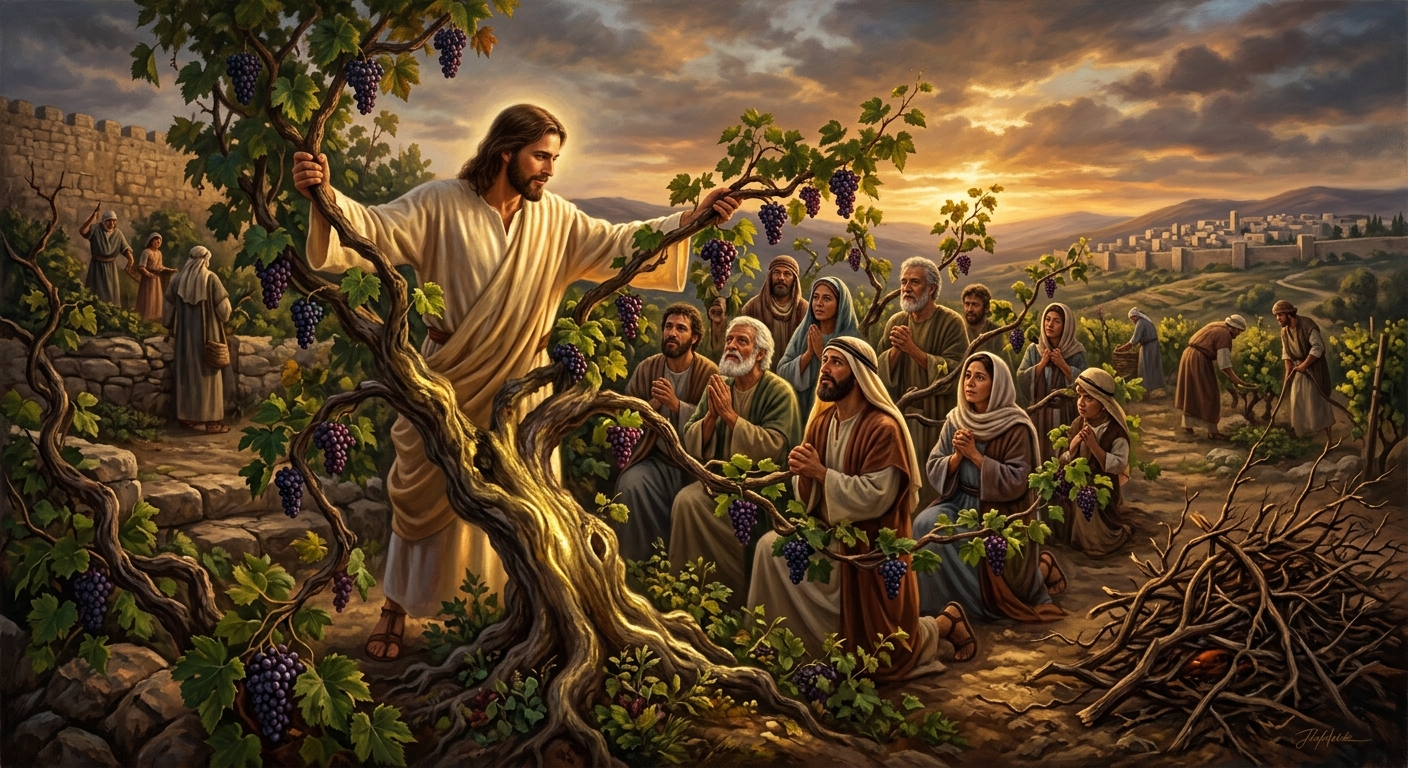
Illustration: Dramatic cinematic biblical illustration for John Chapter 15 showing Union with Christ as the Vine, photorealistic oil painting style.
🔊
Listen to Chapter
Grace Notes Journey Audio Narration
Author
John the Apostle
Written
~90-95 AD
Key Theme
Union with Christ as the Vine
Setting
Jerusalem, Upper Room gathering
Key Verse
John 15:4
Total Verses
27
Chapter Introduction
*In this tender discourse, our Lord invites us into an intimate fellowship with Him, likening Himself to a flourishing vine. He reminds us that apart from His life-giving presence we cannot bear fruit, but when we remain in Him, the Father nurtures us to grow. The promise of cleansing through His spoken word assures us that our communion with Him is both spiritual and transformative. As we abide, He promises to grant us the love that surpasses all understanding.*
John — Chapter 15 — KJV
1
I am the true vine, and my Father is the husbandman.
Simply PutI am the true vine—think of a living, thriving grapevine that supplies life to every branch. The Father is the husbandman (poimen, G4179), a devoted farmer who tends well. If you're feeling empty or broken, remember He is the one who cultivates and restores you.
2
Every branch in me that beareth not fruit he taketh away: and every branch that beareth fruit, he purgeth it, that it may bring forth more fruit.
Simply PutAny branch that doesn't bear fruit (karpos, G2971) is cut away; any fruitful branch is pruned to produce even more. This pruning can feel like loss or pain, but it's God's method of shaping us for greater harvest.
3
Now ye are clean through the word which I have spoken unto you.
Simply PutYou are clean through the word I've spoken to you. The cleansing comes not from your effort but from His truth (word) that washes away guilt and doubt.
4
Abide in me, and I in you. As the branch cannot bear fruit of itself, except it abide in the vine; no more can ye, except ye abide in me.
Simply PutAbide in me—let my presence be your source of life. Just as a branch can't bear fruit on its own, we can't thrive without staying connected to Christ's life-giving power.
5
I am the vine, ye are the branches: He that abideth in me, and I in him, the same bringeth forth much fruit: for without me ye can do nothing.
Simply PutI am the vine, you are the branches. Whoever remains in me (meno, G2258) and I in them will bear abundant fruit; without this relationship, you are powerless—like a branch cut off from its source.
6
If a man abide not in me, he is cast forth as a branch, and is withered; and men gather them, and cast them into the fire, and they are burned.
Simply PutIf someone doesn't stay connected, they are gathered like dead branches and thrown into the fire. This vivid picture warns that a life disconnected from Christ leads to decay and loss.
7
If ye abide in me, and my words abide in you, ye shall ask what ye will, and it shall be done unto you.
Simply PutWhen you stay in me and let my words dwell within you, your prayers become aligned with His will. You can ask confidently, trusting that He hears and responds.
8
Herein is my Father glorified, that ye bear much fruit; so shall ye be my disciples.
Simply PutThe Father is glorified when you bear much fruit. This fruitfulness is the evidence of true discipleship—living lives that reflect God's love and purpose.
9
As the Father hath loved me, so have I loved you: continue ye in my love.
Simply PutAs the Father loves Me, so I have loved you. Keep living in this love (agape, G26); it's the foundation for your spiritual growth.
10
If ye keep my commandments, ye shall abide in my love; even as I have kept my Father’s commandments, and abide in his love.
Simply PutKeep my commandments (entolē, G1610), and you will remain in My love. Just as I obey the Father's commands, your obedience secures a deep, abiding relationship with God.
11
These things have I spoken unto you, that my joy might remain in you, and that your joy might be full.
Simply PutI have spoken these things so that My joy may remain in you, and your joy may be full. This joy is not fleeting happiness but a deep, lasting contentment that fills your heart.
12
This is my commandment, That ye love one another, as I have loved you.
Simply PutMy command for you is to love one another as I have loved you. This love (agape) is the defining mark of a community rooted in Christ.
13
Greater love hath no man than this, that a man lay down his life for his friends.
Simply PutNo greater love exists than when someone lays down his life (balō, G2979) for friends. This shows the ultimate depth of Christ's love—sacrificial and self-giving.
14
Ye are my friends, if ye do whatsoever I command you.
Simply PutYou are My friends if you do everything I command. Friendship with Jesus means obedience, not just a casual acquaintance.
15
Henceforth I call you not servants; for the servant knoweth not what his lord doeth: but I have called you friends; for all things that I have heard of my Father I have made known unto you.
Simply PutFrom now on I call you friends, not servants. While servants only know what their master does, friends share in the Father's thoughts and plans—God has revealed His heart to you.
16
Ye have not chosen me, but I have chosen you, and ordained you, that ye should go and bring forth fruit, and that your fruit should remain: that whatsoever ye shall ask of the Father in my name, he may give it you.
Simply PutJesus tells us that He chose us first (Greek "proorizo," G4350, meaning “to set beforehand”) and set us apart so we would bear lasting fruit. In the middle of our struggles, this means we’re not wandering alone; He’s guiding us toward a purpose that endures, and when we ask the Father in Jesus’ name, He promises to meet those needs.
17
These things I command you, that ye love one another.
Simply PutThe command here isn’t a rule but a call to “agape” love (Greek G26), the deep, selfless kind of love God showed us. When you feel empty or isolated, this verse reminds you that the real answer to your longing is found in loving others as He loves us.
18
If the world hate you, ye know that it hated me before it hated you.
Simply Put“World” (Greek G2889) refers to the system of human values that opposes God. Its “hate” (Greek G5343) tells us that when we’re rejected or hurt by the world, it’s because the very thing they cherish—self-sufficiency—is what turned away from Christ.
19
If ye were of the world, the world would love his own: but because ye are not of the world, but I have chosen you out of the world, therefore the world hateth you.
Simply PutIf we belonged to the world, it would simply love its own. But Jesus “chose” us (Greek "eklegó," G1740) from outside its system, which is why the world now rejects us. This gives you a cause for your persecution: it’s not personal, but spiritual.
20
Remember the word that I said unto you, The servant is not greater than his lord. If they have persecuted me, they will also persecute you; if they have kept my saying, they will keep yours also.
Simply PutJesus reminds us that a servant (Greek “doulos,” G1415) is not greater than his lord. If the authorities persecuted Him, they will do the same to us—yet we’re also promised that they’ll keep our teachings as He kept His. It’s a reassurance that loyalty to truth endures beyond suffering.
21
But all these things will they do unto you for my name’s sake, because they know not him that sent me.
Simply PutThe world attacks us “for my name’s sake” (Greek G1483), not because they understand Him, but because they don’t know the Father who sent Jesus. In moments of doubt or fear, this verse reminds you that their hostility is a sign they’re missing the One who truly loves them.
22
If I had not come and spoken unto them, they had not had sin: but now they have no cloak for their sin.
Simply PutJesus says that if He hadn’t spoken to them, they wouldn’t have “sin” (Greek “hamartia,” G2585). Now that He has, they have no “cloke” (Greek “skopeō,” G5213), meaning no excuse or cover for their wrongdoing. This speaks directly to the guilt you may feel—there’s now a clear way forward.
23
He that hateth me hateth my Father also.
Simply PutWhoever hates Jesus also hates His Father (Greek “pote,” G4173). This truth helps you see that personal animosity toward Him is actually a rejection of the entire family God offers.
24
If I had not done among them the works which none other man did, they had not had sin: but now have they both seen and hated both me and my Father.
Simply PutJesus claims that if He hadn’t performed deeds no one else could, they wouldn’t have “sin” (G2585). Now they’ve witnessed His miracles and still chose to hate both Him and the Father. It shows that even when we see evidence of God’s power, our hearts can still refuse Him.
25
But this cometh to pass, that the word might be fulfilled that is written in their law, They hated me without a cause.
Simply Put“This cometh to pass” (Greek “gennaō,” G1153) means that the prophecy in their law is fulfilled: they hated Jesus “without a cause.” It reminds you that sometimes people reject what’s right, not because they’ve evaluated it fairly, but for deeper reasons.
26
But when the Comforter is come, whom I will send unto you from the Father, even the Spirit of truth, which proceedeth from the Father, he shall testify of me:
Simply PutJesus promises the “Comforter” (Greek “Parakletos,” G3982), the Spirit of Truth, who proceeds from the Father (Greek “ekporeuomai,” G1644). When you’re feeling lonely or uncertain, this verse assures you that a divine presence will always come to guide and affirm the truth.
27
And ye also shall bear witness, because ye have been with me from the beginning.
Simply PutWe are called to “bear witness” (Greek “marturian,” G3145) because we have been with Jesus from the beginning. Even in your deepest hunger for meaning, this gives you a purpose: to testify to His love and truth as part of an ongoing story.
Isaiah 5:1‑2This Old Testament vineyard passage provides the foundational metaphor of a vine that bears fruit, which Jesus expands upon in John 15.
Romans 11:16‑17Paul’s analogy of grafting into an olive tree mirrors the concept of abiding in Christ and bearing fruit, illustrating spiritual continuity and inclusion.
Galatians 5:22‑23The list of the fruit of the Spirit defines the qualities that result from abiding in Christ, directly illuminating John 15:5‑8’s promise of abundant fruit.
Jeremiah 2:21The prophet’s warning about a vine being cast away parallels Jesus’ teaching that unfruitful branches are removed, underscoring the seriousness of bearing fruit.
Reflect
What is one specific decision you’re facing today—at work, with family, or within yourself—that you could approach as a friend of Jesus, seeking to align your actions with His love and teachings?