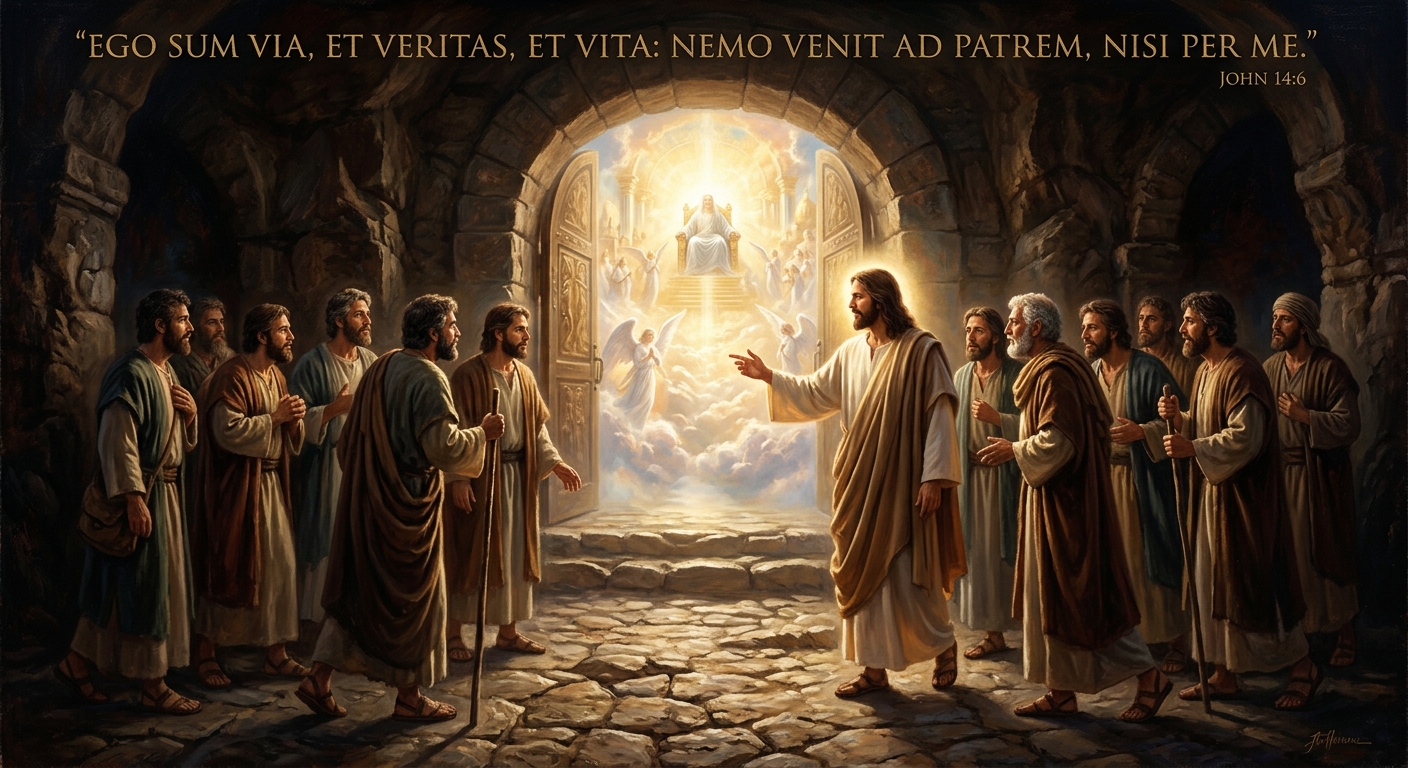
Illustration: Dramatic cinematic biblical illustration for John Chapter 14 showing Christ as the Way to Father, photorealistic oil painting style.
🔊
Listen to Chapter
Grace Notes Journey Audio Narration
Author
John the Apostle
Written
~90-95 AD
Key Theme
Christ as the Way to Father
Setting
Upper Room - before crucifixion
Key Verse
John 14:6
Total Verses
31
Chapter Introduction
*Beloved child, as the night draws near and Jesus prepares to leave His earthly home, He gently whispers to our trembling hearts: "Believe in Me." In this tender promise, He assures us that the path to the Father's house is not a mystery but a covenant of love. Though we may stumble in doubt, He offers us an everlasting dwelling place within His presence. Let this assurance fill your heart with peace and hope, for He is the true Shepherd who leads us home.*
John — Chapter 14 — KJV
1
Let not your heart be troubled: ye believe in God, believe also in me.
Simply PutThe Greek word for “heart” here, kardia (G2580), means the innermost seat of feelings and thoughts. Jesus tells us to trust in God—pisteuo (G4102)—and also in Him, because He is the one who keeps us from being shaken in our deepest worries.
2
In my Father’s house are many mansions: if it were not so, I would have told you. I go to prepare a place for you.
Simply Put“Mansions” translates the Greek monas (G3365), a word for dwelling places or rooms in a house. Jesus assures us that His Father’s house (oikos, G3615) has many rooms prepared for each believer; He must go ahead to set them up.
3
And if I go and prepare a place for you, I will come again, and receive you unto myself; that where I am, there ye may be also.
Simply Put“I will come again” and “receive you unto myself” use the Greek word labon (G2984), meaning to welcome or take into one’s care. He promises that when He returns, we will be gathered so closely to Him that wherever He is, we’ll be there too.
4
And whither I go ye know, and the way ye know.
Simply PutThe phrase “where I go you know and the way you know” points to hodos (G5627), the road or path. Jesus reassures that He is not leading us into mystery—His destination and the route are already known to His followers.
5
Thomas saith unto him, Lord, we know not whither thou goest; and how can we know the way?
Simply PutThomas’s question centers on oida (G1492), the verb for “to know.” He admits that he cannot see where Jesus is headed, and therefore wonders how they can be sure of the path.
6
Jesus saith unto him, I am the way, the truth, and the life: no man cometh unto the Father, but by me.
Simply PutJesus identifies Himself as “the way” (hodos, G5627), “the truth” (aletheia, G225), and “the life” (zoe, G2222). He means that the only route to God the Father is through Him alone.
Key Verse
7
If ye had known me, ye should have known my Father also: and from henceforth ye know him, and have seen him.
Simply PutThe Greek word for “Father” is pater (G3962). Knowing Jesus opens our eyes to the Father; from this moment onward, we can truly know and see Him.
8
Philip saith unto him, Lord, shew us the Father, and it sufficeth us.
Simply PutPhilip’s request uses deiknumi (G1165), meaning “to show.” He feels that seeing the Father would satisfy his longing, but it’s an incomplete request.
9
Jesus saith unto him, Have I been so long time with you, and yet hast thou not known me, Philip? he that hath seen me hath seen the Father; and how sayest thou then, Shew us the Father?
Simply PutJesus says that whoever has seen Him has already seen the Father. The Greek verb for “seen” is eidenai (G1492). He points out that the Father’s presence is fully revealed in Him.
10
Believest thou not that I am in the Father, and the Father in me? the words that I speak unto you I speak not of myself: but the Father that dwelleth in me, he doeth the works.
Simply PutThe verb pistēuō (G4102) appears again—believing isn’t about words alone but about the Father’s work living in and through Jesus. What He says is not His own, but the Father's truth manifesting in deeds.
11
Believe me that I am in the Father, and the Father in me: or else believe me for the very works’ sake.
Simply PutJesus urges us to believe (pistēuō, G4102) that He is united with the Father. If we doubt this unity, let the miracles He performed confirm it for you.
12
Verily, verily, I say unto you, He that believeth on me, the works that I do shall he do also; and greater works than these shall he do; because I go unto my Father.
Simply Put“Verily, verily” is the Greek term amen (G282), underscoring absolute truth. Those who trust in Jesus will do His works and even greater ones, because He is returning to the Father.
13
And whatsoever ye shall ask in my name, that will I do, that the Father may be glorified in the Son.
Simply PutThe Greek word aiteō (G150) means “to ask.” Jesus promises that any request made in His name will be answered, so the Father’s glory shines through the Son.
14
If ye shall ask any thing in my name, I will do it.
Simply PutAgain using aiteō (G150), Jesus assures that any petition made in His name will be fulfilled.
15
If ye love me, keep my commandments.
Simply PutThe word agapē (G26) for “love” and entolēs (G1790) for “commandments” show that true affection for Jesus is expressed through obedience to His teachings.
16
And I will pray the Father, and he shall give you another Comforter, that he may abide with you for ever;
Simply PutJesus promises to ask the Father for another Helper—what the Greeks call a Parakletos (G3985), meaning an advocate or counselor. This Comforter won’t be a temporary visitor; He will dwell with us forever, giving steady guidance when we feel alone.
17
Even the Spirit of truth; whom the world cannot receive, because it seeth him not, neither knoweth him: but ye know him; for he dwelleth with you, and shall be in you.
Simply PutThe Spirit of truth (Greek pistis, G4102) is a living presence that the world can’t grasp because it doesn’t see or know Him. But we, who have received Him, already know the Spirit; He lives within us and will keep reminding us of the truth.
18
I will not leave you comfortless: I will come to you.
Simply PutJesus assures that He won’t leave you as an orphan (Greek teknon, G5043). He will come to you and fill the empty space in your heart with His comforting presence.
19
Yet a little while, and the world seeth me no more; but ye see me: because I live, ye shall live also.
Simply PutThough the world will soon lose sight of Jesus, we will still see Him because He lives. His life (Greek zoe, G2222) is transferred to us—if He lives, we too will share in that living hope.
20
At that day ye shall know that I am in my Father, and ye in me, and I in you.
Simply PutOne day you’ll truly understand the deep union of Christ with the Father, and your own connection to both. It’s more than a feeling; it’s an inside reality that shows you belong to the divine family.
21
He that hath my commandments, and keepeth them, he it is that loveth me: and he that loveth me shall be loved of my Father, and I will love him, and will manifest myself to him.
Simply PutKeeping Jesus’ commandments (Greek entolē, G1749) isn’t a legal duty; it’s a sign of love (agape, G26). When you love Him, the Father loves you too, and Jesus will reveal Himself to you, drawing you into a personal relationship.
22
Judas saith unto him, not Iscariot, Lord, how is it that thou wilt manifest thyself unto us, and not unto the world?
Simply PutJudas asks why this manifestation is for believers and not the whole world. He’s seeking to understand how the Father’s love will be shared—Jesus is about to explain that it’s reserved for those who truly love Him.
23
Jesus answered and said unto him, If a man love me, he will keep my words: and my Father will love him, and we will come unto him, and make our abode with him.
Simply PutJesus says, if you love me, you’ll keep my words, and the Father will love you. Then He says, “we will come to you” and make our home (Greek katoikeō, G2596) within your heart—an intimate dwelling of divine love.
24
He that loveth me not keepeth not my sayings: and the word which ye hear is not mine, but the Father’s which sent me.
Simply PutThose who don’t love Jesus won’t keep His sayings. The words you hear aren’t just His; they’re the Father’s voice, sent through Jesus. Recognizing this helps you know you’re listening to God Himself.
25
These things have I spoken unto you, being yet present with you.
Simply PutEven as Jesus speaks, He’s still present among you. His words carry the weight of someone who is physically with you, not a distant teacher.
26
But the Comforter, which is the Holy Ghost, whom the Father will send in my name, he shall teach you all things, and bring all things to your remembrance, whatsoever I have said unto you.
Simply PutThe Comforter (Greek Parakletos, G3985), the Holy Spirit, whom the Father sends in Jesus’ name, will teach you everything and remind you of all He’s said. This means you won’t have to rely on memory alone; the Spirit will guide and refresh your understanding.
27
Peace I leave with you, my peace I give unto you: not as the world giveth, give I unto you. Let not your heart be troubled, neither let it be afraid.
Simply PutJesus leaves you His peace (Greek eirēnē, G1515)—a deep calm that the world can’t give. He tells you not to be troubled or scared, because His peace steadies your heart in the midst of chaos.
28
Ye have heard how I said unto you, I go away, and come again unto you. If ye loved me, ye would rejoice, because I said, I go unto the Father: for my Father is greater than I.
Simply PutJesus says that if you love Him, you’ll rejoice because He’s going to the Father. The Father is greater than Jesus; this ascent means a step toward an even higher place of love and comfort.
29
And now I have told you before it come to pass, that, when it is come to pass, ye might believe.
Simply PutJesus has spoken these things in advance so that when they happen, you’ll have a reason to believe. It’s like he’s giving you a roadmap for the future, so your faith won’t be blind.
30
Hereafter I will not talk much with you: for the prince of this world cometh, and hath nothing in me.
Simply PutHe warns that after this talk, the prince of this world (Greek archōn, G731) will come and have no power over Him. This is a reminder that worldly forces can’t touch Christ, so you’re safe under His protection.
31
But that the world may know that I love the Father; and as the Father gave me commandment, even so I do. Arise, let us go hence.
Simply PutThe Greek word for love here, agape (G26), points to a deep, unselfish devotion that flows from the heart. When Jesus says He obeyed His Father’s commandment, it shows a perfect trust and commitment to God’s will. In our moments of doubt or pain, this reminds us that the way to peace is to follow God’s guidance with a sincere love, just as Jesus did. The invitation "Arise, let us go hence" is a gentle call to move forward in faith, leaving behind confusion and stepping into the comfort of God’s steady presence.