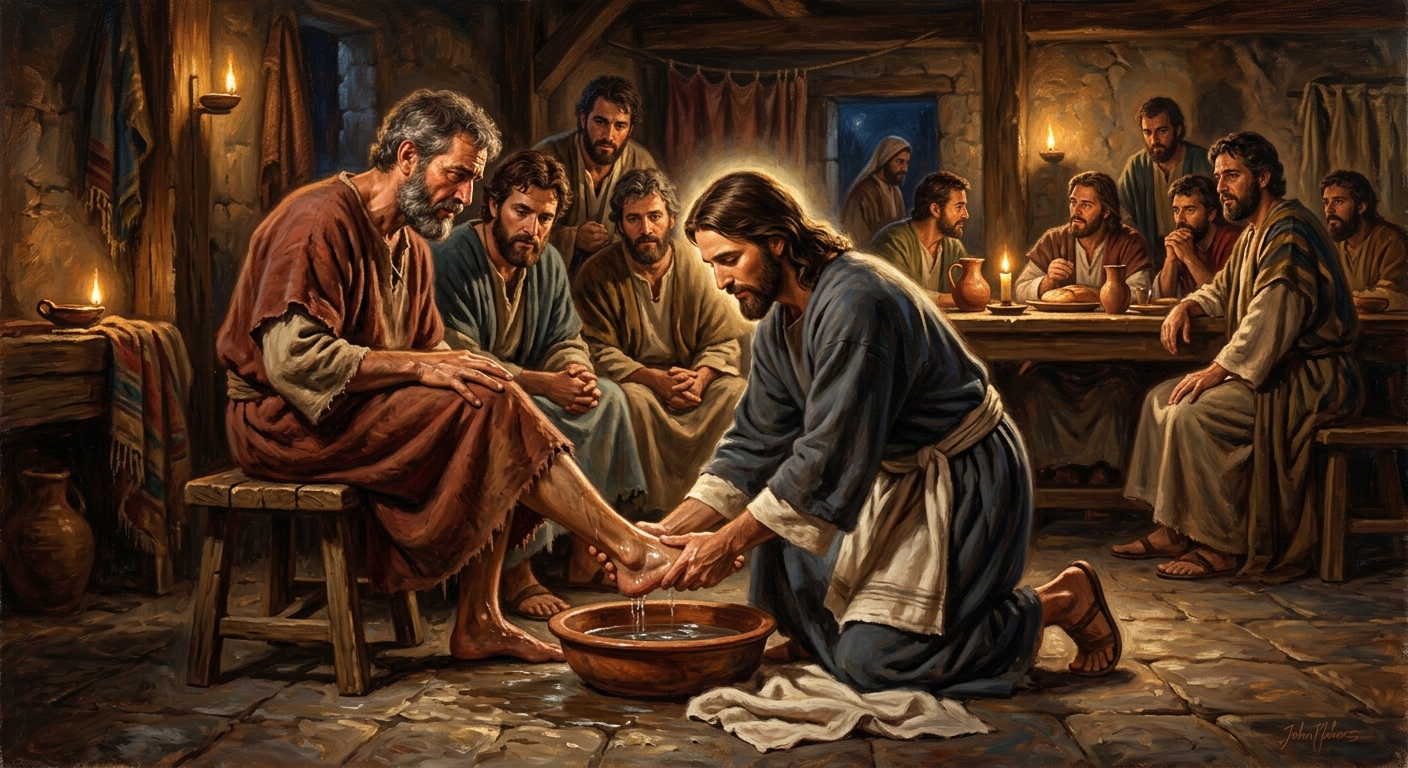
Illustration: Dramatic cinematic biblical illustration for John Chapter 13 showing Servant leadership through love, photorealistic oil painting style.
🔊
Listen to Chapter
Grace Notes Journey Audio Narration
Author
John the Apostle
Written
~90 AD
Key Theme
Servant leadership through love
Setting
Jerusalem - Upper Room
Key Verse
John 13:34
Total Verses
38
Chapter Introduction
*In the quiet hush of the Upper Room, our Lord gently reminds us that greatness lies in humble service. He washes the feet of His disciples, showing that true love is expressed through self‑sacrificial acts. As we read this chapter, let the warmth of His hands wash over our hearts, inviting us to follow His example. May we embrace this new commandment with gracious faith, serving one another as He has served us.*
John — Chapter 13 — KJV
1
Now before the feast of the passover, when Jesus knew that his hour was come that he should depart out of this world unto the Father, having loved his own which were in the world, he loved them unto the end.
Simply PutWhen Jesus says his "hour" (Greek hora, G2259), he means the exact appointed moment when He would leave this world and return to the Father. Even knowing this, He kept loving His friends in the world all the way to the very end. This reminds us that God’s love never wavers, even when we feel abandoned or broken.
2
And supper being ended, the devil having now put into the heart of Judas Iscariot, Simon’s son, to betray him;
Simply PutThe devil "put into the heart" (Greek kardia, G2588) of Judas a plan to betray. It shows that even in the midst of fellowship, betrayal can creep in, like a hidden wound. Yet God’s grace isn’t interrupted by that flaw; He still reaches out to the broken.
3
Jesus knowing that the Father had given all things into his hands, and that he was come from God, and went to God;
Simply PutJesus knows that the Father had "given all things into his hands" (Greek cheir, G5620), meaning He has total authority and responsibility. He also knows He "went to God" (Greek poreuomai, G4203), showing His intimate communion with the Father. In our hardest moments, we can trust that He’s in control and deeply connected to God.
4
He riseth from supper, and laid aside his garments; and took a towel, and girded himself.
Simply PutJesus "riseth from supper," takes off His outer clothing, and "girds" Himself with a towel (Greek perizomai, G4030). He is moving from the role of teacher to a servant. This act invites us into humility, showing that true leadership starts with serving the least.
5
After that he poureth water into a bason, and began to wash the disciples’ feet, and to wipe them with the towel wherewith he was girded.
Simply PutHe "pours water into a basin" (Greek basileus, G901) and washes the disciples' feet. In the ancient world, washing feet was a lowly task for servants. By doing this, He demonstrates that love is expressed through humble actions, not lofty speeches.
6
Then cometh he to Simon Peter: and Peter saith unto him, Lord, dost thou wash my feet?
Simply PutPeter asks, "Lord, dost thou wash my feet?" The Greek word for 'Lord' here is kyrios (G2962), a title of authority. Peter’s question reveals his surprise—he expected Jesus to be the teacher, not the servant.
7
Jesus answered and said unto him, What I do thou knowest not now; but thou shalt know hereafter.
Simply PutJesus says, "What I do thou knowest not now; but thou shalt know hereafter." The Greek word "know" (ginosko, G1096) means to fully understand. He’s telling Peter that some truths about service and love are hidden now but will be revealed later.
8
Peter saith unto him, Thou shalt never wash my feet. Jesus answered him, If I wash thee not, thou hast no part with me.
Simply PutPeter declares, "Thou shalt never wash my feet." Jesus replies, "If I wash thee not, thou hast no part with me." The Greek word for "part" (meros, G3326) means share or portion. Without receiving this humble service, we cannot truly be part of Jesus’ life.
9
Simon Peter saith unto him, Lord, not my feet only, but also my hands and my head.
Simply PutPeter asks for his whole body—hands and head—to be washed. In that culture, washing the hands and head was a sign of total cleansing. He wants complete purification, seeking assurance that he is wholly clean.
10
Jesus saith to him, He that is washed needeth not save to wash his feet, but is clean every whit: and ye are clean, but not all.
Simply PutJesus says, "He that is washed needeth not save to wash his feet." The Greek word for "clean" (katharos, G2671) means spotless. Even after the whole body is clean, a servant still needs his feet washed because that’s where dirt gathers in daily life.
11
For he knew who should betray him; therefore said he, Ye are not all clean.
Simply PutJesus knows who would betray Him, so He says, "Ye are not all clean." The word "betray" (Greek paradidonai, G3949) means to hand over or deliver. This reveals that spiritual cleanliness is a continual process, not a one-time event.
12
So after he had washed their feet, and had taken his garments, and was set down again, he said unto them, Know ye what I have done to you?
Simply PutAfter washing their feet and putting on His clothes again, He asks them, "Know ye what I have done to you?" The Greek word for "know" (ginosko) emphasizes deep, experiential understanding. He’s inviting them to see beyond the act itself and grasp its spiritual significance.
13
Ye call me Master and Lord: and ye say well; for so I am.
Simply PutThe disciples call Him "Master" (Greek didaskalos, G1325) and "Lord." Jesus affirms this title because He truly is theirs. It shows that following Him involves recognizing His authority and loving leadership.
14
If I then, your Lord and Master, have washed your feet; ye also ought to wash one another’s feet.
Simply PutJesus says, "If I then, your Lord and Master, have washed your feet; ye also ought to wash one another's feet." He uses the word "ought" (Greek deomai, G1123) to convey a moral obligation. He calls us to the same humble service that He modeled, caring for one another's needs.
15
For I have given you an example, that ye should do as I have done to you.
Simply PutHe says, "For I have given you an example (Greek paradeigma, G3949), that ye should do as I have done to you." This is not just a suggestion; it’s an example set in motion. He expects us to follow His pattern of love and service, especially toward those who feel low or in need.
16
Verily, verily, I say unto you, The servant is not greater than his lord; neither he that is sent greater than he that sent him.
Simply PutIn this verse, the Greek word for "servant" (doulos G1405) and "lord" (kyrios G2962) set the tone. Jesus is reminding us that true greatness comes from humble service; no one who follows Him should think they are above the One they serve.
17
If ye know these things, happy are ye if ye do them.
Simply PutThe key term here is "know these things" (ginōskō G1097), which means to understand the truth. Jesus says that real happiness comes from putting what we have learned about Him into daily action.
18
I speak not of you all: I know whom I have chosen: but that the scripture may be fulfilled, He that eateth bread with me hath lifted up his heel against me.
Simply PutThe loaded words are "chosen" (eklegō G1655) and the vivid image of lifting a heel against someone. Jesus hints that even among close friends, betrayal can arise—yet He knows exactly whom He has selected for the task.
19
Now I tell you before it come, that, when it is come to pass, ye may believe that I am he.
Simply PutHere Jesus uses "I am he" (ego eimi G1510), a declaration of His identity. He warns His disciples ahead of time so that when the betrayal happens, they can still recognize Him as their Savior.
20
Verily, verily, I say unto you, He that receiveth whomsoever I send receiveth me; and he that receiveth me receiveth him that sent me.
Simply PutThe word "receiveth" (lambano G2980) shows that accepting the messenger Jesus sends is the same as receiving Jesus Himself. When we welcome His message, we are welcoming God.
21
When Jesus had thus said, he was troubled in spirit, and testified, and said, Verily, verily, I say unto you, that one of you shall betray me.
Simply PutThe Greek term "troubled" (tarach G5022) reveals Jesus' deep sorrow. He openly shares that one of His close companions will betray Him, showing even the Son of God experiences anguish.
22
Then the disciples looked one on another, doubting of whom he spake.
Simply PutThe word "doubted" (diō) captures the disciples' confusion. They look at each other, wondering who could possibly be the one Jesus speaks of.
23
Now there was leaning on Jesus’ bosom one of his disciples, whom Jesus loved.
Simply Put"Leaning on Jesus' bosom" (kymatē G2959) describes a posture of intimacy and trust. One disciple, often thought to be John, rests close to Jesus, seeking comfort.
24
Simon Peter therefore beckoned to him, that he should ask who it should be of whom he spake.
Simply PutPeter "beckoned" (kaleō G2580), meaning he called out to the beloved disciple. He wants clarification on who Jesus means, showing his earnest desire for truth.
25
He then lying on Jesus’ breast saith unto him, Lord, who is it?
Simply PutThe disciple asks, "Lord, who is it?" The title "Lord" (kyrios G2962) underscores his reverence. He seeks to know the identity of the betrayer for peace of mind.
26
Jesus answered, He it is, to whom I shall give a sop, when I have dipped it. And when he had dipped the sop, he gave it to Judas Iscariot, the son of Simon.
Simply PutJesus says He will give a "sop" (spoon G4981), a dipped morsel of bread. He uses this simple act to reveal that Judas Iscariot, the son of Simon, will be the one who betrays Him.
27
And after the sop Satan entered into him. Then said Jesus unto him, That thou doest, do quickly.
Simply PutAfter receiving the mop, "Satan entered into him." The Greek word (diathēmi G1325) implies that Satan took a hold of Judas' heart, prompting Jesus to urge him to act swiftly.
28
Now no man at the table knew for what intent he spake this unto him.
Simply PutNone at the table understood why Jesus gave the morsel in this way. The word "none" (ouden G3766) highlights their lack of insight into the prophetic gesture.
29
For some of them thought, because Judas had the bag, that Jesus had said unto him, Buy those things that we have need of against the feast; or, that he should give something to the poor.
Simply PutSome thought Judas got the bag for a practical purpose—perhaps to buy supplies for the feast or aid the poor. The word "bag" (pothēria G4184) was seen as a sign of financial responsibility.
30
He then having received the sop went immediately out: and it was night.
Simply PutJudas took the morsel, left immediately, and it was night. The setting of "night" (nyx G3681) underscores the looming darkness and secrecy surrounding his betrayal.
31
Therefore, when he was gone out, Jesus said, Now is the Son of man glorified, and God is glorified in him.
Simply PutThe Greek word for “Son of Man” (huios tou anthrōpou, G5209) points to the human side of Jesus, while “glorified” (doxazo, G1391) means to be given honor and splendor. In moments of doubt, this verse reminds us that when Jesus steps aside to pray and serve, He is not diminishing Himself but actually revealing the glory of God within Him—God’s love is made visible in our Savior.
32
If God be glorified in him, God shall also glorify him in himself, and shall straightway glorify him.
Simply Put“Glorify” (doxazo, G1391) appears again, and the phrase “in himself” underscores God’s own self‑existence. For someone in pain, this promises that if we see Jesus glorified now, God will soon fully honor Him—this future glorification is the hope that steadies our hearts during trials.
33
Little children, yet a little while I am with you. Ye shall seek me: and as I said unto the Jews, Whither I go, ye cannot come; so now I say to you.
Simply PutThe Greek word “little children” (paidia, G3955) conveys tenderness, and “seek” (zeteo, G2219) implies an earnest pursuit. As Jesus prepares to leave us physically, He invites us to a deeper spiritual search—though He will go away, our longing for Him becomes the path that leads us to true fulfillment.
34
A new commandment I give unto you, That ye love one another; as I have loved you, that ye also love one another.
Simply PutThe “new commandment” (entolē, G1845) is not a brand‑new rule but a fresh emphasis on love. The Greek word “love” (agape, G26) refers to a self‑sacrificial, unconditional love. Jesus is saying that the only way we can truly reflect Him is by loving others exactly as He has loved us—this love meets the hungry heart and heals brokenness.
35
By this shall all men know that ye are my disciples, if ye have love one to another.
Simply PutThe word “men” (anthrōpos, G444) is generic—anyone can see the evidence of discipleship. This verse declares that love among believers is the living proof to the world; if we truly care for one another, people will recognize us as followers of Christ.
36
Simon Peter said unto him, Lord, whither goest thou? Jesus answered him, Whither I go, thou canst not follow me now; but thou shalt follow me afterwards.
Simply Put“Follow” (akolouthein, G72) is about walking in step with Jesus. Peter’s question shows his eagerness, but Jesus hints that there is a proper season to follow—right now is a time of preparation, and later it will become a deeper walking in faith.
37
Peter said unto him, Lord, why cannot I follow thee now? I will lay down my life for thy sake.
Simply PutPeter’s wish to “lay down his life” (zēn, G2222) reflects a passionate desire to protect Jesus. Yet the verse gently reminds us that true sacrifice must be guided by God’s timing; premature zeal can lead to misunderstanding the actual cost of discipleship.
38
Jesus answered him, Wilt thou lay down thy life for my sake? Verily, verily, I say unto thee, The cock shall not crow, till thou hast denied me thrice.
Simply PutThe Greek word “deny” (apomakrosko, G530) describes a rejection of one's allegiance. Jesus predicts Peter’s threefold denial—a painful warning that even the most devoted can falter, but it also assures us that repentance and restoration are always possible after we stumble.
Exodus 12:1This verse establishes the Passover feast, providing the historical backdrop for Jesus' actions in John 13 at the Last Supper.
Psalm 41:9The prophetic mention of a trusted friend lifting his heel against the psalmist foreshadows Judas' betrayal as described in John 13.
Luke 22:27Jesus declares that He came to serve, not to be served, directly illuminating the humility demonstrated in His foot-washing of the disciples.
John 15:13The declaration that greater love is shown by laying down one's life for friends underscores the sacrificial love underlying Jesus' servant leadership in John 13.
Reflect
Think of the last time someone offered you a humble act of service—how did you receive them, and what does that reveal about how you receive Jesus today?