The Guest Who Didn't Belong
It's three in the morning. The house is still, but your mind is a courtroom, and you are on trial for everything you failed to do today. The sharp words you spoke. The opportunity you missed. The nagging feeling that you are, at your core, an imposter just waiting to be found out. We live with this low-grade hum of inadequacy, this quiet dread that if people knew the real us, they’d show us the door. So we perform. We polish the outside, we arrange our lives just so, we learn the script, hoping that if we play the part well enough, we’ll finally earn our seat at the table. But the effort is exhausting, isn't it? It’s a lonely, draining way to live, always measuring, always falling short, always afraid the mask will slip.
This whole scene plays out in a Pharisee’s dining room in the seventh chapter of Luke. Simon, the host, is the very picture of religious performance; his house is clean, his theology is correct, and he has the esteemed Teacher as his guest of honor. Everything is in its proper place, until it isn't. A woman crashes his perfectly curated evening—a woman with a reputation, a woman the whole town knows is a 'sinner'. She brings no invitation, no credentials, only a jar of precious ointment and a heart so full of repentance and love that it spills out as tears, washing the dusty feet of Jesus. She doesn't say a word. She just weeps, and wipes, and anoints. She isn’t performing for acceptance; she is responding to it.
And Jesus, seeing the whole thing, turns the tables on the self-righteous host. He doesn't see a sinner defiling his dinner party; He sees a soul set free. He tells a quick story about two debtors, one who owed a great deal and one who owed little, and how the one forgiven more, loved more. Then He looks right at Simon. 'Seest thou this woman?' He asks, pointing out every failure of Simon’s hospitality, every box the Pharisee checked while his heart remained cold and distant. Simon offered no water, no welcoming kiss, no anointing oil—the basic courtesies of the day. But this woman, this outcast, she gave extravagantly from a place of profound gratitude. Her love wasn't the currency she used to buy forgiveness; it was the undeniable proof that she had already received it.
Wherefore I say unto thee, Her sins, which are many, are forgiven; for she loved much: but to whom little is forgiven, the same loveth little.— Luke 7:47, KJV
The Great Reversal
Simon’s religion was built on a foundation of careful self-reliance. It was a system of manageable debts and achievable merits, where God was a creditor you could keep at bay with regular, predictable payments of piety. But this kind of faith has no category for a debt so large it can only be cancelled. It has no room for messy, extravagant, tear-soaked gratitude. When confronted with true grace, Simon’s performance-based system just short-circuits. He can only see the woman's past, her sin, her scandalous interruption of his orderly world. He can't see her freedom, because he's still a prisoner to his own balance sheet, convinced that his small debt makes him superior to her large one. He is blind to the fact that before a holy God, we are all bankrupt debtors with 'nothing to pay.'
This is where the Gospel flips the whole world on its head. Jesus looks at this broken woman, past the judgment of the room, past her history of sin, and speaks the most beautiful words she has ever heard: 'Thy sins are forgiven.' It is a declaration, not a negotiation. It is a finished reality, not a future possibility. The Apostle Paul would later explain this profound truth to the church at Ephesus, telling them that God 'hath made us accepted in the beloved.' Your acceptance is not a goal you are striving toward; it is a status you already possess if you are in Christ. It's not something you earn through good behavior or lose through a bad day. The creditor, in his infinite mercy, saw our bankruptcy and 'frankly forgave' the entire debt, wiping the slate clean through the sacrifice of His Son.
Jesus’s logic in that room is so crucial for us to grasp. He says her sins are forgiven *for* she loved much. At a glance, it sounds like her love is the cause. But He immediately clarifies by contrasting her with Simon: 'to whom little is forgiven, the same loveth little.' Her profound love is the *result*, the beautiful and undeniable fruit, of a profound forgiveness already received. The forgiveness came first. It had to. A heart chained by the need to perform and prove its worth can't love like that. It’s only when the chains fall off, when you realize the debt is cancelled and you are utterly free, that a love so real, so reckless, so grateful can finally pour out.
And when they had nothing to pay, he frankly forgave them both. Tell me therefore, which of them will love him most?— Luke 7:42, KJV
Living from Accepted
So what does this look like when the alarm goes off tomorrow? It means you don't roll out of bed and into that courtroom in your mind, trying to build a case for your own worthiness before God. You start the day from the verdict: forgiven, accepted, beloved. This truth changes how you speak to your spouse after a disagreement, offering grace because you know the ocean of grace you swim in yourself. It changes how you see your own mistakes, not as evidence of your disqualification, but as opportunities to run back to the feet of Jesus, like that woman, and be reminded of His finished work. Living from acceptance is messy, because it means being honest about our brokenness instead of hiding it behind a religious facade. It's admitting we have nothing to pay, and then living in the wild freedom of a debt paid in full by another.
I need you to hear this today: stop trying to fix yourself up before you come to Jesus. Stop polishing your resume. He is not Simon, standing at the door with a clipboard, checking your credentials and judging your past. He is the one who lets the uninvited guest weep on His feet. He is the one whose presence makes a sinner feel more welcome than a Pharisee. Your faith, not your frantic effort, is what connects you to His saving grace. Jesus' final words to the woman were not a new list of rules to follow. He said, 'Thy faith hath saved thee; go in peace.' That peace isn't a prize you win at the end of a long, hard race; it is your starting position because the race has already been won for you.
Walking in this grace day by day is a constant act of surrender. It is the surrender of our pride, which tells us we can somehow contribute to our salvation. It is the surrender of our fear, which whispers that we're one mistake away from being rejected. It means choosing, sometimes minute by minute, to believe that His declaration over you is more real than your feelings of inadequacy or the accusations of the enemy. It's learning to let gratitude, not guilt, be the engine of your life. It's the quiet, deep, soul-settling rest that comes from knowing you are already and always 'accepted in the beloved.' You don't have to fight for a seat at the table; your name has been on the place card from the beginning.
And he said to the woman, Thy faith hath saved thee; go in peace.— Luke 7:50, KJV
The Open Door and the Shut
The ground beneath your feet is solid. Your acceptance is not a shifting mood or a conditional contract; it is an eternal fact, secured by the blood of Jesus and declared by God Himself. It is a promise as unshakeable as its maker. This isn't wishful thinking; it is the bedrock of our faith. The Bible doesn't say God *might* accept you if you try hard enough. It says He *hath made us* accepted. It is a done deal. The gavel has come down, the verdict is in, and you have been transferred from the kingdom of darkness into the kingdom of His dear Son. This is not a hope, but a reality. You are not a candidate for acceptance. You are a child in the house.
But there is a solemn warning we must not ignore. In another of His parables, Jesus tells of five foolish virgins who arrive late for the wedding feast. They had lamps, they looked the part, but they had no oil. They were running on the fumes of external religion. When the bridegroom finally arrives, they are shut out, and they stand outside banging on the door, crying, 'Lord, Lord, open to us.' They are trying to gain entry based on a last-minute plea, on their own desperate effort. But the bridegroom gives a terrifying reply: 'Verily I say unto you, I know you not.' Their tragedy was not a lack of activity, but a lack of relationship. They were trying to get in by performance at the very end, when the only way in was to have been known by Him all along. Don't live your life trying to earn an invitation that has already been sent.
But he answered and said, Verily I say unto you, I know you not.— Matthew 25:12, KJV
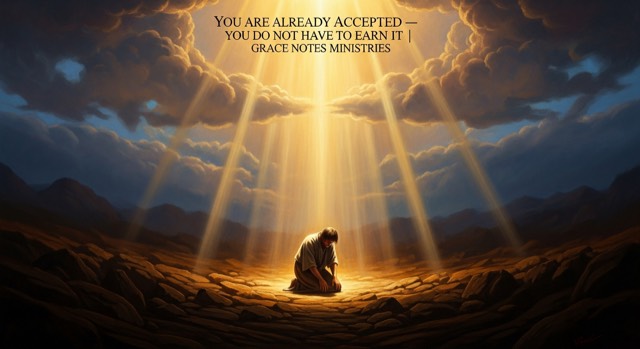
So let this truth settle deep into your bones today. You are already accepted. You do not have to earn it. The God of the universe looks upon you, not with a critical eye of inspection, but with the boundless affection of a Father for His child, all because you are hidden in His Son. Let this reality dismantle your anxiety and silence your striving. Let it be the thing that fuels a love so deep and a gratitude so extravagant that, like the woman at Simon's house, you can't help but pour out your life at His feet. You are not on probation. You are home. Go in that peace.