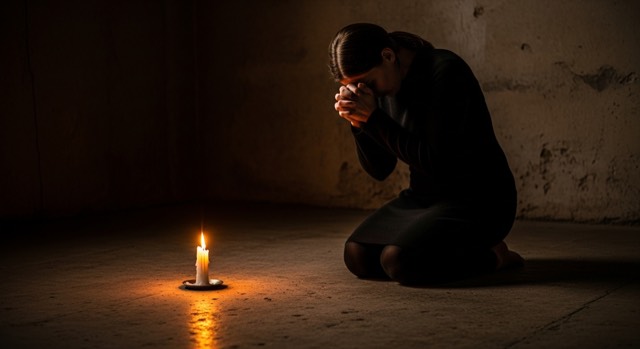
The Cry of Peter at Gethsemane

It was a cold night on the Mount of Olives; the sky hung heavy with stars, and I could hear my own breath like a shivering wind. In that hush, the disciples huddled around the Master, eyes wide with fear and wonder. Suddenly a voice cut through the silence—Peter's startled gasp as he remembered Jesus' warning. He stepped forward, his heart pounding, and fell to his knees, tears streaming down his cheeks. The scene felt as if the whole world had paused, waiting for a divine answer.

Luke records that moment with stark clarity: "And the Lord turned, and looked upon Peter. And Peter remembered the word of the Lord, how he had said unto him, Before the cock crow, thou shalt deny me thrice." (Luke 22:61). The verse places Peter's terror beside his memory of Christ's foretelling, showing how promise and pain can sit side by side. Jesus' steady gaze meets Peter's trembling form, offering a silent invitation to trust despite the looming shame. The text reminds us that God's foreknowledge does not erase our fear; it invites us into a deeper reliance on His grace. In that instant, Peter's weeping becomes the first true encounter with suffering under Christ's eye.

Theologically, this episode uncovers why God permits pain: He uses our brokenness to draw us nearer to His mercy. Peter's denial, foretold and fulfilled, displays divine sovereignty working through human frailty. Yet the promise that follows—"Hereafter shall the Son of man sit on the right hand of the power of God" (Luke 22:69)—shows that suffering is never without purpose. The cross, the very seat of power, was secured through Peter's stumble; his weeping prepares the way for the resurrection hope. Thus, when God allows suffering, He is not indifferent; He is preparing a throne for His glory. In the midst of our anguish, we are invited to glimpse the eternal victory that follows.

"And Peter went out, and wept bitterly."— Luke 22:62, KJV

When Human Effort Falters

Many of us cling to self‑strength, believing that if we simply work harder, the storm will cease. We line up good deeds like armor, hoping that righteousness will shield us from pain. Yet the Bible warns that such reliance is a house built on sand; it collapses when the wind of trial blows. The apostle Paul, in his letters, tells us that our works cannot save us from the weight of sin. When we try to earn God's favor, we become exhausted, and suffering sharpens our sense of failure. The result is a hollow victory that leaves the soul empty.

The gospel, however, declares another way: Christ's finished work removes the need for our performance. "If I tell you, ye will not believe; and if I also ask you, ye will not answer me" (Luke 22:68) shows that even the greatest human effort is futile before divine truth. The moment Jesus declares His identity, He also points to the power that will sustain us—His own resurrection. By placing our hope in His completed work, we escape the endless cycle of striving and disappointment. The cross becomes the antidote to our self‑reliance, turning guilt into gratitude. In that exchange, suffering loses its power to condemn and gains a purpose to point us toward grace.

The exegesis of Luke 22:69‑70 deepens this truth. When Jesus says, "Hereafter shall the Son of man sit on the right hand of the power of God," He is affirming His authority over both heaven and earth. The right hand signifies a place of honor and active rule; it also signals that Christ's authority is now exercised on our behalf. Therefore, the suffering we endure is not a sign of divine abandonment but a field where Christ's reign becomes visible. Our brokenness is the soil in which His life‑giving power takes root. The passage invites us to surrender our attempts at control and let His sovereign rule bring peace.

"If I tell you, ye will not believe; and if I also ask you, ye will not answer me"— Luke 22:68, KJV
Biblical illustration — Why does God permit suffering — Lo, I see four men loose... and the form of the fourth is like the Son of God — Daniel 3:25 KJV
✦ Lo, I see four men loose... and the form of the fourth is like the Son of God — Daniel 3:25 KJV
View Full Scripture Illustrated Gallery →

Living Within Christ's Suffering

Consider a mother who watches her child battle illness; each night she sits by the bedside, praying while watching the monitor beep. The room feels both holy and terrifying, as hope flickers like a candle in wind. In those moments, the mother may feel abandoned, yet she also senses Christ's presence beside her. The ordinary act of holding a hand becomes a conduit for divine comfort. Her pain does not go unnoticed; it is woven into the larger story of redemption that Christ has already won. As she weeps, she also whispers the promise that He will sit at the right hand of power.

Pastorally, I tell my congregation that we are invited to rest in Christ's finished work instead of trying to fix the brokenness ourselves. When we cease striving and begin relying on His sufficiency, our hearts find a steadier rhythm. The act of surrender is not passive defeat but active trust in the One who holds all things together. Each sigh, each tear becomes an offering that invites the Holy Spirit to work within us. The peace that follows is not the absence of pain but a deep assurance that He walks with us through it. This truth transforms daily mess into moments of holy communion.

Theologically, this living out of grace means that our identity is no longer bound to performance. We are defined by the righteousness of Christ, which covers every stumble. The daily grind—bills, chores, strained relationships—does not diminish our worth when we rest in Him. Instead, each task becomes a platform for displaying His love to those around us. By viewing suffering through the lens of Christ's victory, we can extend compassion that mirrors His own. In this way, our ordinary life becomes a testimony to the world.

"Hereafter shall the Son of man sit on the right hand of the power of God"— Luke 22:69, KJV

Anchored in the Promise

The Scripture gives us an unshakable foundation: "And he said unto them, Ye say that I am" (Luke 22:70). This declaration affirms Christ's identity and the authority that undergirds every promise. When we stand on this truth, suffering loses its power to destabilize us. The promises attached to the throne—salvation, comfort, future glory—remain firm regardless of present pain. Our hearts can cling to the certainty that He who suffered is also our ever‑present help. This assurance steadies us like a lighthouse in a stormy sea.

Finally, let us beware of slipping back into the trap of legalism. The temptation is to think that if we obey enough rules, suffering will vanish. Yet the gospel warns that such thinking leads to spiritual fatigue and pride. When we return to performance, we trade the freedom of grace for a burden of guilt. The cross reminds us that our standing before God rests on Christ's work, not our own deeds. Therefore, we must keep our eyes fixed on Him, lest we fall into the same despair that plagued the religious leaders of Jesus' day.

"And he said unto them, Ye say that I am"— Luke 22:70, KJV

So, dear friends, when the night feels too dark and pain seems endless, remember that Christ once wept at Gethsemane and yet declared His triumph. He invites us to lay our brokenness at the foot of the cross, where it is transformed into a testimony of His power. Let each tear be an offering that points to the One who sits at the right hand of God, ready to sustain us. May we walk each day with the confidence that our suffering is never without purpose, for it draws us deeper into His unfailing love. In the midst of our trials, may we find rest in the finished work that redeems all pain into hope.