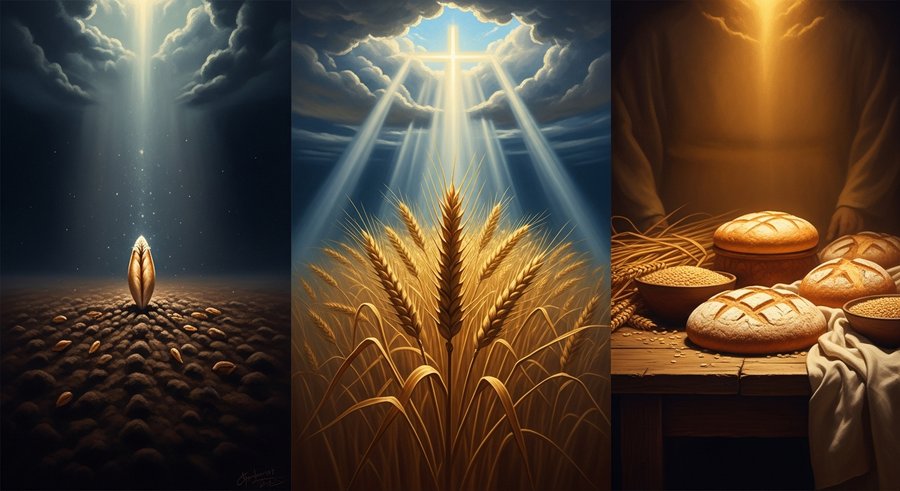
There is a principle embedded so deeply in creation that even the earth beneath our feet proclaims it: nothing produces without first being buried. A farmer does not plant a seed and expect to see bread the same afternoon. He handles the seed, trusts the soil, and then — and this is the part we all overlook — he walks away. Because once the seed is in the ground, the hard part transfers to Someone else entirely.
There is a principle embedded so deeply in creation that even the earth beneath our feet proclaims it: nothing produces without first being buried. A farmer does not plant a seed and expect to see bread the same afternoo...
- What the Dark Season Is Actually Doing: Trusting God's Word through life's deepest trials and seasons of waiting.
- You Were Already Bread Before You Were Buried: Trusting God's Word through life's deepest trials and seasons of waiting.
- God Has the Hard Part: Trusting God's Word through life's deepest trials and seasons of waiting.
What the Dark Season Is Actually Doing
I want to speak plainly to someone who is in what I will call the dark place right now. Maybe you have been in it so long that you have forgotten there was ever anything above ground. The dream seems dead. The relationship seems beyond repair. The calling feels distant. The season feels endless. You planted something in faith, and now you are standing over soil that looks like nothing.
But here is what the dark does that the light cannot: it pulls things out of a seed that could never emerge any other way. The pressure, the moisture, the tension — all of it is conspiring not against the seed but for it. The seed doesn't experience that process as growth. It experiences it as the most uncomfortable thing that has ever happened to it. And then it breaks open, and everything that was encoded inside it — everything God placed there before it was ever planted — begins to rise.
"Most assuredly, I say to you, unless a grain of wheat falls into the ground and dies, it abides alone; but if it dies, it produces much grain."— John 12:24 (KJV)
You Were Already Bread Before You Were Buried
This is the part that floors me every time I read it: the potential was in the seed before it ever touched the soil. What the ground brings forth was never created by the ground. It was created by the One who designed the seed. The soil simply reveals what was already there.
What does that mean for you? It means this season has not made you something new. It is revealing what God placed in you before you understood your own story. The gifts that feel dormant right now are not gone — they are simply underground, gaining the root depth they need to grow tall enough to weather every storm that comes after. You don't have to manufacture your purpose. You don't have to produce what God didn't put inside you. You only have to stop trying to dig yourself back up before the process is finished.
I have made that mistake more times than I care to admit. Impatient with God's timing. Frustrated with what looked like silence. Certain that something had gone terribly wrong. But every single time, when the season finally turned, I looked back and saw exactly what He was doing underground. Not a single moment was wasted. Not one dark day was random. It was all formation.
"For I know the thoughts that I think toward you, says the LORD, thoughts of peace and not of evil, to give you a future and a hope."— Jeremiah 29:11 (KJV)
God Has the Hard Part
This is the grace that makes the whole thing workable: God signed up for the hard part. When Jesus took the bread at the Last Supper and broke it — this is my body, broken for you — He was showing us the ultimate seed. The One who was buried so that we could rise. The One who went down into the earth for three days and came up as the bread of life for all of humanity.
If He did the hardest thing that has ever been done in the history of creation, I think we can trust Him with whatever you are carrying right now. Give it to Him — not halfway, not with one hand still gripping — but fully. Let the seed go. Let it be buried. Because before it is bread, it must be buried, but before it is buried, it is already bread. Everything you need to be who God called you to be is already encoded inside you. He just needs the ground and the time.
Your dark season is not the end of the story. It is not even close. It is the soil in which the next chapter of your life is forming. And when it comes up — and it will come up — it will be more than you could have produced on your own. Because what God grows always exceeds what we plant.
"He who goes out weeping, carrying seed to sow, will return with songs of joy, carrying sheaves with him."— Psalm 126:6 (NIV)
Hold on. Stay in the ground. Don't quit the process. Harvest is not a maybe — it is a promise.
What John 12:24 Really Means — The Full Picture
The verse Jesus spoke in John 12:24 was not delivered in a classroom. It was spoken at a turning point — the Greeks had come seeking Him (John 12:20–21), His hour was at hand, and He used a single image to explain something the disciples could not yet comprehend: that His death would not be a defeat. It would be a multiplication.
In the King James Version, the verse reads: "Verily, verily, I say unto you, Except a corn of wheat fall into the ground and die, it abideth alone: but if it die, it bringeth forth much fruit." The word verily, verily — translated from the Greek amēn, amēn — is Jesus's signature marker for a statement of the highest weight. He said it before this truth because He needed His listeners to receive it in their bones, not just their minds.
The principle is this: a seed that is never buried never becomes anything. It abides alone, as the text says — intact, preserved, and completely unfruitful. It is only the seed that accepts burial — that surrenders itself to the soil, to the darkness, to the process it cannot control — that produces much fruit. Not a little fruit. Much fruit.
Jesus was not speaking theoretically. He was describing what was about to happen to Him. The corn of wheat that was the Son of God fell into the ground on a Friday. On the third day, the harvest began — and it has not stopped since. That verse was written for you. Whatever feels like it is dying in your life right now, God may be operating on a seed principle that you simply cannot see from where you are standing.
Three Signs Your Season Is About to Break Open
I have watched enough of these seasons — in my own life and in the lives of people I have walked alongside — to recognize certain markers that appear just before the ground breaks. I offer these not as a formula but as signposts, because sometimes you need someone to tell you that what you are feeling is not the end. It is the turn.
First: the striving stops. There is a moment in a dark season when you finally exhaust your own solutions. When you stop trying to manufacture the outcome and simply give the seed back to God. That surrender is not defeat — it is the moment the process can actually begin. The farmer does not grow the plant. He plants the seed and steps back. The moment you can do the same is the moment something shifts.
Second: Scripture becomes personal again. Verses you have read a hundred times suddenly land differently. Jeremiah 29:11 stops being a greeting card and becomes a word spoken directly over your situation. Psalm 30:5 — "weeping may endure for a night, but joy cometh in the morning" (KJV) — stops being a cliché and becomes a lifeline. When the Word starts speaking to you instead of past you, the season is turning.
Third: you sense a quiet peace that has no logical explanation. Paul called it "the peace of God, which passeth all understanding" (Philippians 4:7, KJV). It does not mean the circumstances have changed. It means your roots have gone deep enough in the dark that they are now drawing from a source the surface cannot see. That peace is not resignation. It is a seed that knows it is about to break open.
A Prayer for Those Who Feel Buried
If you are in that season right now — if you are reading this because something in you needed to hear that what you are carrying is not wasted — I want to close with a prayer. Not a performance. Just words toward the One who planted the seed and knows exactly what He is growing.
Lord, I am in the ground. I cannot see the sun from here, and I do not always feel Your presence the way I used to. But I choose to trust the process You have designed — the same process You submitted to in the burial and resurrection of Your own Son. I give You the seed. I give You the timeline. I trust that what You encoded inside me before I ever understood my own story is still there, still growing, still being prepared for a harvest I cannot yet see. Hold me in the dark. And when the season turns — and I believe that it will — let what comes up be entirely for Your glory. Amen.
The harvest is coming. Stay in the ground.
Frequently Asked Questions
What does it mean to be buried as a seed, raised as bread?
It is a spiritual metaphor drawn from John 12:24. A seed buried in dark soil does not experience that burial as growth — it experiences it as pressure, silence, and loss of everything familiar. But it is in that burial that everything encoded inside the seed begins to rise. Being buried as a seed and raised as bread means that your dark season — the waiting, the loss, the unanswered prayers — is not the end of God's plan for you. It is the soil in which the next chapter of your life is forming.
What does John 12:24 mean in the Bible?
John 12:24 reads: "Verily, verily, I say unto you, Except a corn of wheat fall into the ground and die, it abideth alone: but if it die, it bringeth forth much fruit." (KJV). Jesus spoke this verse just before His crucifixion, using the image of a seed to explain that His death would not be an ending — it would be a multiplication. A seed that is never buried never becomes anything. Only the seed that accepts burial produces much fruit. Jesus was describing both His own resurrection and a spiritual principle that applies to every believer in every generation.
How do you trust God in a dark season when nothing seems to be changing?
A seed cannot observe its own germination from the inside. In the same way, we often cannot see what God is doing underground during a dark season. Trusting Him requires anchoring your faith in what Scripture declares rather than what circumstances appear to confirm. Jeremiah 29:11 promises that God's plans toward you are peace and not evil. Psalm 126:6 promises that those who sow in tears will reap in joy. Practically: stay in Scripture, stay in community, keep praying even when it feels like silence, and resist the urge to dig yourself up before the process God has designed is complete.
What is the spiritual meaning of a grain of wheat falling into the ground?
In John 12:24, Jesus uses the grain of wheat as a picture of His own death and resurrection — and by extension, the spiritual principle that God uses endings as the ground for new beginnings. A grain of wheat that remains on the surface stays exactly what it is. But a grain that falls into the ground and dies produces a harvest that far exceeds what was planted. The spiritual meaning is surrender: letting go of a season, a plan, or a version of yourself so that God can produce something greater from it than you could manufacture on your own.