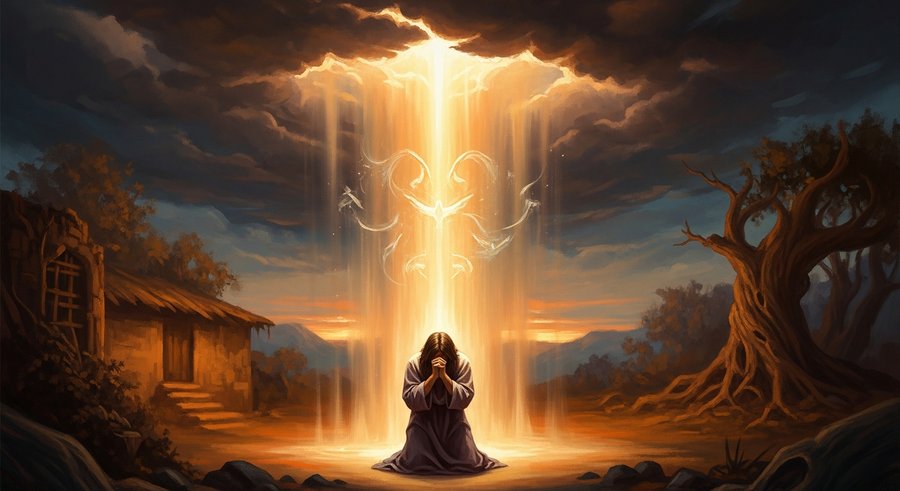
Have you ever felt the pressure to put on a brave face at church? To answer 'I'm blessed' when what you really mean is 'I'm breaking'? We live in a world, even a Christian world, that often celebrates the victory story m...
- God is Not Afraid of Your Questions: Trusting God's Word through life's deepest trials and seasons of waiting.
- The Loneliest Prayer Ever Prayed: Trusting God's Word through life's deepest trials and seasons of waiting.
- The Unfailing Pivot to Praise: Trusting God's Word through life's deepest trials and seasons of waiting.
God is Not Afraid of Your Questions
Have you ever felt the pressure to put on a brave face at church? To answer 'I'm blessed' when what you really mean is 'I'm breaking'? We live in a world, even a Christian world, that often celebrates the victory story more than the struggle. We are quick to share the testimony of the answered prayer, the healed sickness, the restored relationship.
But what about the prayers that hang in the air, seemingly unanswered? What about the seasons of darkness that stretch from weeks into months, even years? We often feel we must hide that part of our story, as if our doubt or our pain is a sign of a faith deficit. We clean up our prayers before we pray them, editing out the anger, the confusion, the raw ache of disappointment, because we’re afraid God can’t handle our mess.
But The truth is that God Himself has provided a language for our lament? He has given us a songbook, right in the middle of His Holy Word, that is filled with the full spectrum of human emotion. This is the book of Psalms. It’s a collection of prayers and poems that are brutally, beautifully honest.
They are not neat and tidy. The psalmists cry out in confusion, they accuse God of forgetting them, they scream from the depths of a darkness so profound it feels like the grave. They give us a script for the seasons when praise feels impossible and all we have is pain. They teach us that the most holy prayer you can pray is an honest prayer.
This is a profound gift. It's permission to be real. Consider Martha, when her brother Lazarus had died. Jesus, the one with all power, finally arrives four days too late. ' That is a raw, honest, and deeply hurting prayer. It’s an accusation born of love and shattered expectation.
And Jesus doesn't rebuke her. He meets her in that honest pain. In the same way, the Psalms invite you to bring your 'if onlys,' your 'why haves,' and your 'how longs' directly to the throne of grace. God is not intimidated by your questions. He is not offended by your tears. He already knows your heart; He just wants you to share it with Him.
How long wilt thou forget me, O LORD? for ever? how long wilt thou hide thy face from me? How long shall I take counsel in my soul, having sorrow in my heart daily? how long shall mine enemy be exalted over me?— Psalm 13:1-2, KJV
The Loneliest Prayer Ever Prayed
There is a particular kind of suffering that feels like a spiritual blackout. It goes beyond sadness into a soul-level despair. This is the reality for so many who wrestle with what we now call depression. The experience of Psalms depression is not a modern phenomenon; it is an ancient ache.
It’s the feeling of being completely and utterly alone, walled off not just from others, but from God Himself. It’s the sense that your prayers are hitting a brass ceiling, that God has turned His face away, that you have been utterly and finally forsaken. If you have ever felt that way, you are in the company of saints. And more than that, you are in the company of the Savior.
There is no greater example of this cry from the abyss than Psalm 22. It is perhaps the most gut-wrenching of all the psalms. ' David, hunted and hiding in caves, pours out a soul that feels abandoned, scorned, and poured out like water.
He speaks of his bones being out of joint, his heart melting like wax, his strength dried up. He describes being encircled by enemies, his hands and feet pierced. It is a portrait of absolute dereliction.
For centuries, these were the words of David. But then, on a hill called Golgotha, as darkness covered the land, these words were consecrated forever. The Son of God, hanging on a Roman cross, bearing the sin of the world, breathed out His last remaining strength and cried David’s prayer. In the moment of His deepest agony, Jesus Christ made Psalm 22 His own.
He didn't offer a theological treatise or a stoic statement. He reached into the human songbook of suffering and gave voice to the most profound sense of abandonment imaginable. He took the loneliest feeling a human can feel and pulled it into Himself.
Let that sink into the deepest part of your pain. Your feeling of being forsaken by God is not a feeling that disqualifies you from His presence. It is a feeling that unites you with His Son. When you are in that pit, you are on holy ground, because Christ has been there.
He sanctified that darkness. He understands that cry. Your most desperate, faithless-feeling prayer has been prayed by Jesus Himself. He did not come to condemn the world, but to save it, and that salvation meant entering into the very heart of our separation and sorrow.
My God, my God, why hast thou forsaken me? why art thou so far from helping me, and from the words of my roaring?— Psalm 22:1, KJV
The Unfailing Pivot to Praise
As raw as the Psalms are in their pain, they rarely end there. Something remarkable happens in the middle of the darkness. After pouring out all the grief, fear, and anger, the psalmist almost always makes a pivot. It's not a denial of the pain; the circumstances often haven't changed.
But the perspective has. ' It is a conscious, deliberate choice to remember who God is, even when feelings dictate otherwise. This is the spiritual discipline of honest prayer: to hold your pain in one hand and God's promises in the other.
This pivot is fueled by memory. The psalmist begins to recount God’s faithfulness in the past. ' When we are in a fog so thick we cannot see God's hand in our present, we must look back. We look to His faithfulness in our own lives.
We look to His faithfulness in the lives of those who came before us. We look to the unchanging truth of His Word. This act of remembering is not a denial of our present reality, but an anchor in it. It is the heart choosing to preach to itself, reminding the soul that the God who delivered before can and will deliver again.
The ultimate fulfillment of this pivot from lament to praise is the resurrection. The cry of forsakenness from the cross on Friday was not the final word. Sunday was coming. Jesus’s prayer from Psalm 22 was answered not by removing the cup of suffering, but by walking through it to the other side, to victory over death itself.
The cross was not an act of condemnation; it was the ultimate act of love. ' His purpose was not to leave us in our darkness, but to enter it, conquer it, and bring us into His marvelous light. The Psalms teach us how to wait in the darkness, and the Gospel shows us the dawn that is guaranteed to break.
For God so loved the world, that he gave his only begotten Son, that whosoever believeth in him should not perish, but have everlasting life. For God sent not his Son into the world to condemn the world; but that the world through him might be saved.— John 3:16-17, KJV
So bring your broken heart to Him. Bring your anger, your disillusionment, your weariness. You do not need to edit your soul for an audience with the King. The Psalms are your permission slip, written in the ink of human tears and inspired by the Holy Spirit.
They prove that God is not looking for perfect praise; He is listening for your honest prayer. He met David in the cave. He inhabited the cry of His own Son on the cross. And right now, in this very moment, He is leaning in to meet you in yours.