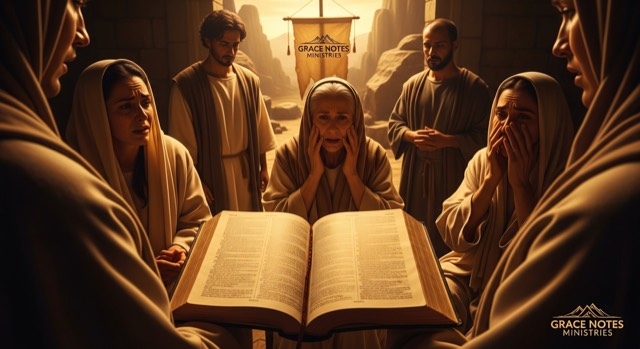
The Accusation in the Quiet

It’s three in the morning. The house is silent, except for the hum of the refrigerator and the frantic turning of a page. You've landed on one of those passages again, maybe in Samuel or Joshua, where the command from God is utterly brutal and final. Slay them all. Man, woman, infant. The words feel like ice in your veins, a betrayal from the God you thought you knew, the one who taught you to love your neighbor. A cold knot forms deep in your gut because this isn't some abstract theological puzzle you debate over coffee; it's a profound crisis of faith that shakes the very foundation you've built your life upon, leaving you alone in the dark with a Bible that suddenly feels like a book of horrors.

And right in that moment of spiritual vertigo, you find yourself standing alongside the Pharisees in the temple courts, listening to Jesus. They think they know God. They have the lineage, the law, the right answers. But Jesus looks them square in the eye and detonates their entire worldview. He doesn't debate their points or offer a defense they can process; He changes the very terms of the argument. He says, “If God were your Father, ye would love me: for I proceeded forth and came from God.” Then He delivers the most devastating diagnosis: “Why do ye not understand my speech? even because ye cannot hear my word.” The problem, He reveals, isn't with the transmission; it's with their spiritual receivers, which are tuned to an entirely different station.

This completely reframes our three-in-the-morning crisis. We come to the hard texts of Scripture as self-appointed prosecutors, placing God in the dock to answer for His actions against our modern sensibilities. But Jesus suggests that we might be spiritually deaf, trying to judge the intricate symphony of divine righteousness with ears that cannot perceive pitch, harmony, or rhythm. The question shifts from a prideful, “Why would God do such a thing?” to a broken and humble, “Lord, why can't I hear your word in this?” It moves us from a posture of judgment to one of desperate dependence, forcing us to ask the terrifyingly honest question of whether we are truly children of the Father He speaks of, or if we've been listening to another voice all along.

He that is of God heareth God’s words: ye therefore hear them not, because ye are not of God.— John 8:47, KJV

A Murderer from the Beginning

Our instinct is to create a god who fits neatly on our moral spreadsheets, a divine chairman of a celestial ethics committee who would certainly agree with our conclusions. This god is reasonable, predictable, and, above all, safe. But this god is an idol, forged in the furnaces of our own limited understanding and fear. When we finally come face to face with the God of Noah's flood, the God who rained fire on Sodom, the God who commanded the utter destruction of the Canaanites, our tidy religious systems buckle and break. Suddenly, we're left with the raw, untamable, and terrifying sovereignty of the Creator, and we find that He will not be managed, explained away, or made to answer to us.

Yet it is precisely in that place of terror and intellectual surrender that the door to grace swings open. The only place where the justice of the Amalekite judgment and the mercy of the Sermon on the Mount can coexist is at the foot of the cross. There, the same God of consuming holiness poured out His undiluted wrath for sin, not upon a rebellious nation, but upon His own beloved Son. He didn't ignore the cancer of evil; He judged it more fiercely than we can possibly imagine, once and for all, in the broken body of Jesus. The death of a child in the Old Testament is a horrifying tremor of the judgment we all deserve; the death of God's perfect Son is the beautiful, finished payment that cancels our debt and silences the accuser forever.

Jesus Himself gives us the key to unlock this mystery of death’s origin. He looks at His accusers and traces their spiritual DNA back to its source, saying of the devil, “He was a murderer from the beginning.” Let that sink in. Who brought death into God's very good creation? It wasn't God. God spoke life into existence. It was the serpent's lie in the garden, the whisper of rebellion, that opened the door for the curse of death to infect all of humanity. Sin is the murderer. The harsh judgments we read in the Old Testament are not the acts of a capricious deity; they are the radical, precise surgery of a holy God cutting out a metastatic spiritual cancer before it consumes everything, a cancer introduced by His enemy and our deceiver.

Ye are of your father the devil, and the lusts of your father ye will do. He was a murderer from the beginning, and abode not in the truth, because there is no truth in him.— John 8:44, KJV
Biblical illustration — Why does God kill children in the Bible — The LORD is my shepherd; I shall not want — Psalm 23:1 KJV
✦ The LORD is my shepherd; I shall not want — Psalm 23:1 KJV
View Full Scripture Illustrated Gallery →

The Centurion's Faith

I’ve seen this truth play out not in a seminary library, but in the sterile quiet of a hospital waiting room. I watched a young couple stand over a clear plastic box, their world shrunk to the rhythmic beep of a tiny heart monitor, their hands pressed against the incubator as if they could will life into their fragile child. They weren't debating the conquest of Canaan. They were face to face with the raw fragility of life and the crushing power of death. In a moment like that, theology ceases to be an academic game and becomes the very air you need to breathe. You either trust the character of the God who gives and takes away, even when His ways are shrouded in mystery, or you curse Him and drown in the abyss of your own sorrow.

And this is where the Roman centurion from Luke 7 walks out of the pages of Scripture and becomes our guide. Here is a man of the world, a commander, a man steeped in power and authority, and he understood something the religious scholars of his day completely missed. His servant, dear to him, was at the point of death. He didn’t march up to Jesus and demand a theological explanation for suffering. He didn’t present a logical case for why his servant deserved to be healed. He simply sent a message of profound humility: “I am not worthy that thou shouldest enter under my roof... but say in a word, and my servant shall be healed.” He recognized the absolute, unquestionable authority of Christ over life and death, and he simply submitted to it.

To walk in that kind of grace means we finally, blessedly, stop demanding that God provide us with an itemized receipt for His providence, one that we can audit and approve before we grant Him our trust. It means we lay down our little gavel and get out of the judge's chair. It means confessing, with the centurion, that we are not worthy and that our only hope, for our dying servant or our doubting soul, is a single word from the Master. This is a daily, sometimes moment-by-moment, surrender of our desperate need to understand everything, trading it for a desperate, clinging trust in the person of Jesus Christ, who holds all things, even the hardest things, together by the word of His power.

Wherefore neither thought I myself worthy to come unto thee: but say in a word, and my servant shall be healed.— Luke 7:7, KJV

Hearing God's Words

Here is the bedrock you can build your life on. God is absolutely sovereign, perfectly holy, and unfailingly just. Sin is not a small mistake; it is a lethal rebellion that has earned the sentence of death. And Jesus Christ is the perfect, complete, and final revelation of the Father’s heart, the Lamb of God slain from the foundation of the world to take away that sin and its penalty. We cannot treat the Bible like a buffet, picking the comforting promises and leaving behind the terrifying judgments. To know the living God is to embrace the whole counsel of His Word, from the passages that show us the terrifying seriousness of our sin to the breathtaking chapters that reveal the unplumbed depths of His grace.

So you must be on guard. When that whisper comes, not from the pages of Scripture but from the serpent in your own heart, tempting you to stand over the Word and critique it, you are on dangerous ground. That is the oldest lie, the primordial question designed to fracture your faith: “Yea, hath God said?” The very moment you believe you are qualified to be God’s moral editor, you have stepped out of the role of a beloved child listening for the Father’s voice and into the role of a Pharisee, spiritually deafened by your own pride. The only escape is to fall on your knees, confess you don't understand it all, and place your trust not in your own intellect, but in the perfect character of Him who does.

Why do ye not understand my speech? even because ye cannot hear my word.— John 8:43, KJV

The ache these questions leave is real, and God does not ask you to pretend it doesn't hurt. But don't stay there, staring into the abyss of judgment. Lift your eyes to the empty tomb, because the final word of God on the subject of death is resurrection. He is the God who wept at the grave of his friend Lazarus right before He commanded him to come forth, alive and whole. He is the God who took the most horrific injustice in history—the murder of His innocent Son—and transformed it into the salvation of the world. This is our anchor. The God who seems so severe in the conquest of Canaan is the same Father who runs to meet His prodigal son on the road home. Don’t try to reconcile the two in your head. Just run to Him and trust His heart.