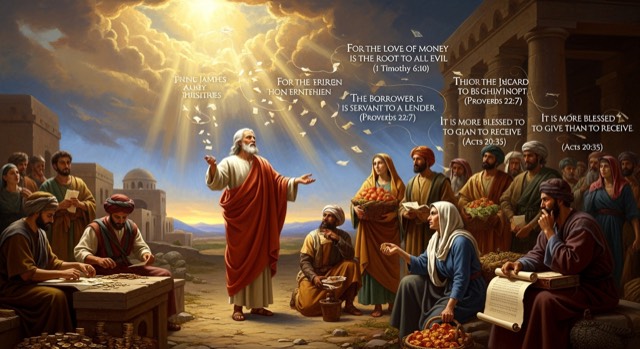
The Master on the Mount

It's three in the morning. The house is quiet, save for the low hum of the refrigerator and the frantic arithmetic running through your own mind. On the kitchen table, a small stack of envelopes sits beneath the pale moonlight filtering through the window, each one a demand, a debt, a declaration of what you lack. The numbers swim together, a dizzying current of fear pulling you under, and your heart hammers against your ribs with a rhythm of insufficiency. You feel the cold weight of it all settle deep in your bones, the silent scream that there will not be enough, that you are not enough. This is the altar of mammon, where we sacrifice our peace in the dead of night, hoping for a salvation our own hands can engineer.

And right into that cold, quiet kitchen, the voice of Jesus speaks from a sun-drenched hillside in Galilee, cutting through two thousand years of history with surgical precision. He looks right at you, past the disciples, past the crowds, and addresses that frantic calculation in your soul. He says, “For where your treasure is, there will your heart be also.” He doesn't offer a five-step plan for financial success; He offers a diagnosis of the heart. The real problem isn't the stack of bills on the table, it’s the location of your treasure, because your heart, that pulsing center of your life, your worship, and your worry, will always, always migrate to the thing you value most. The anxiety you feel is just a homing beacon, showing you exactly where you've placed your trust.

This changes everything. Suddenly, the conversation is not about budgeting strategies or investment portfolios; it's about allegiance. It's about worship. Our Lord makes it painfully, beautifully clear: “No man can serve two masters: for either he will hate the one, and love the other; or else he will hold to the one, and despise the other.” You see, money is not a neutral tool; it is a spiritual power, a rival god named mammon that demands loyalty and promises a security it can never deliver. Jesus forces a choice, drawing a line in the sand not between poverty and riches, but between two kingdoms, two lords, two entirely different ways of orienting a human life. You simply cannot hedge your bets. You cannot have one foot in the Kingdom of God and one hand clutching the securities of the kingdom of mammon.

Ye cannot serve God and mammon.— Matthew 6:24, KJV

The Lilies and the Light

Our self-reliant solutions are a house of cards in a hurricane. We build elaborate systems of control, creating budgets that account for every penny and retirement plans that project decades into the future, believing our diligence is a fortress against disaster. We work longer hours, chase the promotion, start the side business, all in a desperate attempt to build the walls of our financial Jericho a little higher. We tell ourselves we are being responsible, and in some ways we are, but underneath it all, a dark current of pride flows, a belief that our own effort is the ultimate safety net. Then a single phone call—from a doctor, from an employer, from a mechanic—can bring the whole thing crashing down, revealing the terrifying truth that our control was only ever an illusion we maintained through sheer, exhausting effort.

But notice the scandalous freedom Jesus presents. He points not to the diligent ant, but to the carefree bird. “Behold the fowls of the air: for they sow not, neither do they reap, nor gather into barns; yet your heavenly Father feedeth them.” This is an affront to our performance-driven religion. The birds do nothing to earn their daily worm; they are simply fed because they belong to the Father. He then directs our gaze lower, to the fleeting beauty of a wildflower. “Consider the lilies of the field, how they grow; they toil not, neither do they spin.” Their breathtaking glory, which outshone even the legendary wealth of Solomon, is not a product of their labor but a gift of their Creator. The unstated, thunderous conclusion is this: if the Father so cares for the temporary and the trivial, how much more does His heart bend toward you, His eternal child?

This isn't a call to irresponsibility, but a radical call to re-center our trust. The light of the body is the eye. When your eye is single—focused only on God as your source, your provider, your Lord—your whole body, your whole life, is flooded with light. There is a peace that comes from this singular focus that no worldly wealth can purchase. But if your eye is evil, or divided, trying to watch God with one eye and your bank account with the other, your whole body will be full of darkness. And if the very light you think you have—your financial savvy, your work ethic, your clever plans—is actually a form of darkness, a trust in self, then as Jesus Himself says, “how great is that darkness!”

If therefore thine eye be single, thy whole body shall be full of light.— Matthew 6:22, KJV
Biblical illustration — What the Bible Says About Money and Wealth — The LORD is my shepherd; I shall not want — Psalm 23:1 KJV
✦ The LORD is my shepherd; I shall not want — Psalm 23:1 KJV
View Full Scripture Illustrated Gallery →

Giving as an Act of War

So what does this look like when the alarm goes off on a Tuesday morning? It looks like the quiet, deliberate act of opening your checkbook or your banking app and setting aside the first portion for the Lord's work before any other bill is paid. This practice of tithing isn't some old law to appease an angry God; it is a declaration of war against the tyranny of mammon. It's looking at the stack of bills from the night before and proclaiming, with your wallet, that your trust is not in the sum of your accounts but in the sufficiency of your God. It is a tangible act of worship that reorders your world, dethroning money from the center of your heart and placing God back on His rightful throne. It is the single most powerful way to keep your eye single.

Friend, hear me on this. You don't need to try harder to worry less. You need to rest deeper in the Father's care. Stop carrying the weight of being your own provider, a burden you were never designed to bear. Jesus said, “Take no thought for your life, what ye shall eat, or what ye shall drink.” He is not commanding you to be thoughtless, but to cease the anxious, strangling grip of worry. You can release that grip because your life is more than meat, and your body more than raiment. Your value is not determined by what you own or what you owe; your value was determined at a cross, where the Son of God paid the ultimate price for you. Rest in that. Let that truth saturate the anxious corners of your mind.

Walking in this grace day by day means you begin to see your money not as a measure of your security but as a tool for the Kingdom. It means a conversation with your spouse about generosity, not just about scarcity. It means praying for wisdom with what He has provided, stewarding it with an open hand rather than a clenched fist. Proverbs tells us, “Wealth gotten by vanity shall be diminished: but he that gathereth by labour shall increase.” There is a place for diligent work, but that work is done from a place of peace, not panic; of worship, not worry. It's the difference between striving to be fed and working because you already are.

Therefore I say unto you, Take no thought for your life, what ye shall eat, or what ye shall drink; nor yet for your body, what ye shall put on.— Matthew 6:25, KJV

Standing on Solid Ground

The solid ground beneath our feet is not a rising stock market or a padded savings account; it is the unshakeable character of our Heavenly Father. He knows what you need before you even ask. He feeds the birds. He clothes the grass. These are not sentimental platitudes; they are divine promises, demonstrations of His nature. Christ’s entire argument on that mountain hinges on a simple, profound comparison: “Are ye not much better than they?” Your relationship with the Father, secured through the blood of Jesus, makes you infinitely more valuable to Him than the entire created order. That is your security. That is your provision. That is the only truth that can silence the fearful arithmetic of three in the morning.

So let us be vigilant. The pull of mammon is subtle and constant, whispering promises of safety and significance if we will just bow down and serve it. It invites us to return to the chains of anxiety, to the performance-based religion of self-reliance where our peace rises and falls with our bank balance. To give in to this is to forget the lilies. It is to ignore the birds. It is to despise the free grace of a Father who has already promised to supply all our needs according to His riches in glory by Christ Jesus. Don't go back. Don't trade the light of a single focus for the great darkness of a divided heart. Stand firm in the knowledge that you are His, and He is yours.

Wherefore, if God so clothe the grass of the field, which to day is, and to morrow is cast into the oven, shall he not much more clothe you, O ye of little faith?— Matthew 6:30, KJV

Let the peace of God, which passes all understanding, guard your hearts and your minds through Christ Jesus. Leave the kitchen table of your worries and walk out into the field of His provision. See how He cares for the smallest things, and know with absolute certainty that His care for you is immeasurably greater. You are His child. Your name is written on His hands. The one who owns the cattle on a thousand hills is the same one who calls you beloved. Rest there tonight. Rest there tomorrow. Let your treasure be Him, and your heart will finally, truly, be home.