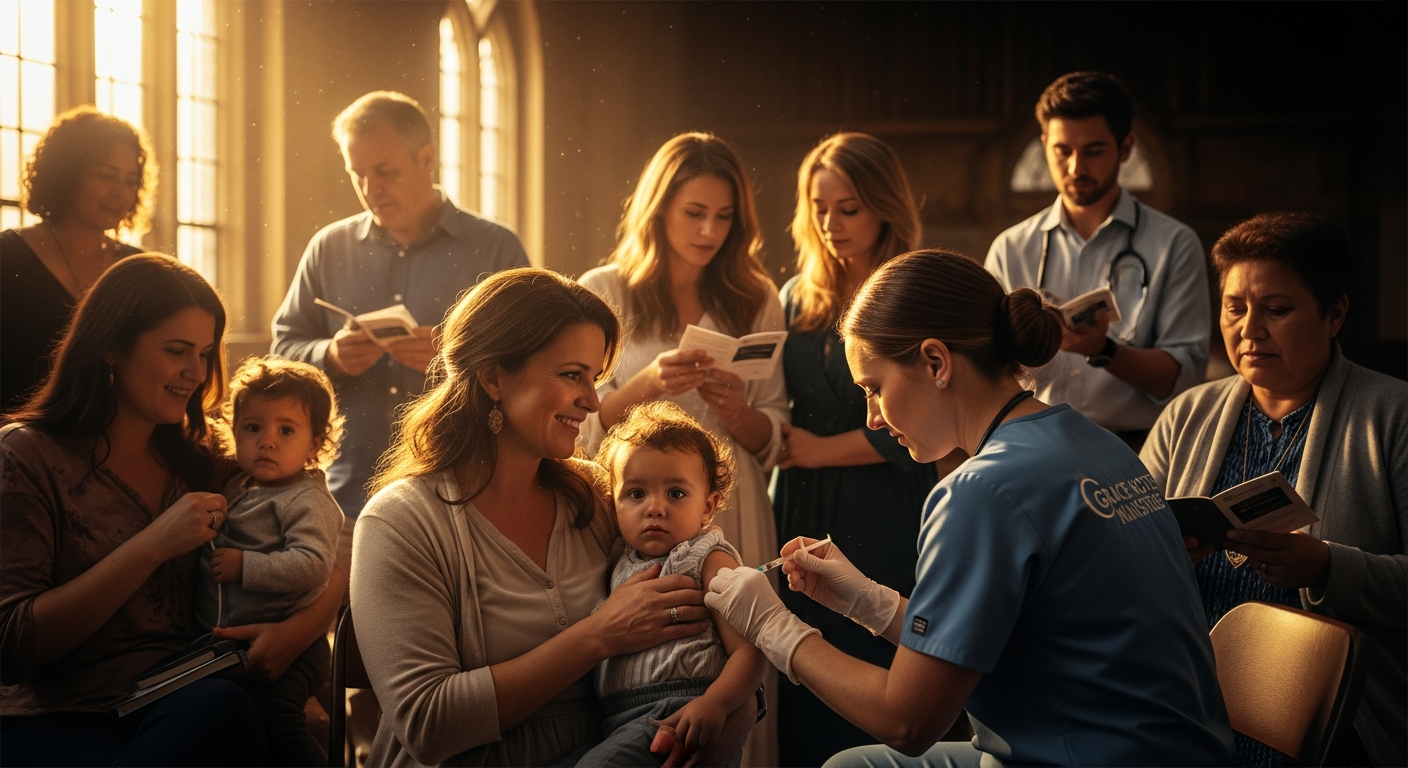
When we face complex medical decisions, it is natural to search the Scriptures for clear, explicit answers. Many believers ask, "What does the Bible say about vaccines?" longing for a direct command that removes all doub...
- Seeking Wisdom in Uncertain Times: Trusting God's Word through life's deepest trials and seasons of waiting.
- The Biblical Use of Medicine and Means: Trusting God's Word through life's deepest trials and seasons of waiting.
- Trusting the Shepherd Amidst Fear: Trusting God's Word through life's deepest trials and seasons of waiting.
Seeking Wisdom in Uncertain Times
When we face complex medical decisions, it is natural to search the Scriptures for clear, explicit answers. Many believers ask, "What does the Bible say about vaccines?" longing for a direct command that removes all doubt. The silence of Scripture on modern medical technologies like immunization can feel like a void, but it is not an absence of divine guidance. Instead, it invites us to look deeply at the heart posture behind our choices, grounding our decisions in the timeless principles of God's Word.
We must remember that God cares for the body as well as the soul. He is the Creator of our physical frames, and He has endowed humanity with minds to reason, discover, and develop means to alleviate suffering. To ask what the Bible teaches about such matters is to seek alignment with His sovereign will, not to escape personal responsibility. We are called to be wise stewards of the physical lives He has entrusted to us, recognizing that our bodies are not our own, but have been bought with a price.
What? know ye not that your body is the temple of the Holy Ghost which is in you, which ye have of God, and ye are not your own? For ye are bought with a price: therefore glorify God in your body, and in your spirit, which are God's.— 1 Corinthians 6:19-20, KJV
In the Old Testament, we see that God often calls His people to step out in active obedience, even when the path forward seems counterintuitive or requires overcoming natural apprehension. When God spoke to Moses at the burning bush, He demonstrated His power over sickness, danger, and the natural world through physical signs. Moses was commanded to perform an act that defied natural self-preservation—reaching out to grab a venomous serpent.
And the LORD said unto Moses, Put forth thine hand, and take it by the tail. And he caught it, and it became a serpent in his hand.— Exodus 4:4, KJV
This act of obedience required Moses to trust the voice of God over his natural instincts. While we do not have a direct, audible command from heaven regarding modern vaccines, this passage reminds us that God often works through physical means and calls us to act in faith rather than being paralyzed by fear. True wisdom begins with a heart surrendered to God's instructions, seeking His guidance through prayer and the study of His Word.
The Biblical Use of Medicine and Means
To understand the biblical perspective on medical interventions, we must examine how Scripture views medicine and those who practice it. Throughout the Old and New Testaments, God is revealed as the ultimate Healer—Jehovah-Rapha, "the LORD that healeth thee" (Exodus 15:26). Yet, God's sovereignty does not negate the use of physical means to bring about healing. Scripture does not condemn the medical profession; rather, it acknowledges it as a common grace.
In the New Testament, the Apostle Paul speaks warmly of Luke, the writer of the third Gospel and the Book of Acts, highlighting his profession as a source of comfort and aid to the early church.
Luke, the beloved physician, and Demas, greet you.— Colossians 4:14, KJV
Furthermore, we see biblical examples of physical remedies being applied to treat ailments. When King Hezekiah was sick unto death, the prophet Isaiah did not merely declare a miraculous healing; he also prescribed a physical treatment. Isaiah directed the application of a poultice to the king's physical affliction, demonstrating that divine healing and natural remedies can work hand-in-hand under God's sovereign design.
And Isaiah said, Take a lump of figs. And they took and laid it on the boil, and he recovered.— 2 Kings 20:7, KJV
Similarly, Paul advised Timothy to use a common medicinal remedy of their day to address his ongoing physical weaknesses, showing that utilizing available means to preserve health is entirely consistent with a life of faith.
Drink no longer water, but use a little wine for thy stomach's sake and thine often infirmities.— 1 Timothy 5:23, KJV
These passages demonstrate that using medicine, vaccines, or other scientific advancements is not inherently a sign of weak faith. God, in His common grace, has allowed humanity to discover ways to prevent and treat disease. However, our ultimate trust must never rest in the medicine itself, but in the God who gave the medicine its power to heal.
Trusting the Shepherd Amidst Fear
Fear often clouds our judgment, making us feel isolated and anxious in our medical decisions. In an age of information overload, conflicting reports, and societal pressure, it is easy to lose our peace. Yet, Jesus reminds us that we are never alone in our vulnerability. He speaks of His intimate knowledge of His sheep and His absolute power to keep them safe. This truth anchors us when the world feels chaotic and unpredictable.
My sheep hear my voice, and I know them, and they follow me: And I give unto them eternal life; and they shall never perish, neither shall any man pluck them out of my hand.— John 10:27-28, KJV
Whether a believer chooses to receive medical interventions or, after prayerful consideration, decides to abstain, our ultimate security does not rest in the efficacy of a vaccine or the strength of our natural immune system. Our security rests entirely in the faithfulness of our Creator. We must guard our hearts against the spirit of fear, which does not come from God.
For God hath not given us the spirit of fear; but of power, and of love, and of a sound mind.— 2 Timothy 1:7, KJV
A "sound mind" allows us to evaluate medical choices calmly, without panic or hysteria. When we rest in the assurance of Christ's love, we are freed from the pressure to find a perfect earthly savior. We can make decisions with a clear conscience, knowing that our lives are securely held in the hands of the Father and the Son.
My Father, which gave them me, is greater than all; and no man is able to pluck them out of my Father's hand.— John 10:29, KJV
Christian Liberty and the Dictates of Conscience
Because the Bible does not contain a direct command regarding vaccination, this issue falls under the category of Christian liberty and the dictates of the individual conscience. In Romans chapter 14, the Apostle Paul provides a profound theological framework for how believers should handle disputable matters where sincere Christians may disagree.
During the first century, the church faced sharp divisions over dietary laws and the observance of certain days. Paul did not lay down a rigid, universal rule; instead, he emphasized the importance of personal conviction before God and mutual respect within the body of Christ.
One man esteemeth one day above another: another esteemeth every day alike. Let every man be fully persuaded in his own mind.— Romans 14:5, KJV
Applied to the modern question of vaccines, this principle means that a believer who chooses to be vaccinated in order to protect their health and the health of others can do so to the glory of God. Conversely, a believer who chooses to abstain due to conscientious objections, ethical concerns, or personal health reasons can also do so to the glory of God. The critical requirement is that each person must act out of faith and a clear conscience, rather than peer pressure or fear.
And he that doubteth is damned if he eat, because he eateth not of faith: for whatsoever is not of faith is sin.— Romans 14:23, KJV
We must examine our motives. If we receive a vaccine, is it done in faith, thanking God for the provision of medicine? If we decline a vaccine, is it done in faith, trusting God's design and protection? Whatever our decision, we must ensure it is rooted in a deep, born-again relationship with Jesus Christ, rather than a legalistic desire to conform to the expectations of others.
Loving Your Neighbor in Discernment
Ultimately, our decisions must flow from a heart of love. The Bible teaches that love is the fulfilling of the law, and it calls us to seek the welfare of others. When making medical decisions, we must consider not only our personal safety but also how our choices impact our families, our churches, and our communities.
For, brethren, ye have been called unto liberty; only use not liberty for an occasion to the flesh, but by love serve one another.— Galatians 5:13, KJV
Christian liberty is never a license for selfishness. It is a freedom to serve. In our discernment, we must ask how we can best love our neighbor. For some, this means getting vaccinated to protect the vulnerable and immunocompromised around them. For others, it means standing up for bodily autonomy and medical freedom out of a conviction that true health care must respect the conscience of every individual.
Regardless of where we land on this issue, we must approach one another with grace, humility, and patience. We must not allow secondary issues to divide the local church, which is the visible body of Christ. Let us refrain from judging or despising those who make different medical choices, remembering that we will all stand before the judgment seat of Christ.
A Pastoral Takeaway and Prayer
At Grace Notes Ministries, we want to remind you that your standing before God does not depend on your medical status. Salvation is not a matter of external regulations, physical treatments, or legalistic checklists. It is a living, born-again relationship with Jesus Christ, received by grace through faith alone.
In the end, our peace comes not from having all the answers to modern medical dilemmas, but from knowing the One who holds the future. Christ's hand is strong enough to sustain you through any health challenge, and His grace is sufficient for every trial. Rest in His sovereignty, love your neighbor with patience, and let faith guide your steps today.
Let us join together in prayer for wisdom and unity:
"Heavenly Father, we come before Thee acknowledging Thy supreme sovereignty over our lives, our health, and our future. Grant us, we pray, the wisdom of a sound mind as we navigate complex medical decisions. Deliver us from the spirit of fear, and fill us with Thy perfect love. Help us to honor Thee with our bodies, which are the temples of the Holy Ghost. Teach us to walk in grace and charity with our brothers and sisters in Christ, preserving the unity of the Spirit in the bond of peace. May our lives bear witness to Thy healing power, Thy saving grace, and Thy eternal faithfulness. In the precious name of our Lord and Saviour Jesus Christ, Amen."