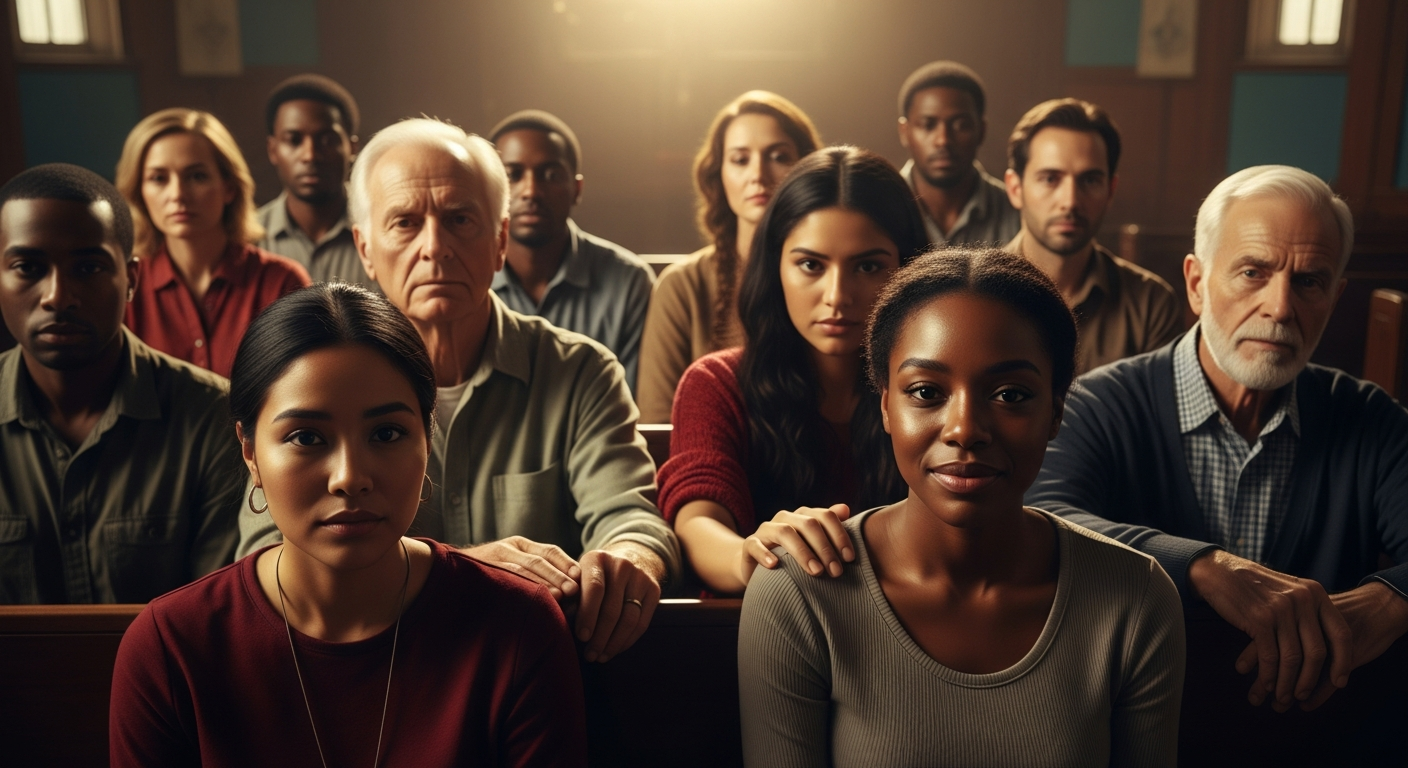
In a world fractured by ethnic division, social unrest, and the relentless clamor of identity politics, the human heart naturally searches for a firm anchor. Secular philosophies attempt to heal these deep-seated divisions through political activism, sociological theories, and legalistic mandates. Yet, these human efforts only scratch the surface of a much deeper, spiritual malady. To truly understand and overcome the sin of racism, we must turn our eyes away from the shifting sands of culture and plant our feet firmly upon the immutable Word of God.
As we open the Scriptures, we find that the Bible does not merely address ethnic prejudice as a minor social issue; rather, it diagnoses it as a grievous sin against the Creator and provides the only lasting remedy through the cross of Jesus Christ. True reconciliation is not found in secular ideologies, but in a born-again relationship with the Savior, where the old man is put off and the new man is put on. Let us journey deep into the Scriptures to discover how the sovereign design of creation, the redemptive work of Christ, and the royal law of love dismantle every wall of division.
In a world fractured by ethnic division, social unrest, and the relentless clamor of identity politics, the human heart naturally searches for a firm anchor. Secular philosophies attempt to heal these deep-seated divisio...
- One Blood, One Creator: Trusting God's Word through life's deepest trials and seasons of waiting.
- The Cross of Calvary: Trusting God's Word through life's deepest trials and seasons of waiting.
- The Royal Law: Trusting God's Word through life's deepest trials and seasons of waiting.
One Blood, One Creator: The Sovereign Design of Humanity
To understand the biblical perspective on ethnic equality, we must return to the very beginning—to the book of Genesis and the sovereign act of creation. The worldly mind seeks to categorize humanity into a hierarchy of races based on skin color, geographic origin, or cultural heritage. However, the Holy Spirit, speaking through the Apostle Paul on Mars Hill, completely dismantles this false paradigm with a single, sweeping declaration of divine truth:
And hath made of one blood all nations of men for to dwell on all the face of the earth, and hath determined the times before appointed, and the bounds of their habitation;— Acts 17:26, KJV
When Paul stood before the Athenian philosophers at the Areopagus, he was addressing a culture steeped in ethnocentric pride. The Greeks viewed themselves as "autochthonous"—sprung from the very soil of Greece—and looked down upon all non-Greeks as uncultured "barbarians." Paul shatters this intellectual and cultural snobbery by pointing them back to the Genesis account of creation. He declares that God "hath made of one blood all nations of men."
The theological implications of this truth are profound. From an exegetical standpoint, the phrase "of one blood" (derived from the Greek ex henos haimatos) establishes the absolute biological and spiritual unity of the entire human race. We are not separate evolutionary branches, nor are we inherently different species. Every human being who has ever walked the face of the earth shares a common ancestry in Adam, and subsequently, in Noah. Therefore, from a biblical perspective, there is only one race—the human race.
Furthermore, this shared origin means that every individual, regardless of their ethnic background, bears the glorious image of the Creator. As it is written in the book of Genesis:
So God created man in his own image, in the image of God created he him; male and female created he them.— Genesis 1:27, KJV
To harbor prejudice, hatred, or a sense of superiority over another human being because of their skin color or national origin is a direct assault on the imago Dei—the image of God—within them. It is a refusal to recognize the divine craftsmanship of the Creator who knit them together in their mother's womb. When we look at our fellow man, we are looking at a bearer of the divine image. Thus, the biblical doctrine of creation utterly demolishes the foundations of racism, establishing that all men stand on equal ground before their Maker.
The Cross of Calvary: Demolishing the Middle Wall of Partition
While creation establishes our shared humanity, the fall of man in Genesis chapter 3 introduced sin, rebellion, and division into the world. The immediate consequence of sin was alienation—not only between man and God, but also between man and his fellow man. Throughout history, humanity has erected formidable walls of hostility to separate "us" from "them." Yet, where human effort fails to scale these walls, the substitutionary death of Jesus Christ completely demolishes them.
In his epistle to the Ephesians, the Apostle Paul addresses the deepest ethnic divide of the ancient world: the division between Jew and Gentile. Under the Old Covenant, there was a sharp distinction, but through the shedding of Christ's precious blood, a radical transformation took place:
For he is our peace, who hath made both one, and hath broken down the middle wall of partition between us; Having abolished in his flesh the enmity, even the law of commandments contained in ordinances; for to make in himself of twain one new man, so making peace;— Ephesians 2:14-15, KJV
To fully appreciate this passage, we must understand the historical and archaeological context of the "middle wall of partition" (Greek: mesotoichon tou phragmou). In the temple in Jerusalem, there was a physical stone barrier called the Soreg, which separated the Court of the Gentiles from the inner courts reserved exclusively for Jewish worshippers. Posted on this wall were inscriptions in Greek and Latin, warning any foreigner that crossing the barrier meant instant death. This physical wall was a vivid, daily reminder of the spiritual and social enmity that existed between Jews and Gentiles.
But Paul declares that Christ, through His finished work on the cross, has "broken down" this wall! He did not merely lower the barrier or create a temporary compromise; He completely demolished it. By abolishing the ceremonial laws and ordinances that separated Jew from Gentile, Christ did something far more glorious than merely bringing two hostile groups to a peace treaty. He joined them together, making "in himself of twain one new man."
This "one new man" is the Church—the Body of Christ. In this new spiritual reality, our primary identity is no longer defined by our earthly lineage, our social status, or our cultural heritage, but by our union with the risen Savior. As the Scripture triumphantly proclaims:
There is neither Jew nor Greek, there is neither bond nor free, there is neither male nor female: for ye are all one in Christ Jesus.— Galatians 3:28, KJV
This is not a call for the erasure of our unique, God-given heritages, but a declaration that these distinctions no longer serve as barriers to fellowship, love, and spiritual equality. In the economy of God's grace, the ground at the foot of the cross is perfectly level. We all come to God the same way: as guilty sinners in need of a Savior, redeemed by the same blood, and inhabited by the same Holy Spirit.
The Royal Law: Love as the Ultimate Antidote to Prejudice
Because we have been redeemed by the blood of the Lamb and made part of this "one new man," our lives must reflect the supernatural reality of our salvation. The world attempts to combat prejudice through external regulations and social pressure, but the Lord Jesus Christ demands a radical, inward transformation of the heart. He gives His disciples a standard of conduct that is impossible to fulfill apart from a born-again relationship with Him:
A new commandment I give unto you, That ye love one another; as I have loved you, that ye also love one another.— John 13:34, KJV
What makes this commandment "new"? The Old Testament already commanded God's people to love their neighbors as themselves (Leviticus 19:18). The novelty of Christ's command lies in the standard of that love: "as I have loved you." This is not a passive, sentimental feeling; it is a sacrificial, self-giving, and unconditional love. It is a love that steps across cultural boundaries, humbles itself to wash the feet of others, and ultimately lays down its life on a Roman cross.
When we harbor prejudice or partiality in our hearts, we are actively violating this royal law of love. The Apostle James addresses this directly in his epistle, warning the church against the sin of showing favoritism or partiality based on outward appearances:
But if ye have respect to persons, ye commit sin, and are convinced of the law as transgressors.— James 2:9, KJV
To "have respect to persons" means to make judgments and treat people differently based on external factors such as wealth, social standing, or ethnic background. James does not mince words: he calls it "sin." It is a transgression of the holy law of God.
Therefore, the biblical antidote to racism is not found in secular moralizing, but in repentance and the cultivation of Christlike love. When we are truly born again, the Holy Spirit sheds the love of God abroad in our hearts, enabling us to love our brothers and sisters with a pure heart, fervently. We no longer look at others through the distorted lens of worldly bias, but through the eyes of grace.
Walking in the Freedom of Grace
The answer to the divisions of our age is not found in the wisdom of this world, which only breeds further resentment, bitterness, and division. The answer is found in the glorious Gospel of Jesus Christ. Through His death and resurrection, He has redeemed us from the curse of sin, reconciled us to God, and united us into one family.
If you have been wounded by the sting of prejudice, or if you have struggled with biases in your own heart, bring those burdens to the cross of Calvary. Let the truth of God's Word wash over your soul. Remember that you are fearfully and wonderfully made, created in the image of the living God, and bought with a price. Let us walk together in the freedom of our shared humanity and our shared salvation, shining as lights in a dark and divided world, until that glorious day when a great multitude, which no man can number, of all nations, and kindreds, and people, and tongues, shall stand before the throne and before the Lamb, crying with a loud voice, "Salvation to our God which sitteth upon the throne, and unto the Lamb."
May the grace of our Lord Jesus Christ reset your heart today, and may you walk in the fullness of His peace.
— Grace — Faith Companion