You know that road. It’s the one you find yourself on after the phone call you never wanted to get, or when the dream you poured your soul into collapses into a heap of dust and debt. It’s a long, lonely walk back from a...
- When Hope Dies on the Road: Trusting God's Word through life's deepest trials and seasons of waiting.
- The Leaven of Hypocrisy: Trusting God's Word through life's deepest trials and seasons of waiting.
- The Necessity of Repentance: Trusting God's Word through life's deepest trials and seasons of waiting.
When Hope Dies on the Road
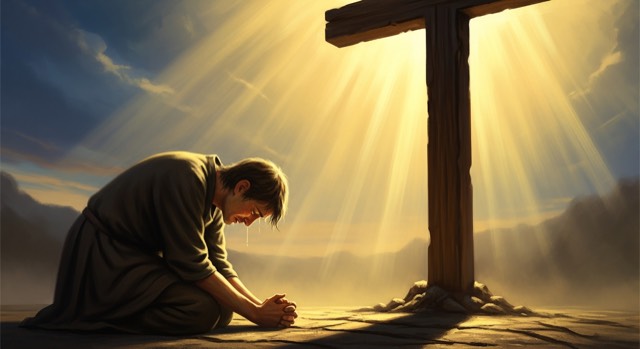
You know that road. It’s the one you find yourself on after the phone call you never wanted to get, or when the dream you poured your soul into collapses into a heap of dust and debt. It’s a long, lonely walk back from a place of bright expectation to the drab reality of what is. The sun is setting, casting long, mournful shadows, and the conversation with your friend, your spouse, or your own heart, is just a low murmur of exhausted disbelief.
"We thought this was it," you whisper. "We were so sure. We trusted this was the way God was leading, the person He was sending, the redemption we were promised. And now… nothing." Just the crunch of gravel underfoot and the hollow echo of a hope that has died.
This is the very dust of the road to Emmaus. After the crucifixion, two disciples walked this path, their hearts heavy with a specific kind of grief: the grief of a shattered expectation. Listen to the ache in their words: "But we trusted that it had been he which should have redeemed Israel." Their trust was placed in a version of the Messiah they had constructed in their own minds—a political king who would overthrow Rome and fix their immediate earthly problems. Their despair wasn't just sadness; it was the fruit of a fundamental misunderstanding, a colossal error in their spiritual calculus.
They needed to repent. In this context, repentance wasn't about apologizing for a specific sin, but about correcting the very framework of their faith. Their whole way of seeing God’s plan was skewed, and it had led them to walk away from the very city where their salvation had just been accomplished. They were blind to the glory because they were looking for the wrong kind of king.
And then Jesus draws near. He doesn't offer a platitude or a gentle pat on the back; instead, He offers a sharp, loving rebuke that cuts right to the heart of their error.
Ought not Christ to have suffered these things, and to enter into his glory? — Luke 24:26, KJV
He calls their condition what it is: a foolishness born of a sluggish heart that refuses to take God at His full Word. But notice, the correction isn't a command for them to try harder or believe better on their own. The remedy comes from Him. He is the one who opens the book, the one who unravels the scarlet thread from Genesis to Malachi, showing them that the path to glory was always, always through suffering. True repentance—the turning of the mind—begins not with our effort, but when the living Word Himself condescends to walk with us and illuminate the written Word.
The Leaven of Hypocrisy
Before we get too hard on those disciples, we have to look at the leaven in our own house. In the Gospel of Matthew, Jesus warns His followers about a subtle spiritual danger that often creeps into the heart of the believer.
Then Jesus said unto them, Take heed and beware of the leaven of the Pharisees and of the Sadducees. — Matthew 16:6, KJV
To the casual reader, "leaven" might seem like a strange metaphor for hypocrisy, but it is a perfect one. Leaven (yeast) is small and nearly invisible at first, but as it works its way through the dough, it expands everything it touches. This is exactly how hypocrisy operates in our spiritual lives. It isn't always about putting on a religious show for the benefit of others; rather, it is a far more subtle, insidious yeast that works its way through the dough of our souls.
This leaven is the spirit of self-reliance. It is the deep-down belief that our spiritual safety depends on our performance, our knowledge, our doctrinal purity, or our moral record. It is a faith built on the shifting sands of our own ability to "get it right." When we rely on our own spiritual maturity, we aren't actually relying on Christ; we are relying on our perception of Christ. This is the essence of the Pharisaic spirit: believing that grace is a reward for our consistency rather than the fuel for it.
When the pressure of life comes—when the innumerable multitude of demands and failures begin to tread one upon another—a religion built on self-reliance always breaks. It breaks because it was never about the finished work of Jesus in the first place; it was about us. The antidote to this hypocrisy is not a more strenuous effort to be authentic, but a radical reordering of our fears.
The Necessity of Repentance
If we are to be freed from the leaven of self-reliance, we must understand what it truly means to repent. Many people view repentance as a somber chore—a heavy lifting of the soul where we must "pay" for our mistakes through contrition. But in the New Testament, repentance is presented as a joyful turning, a pivot from the mirror of self-examination to the window of Christ's sufficiency.
Repent ye therefore, and be converted, that your sins may be blotted out, when the times of refreshing shall come from the presence of the Lord;— Acts 3:19, KJV
The phrase "be converted" implies a change in direction. It is the act of stopping our frantic attempts to scrub our own records clean and instead looking upward to the One who has already signed the ledger. To have our sins "blotted out" is a beautiful legal image; it suggests that the ink of our failures has been wiped away by the blood of the Lamb, leaving a blank page upon which God writes His grace.
Repentance, therefore, is not a work we perform to earn God's favor; it is the response of a heart that has finally realized that human effort is an exhausted road. It is the moment we stop asking, "How can I be better for God?" and start asking, "What has God already done for me in Christ?" This shift is the heartbeat of the Gospel. When we repent, we are not just turning from sin; we are turning toward the finished work of Jesus, finding that His strength is made perfect in our weakness.
Fear and Trust in God
Once we have turned our minds toward Christ, we are faced with the challenge of living in a world that constantly tries to pull our gaze back toward ourselves and our critics. Jesus knew that His disciples would face opposition, and He gave them a strategic key to maintaining their peace: the redirection of fear.
And fear not them which kill the body, but are not able to kill the soul: but rather fear him which is able to destroy both soul and body in hell. — Matthew 10:28, KJV
At first glance, this seems like a daunting command. Why would we want to "fear" the One who has the power to cast us into hell? However, in a biblical sense, this "fear" is not the trembling of a slave before a capricious tyrant; it is the awe-struck reverence of a child before a loving Father. It is a "holy fear" that recognizes God's absolute sovereignty and mercy.
When we rightly orient ourselves to His majesty, our earthly fears begin to shrink. We stop living our lives trying to manage the opinions of people who have no power over our eternal soul. We stop trembling before the "body-killers"—the bosses, the critics, the debts, and the disappointments—because we are anchored in the One who holds all things in His hands. Trusting in God's plan means accepting that even the "suffering" on the road to Emmaus is a necessary precursor to the "glory" of the resurrection.
A Call to Renewal
As you walk your own road today, remember that repentance is not a destination, but a continuous journey of returning to the grace of God. Whether you are dealing with the "leaven" of self-reliance or the crushing weight of a died-out hope, there is a promise of renewal waiting for you. The same Christ who walked with the discouraged disciples is walking beside you now, opening the Scriptures and whispering truth into your weary soul.
The beauty of grace is that it never asks us to start over from a place of perfection; it simply invites us to come as we are, burdened by our failures and hopeful for His mercy.
Create in me a clean heart, O God; and renew a right spirit within me. — Psalm 51:10, KJV
Let this be your prayer today. Not a prayer of desperation, but a prayer of confidence, knowing that the God who began a good work in you is faithful to complete it. He is the Potter, and we are but the clay; He is the Word, and we are the listeners. In His grace, our brokenness becomes the canvas for His glory.
A Closing Prayer:
Heavenly Father, we thank Thee for the gift of repentance—the grace that allows us to turn from our own flawed frameworks and gaze upon the sufficiency of Thy Son. Forgive us for the leaven of hypocrisy and self-reliance that often clouds our faith. Create in us clean hearts, O God, and renew a right spirit within us, that we may walk the roads of this life not in fear of man, but in awe of Thy majesty. May we ever remember that the path to glory leads through the cross, and that in Christ, every tear is a seed for a future harvest. In the precious name of Jesus, Amen.