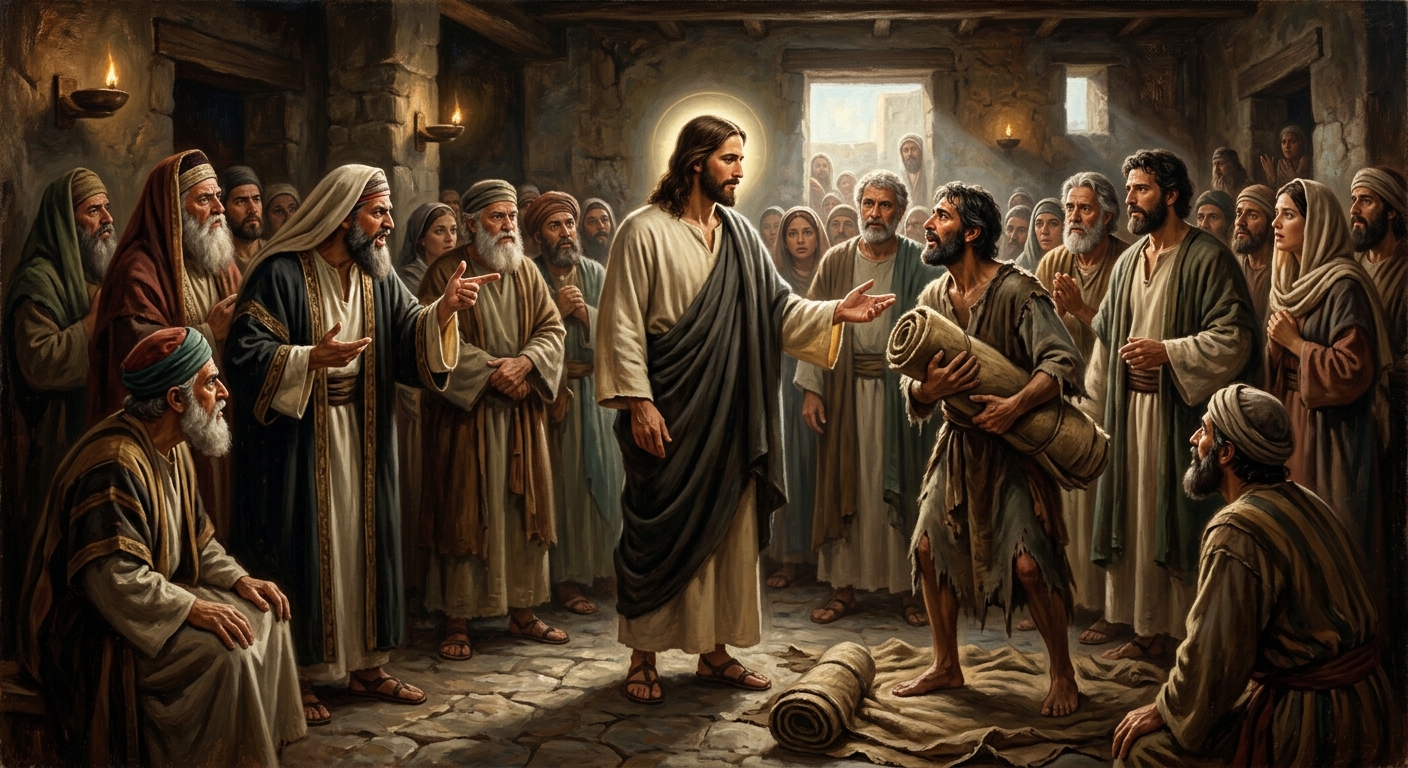
Illustration: Dramatic cinematic biblical illustration for Matthew Chapter 9 showing Authority of Jesus over sin and sickness, photorealistic oil painting style.
Author
Matthew the Apostle
Written
~80-90 AD
Key Theme
Authority of Jesus over sin and sickness
Setting
Capernaum - by the Sea of Galilee
Key Verse
Matthew 9:5
Total Verses
38
Chapter Introduction
*In this blessed chapter, we see our Lord stepping into the ordinary world—a humble boat and a familiar town—yet His presence transforms it. He meets those crippled by the palsy, not just with physical healing but with a profound proclamation of forgiveness. With gentle authority He confronts the doubts of scribes, revealing that the power to forgive sins and to command bodies to rise are one and the same. May we, too, trust in His word that brings wholeness to heart and body.*
Matthew — Chapter 9 — KJV
1
And he entered into a ship, and passed over, and came into his own city.
Simply PutHe steps onto a boat (πλοῖον, G4151), crosses the water, and returns to his hometown—showing that even the Son of God moves through ordinary life among us.
2
And, behold, they brought to him a man sick of the palsy, lying on a bed: and Jesus seeing their faith said unto the sick of the palsy; Son, be of good cheer; thy sins be forgiven thee.
Simply PutSeeing their faith (πίστις, G4102), He tells the paralytic, “Take heart! Your sins are forgiven” (ἀφέω, G075), showing that spiritual healing comes before physical restoration.
3
And, behold, certain of the scribes said within themselves, This man blasphemeth.
Simply PutSome scribes think He is blaspheming (βλασφημέω, G954), because they cannot imagine a man forgiving sins; their thoughts reveal a deep misunderstanding of God’s power.
4
And Jesus knowing their thoughts said, Wherefore think ye evil in your hearts?
Simply PutJesus, knowing their hearts, asks why they think evil (πονηρία, G5400) in their thoughts—reminding us that He sees even the hidden doubts within us.
5
For whether is easier, to say, Thy sins be forgiven thee; or to say, Arise, and walk?
Simply PutHe asks which is easier—saying, “Your sins are forgiven,” or saying, “Arise and walk?” The point is that forgiving sins reveals divine authority, which He possesses.
6
But that ye may know that the Son of man hath power on earth to forgive sins, (then saith he to the sick of the palsy,) Arise, take up thy bed, and go unto thine house.
Simply PutTo show His power (δύναμις, G1415) as the Son of Man on earth to forgive sins, He commands the man to rise (ἀνίστημι, G043), proving that His words are backed by supernatural might.
7
And he arose, and departed to his house.
Simply PutThe man obeys, rises, and goes home—demonstrating that Jesus’ promise is real if we trust Him.
8
But when the multitudes saw it, they marvelled, and glorified God, which had given such power unto men.
Simply PutThe crowd marvels (θαυμάζω, G2320) and glorifies God (δοξάζω, G1396), acknowledging that the divine has given such power to a man.
9
And as Jesus passed forth from thence, he saw a man, named Matthew, sitting at the receipt of custom: and he saith unto him, Follow me. And he arose, and followed him.
Simply PutWhile passing, Jesus sees Matthew at the tax booth (λογιστής τῆς τελώνης) and says, “Follow me.” Matthew rises and follows—showing that a simple invitation can change a life forever.
10
And it came to pass, as Jesus sat at meat in the house, behold, many publicans and sinners came and sat down with him and his disciples.
Simply PutAs He dines, many tax collectors and sinners sit with Him—showing that Jesus’ table is open to the lost and broken.
11
And when the Pharisees saw it, they said unto his disciples, Why eateth your Master with publicans and sinners?
Simply PutThe Pharisees question, “Why does your Master eat with tax collectors and sinners?” Their inquiry reflects a self‑righteous mindset.
12
But when Jesus heard that, he said unto them, They that be whole need not a physician, but they that are sick.
Simply PutJesus replies, “The healthy need no doctor (ἰατρὸς, G2398), but the sick do.” He emphasizes that He came to heal those who recognize their need.
13
But go ye and learn what that meaneth, I will have mercy, and not sacrifice: for I am not come to call the righteous, but sinners to repentance.
Simply Put“Learn what this means,” He says—“I desire mercy (ἔλεος, G1651) over sacrifice.” His purpose is to call sinners to repentance, not the righteous.
14
Then came to him the disciples of John, saying, Why do we and the Pharisees fast oft, but thy disciples fast not?
Simply PutJohn’s disciples ask why they and the Pharisees fast often, while Jesus’ followers do not—seeking a clue to spiritual discipline.
15
And Jesus said unto them, Can the children of the bridechamber mourn, as long as the bridegroom is with them? but the days will come, when the bridegroom shall be taken from them, and then shall they fast.
Simply PutHe answers, “Can the wedding guests mourn while the bridegroom is with them?” They will fast when He departs, pointing to His future suffering and the need for heartfelt devotion.
16
No man putteth a piece of new cloth unto an old garment, for that which is put in to fill it up taketh from the garment, and the rent is made worse.
Simply PutThe idea here is that you can’t fix an old, torn coat with a brand‑new piece of fabric. The Greek word for “new” (kainourgion, G2582) means fresh and unwrought. When we try to patch our broken lives with half‑hearted fixes, the old wounds get worse; true restoration needs a whole new covering.
17
Neither do men put new wine into old bottles: else the bottles break, and the wine runneth out, and the bottles perish: but they put new wine into new bottles, and both are preserved.
Simply PutThe same principle works with wine and its container. “New wine” (kainourgion, G2582) is still bubbling and expanding; if you pour it into an old leather sack (sácon, G436), the skin will burst. God’s fresh blessings require fresh hearts—if we cling to old, cramped habits, the new life He gives will spill over.
18
While he spake these things unto them, behold, there came a certain ruler, and worshipped him, saying, My daughter is even now dead: but come and lay thy hand upon her, and she shall live.
Simply PutA ruler bows down (prosēkynēsen, G4365) to Jesus, pleading for his dead daughter. He offers hope: “Lay your hand upon her and she shall live.” Even in our darkest moments, when we feel hopeless, the simple faith of a humble prayer can open the door to life.
19
And Jesus arose, and followed him, and so did his disciples.
Simply PutJesus gets up and follows the ruler, and his disciples tag along. This shows that Jesus is always moving toward those in need, not staying put. If you’re feeling stuck or abandoned, remember that He’s walking toward you right now.
20
And, behold, a woman, which was diseased with an issue of blood twelve years, came behind him, and touched the hem of his garment:
Simply PutA woman who has suffered twelve years of bleeding (αἱμώδης, G137) pushes through the crowd and touches the hem of Jesus’ garment. She believes even a tiny touch will bring healing. When you’re in pain, sometimes the smallest act of faith—reaching out for help—is enough to begin restoration.
21
For she said within herself, If I may but touch his garment, I shall be whole.
Simply PutShe whispers to herself, “If I may but touch his garment, I shall be whole.” The word for “whole” (holoklēros, G2255) means completely restored. That inner conviction is a powerful reminder that hope can grow in the quiet corners of our hearts, even when we’re alone.
22
But Jesus turned him about, and when he saw her, he said, Daughter, be of good comfort; thy faith hath made thee whole. And the woman was made whole from that hour.
Simply PutJesus turns and calls her “Daughter,” offering comfort. He says, “Your faith has made you whole.” The Greek word for faith (pistis, G4102) isn’t just belief; it’s a deep trust that activates God’s power. When you hold onto this kind of faith, you can experience true wholeness.
23
And when Jesus came into the ruler’s house, and saw the minstrels and the people making a noise,
Simply PutWhen Jesus enters the ruler’s house, He sees noisy minstrels and a bustling crowd. Their clamor shows how quickly we can fill a space with distractions, forgetting the one person who truly needs help. In your life, cut through the noise to focus on what really matters.
24
He said unto them, Give place: for the maid is not dead, but sleepeth. And they laughed him to scorn.
Simply PutJesus tells them, “Give place; the maid is not dead but sleeping.” The word for “sleep” (καθεύδει, G2672) implies a temporary state. The crowd’s laughter shows their doubt, but Jesus reminds us that sometimes what appears as loss is actually a waiting period for renewal.
25
But when the people were put forth, he went in, and took her by the hand, and the maid arose.
Simply PutWhen the crowd leaves, Jesus goes in and takes the girl by the hand. He physically lifts her up and she rises. This act shows that Jesus not only speaks life—He also reaches out and physically restores us.
26
And the fame hereof went abroad into all that land.
Simply PutThe news of this miracle spreads throughout the whole region. “Fame” (δόξα, G1393) here isn’t just gossip; it’s the visible testimony of God’s power. When something real happens, it moves beyond the moment and impacts a whole community.
27
And when Jesus departed thence, two blind men followed him, crying, and saying, Thou son of David, have mercy on us.
Simply PutTwo blind men follow Jesus, crying out for mercy. They address Him as “Son of David,” a messianic title that shows they recognize His royal authority. Even when you feel invisible, your heartfelt cry can reach the King.
28
And when he was come into the house, the blind men came to him: and Jesus saith unto them, Believe ye that I am able to do this? They said unto him, Yea, Lord.
Simply PutJesus asks them, “Do you believe I am able to do this?” The Greek word for “believe” (pisteuō, G4102) means to trust with confidence. Their answer—“Yes, Lord”—showcases the simple power of faith in action.
29
Then touched he their eyes, saying, According to your faith be it unto you.
Simply PutHe touches their eyes and says, “According to your faith be it unto you.” Faith is the trigger that unlocks God’s promises. When you trust fully, you experience the fullness of His word.
30
And their eyes were opened; and Jesus straitly charged them, saying, See that no man know it.
Simply PutTheir eyes are opened, and Jesus strictly commands them to keep it secret. “See” (ὁράω, G1917) here means to perceive and understand. This reminder tells us that some blessings are meant for personal transformation before we share them with the world.
31
But they, when they were departed, spread abroad his fame in all that country.
Simply PutThe Greek word for fame, “doxa,” means reputation and honor. When the people went away, they carried His reputation far across that region.
32
As they went out, behold, they brought to him a dumb man possessed with a devil.
Simply PutAs they left, they brought a man who could not speak because he was possessed by an evil spirit. The word for “devil” (daimonion) points to a hostile spiritual force that had taken hold of the man.
33
And when the devil was cast out, the dumb spake: and the multitudes marvelled, saying, It was never so seen in Israel.
Simply PutWhen the demon was thrown out, the mute man began to speak, and the crowds were amazed. The Greek word for “marvelled” (thauma) captures their astonishment at something never seen before in Israel.
34
But the Pharisees said, He casteth out devils through the prince of the devils.
Simply PutBut the Pharisees responded with jealousy, saying He cast out demons through the “prince” (archon) of the devils. They tried to diminish His work by attributing it to a higher spiritual power.
35
And Jesus went about all the cities and villages, teaching in their synagogues, and preaching the gospel of the kingdom, and healing every sickness and every disease among the people.
Simply PutJesus moved through every town and village, teaching in the synagogues and preaching the good news (euangelion) of God’s reign, while also healing every sickness. His life was a living proclamation that the Kingdom is coming and that God cares for physical needs.
36
But when he saw the multitudes, he was moved with compassion on them, because they fainted, and were scattered abroad, as sheep having no shepherd.
Simply PutWhen He saw the crowds, He was deeply moved with compassion (splagchnizomai), feeling for them as a shepherd feels for his scattered flock. He saw they were weary, tired, and without guidance, like sheep without a shepherd.
37
Then saith he unto his disciples, The harvest truly is plenteous, but the labourers are few;
Simply PutHe told His disciples that the harvest (thresis) is plentiful, but the workers are few. There’s a great need for people to share the message, yet too few are ready and willing.
38
Pray ye therefore the Lord of the harvest, that he will send forth labourers into his harvest.
Simply PutHe urged them to pray for the Lord of the harvest, that He would send more workers into His fields. Prayer becomes the key to gathering the laborers needed for God’s work.
Mark 2:5-12This passage parallels the healing of the paralytic and Jesus' claim to forgive sins, underscoring his divine authority.
Luke 5:20-26The Synoptic parallel reinforces the significance of faith and Jesus' power to heal both physically and spiritually.
John 10:28-30These verses illuminate Jesus' authority to grant eternal life, echoing the theme of forgiveness and divine power in Matthew 9.
Isaiah 53:4-5This prophetic text foreshadows the Messiah's role in bearing infirmities and providing healing, which is fulfilled in Matthew 9.
Reflect
What hidden pain or struggle are you carrying today, and how might a small, faith‑filled step—like the woman who touched Jesus' garment—open you to healing?