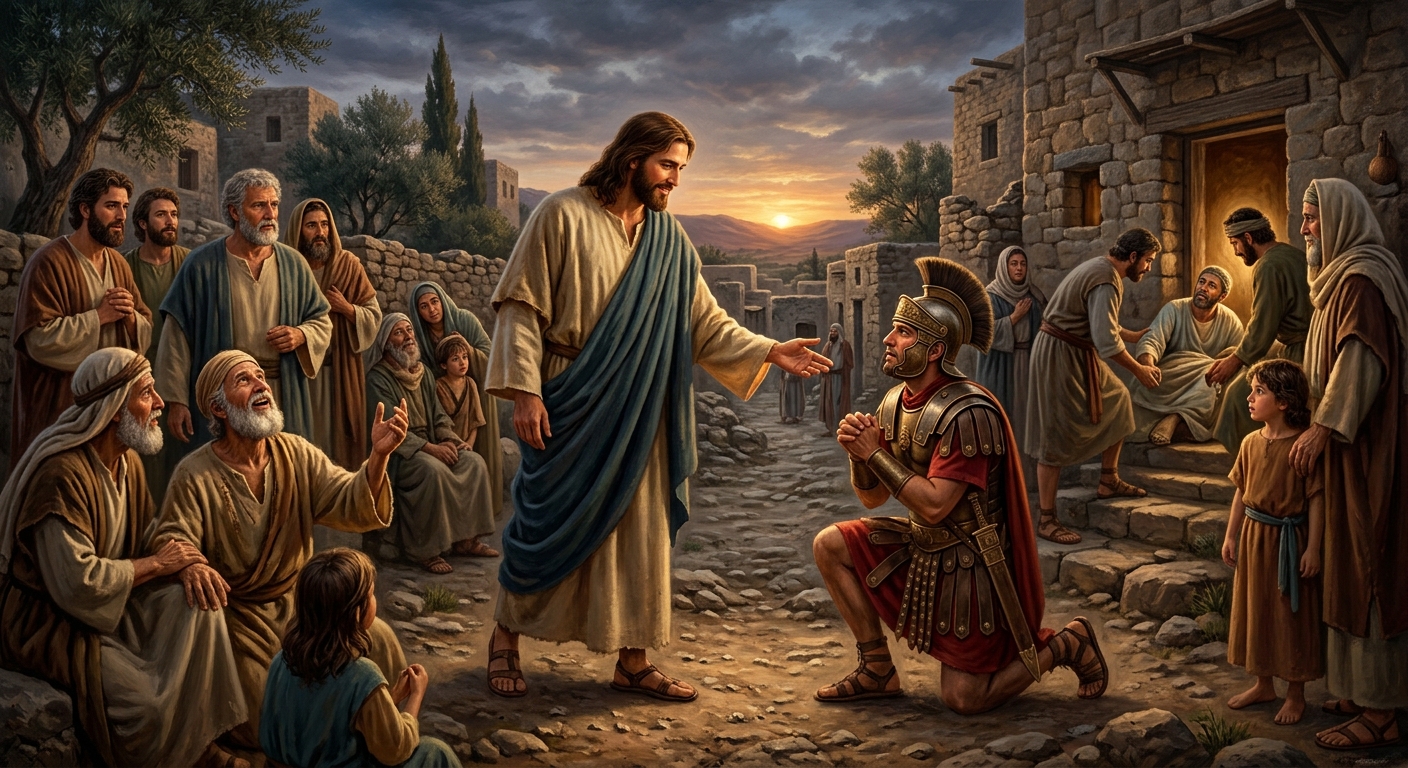
Illustration: Dramatic cinematic biblical illustration for Matthew Chapter 8 showing Authority over disease and faith, photorealistic oil painting style.
🔊
Listen to Chapter
Grace Notes Journey Audio Narration
Author
Matthew the Apostle
Written
~85 AD
Key Theme
Authority over disease and faith
Setting
Galilean region - post-mountain descent
Key Verse
Matthew 8:13
Total Verses
34
Chapter Introduction
*When Jesus descended from the mountain, He welcomed those who came in faith and desperation alike. The leper's humble worship and the centurion's quiet confidence reveal that God's grace meets us wherever we stand—whether in sickness or authority. Each miracle is not just a display of power, but an invitation to trust that the same One who healed the leper can heal our hearts today. Let us be reminded that we are called to receive this grace with gratitude and humility.*
Matthew — Chapter 8 — KJV
1
When he was come down from the mountain, great multitudes followed him.
Simply PutWhen Jesus descended from the mountain He drew a great crowd, as the Greek word "ochlos" (G2631) signifies—a mass of people seeking hope. Real hunger for God often finds its voice in the moment we hear Him speak and then see His feet on our ground.
2
And, behold, there came a leper and worshipped him, saying, Lord, if thou wilt, thou canst make me clean.
Simply PutA leper fled to Jesus, worshiped Him, and begged that He would “make me clean.” The word for leprosy (lepra, G3031) was more than a disease—it meant social exile. In our deepest pain, it reminds us that even the most broken can find a place before God if they humbly seek His grace.
3
And Jesus put forth his hand, and touched him, saying, I will; be thou clean. And immediately his leprosy was cleansed.
Simply PutJesus reached out (echō, G2192) and touched the leper, declaring “I will; be thou clean.” By touching what others wouldn’t touch, He shows that divine compassion overcomes human separation. Real doubt fades when we feel God’s hand on our suffering and see it healed instantly.
4
And Jesus saith unto him, See thou tell no man; but go thy way, shew thyself to the priest, and offer the gift that Moses commanded, for a testimony unto them.
Simply PutJesus instructed the man to keep quiet, go to the priest, and offer Moses’ prescribed gift as a testimony. The Greek “marturia” (G3141) means witness—by obeying, the healed man would testify to God’s power. In our lives, obedience can become a living testimony for those still searching.
5
And when Jesus was entered into Capernaum, there came unto him a centurion, beseeching him,
Simply PutJesus entered Capernaum and was approached by a centurion, a Roman officer of authority (kenturion, G2813). The humble approach of someone powerful shows that all ages and stations can seek Him. Real hunger for help often arrives from unexpected places.
6
And saying, Lord, my servant lieth at home sick of the palsy, grievously tormented.
Simply PutThe centurion pleaded, saying his servant lay at home suffering from palsy (plegma, G3999) and severe torment. The description of “grievously tormented” mirrors our own desperate cries for relief. In such moments, the request is not just for healing but for a mercy that restores peace.
7
And Jesus saith unto him, I will come and heal him.
Simply Put“I will come and heal him.” The verb “therapeuo” (G2392) conveys a holistic restoration—body, soul, and spirit. When we hear this promise, we can trust that Jesus offers not just a cure but a complete restoration of our brokenness.
8
The centurion answered and said, Lord, I am not worthy that thou shouldest come under my roof: but speak the word only, and my servant shall be healed.
Simply PutThe centurion confessed he was unworthy for Jesus to come into his house, yet believed His word alone would heal. The Greek “dunamis” (G1413) reflects power or ability—his humility recognized that true worth lies in faith, not status. In our doubts, this teaches us that belief, rather than merit, unlocks divine power.
9
For I am a man under authority, having soldiers under me: and I say to this man, Go, and he goeth; and to another, Come, and he cometh; and to my servant, Do this, and he doeth it.
Simply Put“I am a man under authority,” he said, comparing his command over soldiers (exousia, G1848) to Jesus’ authority. His faith, that a spoken word could heal at distance, demonstrates trust in God’s sovereign power. For those seeking assurance, it shows that faith can transcend physical presence.
10
When Jesus heard it, he marvelled, and said to them that followed, Verily I say unto you, I have not found so great faith, no, not in Israel.
Simply PutJesus marveled (thauma, G2366) at the centurion’s faith, declaring He hadn’t found such greatness in Israel. This astonishment emphasizes that genuine belief can come from any nation, not just the chosen people. Real doubt is dispelled when we see that faith is recognized wherever it blossoms.
11
And I say unto you, That many shall come from the east and west, and shall sit down with Abraham, and Isaac, and Jacob, in the kingdom of heaven.
Simply PutHe promised that many from the east (anatole, G325) and west will sit with Abraham, Isaac, and Jacob in the kingdom of heaven. The sunrise imagery signifies new beginnings—no matter where we come from, we can share in God’s eternal promise. Hunger for belonging finds fulfillment here.
12
But the children of the kingdom shall be cast out into outer darkness: there shall be weeping and gnashing of teeth.
Simply PutYet the children of the kingdom will be cast out into outer darkness, where there is weeping and gnashing of teeth. The term “kingdom” (basileia, G932) warns that merely belonging isn’t enough; one must live in the light of God’s truth. Real fear is confronted by examining whether we truly walk in that light.
13
And Jesus said unto the centurion, Go thy way; and as thou hast believed, so be it done unto thee. And his servant was healed in the selfsame hour.
Simply Put“Go thy way; as thou hast believed, so be it done unto thee.” The word for belief (pisteuo, G4100) shows that trust in God's promise brings immediate results. The servant’s healing at the very hour confirms that faith can prompt instant divine action.
14
And when Jesus was come into Peter’s house, he saw his wife’s mother laid, and sick of a fever.
Simply PutIn Peter’s house, Jesus saw the mother-in-law sick with a fever. The Greek term for fever (pyrexia, G5456) indicates intense heat and distress, much like the pressures we face. Even within familiar homes, Jesus brings relief.
15
And he touched her hand, and the fever left her: and she arose, and ministered unto them.
Simply PutHe touched her hand and the fever left; she rose and began serving them. The verb “diakoneo” (G1325) means to serve—her healing liberated her for service. Real hunger for purpose is often fulfilled when we receive restoration and can then give back to others.
16
When the even was come, they brought unto him many that were possessed with devils: and he cast out the spirits with his word, and healed all that were sick:
Simply PutWhen evening came, people brought to Him many who were possessed by demons. He cast out the spirits with His word and healed all that were sick. The Greek word here for "possessed" (G2444) comes from the root meaning to be seized or held; it tells us that Jesus spoke power into those chains, and the same word for "healed" (G2192) means to make whole. To someone in pain, this verse says that the Master's voice alone can set you free and restore your broken body.
17
That it might be fulfilled which was spoken by Esaias the prophet, saying, Himself took our infirmities, and bare our sicknesses.
Simply PutHe did this to fulfill what Isaiah the prophet had spoken, saying, "He Himself took our infirmities and bore our sicknesses." The Greek term for "infirmities" (G534) means weakness or disease, and "bore" (G1473) is the same verb used for carrying a load. This tells us that Christ took on every illness we face, so He could lift it off us; for the doubting heart, it's a promise that the One who knows our pain has already carried it.
18
Now when Jesus saw great multitudes about him, he gave commandment to depart unto the other side.
Simply PutSeeing great multitudes gathering around Him, Jesus gave a command to go across the lake. The Greek word for "commandment" (G2243) is a strong directive, like a captain steering his ship. It's a reminder that God often moves us to new places, even when the crowd is pressing close; He may lead us away from comfort into a deeper trust.
19
And a certain scribe came, and said unto him, Master, I will follow thee whithersoever thou goest.
Simply PutA certain scribe approached and said to Him, "Master, I will follow you wherever you go." The word here for "scribe" (G3319) indicates a learned man of the law, someone seeking to understand God's ways. To those hungry for direction, this shows that even a man of the law recognized his need to walk with Christ.
20
And Jesus saith unto him, The foxes have holes, and the birds of the air have nests; but the Son of man hath not where to lay his head.
Simply PutJesus replied, "Foxes have holes and birds of the air have nests; but the Son of Man has nowhere to lay His head." The phrase "Son of Man" (G5202) is how Jesus often referred to Himself, emphasizing His humanity. This tells us that following Him may mean giving up comforts and security; the path is simple, but it requires surrender.
21
And another of his disciples said unto him, Lord, suffer me first to go and bury my father.
Simply PutAnother disciple said to Him, "Lord, let me first go and bury my father." The word "first" (G2915) here means before anything else. In real life, we often prioritize family duties over following God; yet this verse challenges us to consider the timing of our devotion.
22
But Jesus said unto him, Follow me; and let the dead bury their dead.
Simply PutJesus replied, "Follow me; let the dead bury their own dead." The phrase "the dead" (G4170) here refers to those who are spiritually lifeless. The message is clear: true discipleship requires leaving behind worldly concerns and walking in spiritual life.
23
And when he was entered into a ship, his disciples followed him.
Simply PutWhen He entered a ship, His disciples followed Him. The word "entered" (G1512) is the same as stepping onto a vessel, signifying trust even amidst danger. This reminds us that walking with Christ may place us in uncertain waters, yet He is always at the helm.
24
And, behold, there arose a great tempest in the sea, insomuch that the ship was covered with the waves: but he was asleep.
Simply PutSuddenly a great storm arose on the sea, so that the ship was covered with waves; yet He slept. The Greek "tempest" (G4472) conveys a violent, sudden windstorm. Even while we panic over life's tempests, Christ's calm sleep assures us that He is in control.
25
And his disciples came to him, and awoke him, saying, Lord, save us: we perish.
Simply PutThe disciples came to Him and awakened Him, saying, "Lord, save us! We're perishing!" The word for "perishing" (G629) means to die, not just physically but spiritually. Their cry shows that in crisis we turn to Jesus for rescue, and He hears our pleas.
26
And he saith unto them, Why are ye fearful, O ye of little faith? Then he arose, and rebuked the winds and the sea; and there was a great calm.
Simply PutHe said to them, "Why are you fearful? O you of little faith!" Then He rose and rebuked the winds and the sea, making a great calm. The Greek "rebuke" (G3422) is to command or order; Jesus shows that a word from Him can halt the fiercest forces. This teaches us to trust His authority over all our fears.
27
But the men marvelled, saying, What manner of man is this, that even the winds and the sea obey him!
Simply PutThe men marveled and said, "What sort of man is this? Even the winds and sea obey Him!" The word for "marvelled" (G2861) reflects astonishment. Witnesses recognized the divine power in Jesus, prompting us to worship Him as the One who rules over creation.
28
And when he was come to the other side into the country of the Gergesenes, there met him two possessed with devils, coming out of the tombs, exceeding fierce, so that no man might pass by that way.
Simply PutComing to the other side, into the country of the Gadarenes, He met two men possessed by demons, coming out of the tombs, so fierce that no one could pass there. The Greek "possessed" (G2444) again shows a total seizure; the demons' intensity made the place impassable. This tells us that Christ confronts even the deepest darkness.
29
And, behold, they cried out, saying, What have we to do with thee, Jesus, thou Son of God? art thou come hither to torment us before the time?
Simply PutThe demons cried out, "What have we to do with You, Jesus, Son of God? Have You come here to torment us before the appointed time?" The phrase "Son of God" (G2316) reveals their awareness of Christ's divine authority. Even the spirits recognize His power, challenging us to submit fully to Him.
30
And there was a good way off from them an herd of many swine feeding.
Simply PutThere was a herd of many swine feeding far off from them. The word for "herd" (G2589) suggests a large group, illustrating how the demonic realm had its own order. The presence of the swine shows that Jesus confronts evil in all places, showing His authority over every domain.
31
So the devils besought him, saying, If thou cast us out, suffer us to go away into the herd of swine.
Simply PutThe devils (Greek daimonia, G1503) are spirit beings that cling to human sorrow; they seek permission from the Master of creation, asking if they may be sent into a herd of swine (Greek pous, G4182), showing their desperation to remain in any earthly host.
32
And he said unto them, Go. And when they were come out, they went into the herd of swine: and, behold, the whole herd of swine ran violently down a steep place into the sea, and perished in the waters.
Simply PutJesus commands them, “Go,” using the Greek word exelthoite (G1844) which means to be sent away; when the swine panic and rush down a steep place into the sea, they drown (Greek apoleto, G621), illustrating how the sudden removal of evil can bring chaos and loss that shakes the whole community.
33
And they that kept them fled, and went their ways into the city, and told every thing, and what was befallen to the possessed of the devils.
Simply PutThe swine owners flee, spreading word of what happened to the possessed men; this plain-speaking testimony shows how even ordinary folk become witnesses when a life is freed from an unseen, oppressive force.
34
And, behold, the whole city came out to meet Jesus: and when they saw him, they besought him that he would depart out of their coasts.
Simply PutThe entire city gathers to meet Jesus and begs Him (Greek ezēsan, G2199) to depart from their coasts; this plea reflects how those who have been touched by the miracle may also fear further disruption, yet their hearts are still drawn to see Him and seek more of His presence.
Leviticus 14:4This verse details the priestly rites for cleansing a leper, illuminating Jesus' instruction in v4 to show himself to the priest and offer the gift prescribed by Moses.
Luke 5:12-13The parallel account of a leper being healed by Jesus underscores the authority and compassion displayed in Matthew 8:2-3.
Luke 7:2-5This passage recounts the same centurion's request for his servant's healing, highlighting the faith that Jesus commends in Matthew 8:5-8.
John 4:46-53The healing of an official's son at a distance mirrors the centurion’s belief that Jesus can heal with just a word, reinforcing the theme of faith without physical proximity.
Reflect
If you feel surrounded by the “great multitudes” of daily demands, what does it look like for you today to heed Jesus’ command and “depart unto the other side”?