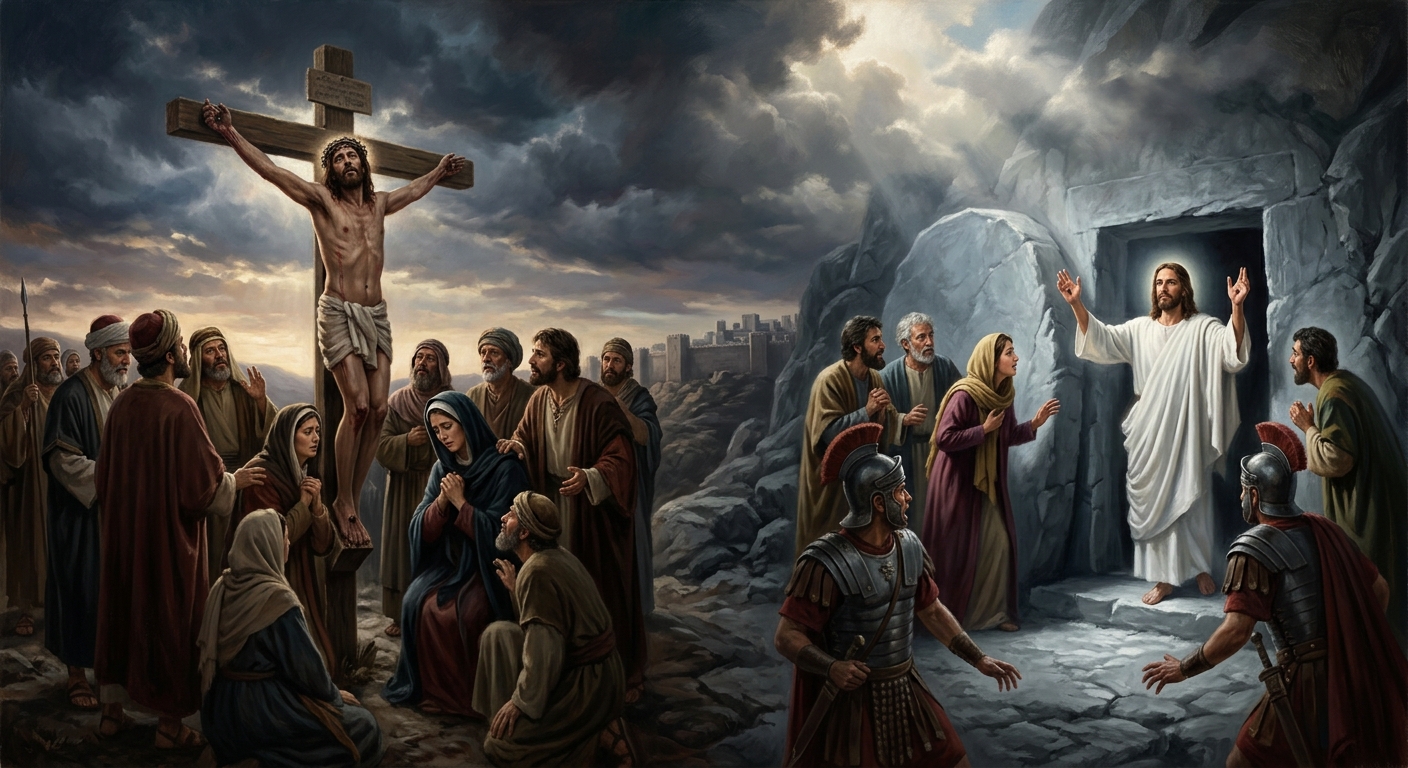
Illustration: Dramatic cinematic biblical illustration for Matthew Chapter 27 showing Christ's Passion and Resurrection, photorealistic oil painting style.
🔊
Listen to Chapter
Grace Notes Journey Audio Narration
Author
Matthew the Apostle
Written
~80-90 AD
Key Theme
Christ's Passion and Resurrection
Setting
Jerusalem - early morning of Passover
Key Verse
Matthew 27:46
Total Verses
66
Chapter Introduction
*In the quiet of early morning, the chief priests and elders conspire against our Lord. Yet even in betrayal, we see a heart that turns back to the Light—Judas's remorse echoes our own need for forgiveness. As Jesus is led before Pilate, we are reminded of the humble obedience that crowns a Savior's path. Let this chapter draw us to the cross, where grace meets justice and love conquers all.*
Matthew — Chapter 27 — KJV
1
When the morning was come, all the chief priests and elders of the people took counsel against Jesus to put him to death:
Simply PutThe chief priests and elders, driven by envy and fear, gathered in secret (Greek "counsel" G3004) to devise a plot that would lead to Jesus’ death. Their scheme shows how human hearts can twist God’s plan into tragedy, yet it also sets the stage for the ultimate redemption that only Christ can fulfill.
2
And when they had bound him, they led him away, and delivered him to Pontius Pilate the governor.
Simply PutWhen they “bound” (Greek G2999) Jesus, it was a physical restraint that mirrored the spiritual bondage of sin. They then “delivered” (Greek G1325) Him to Pilate, the political authority, trusting that human power would seal His fate. Yet even this handoff was part of God’s sovereign design.
3
Then Judas, which had betrayed him, when he saw that he was condemned, repented himself, and brought again the thirty pieces of silver to the chief priests and elders,
Simply PutJudas, after seeing Jesus condemned, felt a sudden “repentance” (Greek G3361)—a turning back toward the truth he had denied. He returned the thirty pieces of silver, hoping that a small act could erase his betrayal. In real life, even the deepest guilt can be met with sincere remorse, though it doesn’t erase the consequences.
4
Saying, I have sinned in that I have betrayed the innocent blood. And they said, What is that to us? see thou to that.
Simply Put“I have sinned” (Greek G260) in betraying the innocent blood of Jesus—an admission that betrayal is a violation against the pure and precious life God gave. When the priests asked, “What to us?” they dismissed his guilt as mere paperwork; many people in pain feel unheard when their tears become “nothing to us” (Greek G3004).
5
And he cast down the pieces of silver in the temple, and departed, and went and hanged himself.
Simply PutOverwhelmed by remorse, Judas “cast down” (Greek G707) the silver in the temple and fled to hang himself—a tragic end that starkly reminds us of how unchecked guilt can lead to despair. Yet even his death points back to the price that would be paid for every human soul.
6
And the chief priests took the silver pieces, and said, It is not lawful for to put them into the treasury, because it is the price of blood.
Simply PutThe chief priests declared that it was “not lawful” to put the silver into the treasury because it was “the price of blood” (Greek G2588). They treated the money as a filthy token, showing how worldly systems often reject divine grace and instead cling to material purity.
7
And they took counsel, and bought with them the potter’s field, to bury strangers in.
Simply PutThey “bought” (Greek G3950) the potter’s field, a place for strangers to be buried—an act of outward generosity that covered the inward corruption of their hearts. The field became a physical reminder that even when we try to hide our sins, God’s truth will surface.
8
Wherefore that field was called, The field of blood, unto this day.
Simply PutThe field became known as “The Field of Blood,” a somber name that still echoes today. It symbolizes how the cost of sin—whether measured in silver or sorrow—leaves a lasting mark on both land and hearts.
9
Then was fulfilled that which was spoken by Jeremy the prophet, saying, And they took the thirty pieces of silver, the price of him that was valued, whom they of the children of Israel did value;
Simply PutIn these verses, the prophecy of Jeremiah is fulfilled—God’s foretelling that “they took the thirty pieces of silver, the price of him they valued.” This reveals how God’s plan works through human actions, even those driven by greed and betrayal.
10
And gave them for the potter’s field, as the Lord appointed me.
Simply Put“The Lord appointed me” to give the field for strangers. This shows that God’s purpose can turn even a tragic act (Judas’ betrayal) into an unexpected blessing for others, reminding us that God can bring good out of our worst mistakes.
11
And Jesus stood before the governor: and the governor asked him, saying, Art thou the King of the Jews? And Jesus said unto him, Thou sayest.
Simply PutPilate asks, “Are you the King of the Jews?” and Jesus replies, “You say it.” The Greek word “sayest” (G3004) implies that He did not claim the title, but allowed others to label Him. In moments of doubt, this teaches that truth can be recognized without needing our validation.
12
And when he was accused of the chief priests and elders, he answered nothing.
Simply PutWhen the chief priests and elders “accused” Him, Jesus remained silent. His quietness in the face of falsehood shows a profound confidence that his innocence needed no defense—God’s love can stand silent against the world’s lies.
13
Then said Pilate unto him, Hearest thou not how many things they witness against thee?
Simply PutPilate questions Him, “Do you not hear how many things they witness against you?” (Greek G3415 for “witness”). This illustrates that human testimony can be overwhelming, yet true identity is found in God’s eye, not the crowd’s whispers.
14
And he answered him to never a word; insomuch that the governor marvelled greatly.
Simply PutJesus answered “not a word,” and Pilate was “greatly astonished.” The silence speaks louder than any defense—sometimes the deepest truth is found in a still heart that refuses to be swayed by pressure.
15
Now at that feast the governor was wont to release unto the people a prisoner, whom they would.
Simply PutDuring the feast, Pilate would release a prisoner chosen by the people. This tradition reminded them that freedom and redemption are possible, foreshadowing how Christ’s sacrifice would release all who believe from spiritual captivity.
16
And they had then a notable prisoner, called Barabbas.
Simply PutBarabbas, whose name means “son of the father,” was a notorious prisoner—some say he was a rebel or murderer. The Greek word for “prisoner” (δεσμώτης, G1195) reminds us that even those who are bound by sin can be freed through Christ’s work.
17
Therefore when they were gathered together, Pilate said unto them, Whom will ye that I release unto you? Barabbas, or Jesus which is called Christ?
Simply PutPilate asked the crowd to choose whom they wanted released—Barabbas or Jesus, “the Christ.” The Greek word for “Christ” (Χριστός, G5547) means the Anointed One, the one God set apart to bring salvation.
18
For he knew that for envy they had delivered him.
Simply PutThe crowd said they had handed over Jesus out of envy. “Envy” (φθόνος, G5385) is a jealous desire that drives people to wrongfully accuse and condemn the innocent.
19
When he was set down on the judgment seat, his wife sent unto him, saying, Have thou nothing to do with that just man: for I have suffered many things this day in a dream because of him.
Simply PutAs Pilate sat on the judgment seat (βήμα, G965), his wife sent a warning: “You have suffered many things in a dream about this man.” A vision (ὄναρ, G3681) can be God’s way of urging us to heed the truth even when we feel unsure.
20
But the chief priests and elders persuaded the multitude that they should ask Barabbas, and destroy Jesus.
Simply PutThe chief priests (ἀρχιερεῖς, G73) and elders (πρεσβύτεροι, G4189) swayed the crowd to ask for Barabbas’ release and Jesus’ death. Their pressure shows how human ambition can drown out God’s voice.
21
The governor answered and said unto them, Whether of the twain will ye that I release unto you? They said, Barabbas.
Simply PutPilate asked again whether they wanted Barabbas or Jesus released. The crowd’s answer, “Barabbas,” reveals how easily we can choose the familiar over the holy.
22
Pilate saith unto them, What shall I do then with Jesus which is called Christ? They all say unto him, Let him be crucified.
Simply PutPilate asked what to do with Jesus, “the Christ.” The crowd shouted, “Let Him be crucified,” demanding the blood of the Anointed One (Χριστός) to be spilled.
23
And the governor said, Why, what evil hath he done? But they cried out the more, saying, Let him be crucified.
Simply PutPilate asked what evil Jesus had done, but the crowd’s cries grew louder. “Evil” (κακία, G2580) shows their frustration with a Savior who came to bring peace but seemed to cause chaos.
24
When Pilate saw that he could prevail nothing, but that rather a tumult was made, he took water, and washed his hands before the multitude, saying, I am innocent of the blood of this just person: see ye to it.
Simply PutSeeing he could not decide, Pilate washed his hands (νίψας, G3533), declaring himself innocent of Jesus’ blood. This act reminds us that we often wash our hands of responsibility while the world suffers.
25
Then answered all the people, and said, His blood be on us, and on our children.
Simply PutThe people replied, “His blood be on us, and on our children.” Their claim (αἷμα, G1520) shows how guilt can be passed down through generations when we reject Christ.
26
Then released he Barabbas unto them: and when he had scourged Jesus, he delivered him to be crucified.
Simply PutPilate released Barabbas and, after scourging Jesus (λουσάμενος, G3055), handed Him over to be crucified. The scourge was a brutal stripping of dignity before the ultimate sacrifice.
27
Then the soldiers of the governor took Jesus into the common hall, and gathered unto him the whole band of soldiers.
Simply PutThe governor’s soldiers took Jesus into the common hall (πραιτώριον, G4260), gathering all the soldiers around Him. This setting of military power underscores how Christ was surrounded by earthly authority.
28
And they stripped him, and put on him a scarlet robe.
Simply PutThey stripped Him and clothed Him in a scarlet robe (χιτών, G5583), mocking His royalty. The bright hue of the robe highlights how they tried to dress Him as a king while planning His death.
29
And when they had platted a crown of thorns, they put it upon his head, and a reed in his right hand: and they bowed the knee before him, and mocked him, saying, Hail, King of the Jews!
Simply PutThey fashioned a crown of thorns (στέφανος, G4665), placed it on His head, gave Him a reed to hold, and mocked him: “Hail, King of the Jews!” Their mockery (ἐβλασφημήσαντο, G983) is a bitter echo of their rejection.
30
And they spit upon him, and took the reed, and smote him on the head.
Simply PutThey spat on Him and struck His head with the reed. The simple but cruel act of spitting (κατεξέλειπεν, G2598) and striking (ἀπέκτεινεν, G647) shows the depth of their contempt for the Savior.
31
And after that they had mocked him, they took the robe off from him, and put his own raiment on him, and led him away to crucify him.
Simply PutThe soldiers mocked Him—using the Greek word "gelo" (G1060), which means to ridicule or scoff at. They stripped Him of a scarlet robe, the symbol of royalty, and put on His own plain clothes before leading Him to be crucified (Greek "stauroo," G5048). In the midst of pain, this shows that Christ endured humiliation for our sake.
32
And as they came out, they found a man of Cyrene, Simon by name: him they compelled to bear his cross.
Simply PutSimon of Cyrene was compelled (Greek "enagesato," G5471) to bear the cross—an iron beam representing death. For someone in real struggle, it's a reminder that God often uses ordinary people to carry the weight of His purpose.
33
And when they were come unto a place called Golgotha, that is to say, a place of a skull,
Simply PutThey arrived at Golgotha, the Greek "Golgotha" (G1101), meaning a place of a skull. This grim name reminds us that the crucifixion was not just an event but a place where sin's head—death itself—was finally broken.
34
They gave him vinegar to drink mingled with gall: and when he had tasted thereof, he would not drink.
Simply PutThe soldiers offered Him vinegar (Greek "oxos," G2184) mixed with gall ("chymos," G2547). Though He tasted it, He would not drink. Even in His thirst, Christ's suffering was complete—He bore the bitter weight of our sin without needing to quench His own thirst.
35
And they crucified him, and parted his garments, casting lots: that it might be fulfilled which was spoken by the prophet, They parted my garments among them, and upon my vesture did they cast lots.
Simply PutWhen they crucified Him, they cast lots (Greek "klēromai," G2914) for His garments to fulfill the prophet’s words. The division of clothing shows that even in death, God's promises are fulfilled, and Christ's sacrifice satisfies the righteous requirement of Scripture.
36
And sitting down they watched him there;
Simply PutThe people sat watching Him. For those feeling watched by judgment, this scene reminds us that in our most painful moments, there is a divine audience witnessing the depth of God's love.
37
And set up over his head his accusation written, THIS IS JESUS THE KING OF THE JEWS.
Simply PutOver His head they wrote, "THIS IS JESUS THE KING OF THE JEWS." The Greek phrase "basileus ton ioudaiōn" (G93, G2456) declares His true identity. Even when mocked, Christ's kingship stands firm—a hope for those seeking a ruler who cares.
38
Then were there two thieves crucified with him, one on the right hand, and another on the left.
Simply PutTwo thieves were crucified with Him—one on the right, one on the left. Their presence shows that no matter how many are around us in suffering, Christ is always there at the center.
39
And they that passed by reviled him, wagging their heads,
Simply PutThose passing by reviled Him, wagging their heads. The mocking reflects the disbelief of many, yet it also highlights that even in scorn, we are still seen by God.
40
And saying, Thou that destroyest the temple, and buildest it in three days, save thyself. If thou be the Son of God, come down from the cross.
Simply PutThey shouted, "If you are the Son of God, come down from the cross!" The claim about destroying and rebuilding the temple in three days (Greek "naos," G3488) refers to Jesus' body as the true temple. In doubt, this verse reminds us that His resurrection proves His divine authority.
41
Likewise also the chief priests mocking him, with the scribes and elders, said,
Simply PutThe chief priests and scribes mocked Him, saying He cannot save Himself. Their ridicule underscores the human tendency to doubt divine power. Yet Christ's silence speaks louder than any accusation.
42
He saved others; himself he cannot save. If he be the King of Israel, let him now come down from the cross, and we will believe him.
Simply PutThey said, "If He is the King of Israel, let Him now come down." The Greek word for save ("sozo," G4982) reveals that they demanded a miracle. In hunger, this shows that true salvation comes from faith in Him, not from watching Him descend.
43
He trusted in God; let him deliver him now, if he will have him: for he said, I am the Son of God.
Simply PutHe trusted in God; let Him deliver Him now. The Greek "pepoios" (G4232) means confident trust. Even in His darkest hour, Christ relied on the Father—a promise that we too can trust when fearing death.
44
The thieves also, which were crucified with him, cast the same in his teeth.
Simply PutThe thieves cast the same in His teeth. Even amid mockery, the physical pain was real—reminding us that Christ’s suffering matches our own.
45
Now from the sixth hour there was darkness over all the land unto the ninth hour.
Simply PutFrom the sixth hour to the ninth hour, darkness covered the land (Greek "skotos," G4675). This supernatural darkness symbolizes the world’s mourning and the spiritual eclipse that only Christ could illuminate.
46
And about the ninth hour Jesus cried with a loud voice, saying, Eli, Eli, lama sabachthani? that is to say, My God, my God, why hast thou forsaken me?
Simply PutThe word "forsaken" comes from the Hebrew root shachah (H7955), meaning to be emptied or cast away, and the Greek "schizo" (G5311) captures that tearing apart. Jesus cries out, “My God, why have you left me?”—He feels the sting of abandonment we all know in our darkest moments. This verse reminds us that even the Son of God felt alone, and He can stand with us in our deepest cries.
47
Some of them that stood there, when they heard that, said, This man calleth for Elias.
Simply PutThe crowd hears “Eli” and jumps to the idea that He’s calling for Elijah, missing the pain behind His cry. It shows how we often hear a voice of anguish and respond with theories rather than compassion.
48
And straightway one of them ran, and took a spunge, and filled it with vinegar, and put it on a reed, and gave him to drink.
Simply PutOne man quickly grabs a spunge (Greek spongos, G4709), fills it with vinegar, and offers it on a reed. He brings a meager, bitter comfort amidst agony—a reminder of the small mercies we receive in our suffering.
49
The rest said, Let be, let us see whether Elias will come to save him.
Simply PutOthers, still doubtful, say, “Let us see whether Elijah will come to save him.” They wait for an external savior instead of trusting the One who is already bearing our burden.
50
Jesus, when he had cried again with a loud voice, yielded up the ghost.
Simply PutWith one final loud cry, Jesus yields up the ghost (Greek pneuma, G4150), surrendering His spirit to the Father. He gives up the breath of life, showing that true victory often follows surrender and stillness.
51
And, behold, the veil of the temple was rent in twain from the top to the bottom; and the earth did quake, and the rocks rent;
Simply PutThe temple veil tears from top to bottom, while the earth shakes and rocks split. In Greek, “rent” (schizo) signifies a tearing apart of separation; the veil that once divided humanity from God is ripped open, signaling direct access to the divine.
52
And the graves were opened; and many bodies of the saints which slept arose,
Simply PutThe graves crack open; many saints who had slept arise. This is the promise of resurrection—death’s door swings wide, reminding us that hope lies beyond the tomb.
53
And came out of the graves after his resurrection, and went into the holy city, and appeared unto many.
Simply PutThe risen saints walk into the holy city (hagios), appearing to many. They enter a place of divine presence, showing that those who trust in Christ are called to dwell with God.
54
Now when the centurion, and they that were with him, watching Jesus, saw the earthquake, and those things that were done, they feared greatly, saying, Truly this was the Son of God.
Simply PutThe centurion and his men, witnessing the quake and events, fear greatly (Greek phobos) and proclaim, “Truly this was the Son of God.” Their reverent awe leads to confession.
55
And many women were there beholding afar off, which followed Jesus from Galilee, ministering unto him:
Simply PutWomen stand afar off, watching and ministering. Their steadfast devotion reminds us that true love often waits patiently from the sidelines.
56
Among which was Mary Magdalene, and Mary the mother of James and Joses, and the mother of Zebedee’s children.
Simply PutAmong them are Mary Magdalene, and the mothers of James, Joses, and Zebedee’s children. Ordinary women are part of this grand story, bearing witness to the greatest events.
57
When the even was come, there came a rich man of Arimathaea, named Joseph, who also himself was Jesus’ disciple:
Simply PutAt evening, a rich man named Joseph of Arimathaea, who is also a disciple, steps forward. He shows that wealth can be used for service when it follows Christ.
58
He went to Pilate, and begged the body of Jesus. Then Pilate commanded the body to be delivered.
Simply PutJoseph goes to Pilate, asking for Jesus’ body. Pilate grants the request—a small yet vital act of humility and love in honoring Christ.
59
And when Joseph had taken the body, he wrapped it in a clean linen cloth,
Simply PutJoseph wraps the body in a clean linen cloth (Greek sindon, G4999). The linen signifies purity and the care given to God’s Body.
60
And laid it in his own new tomb, which he had hewn out in the rock: and he rolled a great stone to the door of the sepulchre, and departed.
Simply PutHe lays it in his own new tomb, hewn from rock, and rolls a great stone to seal the door. The “new” (neos) tomb marks the beginning of a new era, one that will soon reveal the miracle of resurrection.
61
And there was Mary Magdalene, and the other Mary, sitting over against the sepulchre.
Simply PutMary Magdalene and another Mary sit at the tomb, their hearts weighed down by loss. The Greek word for "sepulchre" (μνήμα, G3225) is simply a burial place, but here it becomes the focal point of their grief and hope—two women who refuse to leave even as darkness closes in. Their presence tells us that devotion does not end with death; it persists, waiting for God's move.
62
Now the next day, that followed the day of the preparation, the chief priests and Pharisees came together unto Pilate,
Simply PutThe next day after the Passover preparation, the chief priests (ἀρχιερεῖς, G71) and Pharisees gather at Pilate's palace. The term "preparation" (ἑτοιμάζω, G2159) signals the day they prepared for Passover—a time of renewal—yet these leaders are preparing a plan to cover up the miracle they fear. Their meeting shows that even a holy festival can be twisted by those in power.
63
Saying, Sir, we remember that that deceiver said, while he was yet alive, After three days I will rise again.
Simply PutThey confront Pilate, calling Jesus "the deceiver" (ψεύστης, G5608) because He claimed in life that He would rise after three days. The Greek verb for "rise again" (ἀναστήσω, G423) carries the idea of being set upright or restored to life. Their accusation reveals a deep fear: they cannot accept that God might triumph over death.
64
Command therefore that the sepulchre be made sure until the third day, lest his disciples come by night, and steal him away, and say unto the people, He is risen from the dead: so the last error shall be worse than the first.
Simply PutPilate tells them to make the tomb "sure" (βεβαιόω, G954) until the third day, to prevent a nighttime theft that would cause confusion. He fears that if the disciples stole the body and claimed resurrection, it would become a bigger "error" (λάθος, G3000) than the first. This shows that even the Roman governor sees the power of a false claim about resurrection.
65
Pilate said unto them, Ye have a watch: go your way, make it as sure as ye can.
Simply PutPilate says, "You have a watch—go your way and make it as sure as you can." The term for "watch" (φύλακας, G5403) implies a guard, but Pilate's tone suggests he trusts the Jewish authorities to secure the tomb. It underscores how even when human guards are set, God's plan can still move beyond their control.
66
So they went, and made the sepulchre sure, sealing the stone, and setting a watch.
Simply PutThe priests and Pharisees seal the stone (σφραγίζω, G5038) and set a guard. Sealing the stone is an act of finality, meant to keep any possibility of resurrection at bay. Yet the sealing itself becomes a part of the story that will be overturned by God's power three days later.
Zechariah 11:12-13This prophetic passage predicts the thirty pieces of silver and the purchase of a potter's field, directly fulfilling Matthew 27:3-8.
Jeremiah 32:6-9The transaction of buying a field to bury strangers mirrors the chief priests' purchase of the potter's field in Matthew 27:7-8.
John 18:31Pilate's inquiry about the law of condemnation parallels Matthew 27:2, highlighting the Roman legal context of Jesus' trial.
Mark 15:1This verse recounts the same council of chief priests and elders delivering Jesus to Pilate, providing a parallel synoptic account of Matthew 27:1-2.
Reflect
When you’ve been offered a quick fix—like a drink of vinegar and gall—that seemed meant to help but left you feeling empty, how did you respond, and what did that reveal about your own needs today?