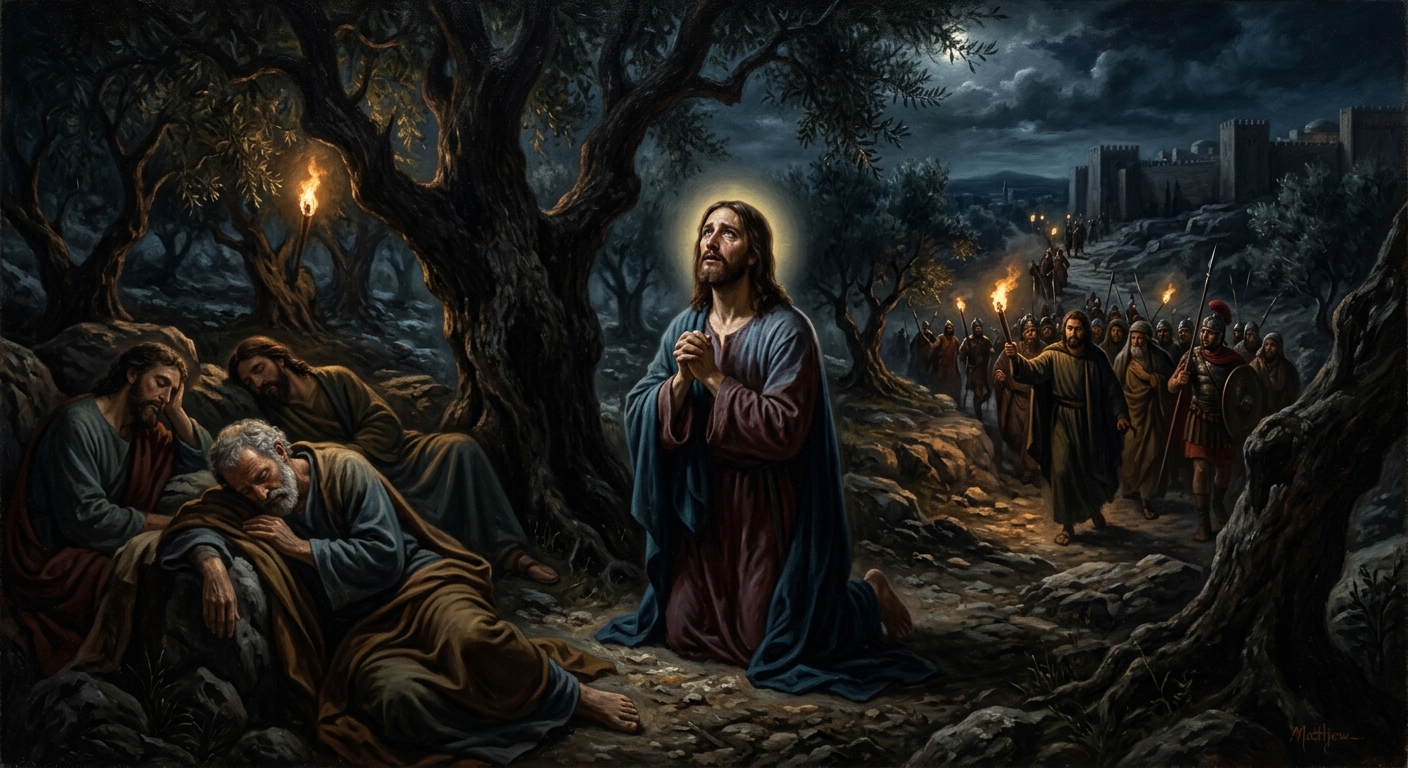
Illustration: Dramatic cinematic biblical illustration for Matthew Chapter 26 showing Christ's Passion and Disciples' Faith, photorealistic oil painting style.
🔊
Listen to Chapter
Grace Notes Journey Audio Narration
Author
Matthew the Apostle
Written
~80 AD
Key Theme
Christ's Passion and Disciples' Faith
Setting
Jerusalem - at night
Key Verse
Matthew 26:28
Total Verses
74
Chapter Introduction
*In the quiet hush of Jerusalem's night, we walk with Jesus into His most intimate moments. He shares a final meal, pours out His heart in prayer, and willingly embraces the path of suffering. As He faces betrayal and abandonment, we are reminded that His love never falters. Let this chapter draw us into the depth of His grace and the call to follow Him faithfully.*
Matthew — Chapter 26 — KJV
1
And it came to pass, when Jesus had finished all these sayings, he said unto his disciples,
Simply PutJesus finishes his teaching and now says, “Now I’m about to tell you something that will change everything.” The Greek word here, gegō (G1093), literally means “to happen” or “to come to pass,” signaling that a pivotal moment is about to unfold in the lives of his followers.
2
Ye know that after two days is the feast of the passover, and the Son of man is betrayed to be crucified.
Simply PutHe reminds them that the Passover feast—pascha (G3952), the celebration of God’s deliverance—is just two days away, and that the Son of Man will be handed over (paradidomi) to die. For anyone feeling helpless, this verse points to the ultimate rescue plan God is about to enact.
3
Then assembled together the chief priests, and the scribes, and the elders of the people, unto the palace of the high priest, who was called Caiaphas,
Simply PutThe religious leaders—presbyteroi (G434) and scribes—gather in the high priest’s palace, plotting against Jesus. Their secret meeting shows that fear and power often drive people to betray the one they claim to follow.
4
And consulted that they might take Jesus by subtilty, and kill him.
Simply PutThey devise a plan to seize Jesus by subtlety (sophizo, G4949) and kill him quietly. This reminds us that God’s enemies often act through clever tricks, not brute force.
5
But they said, Not on the feast day, lest there be an uproar among the people.
Simply Put“Let’s wait until after the feast,” they say, fearing an uproar among the crowd. Their concern for public order reveals how worldly politics can dictate spiritual decisions.
6
Now when Jesus was in Bethany, in the house of Simon the leper,
Simply PutJesus stays in Bethany, the home of Simon the leper—a place where he rests and heals. It’s a reminder that even the Son of God needed moments of quiet and companionship.
7
There came unto him a woman having an alabaster box of very precious ointment, and poured it on his head, as he sat at meat.
Simply PutA woman arrives with a precious alabaster jar of ointment (elaion, G2197) and pours it over Jesus’ head as he eats. Her act of devotion shows how love can be expressed through the finest gifts we have.
8
But when his disciples saw it, they had indignation, saying, To what purpose is this waste?
Simply PutThe disciples become indignant (thymisma, G2380), questioning why the woman wasted such valuable oil. Their reaction exposes how human minds can miss deeper truths in favor of practicality.
9
For this ointment might have been sold for much, and given to the poor.
Simply Put“She could have sold it and given it to the poor,” they argue. While charity matters, this verse highlights that worship and sacrifice sometimes demand more than just material generosity.
10
When Jesus understood it, he said unto them, Why trouble ye the woman? for she hath wrought a good work upon me.
Simply PutJesus, understanding (sunidomi, G4842) their heart, gently rebukes them. He calls the woman’s act a good work upon him, showing that true worship honors God directly rather than through indirect means.
11
For ye have the poor always with you; but me ye have not always.
Simply Put“You always have the poor with you, but not me,” he says. The Greek word panta (G3956) emphasizes the constant presence of the needy, while Jesus’ unique presence underscores his divine mission.
12
For in that she hath poured this ointment on my body, she did it for my burial.
Simply PutHe explains that she poured the ointment for his burial (thriambos, G2398), a funeral feast. This points to the reality that his death was already part of God’s plan, and our worship can anticipate that purpose.
13
Verily I say unto you, Wheresoever this gospel shall be preached in the whole world, there shall also this, that this woman hath done, be told for a memorial of her.
Simply Put“Amen (G281), truly I say,” Jesus declares, promising that wherever the gospel spreads, this woman’s story will be remembered. Her act becomes a timeless example of heartfelt worship.
14
Then one of the twelve, called Judas Iscariot, went unto the chief priests,
Simply PutJudas Iscariot, one of the twelve disciples, goes to the chief priests. His secret trip shows how betrayal can come from those closest to us.
15
And said unto them, What will ye give me, and I will deliver him unto you? And they covenanted with him for thirty pieces of silver.
Simply PutHe asks, “What will you pay me?” and they agree on thirty pieces of silver (dikaioo, G1335), a price that would later weigh heavily on the cross. This transaction underscores how even God’s redemption can be bought with human greed.
16
And from that time he sought opportunity to betray him.
Simply PutJesus knew that one among his closest friends was already plotting to hand him over. The Greek word for betray, "paradidomai" (G3952), literally means to deliver someone into another's hands. This reminds us that the darkness can creep up quietly, even when you think everything is steady.
17
Now the first day of the feast of unleavened bread the disciples came to Jesus, saying unto him, Where wilt thou that we prepare for thee to eat the passover?
Simply PutThe disciples came to Jesus at the very start of Passover, the feast that remembers God's deliverance. They asked where to make preparations for the sacred meal. This shows their desire to honor God, even as they sensed something heavy in the air.
18
And he said, Go into the city to such a man, and say unto him, The Master saith, My time is at hand; I will keep the passover at thy house with my disciples.
Simply PutJesus told them to go into the city and find a man who would host the Passover. He said, "My time is at hand" – the Greek "kairos" (G2580) points to a specific, divine appointment. He knew the moment of his sacrifice was approaching, and he set the stage for it.
19
And the disciples did as Jesus had appointed them; and they made ready the passover.
Simply PutThe disciples did exactly as Jesus instructed, making ready all the things needed for the Passover feast. Their obedience reflects the importance of following God's directions, especially when the whole world seems to be shifting.
20
Now when the even was come, he sat down with the twelve.
Simply PutAs evening fell, Jesus sat down with the twelve disciples at a familiar table. The Greek word "hespera" (G5608) marks the end of day and hints at the close of an era. In that quiet hour, conversations would turn toward destiny.
21
And as they did eat, he said, Verily I say unto you, that one of you shall betray me.
Simply PutWhile they ate, Jesus said plainly, "One of you will betray me." The word "verily" (Greek "amen," G281) is a seal of truth, emphasizing that what follows must be taken seriously. Even in the midst of fellowship, reality can snap into focus.
22
And they were exceeding sorrowful, and began every one of them to say unto him, Lord, is it I?
Simply PutThe disciples were overwhelmed with sorrow; each one asked, "Lord, is it I?" The Greek term for sorrowful, "penthos" (G3993), captures a deep ache that even the strongest heart can feel. Their grief shows how quickly hope can be shaken by betrayal.
23
And he answered and said, He that dippeth his hand with me in the dish, the same shall betray me.
Simply PutJesus answered, "The one who dips his hand with me in the dish will betray me." The verb "bapto" (G903) means to immerse or wash, a symbol of close friendship. Sharing the same plate points to intimacy, yet it also foreshadows hidden deceit.
24
The Son of man goeth as it is written of him: but woe unto that man by whom the Son of man is betrayed! it had been good for that man if he had not been born.
Simply PutJesus warned that woe would be on the man who betrays him, noting it would have been better for that person never to have been born. The term "woe" (Greek "eulabeia," G2195) signals deep suffering, and the word for "born" (Greek "gennaomai," G1073) suggests that a life lived without this betrayal would be spared from such pain.
25
Then Judas, which betrayed him, answered and said, Master, is it I? He said unto him, Thou hast said.
Simply PutJudas, the betrayer, asked, "Master, is it I?" Jesus replied, "You have said." The Greek word for "said" (Greek "legei," G3004) points to the inevitability of his confession. In that moment, the truth was laid bare for all to see.
26
And as they were eating, Jesus took bread, and blessed it, and brake it, and gave it to the disciples, and said, Take, eat; this is my body.
Simply PutAs they ate, Jesus took bread, gave thanks (Greek "eucharisto," G2198), broke it, and said, "Take, eat; this is my body." The act of blessing the bread connects to gratitude and the promise that his physical life would nourish believers forever.
27
And he took the cup, and gave thanks, and gave it to them, saying, Drink ye all of it;
Simply PutHe took the cup, gave thanks (Greek "eucharisto," G2198), and said to them, "Drink ye all of it." This simple sharing becomes a powerful reminder that the sacrifice poured out for them is to be received with grateful hearts.
28
For this is my blood of the new testament, which is shed for many for the remission of sins.
Simply PutHe explained, "This is my blood of the new covenant, shed for many for the remission of sins." The term "new covenant" (Greek "kainos diatheke," G2542) points to a fresh, living agreement between God and humanity, sealed by his blood.
29
But I say unto you, I will not drink henceforth of this fruit of the vine, until that day when I drink it new with you in my Father’s kingdom.
Simply PutJesus told them he would not drink the fruit of the vine again until the day he drinks it anew with them in his Father's kingdom. The word "fruit" (Greek "karpos," G2588) hints at future fellowship and hope beyond this earthly life.
30
And when they had sung an hymn, they went out into the mount of Olives.
Simply PutAfter they sang a hymn (Greek "hymnos," G5615), they went out onto the Mount of Olives. Their final song wraps up their gathering with worship and prepares them for the walk toward what lies ahead.
31
Then saith Jesus unto them, All ye shall be offended because of me this night: for it is written, I will smite the shepherd, and the sheep of the flock shall be scattered abroad.
Simply PutSome of you will be stunned this night, just as a stone can trip a traveler. The Greek word for "offended" (skandalizo, G4567) shows that people will stumble because I am about to be "smitten" (sphuzō, G5546), and the flock will scatter in panic.
32
But after I am risen again, I will go before you into Galilee.
Simply PutBut don't be terrified—after I'm resurrected, I will meet you in Galilee. The promise of the "rising again" (Greek: anastasis) is a beacon of hope that darkness does not have the final word.
33
Peter answered and said unto him, Though all men shall be offended because of thee, yet will I never be offended.
Simply PutPeter says, "Even if everyone else stumbles because of you, my faith will stay firm." He uses the same Greek word "skandalizo" (G4567) to stress that his own resolve will not be shaken, though the world around him may be.
34
Jesus said unto him, Verily I say unto thee, That this night, before the cock crow, thou shalt deny me thrice.
Simply PutJesus quietly tells Peter, "Tonight you will deny me three times before the rooster crows." The crowing of the cock (Greek: kukkoa) is a simple, everyday sound that will mark the moment when Peter's confidence turns into fear.
35
Peter said unto him, Though I should die with thee, yet will I not deny thee. Likewise also said all the disciples.
Simply PutPeter declares, "Even if I have to die with you, I will never deny you." His bold promise reflects the desperation of loyalty—yet all the disciples are essentially saying the same thing, hoping to hold onto their faith.
36
Then cometh Jesus with them unto a place called Gethsemane, and saith unto the disciples, Sit ye here, while I go and pray yonder.
Simply PutJesus leads them to a place called Gethsemane, telling the disciples to sit while He goes to pray. The garden is a quiet spot where He will wrestle with His deepest worries, asking them to be still and supportive.
37
And he took with him Peter and the two sons of Zebedee, and began to be sorrowful and very heavy.
Simply PutHe takes Peter and the two sons of Zebedee, becoming deeply sorrowful and burdened. The Greek word for "sorrowful" (penthos, G3971) captures a weight of grief so heavy that it feels like an unshakable load.
38
Then saith he unto them, My soul is exceeding sorrowful, even unto death: tarry ye here, and watch with me.
Simply PutHe kneels down and prays, "Father, if possible, let this cup pass from me; yet not as I will, but as You will." The "cup" (phialē) symbolizes the suffering He faces, and the Greek word for "will" (thelo, G2399) shows His ultimate surrender to God's desire.
39
And he went a little farther, and fell on his face, and prayed, saying, O my Father, if it be possible, let this cup pass from me: nevertheless not as I will, but as thou wilt.
40
And he cometh unto the disciples, and findeth them asleep, and saith unto Peter, What, could ye not watch with me one hour?
Simply PutHe returns and finds the disciples asleep, asking Peter, "Couldn't you stay awake with me for one hour?" The Greek word for "watch" (phrasthai, G5498) underscores the disappointment that they couldn't stay alert at such a crucial time.
41
Watch and pray, that ye enter not into temptation: the spirit indeed is willing, but the flesh is weak.
Simply PutHe tells them, "Watch and pray so you won’t fall into temptation. The spirit is willing, but the flesh is weak." This says that even when we want to do right (spirit), our human nature (flesh) often lets us down.
42
He went away again the second time, and prayed, saying, O my Father, if this cup may not pass away from me, except I drink it, thy will be done.
Simply PutHe goes away again to pray, saying, "If this cup cannot pass from me unless I drink it, then Your will be done." The act of "drinking" (poto, G4372) is a metaphor for fully accepting the suffering He must endure.
43
And he came and found them asleep again: for their eyes were heavy.
Simply PutHe returns to find them asleep again, their eyes heavy with fatigue. The Greek word for "heavy" (pachys) paints a picture of exhausted minds that can’t stay vigilant.
44
And he left them, and went away again, and prayed the third time, saying the same words.
Simply PutHe leaves them once more, praying a third time and saying the same words. The persistence of His prayers shows that He is preparing for what’s ahead with unwavering resolve.
45
Then cometh he to his disciples, and saith unto them, Sleep on now, and take your rest: behold, the hour is at hand, and the Son of man is betrayed into the hands of sinners.
Simply PutHe comes to the disciples and says, "Sleep now and rest. The appointed hour (kairos) is at hand; the Son of Man will be betrayed into sinners' hands." The moment has arrived, and betrayal is about to unfold.
46
Rise, let us be going: behold, he is at hand that doth betray me.
Simply PutHe tells them, "Rise up; we must go. Look, the one who betrays me is nearby." The call to "rise" (egeiro, G1071) urges them to move forward into the imminent tragedy that awaits.
47
And while he yet spake, lo, Judas, one of the twelve, came, and with him a great multitude with swords and staves, from the chief priests and elders of the people.
Simply PutEven as Jesus was speaking, Judas—his chosen disciple turned betrayer (from the Greek paradidomi, meaning "to hand over")—arrived with a huge crowd armed for violence. The chief priests and elders, the religious leaders, had called them in to seize Him.
48
Now he that betrayed him gave them a sign, saying, Whomsoever I shall kiss, that same is he: hold him fast.
Simply PutJudas gave the crowd a clear sign: "The one I kiss is He; seize Him." This was his way of identifying Jesus, using a simple gesture to fulfill the betrayal foretold in Scripture.
49
And forthwith he came to Jesus, and said, Hail, master; and kissed him.
Simply PutJudas hurried up to Jesus, greeting Him with a friendly "Hail," but the kiss was no warm greeting—it was a dagger of betrayal. The Greek word chaire here means to rejoice, yet the joy turned into a deadly plan.
50
And Jesus said unto him, Friend, wherefore art thou come? Then came they, and laid hands on Jesus, and took him.
Simply PutJesus asked Judas, "Friend, why did you come?" He knew the purpose behind Judas' arrival. Then the crowd lay hands on Him and took Him away, fulfilling the prophetic plan of His arrest.
51
And, behold, one of them which were with Jesus stretched out his hand, and drew his sword, and struck a servant of the high priest’s, and smote off his ear.
Simply PutOne of Jesus' followers drew his sword and struck the high priest's servant, cutting off his ear. The Greek word chērō (to stretch out) shows the impulsive reach for violence, even in a moment of darkness.
52
Then said Jesus unto him, Put up again thy sword into his place: for all they that take the sword shall perish with the sword.
Simply PutJesus told him to put the sword back. "All who take up a sword will die by one." The Greek balteō (to bear) reminds us that relying on weapons only brings destruction.
53
Thinkest thou that I cannot now pray to my Father, and he shall presently give me more than twelve legions of angels?
Simply PutJesus asked, "Do you think I cannot pray now?" He trusted the Father, who could bring more than twelve legions of angels (a legion is 6,000). His confidence was in God's power, not human strength.
54
But how then shall the scriptures be fulfilled, that thus it must be?
Simply PutBut He needed the Scriptures to be fulfilled. The Greek grapho (to write) shows that everything was happening as God had already recorded.
55
In that same hour said Jesus to the multitudes, Are ye come out as against a thief with swords and staves for to take me? I sat daily with you teaching in the temple, and ye laid no hold on me.
Simply PutJesus challenged the crowd, "Did you come like thieves with swords and staves?" He had taught peacefully in the temple daily, yet they now seized Him violently.
56
But all this was done, that the scriptures of the prophets might be fulfilled. Then all the disciples forsook him, and fled.
Simply PutAll this was to fulfill the prophets' words. Then, in fear and confusion, all the disciples fled, leaving Jesus alone.
57
And they that had laid hold on Jesus led him away to Caiaphas the high priest, where the scribes and the elders were assembled.
Simply PutThose who had seized Jesus led Him to Caiaphas the high priest, where scribes and elders were gathered—setting the stage for His trial.
58
But Peter followed him afar off unto the high priest’s palace, and went in, and sat with the servants, to see the end.
Simply PutPeter followed from a distance into the high priest's palace, sitting among the servants to see what would happen.
59
Now the chief priests, and elders, and all the council, sought false witness against Jesus, to put him to death;
Simply PutThe chief priests and council searched for false witnesses to condemn Jesus to death—seeking lies as the basis for judgment.
60
But found none: yea, though many false witnesses came, yet found they none. At the last came two false witnesses,
Simply PutThey found none at first, though many false witnesses came. Finally, two false witnesses stepped forward.
61
And said, This fellow said, I am able to destroy the temple of God, and to build it in three days.
62
And the high priest arose, and said unto him, Answerest thou nothing? what is it which these witness against thee?
Simply PutThe chief priest forces Jesus to respond, asking what he will say about the false testimony against Him. The Greek word for witness, marturia (G3317), means a formal accusation that can seal someone's destiny. For anyone feeling condemned or unheard, this verse shows the pressure to speak truth when lies are piled up.
63
But Jesus held his peace. And the high priest answered and said unto him, I adjure thee by the living God, that thou tell us whether thou be the Christ, the Son of God.
Simply PutJesus stays silent, but the priest swears a solemn oath—using the Greek term hēomai (G5275), meaning to bind by a sacred promise—to force Jesus to declare if He is the Christ, the Anointed One (christos, G5541), and Son of God. It’s a moment where the truth is demanded under the most serious oath, echoing the deep hunger for recognition of who He truly is.
64
Jesus saith unto him, Thou hast said: nevertheless I say unto you, Hereafter shall ye see the Son of man sitting on the right hand of power, and coming in the clouds of heaven.
Simply PutJesus replies with a prophetic promise, pointing to the future vision of the Son of man (huios tou anthrōpou, G5203+G550), sitting at the right hand of power (dexia ischyos, G1164) and descending in clouds. This language paints a picture of ultimate authority and divine glory, comforting those who feel powerless by reminding them that true power belongs to Him.
65
Then the high priest rent his clothes, saying, He hath spoken blasphemy; what further need have we of witnesses? behold, now ye have heard his blasphemy.
Simply PutThe high priest tears his clothes—a sign of deep grief—and declares that Jesus has spoken blasphemy (blasphēmia, G949). The accusation of blasphemy highlights the seriousness of claiming divine status, a burden for anyone wrestling with doubts about their own identity and worth.
66
What think ye? They answered and said, He is guilty of death.
Simply PutThe council asks, “What do you think?” and declares Jesus guilty of death. This decisive verdict shows how quickly judgment can be passed, reminding those in turmoil that false accusations often lead to swift condemnation.
67
Then did they spit in his face, and buffeted him; and others smote him with the palms of their hands,
Simply PutThey spit on Jesus, beat Him with their fists, and strike Him with rods. The raw cruelty of these actions reflects the humiliation that believers may endure when they stand for truth in a hostile world.
68
Saying, Prophesy unto us, thou Christ, Who is he that smote thee?
Simply PutThe crowd demands a prophecy—using the Greek word prophēteusate (G4242), meaning to utter divine prediction—from Jesus, the Christ. Their demand for a sign underscores human longing for proof amid skepticism.
69
Now Peter sat without in the palace: and a damsel came unto him, saying, Thou also wast with Jesus of Galilee.
Simply PutPeter sits outside, and a servant girl tells him he was also with Jesus of Galilee. The gentle reminder pulls Peter back into the unfolding drama, highlighting how even quiet moments can be interrupted by truth.
70
But he denied before them all, saying, I know not what thou sayest.
71
And when he was gone out into the porch, another maid saw him, and said unto them that were there, This fellow was also with Jesus of Nazareth.
Simply PutAs Peter steps onto the porch, another servant girl confirms his presence with Jesus of Nazareth. This layered denial shows how social pressure can intensify our inner conflict.
72
And again he denied with an oath, I do not know the man.
Simply PutHe swears again—using the Greek term horkos (G3740), a binding oath—that he doesn’t know the man. The repeated oaths reveal Peter’s desperation to protect himself at all costs.
73
And after a while came unto him they that stood by, and said to Peter, Surely thou also art one of them; for thy speech bewrayeth thee.
Simply PutThose standing nearby accuse Peter, pointing out that his speech betrays him. The mounting pressure forces him to confront the reality of his denial.
74
Then began he to curse and to swear, saying, I know not the man. And immediately the cock crew.
Simply PutPeter begins to curse and swear, “I don’t know the man,” and immediately a rooster crows. The Greek word for rooster, kopros (G2781), signals the moment of realization and the painful echo of his failure.
75
And Peter remembered the word of Jesus, which said unto him, Before the cock crow, thou shalt deny me thrice. And he went out, and wept bitterly.
Simply PutPeter remembers Jesus’ warning—“Before the rooster crows, you will deny me three times”—and he goes out and weeps bitterly. The Greek term mnēmon (G3411) for memory underscores the crushing weight of guilt and the start of repentance.
Facing a situation today that feels like an unmanageable “cup”—whether it’s illness, stress, or a tough decision—how can you move from hoping it passes to trusting that the path ahead aligns with a purpose beyond your own plans?