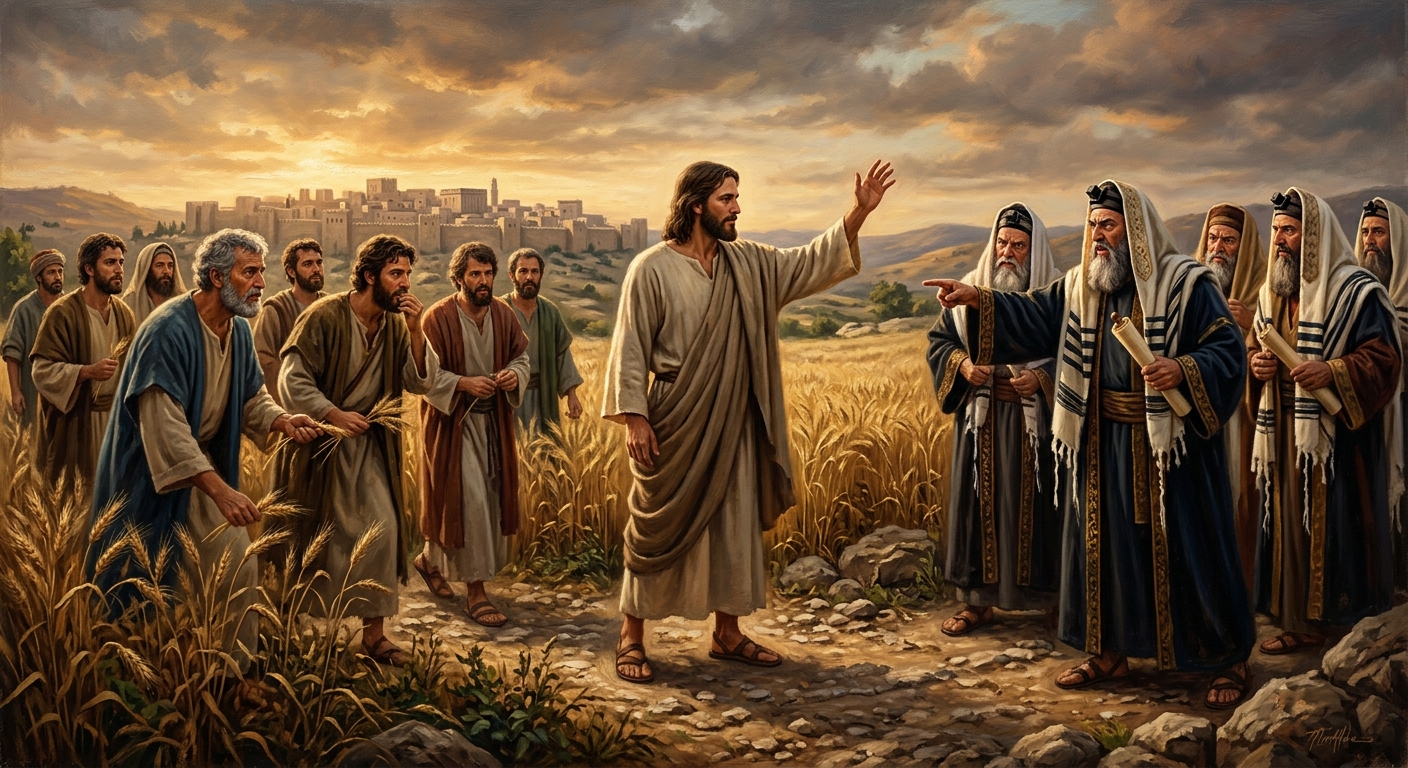
Illustration: Dramatic cinematic biblical illustration for Matthew Chapter 12 showing Lordship of Christ over Sabbath, photorealistic oil painting style.
🔊
Listen to Chapter
Grace Notes Journey Audio Narration
Author
Matthew the Apostle
Written
~60-70 AD
Key Theme
Lordship of Christ over Sabbath
Setting
Galilean fields on Sabbath
Key Verse
Matthew 12:8
Total Verses
50
Chapter Introduction
*In this tender scene, we find our Savior walking through the grainfields on a Sabbath day, his heart attuned to the hunger of those He loves. When the Pharisees question His disciples, Jesus gently reminds them—and us—of the deeper purpose behind God's law: mercy and compassion. He points to David, a man after God’s own heart, who sought sustenance in the house of worship. Through these words, we see that true Sabbath-keeping is not about strict rules, but about aligning our hearts with the Lord who is "Lord of the Sabbath."*
Matthew — Chapter 12 — KJV
1
At that time Jesus went on the sabbath day through the corn; and his disciples were an hungred, and began to pluck the ears of corn, and to eat.
Simply PutJesus and His hungry disciples walked through the grain fields on the Sabbath. The Greek word “sabbath” (G1510) denotes a day of rest, but here the disciples were driven by real physical need. Their act shows that God’s law is meant to serve us, not starve us.
2
But when the Pharisees saw it, they said unto him, Behold, thy disciples do that which is not lawful to do upon the sabbath day.
Simply PutThe Pharisees watched the disciples and claimed they were breaking Sabbath law. “Lawful” (Greek nomos) carries a weight of strict rule-keeping, but their obsession with the letter missed the spirit. They judged hunger as a crime, forgetting that God made the Sabbath for blessing.
3
But he said unto them, Have ye not read what David did, when he was an hungred, and they that were with him;
Simply PutJesus points to David’s desperate hunger, recalling how he ate the showbread. “Showbread” (Greek prosphora) was reserved for priests, yet David took it when life demanded. It reminds us that human need can rightfully override ritual duty.
4
How he entered into the house of God, and did eat the shewbread, which was not lawful for him to eat, neither for them which were with him, but only for the priests?
Simply PutDavid entered the house of God and ate bread that wasn’t allowed for ordinary men. The word “shewbread” (Greek prosphora) symbolized holy provision, and David’s act shows that mercy trumps ceremonial law. Even the priests needed to bend rules for basic sustenance.
5
Or have ye not read in the law, how that on the sabbath days the priests in the temple profane the sabbath, and are blameless?
Simply PutJesus reminds them that priests themselves “profane” (Greek skandazo) the Sabbath in temple work, yet they’re considered blameless. This highlights that God’s true intent is service and worship, not idle restriction. The law serves the work of the temple, not the people’s lives.
6
But I say unto you, That in this place is one greater than the temple.
Simply PutHe tells them that one is greater than the temple. “Greater” (Greek meizon) emphasizes Jesus’ authority surpassing all religious structures. In real pain, we need to know that the presence of God is more vital than any building.
7
But if ye had known what this meaneth, I will have mercy, and not sacrifice, ye would not have condemned the guiltless.
Simply PutIf they understood “mercy” (Greek eleos), they would have shown compassion instead of ritual sacrifice. The Greek word for mercy underscores genuine love, not mere offerings. In doubt, we must seek God’s heart, not just His rules.
8
For the Son of man is Lord even of the sabbath day.
Simply PutJesus declares that He is “Lord” (Greek kyrios) of the Sabbath. This means He has ultimate authority over how the day is meant to be observed. For those hungry for direction, it assures that He can restore life on the day meant for rest.
9
And when he was departed thence, he went into their synagogue:
Simply PutAfter leaving, Jesus entered a synagogue. “Synagogue” (Greek synagōgē) means a gathering place for worship, showing that He meets people where they gather. It signals that His ministry is not confined to the temple alone.
10
And, behold, there was a man which had his hand withered. And they asked him, saying, Is it lawful to heal on the sabbath days? that they might accuse him.
Simply PutA man with a withered hand was present, and they asked if it was lawful to heal on the Sabbath. “Heal” (Greek therapeuo) reflects restorative power, and their question was a trap to accuse Him. For those feeling broken, this shows that God’s compassion isn’t limited by the calendar.
11
And he said unto them, What man shall there be among you, that shall have one sheep, and if it fall into a pit on the sabbath day, will he not lay hold on it, and lift it out?
Simply PutJesus asked who among them would rescue a sheep that fell into a pit on the Sabbath. “Sheep” (Greek poimni) represents vulnerability, and any caretaker would act without hesitation. He points out that compassion for a sheep is more urgent than strict rule-keeping.
12
How much then is a man better than a sheep? Wherefore it is lawful to do well on the sabbath days.
Simply PutHe says, therefore, a man is worth more than a sheep; it’s lawful to do good on the Sabbath. “Do well” (Greek poieō) is about acts of kindness, not ritual restriction. This tells those in need that love and mercy are always permissible.
13
Then saith he to the man, Stretch forth thine hand. And he stretched it forth; and it was restored whole, like as the other.
Simply PutHe instructed the man to stretch out his hand, and it was restored whole. “Whole” (Greek holos) reflects complete healing, not a partial fix. The power to restore is available even on a day set aside for rest.
14
Then the Pharisees went out, and held a council against him, how they might destroy him.
Simply PutThe Pharisees gathered a council to plot against Him. “Council” (Greek synedrio) shows their organized intent to destroy His ministry. Their fear reveals that they were threatened by a truth greater than their traditions.
15
But when Jesus knew it, he withdrew himself from thence: and great multitudes followed him, and he healed them all;
Simply PutAs Jesus sensed their plans, He withdrew and healed the crowds that followed. “Heal” (Greek therapeuo) reflects the boundless compassion He extends to those who come in faith. Even when enemies conspire, His love continues to restore the broken-hearted.
16
And charged them that they should not make him known:
Simply PutJesus quietly tells His disciples to keep this miracle hidden. The Greek word "charged" (G2699, ethēkō) means to set or appoint a task—He wants them to protect the moment until the right time. For us in pain, it's a reminder that sometimes God works behind the scenes before He makes His work known.
17
That it might be fulfilled which was spoken by Esaias the prophet, saying,
Simply PutThe purpose of keeping it hidden was to fulfill what Isaiah had written. The Greek "fulfilled" (G5295, plenóō) means to fill up completely—God's plan is perfect and unhurried. When doubts arise, we can trust that He is fulfilling His promises, even if we can't see the whole picture yet.
18
Behold my servant, whom I have chosen; my beloved, in whom my soul is well pleased: I will put my spirit upon him, and he shall shew judgment to the Gentiles.
Simply PutIsaiah speaks of a servant "chosen" (G2699), "beloved," and filled with God's Spirit. The Greek word for "spirit" (G4151, ruach) signifies the breath of life and divine power. To someone longing for guidance, this verse assures that God’s chosen One will bring fresh judgment—a new way of seeing justice for all nations.
19
He shall not strive, nor cry; neither shall any man hear his voice in the streets.
Simply PutHe says the servant "shall not strive, nor cry," and no one will hear his voice in streets. The Greek for "voice" (G4072, phōnē) refers to a public proclamation. In real hunger for God, this suggests that His work may be quiet and unnoticed, yet it is powerful beyond the applause of crowds.
20
A bruised reed shall he not break, and smoking flax shall he not quench, till he send forth judgment unto victory.
Simply PutHe will not break a "bruised reed" nor quench "smoking flax." The Greek "quench" (G2194, smēdō) means to extinguish a flame. For the weary heart, this promises that Jesus will gently care for those who are fragile and dimmed, until He ushers in a victorious judgment.
21
And in his name shall the Gentiles trust.
Simply PutIn His name the Gentiles will trust. The Greek word "trust" (G5215, pistis) is the foundation of faith—a firm reliance on someone. For anyone searching for hope, this shows that across all peoples, the name of Christ becomes a trustworthy anchor.
22
Then was brought unto him one possessed with a devil, blind, and dumb: and he healed him, insomuch that the blind and dumb both spake and saw.
Simply PutA man possessed by a devil—blind and mute—is healed, so he can speak and see. The Greek "possessed" (G225) conveys being under the control of an evil spirit. For those feeling trapped, this verse demonstrates that Jesus can bring total restoration—turning silence into testimony.
23
And all the people were amazed, and said, Is not this the son of David?
Simply PutThe crowd marvels, asking, "Is this not the son of David?" The title "Son of David" (G2315) points to the promised Messiah. In moments of awe, we see that people recognized a divine fulfillment in Jesus' healing power.
24
But when the Pharisees heard it, they said, This fellow doth not cast out devils, but by Beelzebub the prince of the devils.
Simply PutThe Pharisees accuse Him of casting out devils by "Beelzebub," the prince of demons. The Greek "Beelzebul" (Bēlezyboul) is a name for the chief of evil spirits. For those facing spiritual attacks, this verse warns against letting jealousy and fear mute the witness of God's work.
25
And Jesus knew their thoughts, and said unto them, Every kingdom divided against itself is brought to desolation; and every city or house divided against itself shall not stand:
Simply PutJesus reads their thoughts, saying a divided kingdom is brought to desolation. The Greek "desolate" (G2295) means a ruined or barren state. In real doubt, we see that division weakens any cause—unity is essential for a thriving spiritual life.
26
And if Satan cast out Satan, he is divided against himself; how shall then his kingdom stand?
Simply PutIf Satan casts out Satan, his kingdom would be divided. The Greek "Satan" (G4692) means the adversary. For someone wrestling with inner conflict, this underscores that every kingdom—especially God's—is sustained by consistent purpose and power.
27
And if I by Beelzebub cast out devils, by whom do your children cast them out? therefore they shall be your judges.
Simply PutHe challenges the Pharisees, asking who casts out devils among their own children. The Greek "children" (G1111) refers to followers or believers. In personal struggle, this verse reminds us that the authenticity of our witness is tested by those closest to us.
28
But if I cast out devils by the Spirit of God, then the kingdom of God is come unto you.
Simply PutIf Jesus casts out devils by the Spirit of God, then God's kingdom has arrived. The Greek "Spirit" (G4151) is the divine presence that empowers. For anyone yearning for change, this declares that with Christ’s power, the kingdom of God is now breaking into our world.
29
Or else how can one enter into a strong man’s house, and spoil his goods, except he first bind the strong man? and then he will spoil his house.
Simply PutHe asks how one can enter a strong man's house without first binding him. The Greek "bind" (G1400) means to restrain or hold fast. In practical terms, this teaches that to overcome a powerful enemy, we must first secure God's authority over him.
30
He that is not with me is against me; and he that gathereth not with me scattereth abroad.
Simply PutHe declares, "He who is not with me is against me." The Greek "gathereth" (G543) means to collect or support. For those in conflict, this sharp truth emphasizes the necessity of choosing a side—either we stand with Christ or we oppose Him.
31
Wherefore I say unto you, All manner of sin and blasphemy shall be forgiven unto men: but the blasphemy against the Holy Ghost shall not be forgiven unto men.
Simply PutThe Greek word for "blasphemy" here, blasphein (G1003), means to speak contemptuously against God. Jesus warns that while any sin can be forgiven, rejecting the Holy Spirit's work in you is a hardening that leads to death. If you're wrestling with doubt, remember it's never too late to let the Spirit speak truth into your heart.
32
And whosoever speaketh a word against the Son of man, it shall be forgiven him: but whosoever speaketh against the Holy Ghost, it shall not be forgiven him, neither in this world, neither in the world to come.
Simply PutThe Greek term "kosmos" (G2889) refers to the world system we live in. Jesus says that speaking against His Son can be forgiven, but rejecting the Holy Spirit—a constant convictor and comforter—leads to a permanent loss. In moments of anguish, know that the Spirit is always ready to draw you nearer if you open your heart.
33
Either make the tree good, and his fruit good; or else make the tree corrupt, and his fruit corrupt: for the tree is known by his fruit.
Simply PutThe Greek words for "tree" (dendron, G1221) and "fruit" (karpos, G1077) illustrate that what we do reveals who we truly are. Jesus teaches that our character is shown by the deeds we produce—good fruit shows a good tree, and vice versa. In daily life, your actions are the true testimony of your faith.
34
O generation of vipers, how can ye, being evil, speak good things? for out of the abundance of the heart the mouth speaketh.
Simply PutThe Greek word "ophis" (G3775) means snake, symbolizing deceit. Jesus calls the Pharisees a "generation of vipers," pointing out that outward righteousness cannot hide an evil heart. Your words flow from what fills your heart, so be honest with yourself about what's truly in there.
35
A good man out of the good treasure of the heart bringeth forth good things: and an evil man out of the evil treasure bringeth forth evil things.
Simply PutThe Greek term "thesauros" (G2365) signifies treasure. Jesus says a good person produces good deeds because his heart holds good treasure, and an evil person produces bad deeds because his heart is full of wickedness. The condition of your heart determines the quality of what you bring forth.
36
But I say unto you, That every idle word that men shall speak, they shall give account thereof in the day of judgment.
Simply PutThe Greek word "kenos" (G2827) means empty or idle. Jesus warns that even casual words are accounted for on the day of judgment. So think before you speak—your speech can bless or harm, and God will care about the weight of each word.
37
For by thy words thou shalt be justified, and by thy words thou shalt be condemned.
Simply PutThe Greek term "dikaiosynē" (G1343) means righteousness. By what we say, we will be justified or condemned. Let the Spirit guide your speech so it reflects God's truth.
38
Then certain of the scribes and of the Pharisees answered, saying, Master, we would see a sign from thee.
Simply PutThe Greek word "sēma" (G4591) means sign or miracle. The scribes asked for a sign, but Jesus points out that they need a deeper sign—a heart transformation. If you're seeking assurance, look beyond miracles to the living work of God's Spirit.
39
But he answered and said unto them, An evil and adulterous generation seeketh after a sign; and there shall no sign be given to it, but the sign of the prophet Jonas:
Simply PutThe Greek word "genea" (G1071) means generation. Jesus says the people of His day are like an adulterous generation that wants signs, but He will give them only the sign of Jonah. This points to His death and resurrection as the ultimate proof.
40
For as Jonas was three days and three nights in the whale’s belly; so shall the Son of man be three days and three nights in the heart of the earth.
Simply PutThe Greek terms "hēmera" (G2253) and "noxos" (G3565) refer to days. Jesus compares His three days in the tomb to Jonah's time in the great fish, showing that He was truly dead for three days before rising. This gives hope to those who feel hopeless, knowing that God can bring life out of death.
41
The men of Nineveh shall rise in judgment with this generation, and shall condemn it: because they repented at the preaching of Jonas; and, behold, a greater than Jonas is here.
Simply PutThe Greek word "metanoia" (G3310) means repentance—a turning to God. Jesus says the Ninevites will rise and condemn this generation because they responded to Jonah, while a greater one—Jesus—has come. This teaches that God's message must be embraced before it's too late.
42
The queen of the south shall rise up in the judgment with this generation, and shall condemn it: for she came from the uttermost parts of the earth to hear the wisdom of Solomon; and, behold, a greater than Solomon is here.
Simply PutThe Greek word "notios" (G3647) means south. Jesus says the Queen of Sheba, who traveled far for Solomon's wisdom, will rise and condemn this generation because a greater than Solomon—Jesus—is among them. This reminds us that wisdom from God surpasses all worldly knowledge.
43
When the unclean spirit is gone out of a man, he walketh through dry places, seeking rest, and findeth none.
Simply PutThe Greek term "pneuma" (G4151) means spirit. When an unclean spirit leaves a person, it wanders through dry places searching for rest but finds none. This shows that once sin is expelled, we must fill our lives with God's Spirit to avoid spiritual emptiness.
44
Then he saith, I will return into my house from whence I came out; and when he is come, he findeth it empty, swept, and garnished.
Simply PutThe Greek word "kenos" (G2827) again, meaning empty. The spirit returns to its house and finds it swept clean but empty, so it brings along seven worse spirits. This warns that if we leave our hearts empty after repentance, the devil can bring in new temptations.
45
Then goeth he, and taketh with himself seven other spirits more wicked than himself, and they enter in and dwell there: and the last state of that man is worse than the first. Even so shall it be also unto this wicked generation.
Simply PutThe Greek term "pneuma" again. When seven worse spirits fill a man, his condition worsens beyond the first. This shows that spiritual decay can deepen unless we stay filled with God's Spirit.
46
While he yet talked to the people, behold, his mother and his brethren stood without, desiring to speak with him.
Simply PutWhile Jesus was still speaking to the crowd, his mother and brothers stood outside, hoping to talk with him. The Greek word “behold” (G2316) signals a sudden shift of focus, and the longing in “desiring to speak” (G1907) shows how human relationships pull on us. In moments when we feel abandoned by loved ones, this verse reminds us that the call of God often draws us away from comfort and into purpose.
47
Then one said unto him, Behold, thy mother and thy brethren stand without, desiring to speak with thee.
Simply PutSomeone in the crowd pointed out, “Look, your mother and brothers are outside, wanting to talk with you.” The Greek verb for “wanting” (G1907) captures a kind of yearning that many feel when they watch their loved ones struggle. It invites us to pause and see how the demands of everyday life can clash with the urgency of Jesus’ message.
48
But he answered and said unto him that told him, Who is my mother? and who are my brethren?
Simply PutYet Jesus asked, “Who is my mother? Who are my brothers?” The Greek word for “mother” (G3328) is not just a biological term here; it becomes a question about spiritual belonging. For anyone wrestling with loneliness or identity, this challenge asks: Who truly defines us—our flesh-and-blood family or the deeper call to follow Christ?
49
And he stretched forth his hand toward his disciples, and said, Behold my mother and my brethren!
Simply PutHe reached out his hand toward his disciples and declared, “Here are my mother and brothers!” The gesture of stretching out the hand (G5305) signifies inclusion, pointing to those who are gathered around him. It tells the hurting heart that belonging is not about proximity but about being present in the community of believers.
50
For whosoever shall do the will of my Father which is in heaven, the same is my brother, and sister, and mother.
Simply Put“Anyone who does my Father’s will (thelema, G2324) in heaven is my brother, sister, and mother.” The Greek word for “will” (G2324) refers to God’s sovereign purpose, and “do” (poieō, G4160) implies active obedience. In real hunger for God’s favor, this verse assures us that spiritual family is built on shared obedience, not merely blood ties.
When you notice competing motives within yourself—one pulling toward growth and another toward old habits—what does that internal division reveal about the stability of your own life?