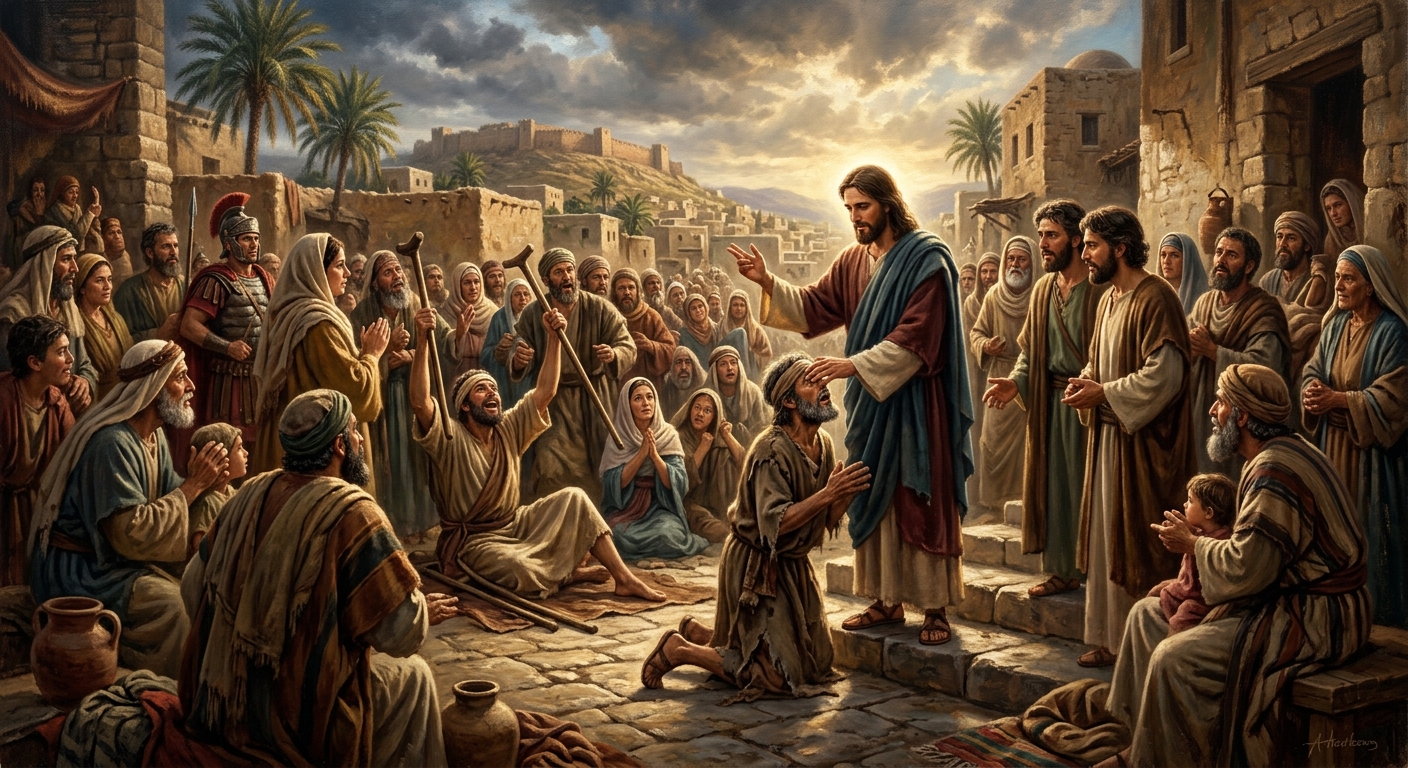
Illustration: Dramatic cinematic biblical illustration for Matthew Chapter 11 showing Christ's identity confirmed by miracles, photorealistic oil painting style.
Author
Matthew the Apostle
Written
~85 AD
Key Theme
Christ's identity confirmed by miracles
Setting
Galilean countryside - post-Sermon
Key Verse
Matthew 11:28
Total Verses
30
Chapter Introduction
*Dear friend, here we find Jesus gently responding to the doubts of John and his disciples. He points them back to the miracles—sight for the blind, walking for the lame—as living proof that He is indeed the promised Messiah. Yet He also extends an invitation to all who are weary, promising a gentle yoke and rest for their souls. This chapter reminds us that the presence of Christ brings both evidence and comfort, inviting every heart to a deeper trust.*
Matthew — Chapter 11 — KJV
1
And it came to pass, when Jesus had made an end of commanding his twelve disciples, he departed thence to teach and to preach in their cities.
Simply PutAfter finishing the instruction of his twelve, Jesus didn't stay put—He went out on His own to teach and preach in the towns. The Greek word "didasko" (G1321) means to teach, to show a way. For someone in real pain, this shows that God doesn't just send others; He Himself comes to meet us where we are.
2
Now when John had heard in the prison the works of Christ, he sent two of his disciples,
Simply PutJohn, locked in prison, heard that the Messiah was doing mighty deeds. The Greek word "ergon" (G2044) means work or deed, especially a divine work. His sending of two disciples is like a friend whispering, "I think I’ve found the one we were waiting for—check it out."
3
And said unto him, Art thou he that should come, or do we look for another?
Simply PutJohn asks, "Are you the One we have been waiting for?" The Greek phrase "ho erchomenos" (G442) refers to the promised Coming One. For a doubting heart, this is that honest seeker who seeks confirmation before proclaiming.
4
Jesus answered and said unto them, Go and shew John again those things which ye do hear and see:
Simply PutJesus tells them to show John the miracles they are hearing about. The Greek word "deiknumi" (G1175) means to point out or demonstrate. This is like saying, "Come see with your own eyes; the evidence will speak louder than any rumor."
5
The blind receive their sight, and the lame walk, the lepers are cleansed, and the deaf hear, the dead are raised up, and the poor have the gospel preached to them.
Simply PutThe blind see, the lame walk, lepers are healed, the deaf hear, the dead rise, and the poor receive the gospel. Each miracle is a sign that God's kingdom has arrived—He cares for those who are broken and brings life to the dead parts of our hearts.
6
And blessed is he, whosoever shall not be offended in me.
Simply Put"Blessed is he who does not stumble over me." The Greek word "makarios" (G310) means truly happy or fortunate. It reminds those in doubt that lasting joy comes from staying steady on the Rock of Christ, even when life tries to knock us down.
7
And as they departed, Jesus began to say unto the multitudes concerning John, What went ye out into the wilderness to see? A reed shaken with the wind?
Simply PutJesus asks the crowd why they went into the wilderness—were they looking for a reed swayed by wind? The Greek "eremos" (G1650) signifies the barren desert where one expects a solid answer. He’s urging them to seek something firm, not flimsy.
8
But what went ye out for to see? A man clothed in soft raiment? behold, they that wear soft clothing are in kings’ houses.
Simply Put"Did you go looking for a man in soft clothing?" The Greek word "chiton" (G5600) refers to fine robes. Those who wear such garments live in comfort, but John’s life was plain and humble—an invitation to value substance over style.
9
But what went ye out for to see? A prophet? yea, I say unto you, and more than a prophet.
Simply Put"Did you go looking for a prophet? He is more than that." The Greek word "prophetes" (G4245) means a spokesperson for God. John is not just any messenger; he points ahead to the One who would change history.
10
For this is he, of whom it is written, Behold, I send my messenger before thy face, which shall prepare thy way before thee.
Simply Put"He is the messenger spoken of in Scripture." The Greek "angelos" (G32) means an angel or messenger. John’s role is to clear the road, announcing that the promised kingdom is about to break through.
11
Verily I say unto you, Among them that are born of women there hath not risen a greater than John the Baptist: notwithstanding he that is least in the kingdom of heaven is greater than he.
Simply Put"No one born of women has risen greater than John, yet the smallest in the kingdom is greater." The Greek "basileia" (G932) means a heavenly reign. This teaches that the kingdom operates on divine values, not earthly status—humility is the key to greatness.
12
And from the days of John the Baptist until now the kingdom of heaven suffereth violence, and the violent take it by force.
Simply Put"Since John’s days, the kingdom of heaven has been forcefully taken." The Greek "biazetai" (G966) suggests a violent, aggressive taking. It means those who are eager and determined press into God's kingdom; it’s a call to spiritual urgency.
13
For all the prophets and the law prophesied until John.
Simply Put"All the prophets and the law spoke until John." The Greek word "nomos" (G3559) means law. This shows that the Old Testament was a preparation for the arrival of John and, ultimately, Christ.
14
And if ye will receive it, this is Elias, which was for to come.
Simply Put"If you accept it, this is Elijah who was to come." The Greek "luteo" (G3158) means to receive or grasp. It speaks to those waiting for the return of Elijah, showing that John fulfills that expectation.
15
He that hath ears to hear, let him hear.
Simply Put"He who has ears to hear—listen." The Greek word "ousia" (G4170) points to the inner ear of spiritual perception. It’s an invitation to open our hearts and truly understand the truth presented to us.
16
But whereunto shall I liken this generation? It is like unto children sitting in the markets, and calling unto their fellows,
Simply PutChrist compares this generation—meaning the whole group of people at the time—to kids in the marketplace (genea, G1075). He says they're like children who shout to friends: “We played music for you, but you didn’t dance; we mourned, but you didn’t lament.” It captures how the people were indifferent to both John’s austere preaching and Jesus’ joyful ministry.
17
And saying, We have piped unto you, and ye have not danced; we have mourned unto you, and ye have not lamented.
Simply PutThe Greek word for “piped” (exegē, G1845) refers to playing an instrument or making a sound. Jesus points out that the crowd never responded—no dancing when they heard music, no lamenting when they heard mourning. It shows the stubbornness of those who missed the heart behind both messages.
18
For John came neither eating nor drinking, and they say, He hath a devil.
Simply PutSome accused John (the Baptist) of being driven by a demon (daimonion, G1407), saying he ate and drank nothing. They misread his ascetic lifestyle as something demonic, not recognizing the purpose of his preparation for Christ.
19
The Son of man came eating and drinking, and they say, Behold a man gluttonous, and a winebibber, a friend of publicans and sinners. But wisdom is justified of her children.
Simply PutThe crowd labeled Jesus a “glutton” and “winebibber,” criticizing his eating and drinking with sinners. Yet Jesus reminds us that true wisdom (sophia, G4676) stands proven by the outcomes of its children—John’s austerity and Jesus’ fellowship both point to God’s plan.
20
Then began he to upbraid the cities wherein most of his mighty works were done, because they repented not:
Simply PutJesus begins to rebuke (berchomai, G1015) the cities where his miracles happened because they didn’t repent. The failure to turn (metanoeo, G3329) after seeing God’s power brought judgment upon them.
21
Woe unto thee, Chorazin! woe unto thee, Bethsaida! for if the mighty works, which were done in you, had been done in Tyre and Sidon, they would have repented long ago in sackcloth and ashes.
Simply PutHe pronounces woe (Greek word for lament) on Chorazin and Bethsaida. If the miracles performed there had happened in Tyre and Sidon, those Gentile cities would have humbled themselves in sackcloth and ashes—a sign of true repentance.
22
But I say unto you, It shall be more tolerable for Tyre and Sidon at the day of judgment, than for you.
Simply PutJesus says Tyre and Sidon will face a lighter judgment than these Jewish cities. Their lesser response to greater miracles made them more tolerable on the day of judgment.
23
And thou, Capernaum, which art exalted unto heaven, shalt be brought down to hell: for if the mighty works, which have been done in thee, had been done in Sodom, it would have remained until this day.
Simply PutCapernaum, once lifted (hypsō, G552) to heavenly heights, will be cast down to hell. If Sodom had received the same miracles, it would have persisted until today—a warning of unrepentant pride.
24
But I say unto you, That it shall be more tolerable for the land of Sodom in the day of judgment, than for thee.
Simply PutSodom’s fate will be more tolerable than Capernaum’s on judgment day. The message is clear: greater exposure to God’s work demands a deeper response.
25
At that time Jesus answered and said, I thank thee, O Father, Lord of heaven and earth, because thou hast hid these things from the wise and prudent, and hast revealed them unto babes.
Simply PutJesus thanks the Father for hiding truths (kraino, G2775) from the wise and revealing them to babes. It reminds us that divine mysteries often become clear through simple, childlike faith rather than intellectual pride.
26
Even so, Father: for so it seemed good in thy sight.
Simply PutHe affirms that the Father’s plan (kathekon, G2596) is good in His sight. When God moves forward, He does it for the right reasons—His wisdom guides every step.
27
All things are delivered unto me of my Father: and no man knoweth the Son, but the Father; neither knoweth any man the Father, save the Son, and he to whomsoever the Son will reveal him.
Simply PutAll authority is given to Jesus from the Father (paradidōmi, G3950). No one truly knows the Son except the Father, and only those to whom the Son reveals Him can know the Father. It underscores the unique relationship between the Father and the Son.
28
Come unto me, all ye that labour and are heavy laden, and I will give you rest.
Simply PutJesus invites all who labor (barus, G903) and carry heavy burdens to come to Him for rest. He offers a sanctuary where the weight of life can be set down and peace found.
29
Take my yoke upon you, and learn of me; for I am meek and lowly in heart: and ye shall find rest unto your souls.
Simply PutHe urges us to take His yoke (zōnē, G2215) and learn from Him. With a meek and lowly heart (praus, G4240), He promises that our souls will discover true rest.
30
For my yoke is easy, and my burden is light.
Simply PutThe yoke of Christ is easy, and the burden He gives (baros, G902) is light. In Him, life's demands become manageable, and we can walk with confidence toward the promised rest.
When you hear God's call amid today’s daily noise and distractions, how do you respond—by staying in the crowd or stepping forward on your own?
✦ Cross-References
Isaiah 40:3This prophecy of a voice crying in the wilderness directly illuminates John the Baptist’s role as the forerunner referenced in Matthew 11:3‑8.
Luke 7:22Jesus’ reply to John’s disciples about the works He is doing mirrors His answer in Matthew 11:4‑5, confirming the same miraculous signs.
John 1:19‑23The questioning of John about whether he is the Christ parallels Matthew 11:3, highlighting the continuity of John's testimony across the Gospels.
Mark 2:5The healing of a lame man by Jesus exemplifies the miracles listed in Matthew 11:5, underscoring His authority over physical infirmities.