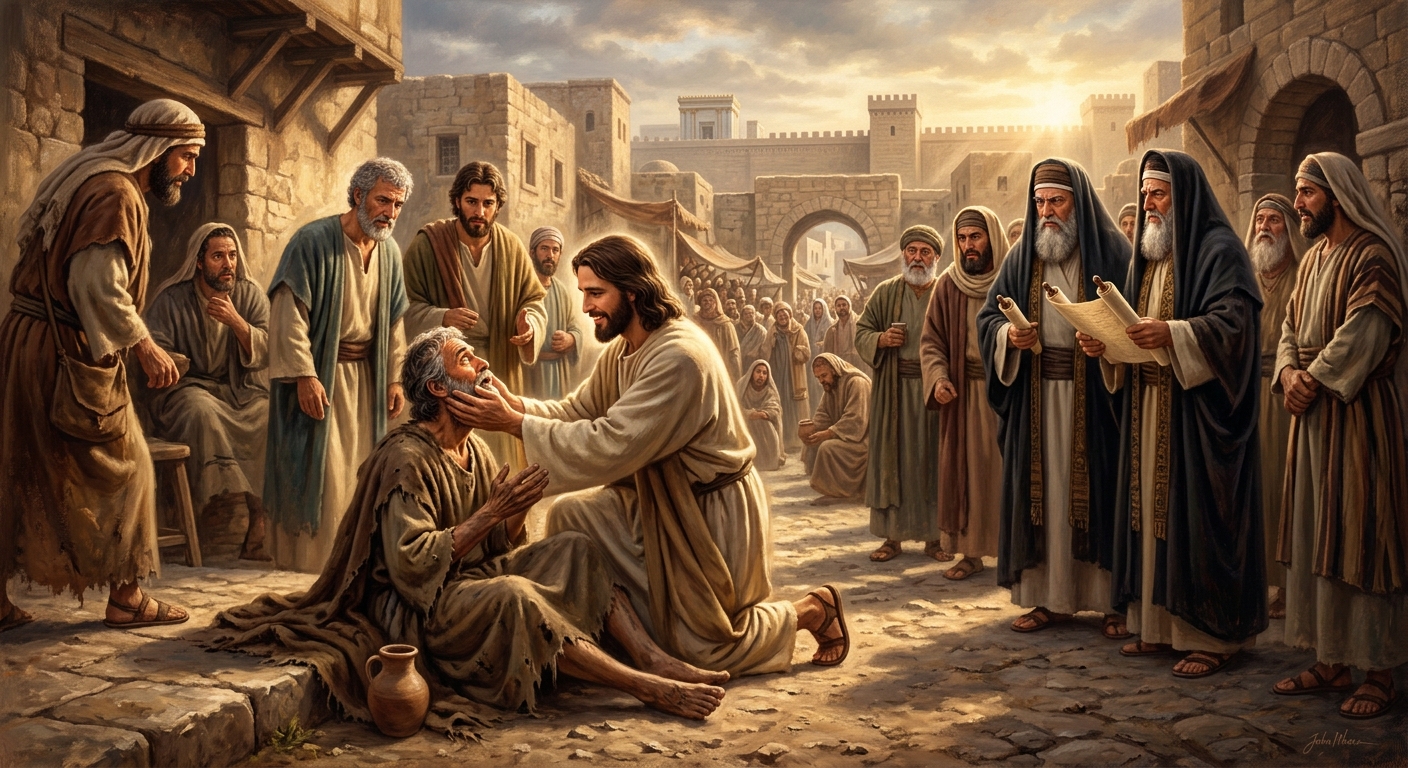
Illustration: Dramatic cinematic biblical illustration for John Chapter 9 showing Spiritual sight through Christ's work, photorealistic oil painting style.
🔊
Listen to Chapter
Grace Notes Journey Audio Narration
Author
John the Apostle
Written
~90-95 AD
Key Theme
Spiritual sight through Christ's work
Setting
Jerusalem - day of healing
Key Verse
John 9:5
Total Verses
41
Chapter Introduction
*As Jesus walked through the bustling streets of Jerusalem, He saw a man blind from birth and offered more than physical sight; He opened the man's eyes to the Light of the world. The miracle is a tender reminder that our true vision comes from faith in Christ, not from the laws of men. Let this story encourage us to trust that God's works are always at work, even in the darkness of our lives. May we walk forward as bearers of that Light, sharing it with those still in need.*
John — Chapter 9 — KJV
1
And as Jesus passed by, he saw a man which was blind from his birth.
Simply PutJesus notices a man blind from birth, using the Greek word typhlos (G5215) for "blind." This reminds anyone in deep pain that God sees us even when we feel invisible, and He cares about our most personal wounds.
2
And his disciples asked him, saying, Master, who did sin, this man, or his parents, that he was born blind?
Simply PutThe disciples ask if the man's blindness is a punishment for sin, using the Greek term hamartia (G26) meaning "to miss the mark." Their doubt reflects a common question: do our hardships mean we've failed God? Jesus offers a different perspective.
3
Jesus answered, Neither hath this man sinned, nor his parents: but that the works of God should be made manifest in him.
Simply PutJesus says neither the man nor his parents sinned; rather, this is so that God's works (erga, G2045) may be displayed. This tells those hungry for purpose that suffering can become a stage where God's power shines.
4
I must work the works of him that sent me, while it is day: the night cometh, when no man can work.
Simply PutJesus declares He must work (ergazomai, G2045) while it's day; night comes when no one can work. The urgency of this statement reminds us that there is a time for action and a time to rest, urging us not to delay God's work.
5
As long as I am in the world, I am the light of the world.
Simply PutJesus proclaims He is the light of the world, using the Greek word phos (G5457). For anyone seeking guidance, this is a promise that He Himself provides illumination and truth in every darkness.
6
When he had thus spoken, he spat on the ground, and made clay of the spittle, and he anointed the eyes of the blind man with the clay,
Simply PutJesus uses spit (ptyssō, G5595) to make clay (pēlon, G4070) and anoints the man's eyes with it (chrio, G5547). This humble method shows that God's healing can work through simple, authentic gestures.
7
And said unto him, Go, wash in the pool of Siloam, (which is by interpretation, Sent.) He went his way therefore, and washed, and came seeing.
Simply PutJesus commands the man to wash (nipto, G3542) in the pool of Siloam, meaning "Sent." The man's obedience brings him sight, demonstrating that faith involves taking steps even when the path is uncertain.
8
The neighbours therefore, and they which before had seen him that he was blind, said, Is not this he that sat and begged?
Simply PutThe neighbors, seeing the man now sighted, question if it's the same beggar. Their skepticism reflects how people often doubt when change appears.
9
Some said, This is he: others said, He is like him: but he said, I am he.
Simply PutSome say "This is he," others say "He looks like him." The man insists, "I am he," underscoring a new personal identity forged by God's touch.
10
Therefore said they unto him, How were thine eyes opened?
Simply PutThe neighbors ask, "How were your eyes opened?" The Greek word eino (G1480) means to unlock. Their curiosity points to a deeper desire for the source of transformation.
11
He answered and said, A man that is called Jesus made clay, and anointed mine eyes, and said unto me, Go to the pool of Siloam, and wash: and I went and washed, and I received sight.
Simply PutHe testifies that a man named Jesus (G2424) made clay, told him to wash, and gave him sight. This personal witness shows that encountering Jesus leads to both physical and spiritual seeing.
12
Then said they unto him, Where is he? He said, I know not.
Simply PutThey ask, "Where is He?" He replies, "I don't know." His lack of knowledge about Jesus' location emphasizes that the miracle's significance lies in what has been received.
13
They brought to the Pharisees him that aforetime was blind.
Simply PutThey bring the healed man to the Pharisees, representatives of religious authority. This sets up a clash between spiritual transformation and legalistic scrutiny.
14
And it was the sabbath day when Jesus made the clay, and opened his eyes.
Simply PutThe Sabbath was underway when Jesus made the clay and opened his eyes. Healing on a day of rest shows that God's compassion can transcend human rules.
15
Then again the Pharisees also asked him how he had received his sight. He said unto them, He put clay upon mine eyes, and I washed, and do see.
Simply PutThe man explains again to the Pharisees how he received sight. His simple testimony—clay, wash, and see—reveals that God's grace can be plainly witnessed, even by those who doubt.
16
Therefore said some of the Pharisees, This man is not of God, because he keepeth not the sabbath day. Others said, How can a man that is a sinner do such miracles? And there was a division among them.
Simply PutSome Pharisees argued that because the man didn't observe the Sabbath day (sabbaton G4428), he couldn't be from God (Theos G2316). Others were baffled, asking how a sinner could perform miracles. Their division shows that they were missing the point—true worship is about heart, not legalism.
17
They say unto the blind man again, What sayest thou of him, that he hath opened thine eyes? He said, He is a prophet.
Simply PutWhen they asked the blind man again, he replied that his healer is a prophet (prophētēs G4445). To him, the one who opened his eyes must be someone who speaks God's truth and power.
18
But the Jews did not believe concerning him, that he had been blind, and received his sight, until they called the parents of him that had received his sight.
Simply PutThe Jews refused to believe the miracle until they called the man's parents, demanding a human witness to confirm what the Spirit had done.
19
And they asked them, saying, Is this your son, who ye say was born blind? how then doth he now see?
Simply PutThey asked the parents, "Is this your son who was born blind? How does he now see?" Their confusion reveals how the miracle challenged their understanding of God's work.
20
His parents answered them and said, We know that this is our son, and that he was born blind:
Simply PutThe parents affirmed, "We know this is our son and that he was born blind." Their simple testimony points to the reality of what God has accomplished.
21
But by what means he now seeth, we know not; or who hath opened his eyes, we know not: he is of age; ask him: he shall speak for himself.
Simply PutYet they said, "We don't know how he now sees or who opened his eyes; he's old enough—ask him, and he'll speak for himself." They recognized the man could now testify to his own experience.
22
These words spake his parents, because they feared the Jews: for the Jews had agreed already, that if any man did confess that he was Christ, he should be put out of the synagogue.
Simply PutThe parents spoke this way because they feared the Jews, who had already agreed that anyone confessing he was Christ would be expelled from the synagogue. Their fear shows how the religious leaders were quick to suppress true revelation.
23
Therefore said his parents, He is of age; ask him.
Simply PutSo they said, "He's of age; ask him." They urged the authorities to hear directly from the man who had been healed.
24
Then again called they the man that was blind, and said unto him, Give God the praise: we know that this man is a sinner.
Simply PutThe Jews called the blind man again, urging him to give God praise and accusing him of being a sinner. Their suspicion highlights their unwillingness to accept a divine act.
25
He answered and said, Whether he be a sinner or no, I know not: one thing I know, that, whereas I was blind, now I see.
Simply PutHe replied, "Whether he is a sinner or not, I don't know; one thing I do know: when I was blind, now I see." His focus is on the transformation itself, not on judging the healer.
26
Then said they to him again, What did he to thee? how opened he thine eyes?
Simply PutThey pressed again, "What did he do for you? How opened his eyes?" Their insistence shows their desire to find a legal explanation rather than embracing the miracle.
27
He answered them, I have told you already, and ye did not hear: wherefore would ye hear it again? will ye also be his disciples?
Simply PutHe answered, "I've told you already and you didn't hear; why would you want to hear again? Will you also be his disciples?" He's inviting them to follow the one who gave him sight, not just to interrogate.
28
Then they reviled him, and said, Thou art his disciple; but we are Moses’ disciples.
Simply PutThey reviled him, saying, "You're his disciple; but we are disciples of Moses." Their claim to tradition blinds them to the new work God is doing.
29
We know that God spake unto Moses: as for this fellow, we know not from whence he is.
Simply Put"We know God spoke to Moses, but we don't know where this fellow comes from," they claimed. Their focus on the past prevents them from seeing God's present work.
30
The man answered and said unto them, Why herein is a marvellous thing, that ye know not from whence he is, and yet he hath opened mine eyes.
Simply PutThe man replied, "Why is it marvelous that you don't know where he comes from, yet he has opened my eyes?" He points out the true wonder is that God can work through anyone, regardless of origin.
31
Now we know that God heareth not sinners: but if any man be a worshipper of God, and doeth his will, him he heareth.
Simply PutGod does not answer the noise of sinful hearts (the Greek word here, hamartō [G2580], means "to miss the mark"). But when someone truly worships Him—when they seek to do God's will—their prayer reaches the heavens.
32
Since the world began was it not heard that any man opened the eyes of one that was born blind.
Simply PutFrom the dawn of time, no one has recorded a miracle like this (the Greek word κόσμος [G2889] means "world"). No human ear has heard of anyone opening the eyes of a man born blind—this is God's work, not man's.
33
If this man were not of God, he could do nothing.
Simply PutIf this man were not sent by God (the Greek phrase ἐξ οὗ means "from whom"), he would have had no power at all. Only the One who comes from God can perform such wonders.
34
They answered and said unto him, Thou wast altogether born in sins, and dost thou teach us? And they cast him out.
Simply PutThey accused him of being born in sin (the Greek word ἁμαρτία [G31] means "sin" or "missing the mark") and tried to cast him out (the Greek verb ἐξέβαλεν [G1855] means "to drive away"). Their rejection showed they were unwilling to hear the truth.
35
Jesus heard that they had cast him out; and when he had found him, he said unto him, Dost thou believe on the Son of God?
Simply PutJesus asked, "Do you believe in the Son of God?" (the Greek word πιστεύω [G4102] means "to trust or place one's faith"). It was a question of heart, not just intellect.
36
He answered and said, Who is he, Lord, that I might believe on him?
Simply PutHe replied, "Who is He?" (the Greek word κύριος [G2962] means "Lord" or "master")—seeking to know the identity of the One who could heal him.
37
And Jesus said unto him, Thou hast both seen him, and it is he that talketh with thee.
Simply PutJesus said, "He is the one you have seen and who is speaking to you." (the Greek word λαλῇ [G2980] means "to speak" or "talk"). The miracle was right before his eyes, and the voice came from the same source.
38
And he said, Lord, I believe. And he worshipped him.
Simply PutHe cried out, "Lord, I believe," and worshipped Him (the Greek verb προσκυνέω [G4335] means "to bow down or worship"). His gratitude turned into heartfelt devotion.
39
And Jesus said, For judgment I am come into this world, that they which see not might see; and that they which see might be made blind.
Simply PutJesus explained, "I came for judgment (Greek κρίσις [G2829]), so that those who can't see might gain sight, and those who can see will be blinded." He was showing that spiritual blindness is still worse than physical.
40
And some of the Pharisees which were with him heard these words, and said unto him, Are we blind also?
Simply PutSome of the Pharisees asked, "Are we also blind?" (the Greek word τυφλός [G5135] means "blind"). Their question revealed that they were missing the spiritual truth.
41
Jesus said unto them, If ye were blind, ye should have no sin: but now ye say, We see; therefore your sin remaineth.
Simply PutJesus replied, "If you were truly blind, you would have no sin. But now you say, 'We see,' and your sin remains." (the Greek word ἁμαρτία [G31] again emphasizes missed divine marks.) Their claim of sight only kept them in error.