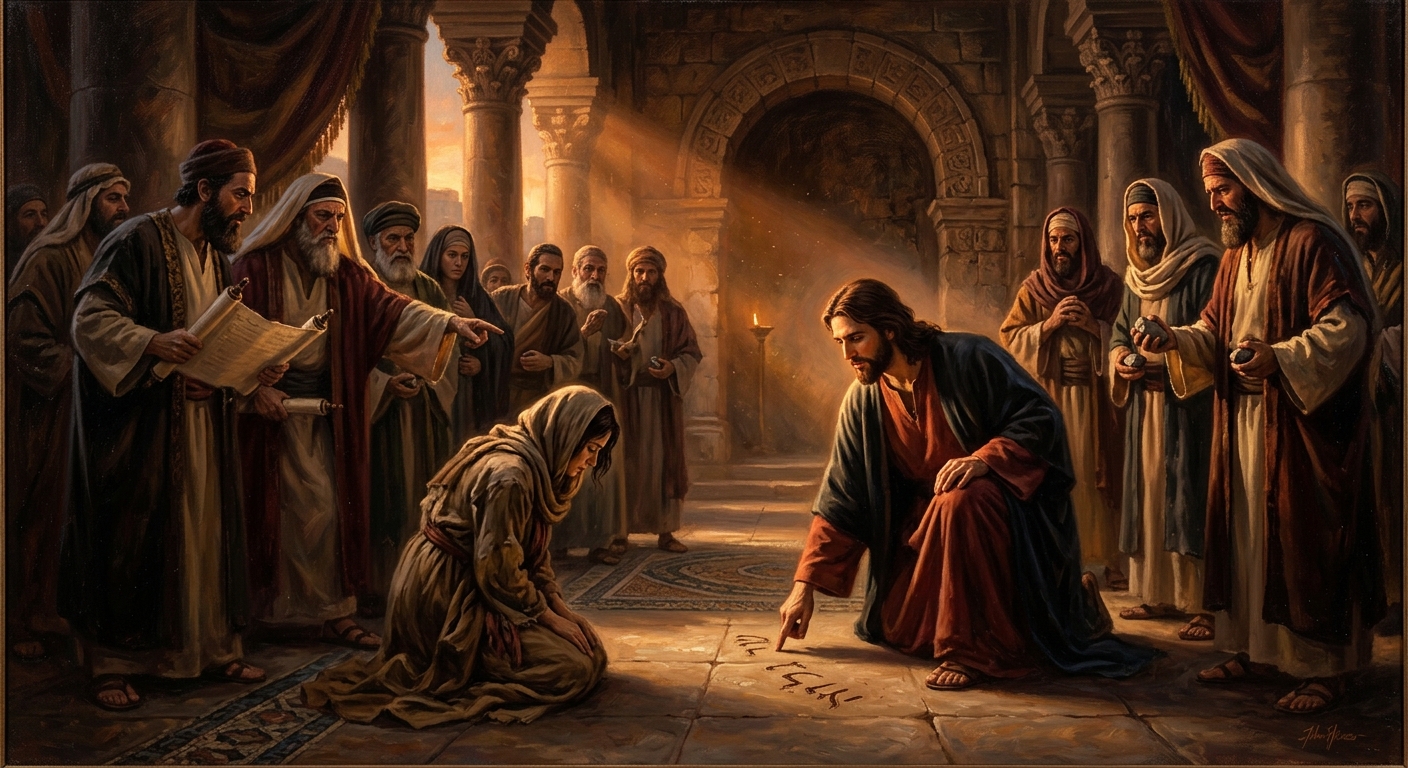
Illustration: Dramatic cinematic biblical illustration for John Chapter 8 showing Grace and Truth in the Law, photorealistic oil painting style.
🔊
Listen to Chapter
Grace Notes Journey Audio Narration
Author
John the Apostle
Written
~90-95 AD
Key Theme
Grace and Truth in the Law
Setting
Jerusalem Temple, early morning
Key Verse
John 8:12
Total Verses
59
Chapter Introduction
_In the quiet hush of morning, Jesus meets us on the Mount of Olives and in the temple courtyard, where He offers the most tender mercy. The woman caught in adultery stands before Him, and His response—“Let him who is without sin cast the first stone”—reminds us that forgiveness is rooted in grace, not judgment. As He declares Himself the Light of the World, He invites us to step out of darkness and into His radiant love. May this encounter awaken your heart to the boundless grace that covers every sin._
John — Chapter 8 — KJV
1
Jesus went unto the mount of Olives.
Simply PutJesus went up to the Mount of Olives, a place of prayer and quiet in Jerusalem. The Greek word for mount (oro, G3680) speaks of a raised place where one can be close to God. Even in the rush of daily life, we can find moments on a "mount"—a hill or quiet spot—to hear God's still voice.
2
And early in the morning he came again into the temple, and all the people came unto him; and he sat down, and taught them.
Simply PutEarly in the morning He entered the temple, the house of worship (naos, G3495). People gathered around Him because He taught with authority. This reminds us that God's truth is most alive at dawn, a fresh start when we seek Him before the day's noise.
3
And the scribes and Pharisees brought unto him a woman taken in adultery; and when they had set her in the midst,
Simply PutThe scribes (scriba, G5635) and Pharisees (pharisaios, G5455) brought a woman caught in adultery (porneia, G4221). They placed her at the center of a courtroom drama, hoping to trap Jesus. In our lives, we often bring our broken pieces before God, not to catch Him in a trap, but to see His mercy on display.
4
They say unto him, Master, this woman was taken in adultery, in the very act.
Simply PutThey addressed Jesus as "Teacher" (didaskalos, G1328), calling Him Master. This title points to His role as the ultimate guide for living rightly. When we feel lost, we can turn to Him as our Teacher, trusting He knows the path from start to finish.
5
Now Moses in the law commanded us, that such should be stoned: but what sayest thou?
Simply PutThey cited Moses' law (nomos, G3559) that commanded stoning for adultery (lithizo, G3044). Yet they asked, "What do You say?" Here lies the tension between ancient law and Jesus' new covenant. For those burdened by guilt, this verse reminds us that God's grace can transform strict judgment into loving forgiveness.
6
This they said, tempting him, that they might have to accuse him. But Jesus stooped down, and with his finger wrote on the ground, as though he heard them not.
Simply PutJesus stooped down (katabaino, G2611) and wrote on the ground, as if He didn't hear them. His quiet action showed that sometimes God writes His answers in the silence of our hearts, not in loud words. When we face accusations, He may be writing the truth in a place we can later see.
7
So when they continued asking him, he lifted up himself, and said unto them, He that is without sin among you, let him first cast a stone at her.
Simply PutHe lifted Himself and said, "He who is without sin among you—let him first cast a stone." The Greek word for sin (hamartia, G2194) means missing the mark. This challenge reveals that no one is perfect; it's a call to self-examination before we judge others.
8
And again he stooped down, and wrote on the ground.
Simply PutOnce more He stooped down and wrote on the ground. His repeated writing suggests that God's truth is deepening, a message not meant for us to see at first glance. In our own trials, we may need to return repeatedly to God's Word to understand His heart.
9
And they which heard it, being convicted by their own conscience, went out one by one, beginning at the eldest, even unto the last: and Jesus was left alone, and the woman standing in the midst.
Simply PutThose who heard it, convicted by their own conscience (phren), left one by one. Their departure, starting with the oldest, shows that self-awareness leads to repentance. When our inner voice convicts us of wrongdoing, we should step away from pride and toward humility.
10
When Jesus had lifted up himself, and saw none but the woman, he said unto her, Woman, where are those thine accusers? hath no man condemned thee?
Simply PutJesus looked up, saw only the woman left, and asked where her accusers were. He revealed that no one had condemned her. This moment shows God's gentle interrogation—He asks us to consider if we've truly been judged or merely accused. For the weary, He offers a place free from false accusations.
11
She said, No man, Lord. And Jesus said unto her, Neither do I condemn thee: go, and sin no more.
Simply PutShe answered "No one," and Jesus said, "Neither do I condemn you; go, and sin no more." The Greek term for condemn (katargizo) implies a harsh judgment. Jesus offers grace instead, urging the woman to live a transformed life. In our own brokenness, He says we are not condemned but invited to continue in a new way.
12
Then spake Jesus again unto them, saying, I am the light of the world: he that followeth me shall not walk in darkness, but shall have the light of life.
Simply PutThen He said, "I am the Light of the world." The Greek word for light (phos, G5450) points to truth and guidance. Those who follow Him will not walk in darkness but will have the light of life (zoe, G2222). When we feel lost in spiritual night, He promises illumination and a full life.
13
The Pharisees therefore said unto him, Thou bearest record of thyself; thy record is not true.
Simply PutThe Pharisees claimed He bears record of Himself, saying His testimony is false. They accused Him of self-approval (marturos, G3114). This reveals that human pride often rejects divine testimony. When we doubt our own worth, God reminds us of His true record.
14
Jesus answered and said unto them, Though I bear record of myself, yet my record is true: for I know whence I came, and whither I go; but ye cannot tell whence I come, and whither I go.
Simply PutJesus replied that even if He bears His own record, it is true because He knows where He came from and where He's going. The Greek verb judge (krino, G2919) signifies discerning truth. He reveals that human knowledge is limited; only God knows the beginning and end.
15
Ye judge after the flesh; I judge no man.
Simply PutHe says, "You judge after the flesh; I judge no man." The Greek word for flesh (sarx, G4562) refers to earthly standards. Jesus shows that divine judgment is about the heart, not outward appearances. For those feeling judged by worldly measures, He offers a higher, merciful perspective.
16
And yet if I judge, my judgment is true: for I am not alone, but I and the Father that sent me.
Simply PutJesus says that if He makes a judgment, it is trustworthy because He does not judge alone—He judges in unity with the Father. The Greek word for “judge,” kriō (G2915), implies a discerning decision made with divine authority, assuring us that His rulings reflect God’s true will.
17
It is also written in your law, that the testimony of two men is true.
Simply PutHe points to the law that says a testimony is credible when confirmed by two witnesses. The Greek term “marturia” (witness) highlights the reliability of a claim when it’s corroborated, reassuring us that God’s truth is never solitary but always backed by divine witnesses.
18
I am one that bear witness of myself, and the Father that sent me beareth witness of me.
Simply PutJesus declares He testifies of Himself, and the Father who sent Him testifies of Him. This double testimony—marturia (G3302)—means that every word Jesus speaks is verified by the Father’s sending power, offering us a solid foundation for faith.
19
Then said they unto him, Where is thy Father? Jesus answered, Ye neither know me, nor my Father: if ye had known me, ye should have known my Father also.
Simply PutHe asks them where their Father is and rebukes them for not knowing Him. If they truly knew Jesus (G1499), they would also know the Father, because “knowing” in Greek involves an intimate relationship that reveals God’s heart.
20
These words spake Jesus in the treasury, as he taught in the temple: and no man laid hands on him; for his hour was not yet come.
Simply PutSpeaking from the temple treasury, Jesus declares that no one has seized Him yet because His appointed time (“hour”) hasn’t arrived. The term “treasury” (thesauros, G2365) signifies the deep spiritual riches He offers, but they must be received at God’s appointed moment.
21
Then said Jesus again unto them, I go my way, and ye shall seek me, and shall die in your sins: whither I go, ye cannot come.
Simply PutJesus warns that those who refuse to follow Him will perish in their sins. The phrase “die in your sins” (apothnēskete) underscores the urgent need to turn away from spiritual death and toward eternal life through Him.
22
Then said the Jews, Will he kill himself? because he saith, Whither I go, ye cannot come.
Simply PutThe Jews mistakenly think He is talking about self-harm when He says “Whither I go, ye cannot come.” Their misunderstanding highlights how worldly perspectives can miss the spiritual significance of His words.
23
And he said unto them, Ye are from beneath; I am from above: ye are of this world; I am not of this world.
Simply PutHe says, “You are from beneath; I am from above.” The word “above” (anōpē, G310) signifies His heavenly origin, reminding us that Jesus stands apart from worldly concerns and offers divine truth.
24
I said therefore unto you, that ye shall die in your sins: for if ye believe not that I am he, ye shall die in your sins.
Simply PutHe says, “If you do not believe that I am [the same] (autos), you will die in your sins.” The word “same” emphasizes His eternal identity as the Son of God, calling us to trust in His divine nature for salvation.
25
Then said they unto him, Who art thou? And Jesus saith unto them, Even the same that I said unto you from the beginning.
Simply PutThey ask who He is, and He replies that He is the same one He has spoken of from the beginning. “The same” (autos) confirms the continuity and reliability of His message throughout Scripture.
26
I have many things to say and to judge of you: but he that sent me is true; and I speak to the world those things which I have heard of him.
Simply PutHe says that although He has many things to say and judge, the One who sent Him is true. The verb “sent” (apostellō, G652) reflects the authority and purpose given to Him by God, ensuring that His teachings are faithful.
27
They understood not that he spake to them of the Father.
Simply PutThey fail to grasp that He is speaking about the Father. Their lack of understanding (G2771) shows how spiritual truths can be missed when hearts are not open.
28
Then said Jesus unto them, When ye have lifted up the Son of man, then shall ye know that I am he, and that I do nothing of myself; but as my Father hath taught me, I speak these things.
Simply PutJesus says that once they lift up the Son of Man, they will know He is the same (autos) and that He does nothing by Himself but speaks what the Father taught Him. “Lifted up” (hēpsō, G2316) foreshadows His crucifixion and exaltation.
29
And he that sent me is with me: the Father hath not left me alone; for I do always those things that please him.
Simply PutHe affirms that the One who sent Him is with Him; the Father has not left Him alone. He does always what pleases Him, showing His perfect obedience and communion with God.
30
As he spake these words, many believed on him.
Simply PutAs He spoke these words, many believed in Him. The response of “believing” (pisteuō, G4102) reflects the heart’s acceptance of His truth and promises.
31
Then said Jesus to those Jews which believed on him, If ye continue in my word, then are ye my disciples indeed;
Simply PutJesus tells those who claim to believe in Him that if they truly stay, or "abide" (Greek: menō, G3004), in His teachings, then they are indeed His followers. It's a call to live out the Word daily, not just wear it as a badge.
32
And ye shall know the truth, and the truth shall make you free.
Simply PutHe says that knowing "the truth" (Greek: alētheia, G2254) isn't just an intellectual fact—it’s a reality that frees us. When we grasp God's real nature, the chains of fear and doubt fall away.
33
They answered him, We be Abraham’s seed, and were never in bondage to any man: how sayest thou, Ye shall be made free?
Simply PutThe Jews boast that they are Abraham's "seed" (Greek: sperma, G3766) and claim they've never been bound. Yet they ask how Jesus can speak of freedom when they see themselves as already free, missing the deeper spiritual bondage.
34
Jesus answered them, Verily, verily, I say unto you, Whosoever committeth sin is the servant of sin.
Simply PutJesus explains that anyone who "commits sin" (Greek: hamartō, G2414) becomes a servant of the very thing that enslaves them. Sin creates a master-servant dynamic that separates us from God.
35
And the servant abideth not in the house for ever: but the Son abideth ever.
Simply PutHe points out that this "servant" (Greek: doulos, G543) doesn't stay forever in the house; only the Son remains eternally. Jesus is contrasting temporary human authority with His own everlasting presence.
36
If the Son therefore shall make you free, ye shall be free indeed.
Simply PutIf the Son—Jesus Himself—grant you freedom, then that freedom is genuine. It's not a promise made by others but the power of Christ Himself releasing you.
37
I know that ye are Abraham’s seed; but ye seek to kill me, because my word hath no place in you.
Simply PutHe sees that they are Abraham's descendants, yet they plot to kill Him because His Word has no place in their hearts. The truth He brings is a threat to their stubbornness.
38
I speak that which I have seen with my Father: and ye do that which ye have seen with your father.
Simply PutJesus says He speaks what He has "seen" (Greek: theō, G1492) with His Father—God. They're acting on what they've "seen" (Greek: theō, G1492) from their own father, not recognizing Jesus' divine vision.
39
They answered and said unto him, Abraham is our father. Jesus saith unto them, If ye were Abraham’s children, ye would do the works of Abraham.
Simply PutThey claim Abraham as their Father, but Jesus says that if they truly were his children, they'd be doing what Abraham did—living in obedience. True lineage is shown by actions, not just blood.
40
But now ye seek to kill me, a man that hath told you the truth, which I have heard of God: this did not Abraham.
Simply PutHe says they are trying to kill a man who tells them the truth, which he heard from God. Abraham never faced such opposition; this is a new conflict over divine truth.
41
Ye do the deeds of your father. Then said they to him, We be not born of fornication; we have one Father, even God.
Simply PutThey argue they aren't born of "fornication" (Greek: porneia, G2541) and that they have one Father—God. Yet their deeds reveal a different, false genealogy.
42
Jesus said unto them, If God were your Father, ye would love me: for I proceeded forth and came from God; neither came I of myself, but he sent me.
Simply PutJesus tells them that if God were truly their Father, they'd love Him. He didn't come on his own; He was sent by the Father (Greek: apostellō, G652). Love is the evidence of true belonging.
43
Why do ye not understand my speech? even because ye cannot hear my word.
Simply PutHe asks why they don't understand His words—to them, it's as if their ears are closed to hearing (Greek: akouō, G158). Their inability to grasp is rooted in a deeper spiritual deafness.
44
Ye are of your father the devil, and the lusts of your father ye will do. He was a murderer from the beginning, and abode not in the truth, because there is no truth in him. When he speaketh a lie, he speaketh of his own: for he is a liar, and the father of it.
Simply PutHe declares they belong to their father, the devil (Greek: diabolos, G1588), and will live out his lusts. The devil lies from the start; there is no truth (Greek: alētheia, G2254) in his words.
45
And because I tell you the truth, ye believe me not.
Simply PutBecause He tells them the truth (Greek: alētheia, G2254), they refuse to believe. Their rejection is a direct response to the reality He offers.
46
Which of you convinceth me of sin? And if I say the truth, why do ye not believe me?
Simply PutJesus is asking, “Who among you can point out my sin?” The Greek word here, kathistemi (G2950), means “to accuse.” He’s saying that if He is telling the truth and yet you still doubt Him, something deeper than a simple mistake is at work.
47
He that is of God heareth God’s words: ye therefore hear them not, because ye are not of God.
Simply Put“Those who belong to God hear His words.” The Greek word for ‘hear’ is akouo (G2399), which carries the idea of paying close attention. Jesus points out that because they aren’t truly from God, they’re missing the message He’s speaking.
48
Then answered the Jews, and said unto him, Say we not well that thou art a Samaritan, and hast a devil?
Simply PutThe Jews reply, “Aren’t we right to call you a Samaritan and say you have a devil?” The Greek word diabolos (G965) means ‘slanderer’ or ‘adversary.’ They’re trying to trap Him by questioning His background and motives.
49
Jesus answered, I have not a devil; but I honour my Father, and ye do dishonour me.
Simply PutJesus answers, “I have no devil; I honor my Father, and you dishonor me.” The Greek word timao (G5092) means ‘to value’ or ‘respect.’ He’s saying that the real problem isn’t a hidden enemy but their attitude toward God.
50
And I seek not mine own glory: there is one that seeketh and judgeth.
Simply Put“I’m not looking for my own glory; it’s the One who seeks and judges.” The Greek word doxa (G2828) means ‘reputation’ or ‘honor.’ Jesus emphasizes that true worth comes from God’s judgment, not self-promotion.
51
Verily, verily, I say unto you, If a man keep my saying, he shall never see death.
Simply Put“Truly, truly, I tell you—if anyone holds to my word, they will never see death.” The Greek word phrenoo (G3825) means ‘to keep’ or ‘retain.’ He’s promising that those who cling to His teachings will have everlasting life.
52
Then said the Jews unto him, Now we know that thou hast a devil. Abraham is dead, and the prophets; and thou sayest, If a man keep my saying, he shall never taste of death.
Simply PutThe Jews say, “Now we know you have a devil! Abraham and the prophets are dead; yet you claim that those who keep your word will never taste death.” The Greek word geuma (G5145) means ‘taste’ or ‘experience.’ They’re challenging Him by pointing out that the old promises seemed impossible.
53
Art thou greater than our father Abraham, which is dead? and the prophets are dead: whom makest thou thyself?
Simply Put“Are you greater than our father Abraham, who is dead? The prophets are also dead—who do you make yourself?” The Greek word megas (G2358) means ‘great’ or ‘mighty.’ They’re questioning Jesus’s claim to superiority and eternity.
54
Jesus answered, If I honour myself, my honour is nothing: it is my Father that honoureth me; of whom ye say, that he is your God:
Simply Put“If I honor myself, my honor means nothing. It is my Father who honors me.” The Greek word timao (G5092) appears again, showing that true honor comes from God’s recognition, not self-praise.
55
Yet ye have not known him; but I know him: and if I should say, I know him not, I shall be a liar like unto you: but I know him, and keep his saying.
Simply Put“You don’t know Him; but I do. If I said I didn’t know Him, I’d be a liar like you.” The Greek word ginōskō (G1492) means ‘to know intimately.’ Jesus asserts that He has a genuine, personal knowledge of God.
56
Your father Abraham rejoiced to see my day: and he saw it, and was glad.
Simply Put“Your father Abraham rejoiced to see my day; he saw it and was glad.” The Greek word euphēzomai (G5312) means ‘to rejoice.’ Abraham’s anticipation shows that God’s plan has always been moving forward.
57
Then said the Jews unto him, Thou art not yet fifty years old, and hast thou seen Abraham?
Simply Put“You’re not even fifty yet—have you seen Abraham?” The Greek word pentacont (G5124) means ‘fifty.’ They’re skeptical, thinking Jesus is too young to have witnessed the patriarch.
58
Jesus said unto them, Verily, verily, I say unto you, Before Abraham was, I am.
Simply Put“Truly, truly, I say—before Abraham was, I am.” The Greek word eimi (G1510) means ‘I am,’ pointing to an eternal existence. Jesus is declaring His divine nature that stretches beyond time.
59
Then took they up stones to cast at him: but Jesus hid himself, and went out of the temple, going through the midst of them, and so passed by.
Simply Put“They picked up stones to throw at Him, but Jesus withdrew and walked through the temple crowd.” The Greek word katalyō (G5369) means ‘to conceal’ or ‘hide.’ He calmly steps away from the threat, continuing His mission.
John 7:14This verse parallels John 8:2 by showing Jesus teaching in the temple early in the morning, highlighting his consistent ministry there.
Exodus 20:14The commandment “Thou shalt not commit adultery” provides the legal basis for the scribes’ question in John 8:5 about stoning a woman caught in adultery.
Romans 3:23Paul’s declaration that “all have sinned” illuminates Jesus’ challenge in John 8:7, emphasizing the universal need for humility before judgment.
Jeremiah 31:33The prophecy that God will write His law upon hearts connects to Jesus’ act of writing on the ground in John 8:6–8, symbolizing internalized divine instruction.
Reflect
When someone offers you words of unexpected grace, how does that invitation to believe reshape your view of yourself and the choices you can make?