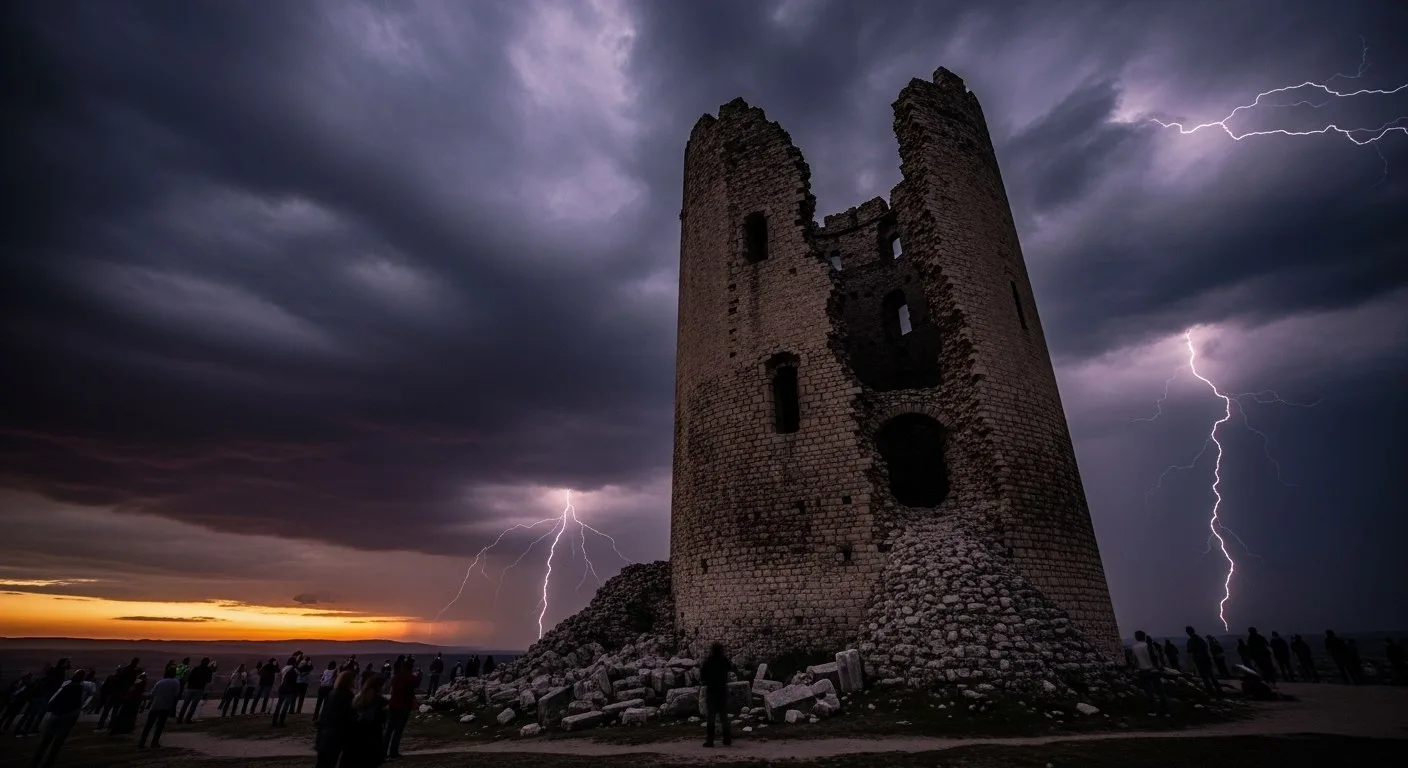
The Weight of Human Ambition

Imagine that gnawing feeling when you've poured every ounce of yourself into something, building, striving, pushing, convinced that *this* effort will finally prove your worth, secure your future, make your name known. It’s that deep-seated human impulse to construct a legacy, to leave an indelible mark on the earth, hoping that through sheer will and collective muscle, we can ascend to a place of undeniable significance. We often chase after a self-made glory, thinking that by reaching higher, by achieving more, we'll finally escape the nagging sense of inadequacy or insignificance that whispers in the quiet hours. This drive, ancient as humanity itself, often makes us forget the very One who gave us breath, replacing reliance on Him with an almost frantic dependence on our own hands. We mistakenly believe that our security and our identity are forged in the fires of our own accomplishments, rather than found in the unshakeable truth of who God says we are.

That restless striving, that determined climb toward self-exaltation, echoes the very spirit that animated the builders of Babel, doesn't it? They weren't just constructing bricks and mortar; they were erecting a monument to human autonomy, declaring their intent to 'make us a name,' to gather themselves rather than disperse as God commanded, to reach heaven on their own terms. God's disruption of their project wasn't an act of arbitrary anger, but a profound act of grace, a loving intervention to halt humanity's headlong rush down a path of self-destruction that leads only to confusion and alienation from Him. It was a divine course correction, a demonstration that true ascent comes not from scaling towers of human achievement, but from receiving the downward-reaching hand of a gracious God.

And here's where Christ's words cut through the clamor of our striving, offering an entirely different way. Think of our Lord, wearied by His journey, sitting at Jacob's well in Samaria, a place steeped in division and human separation, much like Babel’s aftermath. He doesn't ask her to build anything, to achieve anything, to prove anything; instead, He simply asks for a drink, then offers her something infinitely more precious. He points to a gift, not a wage, to an asking, not an earning, to a freely given provision that quenches the deepest thirst no self-made tower could ever touch.

If thou knewest the gift of God, and who it is that saith to thee, Give me to drink; thou wouldest have asked of him, and he would have given thee living water.— John 4:10, KJV

The Futility of Self-Reliance, The Freedom of Christ

We often persist in this Babel-like endeavor, don't we? We try to build our own spiritual towers, piling up good deeds, religious observances, moral achievements, hoping that if we just reach high enough, God will finally be impressed, or at least, that we'll feel good enough about ourselves. The sheer exhaustion of this performance-driven faith is crushing, leaving us constantly wondering if we've done enough, if our foundation is strong enough, if our name is truly made. Religion, with its endless rules and unspoken expectations, can become the modern architect of these self-erected structures, demanding that we prove our worthiness through ceaseless effort, always leaving us with the hollow ache of falling short. This continuous striving to earn what's freely given only deepens our weariness, making the burden heavier with each new attempt.

But notice how Jesus completely dismantles that whole system of earning and striving, offering instead a profound and liberating rest. He doesn't ask us to build a better tower, but to abandon our construction projects altogether. This isn't a call to more work, but to a cessation of work, an invitation to lay down the bricks of our self-righteousness, the heavy loads of our guilt and shame, and find true repose in Him. He doesn't promise to help us carry our burdens; He promises to take them entirely, replacing our crushing yoke with His own easy one, our heavy burden with His light one. That's a complete cancellation of the debt we could never pay, a finished work that requires only our acceptance, not our contribution.

Consider those cities, Chorazin and Bethsaida, to whom Jesus pronounced woe. They witnessed 'mighty works,' profound demonstrations of God's power and grace, yet they remained unrepentant, clinging to their own ways, their own understanding, refusing the living water offered right before their eyes. Their refusal to acknowledge the gift, to see 'who it is that saith to thee, Give me to drink,' sealed their fate, much like the builders of Babel who refused to acknowledge God's command to scatter and fill the earth. Jesus wasn't just lamenting their lost opportunity; He was revealing the heart's stubborn refusal to receive grace, preferring instead the illusion of self-sufficiency. But for those who turn, for those who come to Him, He offers an alternative to that stubbornness, a gentle invitation to learn of Him, to find rest for their souls.

Come unto me, all ye that labour and are heavy laden, and I will give you rest.— Matthew 11:28, KJV
Biblical illustration — Why was God upset about the tower of babel — The LORD is my shepherd; I shall not want — Psalm 23:1 KJV
✦ The LORD is my shepherd; I shall not want — Psalm 23:1 KJV
View Full Scripture Illustrated Gallery →

Living Water in a Thirsty World

So what does this look like in the grit and grime of a Tuesday morning, when the kids are late, the boss is demanding, and the quiet whisper of inadequacy starts to rise again? It means recognizing that the pressure to perform, to prove your worth as a parent, an employee, a spouse, or even as a 'good Christian,' is the same spirit that drove those ancient builders at Babel (Hebrew: חָרַשׁ, chazaq, to strive). God's interruption of their tower was not a random act of grace but a decisive judgment against the pride that sought to make a name for themselves apart from Him (Genesis 11:1‑9 KJV). They weren't merely stacking bricks and mortar; they were erecting a monument to human glory—a rebellion that Scripture records in Genesis 11:1‑9. In our own lives, the proper response is to pause, even for a breath, and remember that our worth rests not in performance but in the finished work of Christ. When that familiar tension spikes, let the memory of God's judgment at Babel remind you that true identity is found in Him alone.

My dear friend, you don't have to carry that crushing weight any longer. You've been striving (Hebrew: חָרַשׁ, charash) long enough, perhaps building silent towers of achievement or religious obligation that echo the prideful ambition of Babel. Yet Jesus does not merely invite you to climb higher; He calls you down, just as God called the Babel builders back from their self‑exaltation (Matt 11:28‑30 KJV). In His invitation to take His yoke, He offers the very antidote to the same pride that provoked divine judgment—humble dependence instead of self‑sufficient ambition. By coming to Him as you are—thirsty, tired, and humbled—you receive the living water that quenches the deeper longing the tower could never satisfy. This rest is not a passive pause but an active surrender that turns the heart from self‑glorification to Christ’s meekness.

Walking in this grace day by day means consciously choosing the security of Christ’s finished work over your own frantic building. When worry or control whispers, you bring to mind His invitation: 'Take my yoke upon you, and learn of me; for I am meek and lowly in heart: and ye shall find rest unto your souls' (Matt 11:28 KJV). This is not resignation but a vibrant exchange—your heavy burdens for His light provision, your self‑reliant striving for His steady stream of life. Each moment becomes an opportunity to replace the noisy construction site of our ambitions with the quiet sanctuary of His presence. In doing so, we discover that true strength flows not from self‑exaltation but from humble dependence on the Giver of living water, who makes all things new (Rev 21:5 KJV).

Take my yoke upon you, and learn of me; for I am meek and lowly in heart: and ye shall find rest unto your souls. (Matt 11:28 KJV)

Standing on Solid Ground

The timeless narrative of Babel, viewed through the lens of Christ's gracious invitation, isn't a story about an angry God punishing human ambition; it's a profound revelation of a loving God protecting humanity from its own destructive self-reliance. He disrupted their tower to redirect their gaze, to show them that true connection and unity don't come from human-made structures, but from His divine initiative. The living water, the rest for the weary soul, the easy yoke – these are not suggestions, but divine promises, the unshakeable bedrock upon which our hope and peace are built. His word stands, eternal and unwavering, a constant invitation to cease our striving and simply receive.

So, let's not be like those in Chorazin and Bethsaida, who heard the mighty works and saw the living water, yet turned away. Don't return to the heavy chains of performance, to the endless labor of trying to make a name for yourself or earn God's favor. That path only leads to confusion, frustration, and a spiritual thirst that can never be quenched. Instead, embrace the radical freedom found in Christ's finished work, knowing that in Him, you are already known, already loved, and already complete, without a single brick laid by your own hand.

For my yoke is easy, and my burden is light.— Matthew 11:30, KJV

✨ What To Do Today

  1. Journal prompt: Reflect on an area where you've been 'building a tower' of self-reliance or striving. What do you hope to achieve by it? How has it left you weary?
  2. Scripture meditation: Read John 4:10 and Matthew 11:28-30 slowly. Ask God: 'What burden am I still carrying that You want to take from me and replace with Your rest?'
  3. Practical step: Today, consciously choose to pause before striving or trying to control a difficult situation. Instead, pray, 'Lord, I give this to You; I receive Your rest and Your living water.'
  4. One act of surrender: Identify one specific expectation or pressure you place on yourself. Name it, lay it down before Jesus, and cling to Matthew 11:28, accepting His invitation to rest.
Heavenly Father, thank You for the living water You freely offer and the profound rest we find in Christ. Help us to lay down our self-made burdens and receive Your grace, trusting in Your finished work above all our striving. Amen.

My friends, may the living water offered by Jesus refresh your weary souls today, washing away the dust and fatigue of striving to build your own towers. Remember, your worth isn't found in what you construct, but in the unshakeable love of the One who came to you, thirsty and humble, to offer a gift beyond measure. Let His easy yoke replace your heavy burdens, allowing His meek and lowly heart to guide you into a profound, soul-deep rest that the world, with all its demands and expectations, can never provide. Walk in the freedom of His grace, knowing you are deeply cherished, not for what you do, but for who you are in Him.