When Pride Whispers in the Night

It was three in the morning, the house quiet save for the hum of the fridge and the soft sigh of my own breath. I had just finished a presentation that earned a standing ovation, and the applause still rang in my ears like distant bells. My heart swelled with a pride that felt almost holy, as if my success were proof of divine favor. Yet as I sat alone in the dim kitchen, a familiar unease settled over me like cold mist. The question rose without my asking: am I the source of this triumph, or merely a vessel?

I turned to John 8:44, where Jesus says, "Ye are of your father the devil, and the lusts of your father ye will do." The verse cuts straight to the heart of self‑exaltation, exposing it as the offspring of deception. When we claim glory for ourselves, we are echoing the devil’s lie that he is God. Christ’s words remind us that true identity rests not in our performance but in being children of the Father. The moment we hear this truth, the night’s whisper loses its power and turns to a reminder of our need for divine grace.

Theologically, the verse reveals that pride is not merely a personality flaw but a spiritual rebellion. The devil’s root lies in refusing to acknowledge the source of all good, thereby setting himself against God. Scripture declares that every boast apart from Him is a step toward spiritual death. Yet the same passage also points to redemption: if we are not of God, we can become of Him through Christ’s truth. The cross becomes the antidote, overturning the devil’s claim and replacing it with the Father's love. Thus, a night of pride can be transformed into a dawn of surrender.

"Ye are of your father the devil, and the lusts of your father ye will do. He was a murderer from the beginning, and abode not in the truth, because there is no truth in him. When he speaketh a lie, he speaketh of his own: for he is a liar, and the father of it."— John 8:44, KJV

The Failure of Self‑Reliance

Consider a man who builds his house on sand, confident that his own skill will keep the walls upright. He works day after day, laying brick upon brick, ignoring the warning of a seasoned builder who knows that the foundation must be rock. When the storm comes, the house collapses, and the builder’s pride lies shattered among the rubble. In the same way, our attempts to earn God’s favor through works crumble under the weight of sin. James 4:6 (KJV) declares, “God resisteth the proud, but giveth grace unto the humble,” a divine principle that no human effort can overturn.

The finished work of Christ, however, stands as a firm rock. Ephesians 2:8‑9 (KJV) says, “For by grace are ye saved through faith; and that not of yourselves: it is the gift of God: Not of works, lest any man should boast.” The verse cuts through our self‑reliance like a sword, reminding us that salvation is not a trophy we earn but a gift we receive. When we cling to our own efforts, we become slaves to an endless cycle of striving and disappointment. By resting in Christ’s finished work, we are freed from the tyranny of performance.

An exegesis of James 4:6 reveals a divine economy where pride (Greek: hyperēphanos, “haughty”) is the barrier that God actively opposes. The verse balances this by promising grace to the humble, implying that humility is not a moral achievement but a posture God creates in our hearts. This New‑Testament truth echoes the covenantal warning of Psalm 147:6 (KJV), “The LORD taketh pleasure in them that fear him, yea, he will magnify his strength toward them that trust in him.” The passage therefore invites us to lay down our self‑made foundations and allow God’s truth to become the cornerstone of our lives. In doing so, we align ourselves with the very covenantal pattern that God established with Israel—trusting in His sovereign grace rather than our own might.

"God resisteth the proud, but giveth grace unto the humble."— James 4:6, KJV
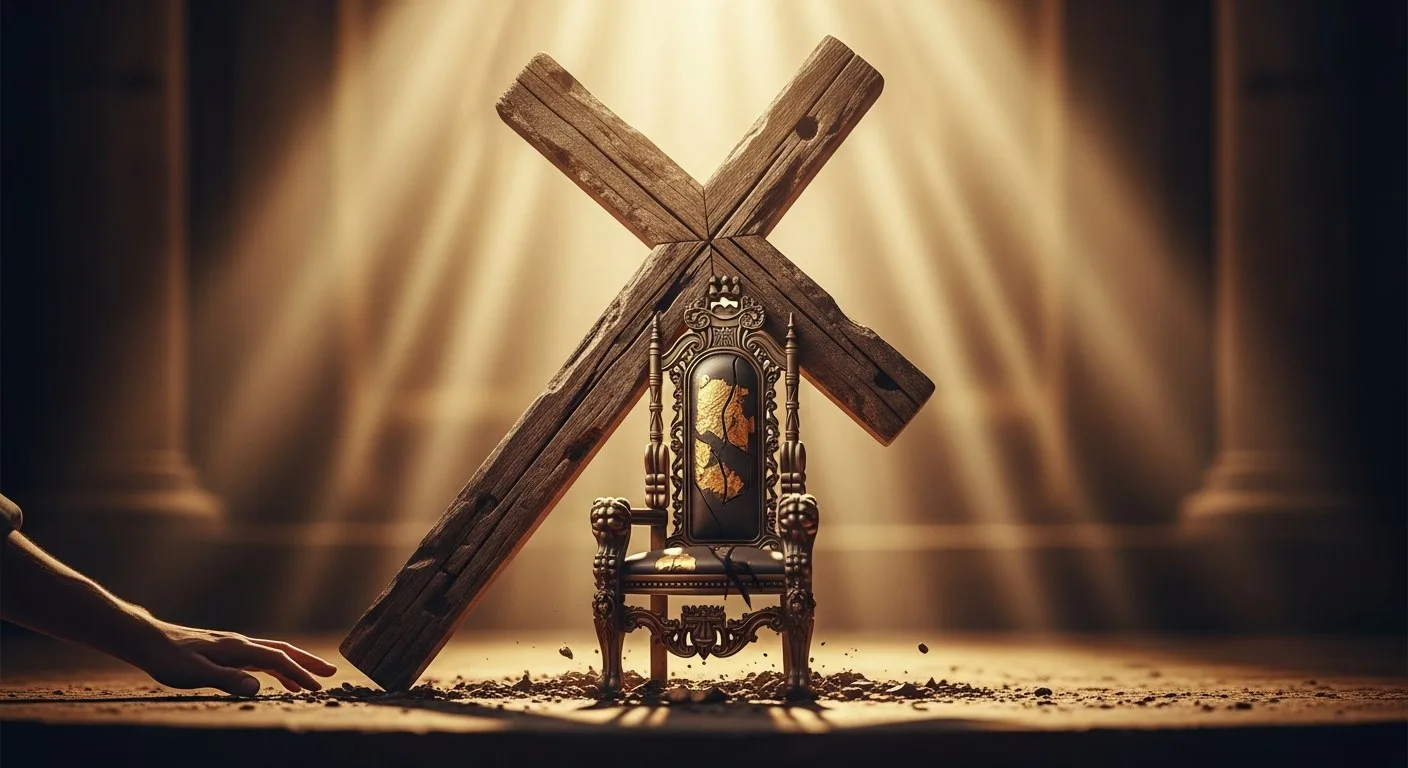
Biblical illustration — The Cross Crushes Pride’s Empty Throne — The LORD is my shepherd; I shall not want — Psalm 23:1 KJV
✦ The LORD is my shepherd; I shall not want — Psalm 23:1 KJV
View Full Scripture Illustrated Gallery →

Living Under Grace, Not Glory

I remember a Sunday afternoon when my teenage son slammed the front door, furious that his chores were not praised. He wanted acknowledgment for every small act, as if each chore earned a medal from the world. I sat with him on the porch, the sun warm on our backs, and shared how my own heart once craved applause for every sermon I preached. The truth that freed me was Romans 5:2 (KJV), “by whom also we have access by faith into this grace wherein now we stand,” a reminder that our standing is not built on applause but on Christ’s merit. I explained that grace, like a river flowing from the throne of God, does not require our performance but merely invites us to receive it with humble gratitude. When we teach our child to find his worth in God’s unmerited favor rather than in earned accolades, we model the biblical truth that true identity rests on being a beloved child of the King.

"We are justified by faith, not by works."— Romans 5:1, KJV

Standing on the Rock of Truth

Proverbs 16:18 warns, "Pride goeth before destruction, and an haughty spirit before a fall." The proverb paints pride as a reckless traveler who rushes ahead of the road, only to tumble into ruin. This image aligns with the biblical narrative that God’s holy anger is kindled against those who trust in themselves rather than Him. Yet the same scripture family offers a counter‑balance: "The Lord loveth him that humbleth himself" (James 4:10). The tension reminds us that God’s judgment is not arbitrary but purposeful, designed to draw the proud back into dependence on Him.

The concluding warning calls us away from the seductive allure of performance. If we return to self‑exaltation, we will find ourselves entangled in guilt that the cross has already paid for. The apostle John writes, "If I say the truth, why do ye not believe me?" (John 8:46). The verse illustrates the tragic irony of a heart that hears truth yet refuses to receive it because pride has built a wall. The final charge is simple: cling to the truth of Christ, and let pride crumble before it.

"Pride goeth before destruction, and an haughty spirit before a fall."— Proverbs 16:18, KJV

✨ What To Do Today

  1. Journal prompt: Write about a recent moment when you felt the sting of pride. Describe the scene, your thoughts, and how Christ’s truth could have changed the outcome.
  2. Scripture meditation: Read John 8:44 and James 4:6 slowly. Ask God: "Where am I trying to earn my worth, and how can I surrender that place to Your grace?"
  3. Practical step: Choose one daily task (washing dishes, replying to an email) and perform it without seeking any acknowledgment, offering the work as a thank‑offering to God.
  4. One act of surrender: Identify a habit where you seek approval (e.g., posting on social media). Declare the verse James 4:6 over it, and commit to let that habit rest in God’s approval alone.
Father, reveal to me the places where my heart has erected its own throne. Help me to lay down every self‑made claim and stand humbled before the cross that has already claimed my victory. Amen.

As we close, picture the cross standing firm on Golgotha while the world’s applause fades into distant noise. The blood that stained its wood is the very river that washes away our pride, leaving only a heart eager to serve. Let each day be a walk where we look not to our own merit but to the One who gave Himself for us. In that posture, pride loses its grip and the Spirit fills us with quiet confidence. May our lives become living testimonies that God resists the proud but lavishes grace upon those who humbly receive it.