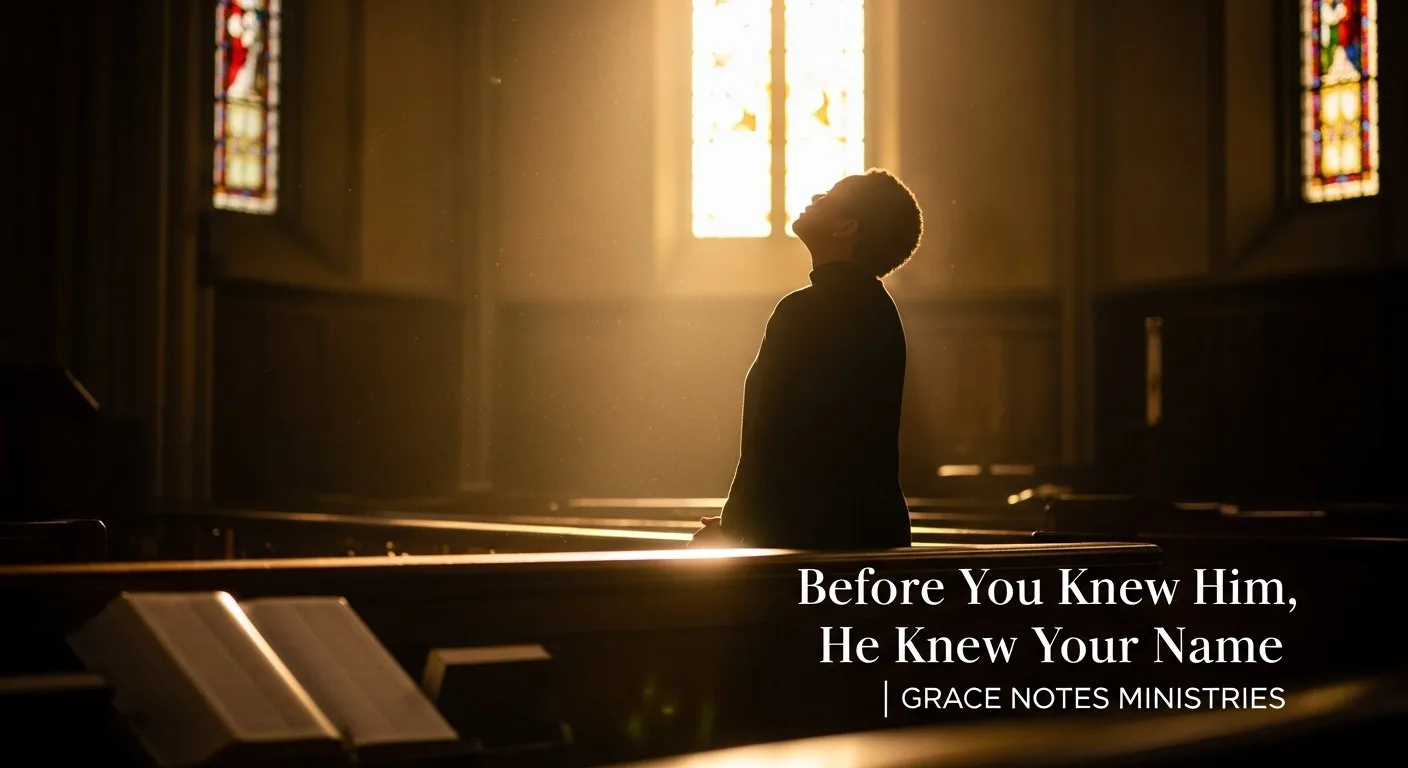
The Whisper in the Wilderness

You ever find yourself awake at three in the morning, staring at the ceiling while a thousand questions swirl in the quiet darkness of your bedroom? Perhaps it is that nagging doubt about your place in the world, a deep‑seated fear that you are an accident, an afterthought, or even a mistake. This longing to be truly seen reflects the biblical picture of Jacob wrestling for a name, Genesis 32:28 KJV, where God declares, “Your name shall not be called Jacob, but Israel.” It is a human ache—to belong, to be chosen, to know that our existence carries purpose beyond our own striving. Yet the good news is that God has already named us before we even ask.

This ache, this deep human need for affirmation, meets its fulfillment in the encounter between Jesus and a leper who lived on the roadside, an outcast untouchable even by his own people (Mark 1:40‑45). The man, rotting away in isolation, cried out for mercy, and Jesus, moved with compassion, reached out His hand and touched him. In that moment He said, “Be clean.” (Greek: katharos καθαρός, meaning pure). The declaration was not a response to the leper’s merit but an act of divine initiative that broke every social and religious barrier. Thus, the leper’s healing illustrates how God’s grace proceeds before any human work.

The reality of that grace is the foundation for our understanding of election. Divine election is not a random lottery; it is rooted in God’s covenant promise to Abraham that through his seed all nations would be blessed (Genesis 12:3). While God sovereignly chooses, He also calls us to respond in faith—our responsibility is to trust the One who has already named us. The New Testament picks up this thread in Ephesians 1:4‑5, where Paul writes that believers were chosen “in Christ before the foundation of the world” and then “were predestinated… according to his purpose.” Thus, election and responsibility are two sides of the same divine narrative: God’s gracious choice meets our obedient response, weaving together Old‑Testament covenant faithfulness and New‑Testament redemption.

The thought of being chosen can feel overwhelming, as if we must measure up to an invisible standard. Yet the Gospel flips that expectation: God does not wait for us to clean ourselves up but steps into our mess, just as He did with the leper. Imagine a storm‑tossed ship; instead of demanding perfect sailing, Christ Himself becomes the steady lighthouse that guides the vessel to safe harbor. With a simple touch and a powerful word, He declares us clean, turning our broken narrative into one of grace. This is not a transactional exchange but a divine appointment that rewrites our story with love.

And Jesus, moved with compassion, put forth his hand,

Born of Water and Spirit

We often try to earn our way into God's favor, don't we? We believe that if we just pray harder, serve more diligently, or live more perfectly, then maybe, just maybe, we'll finally be 'elect' enough. This is the oldest trap in the book, the same one Nicodemus, a man of impeccable religious standing, fell into when he came to Jesus by night. He was a Pharisee, a ruler, someone who had meticulously followed every rule, yet he sensed a profound spiritual lack, a gap that his religious efforts simply couldn't bridge. He sought a formula, a method, a secret to God's kingdom, hoping to add another achievement to his already impressive spiritual resume.

But Jesus didn't offer him a checklist or a new set of rules; He offered him a complete re-birth, a divine intervention that bypassed human effort entirely. "Verily, verily, I say unto thee, Except a man be born again, he cannot see the kingdom of God." This wasn't about self-improvement; it was about a new creation. Nicodemus, with all his learning and piety, couldn't comprehend such a radical concept, asking how an old man could re-enter his mother's womb. He was thinking in terms of human possibility, of physical limitations, of what he could *do*.

Jesus patiently explained that this rebirth isn't a physical act, nor is it a human achievement; it’s a spiritual transformation. "Verily, verily, I say unto thee, Except a man be born of water and of the Spirit, he cannot enter into the kingdom of God." The 'water' often speaks of repentance and cleansing, but the 'Spirit' speaks of God's direct, sovereign work. It’s the breath of God animating a dead spirit, a divine choosing that brings us into His family. This isn't something we initiate or earn; it’s a gift, a profound act of grace where God Himself reaches down and makes us alive, making us His own.

This concept utterly shatters the notion that our election is based on our performance. It means that God’s choice isn't a reward for our spiritual striving, but the very source of our ability to strive. Before we ever took a step towards Him, He had already moved toward us, breathing life into our spirits through the Spirit. Our part is simply to receive, to believe, and to surrender to the beautiful, unearned reality that we are chosen, not because we were good enough, but because He is good enough, and He desires us.

Jesus answered, Verily, verily, I say unto thee, Except a man be born of water and of the Spirit, he cannot enter into the kingdom of God.— John 3:5, KJV
Biblical illustration — Before You Knew Him, He Knew Your Name — The LORD is my shepherd; I shall not want — Psalm 23:1 KJV
✦ The LORD is my shepherd; I shall not want — Psalm 23:1 KJV
View Full Scripture Illustrated Gallery →

Resting in the Chosen Place

So, what does this actually mean for us, living in the messy, beautiful reality of our daily lives? It means that when you wake up feeling inadequate, when you face a difficult conversation with a loved one, or when you simply doubt your own strength, you don't have to scramble to prove your worth. You don't have to perform for God’s love or secure your place in His heart. You are already in the chosen place, not because you earned it, but because He put you there. This truth should settle deep into your bones, transforming how you see yourself and how you interact with the world.

My friend, I want you to truly hear this: you don't need to fix yourself before you come to Him. You don't need to clean up your act or polish your image. The God who chose you before the foundation of the world, the God who met that leper with compassion and told Nicodemus he needed a divine rebirth, is the same God who sees you right now. He knows your struggles, your secret fears, your deepest longings, and His love for you isn't contingent on your ability to overcome them. His love is the very power that helps you overcome them, a love poured out freely, without conditions.

Walking in this grace day by day means releasing the heavy burden of self-reliance and embracing the lightness of His embrace. It’s about letting His choice define your identity, rather than letting your failures or your successes dictate your worth. When you understand that you are chosen, not by your merit but by His magnificent grace, you find a profound peace that transcends circumstance. You can face your day, your challenges, and even your shortcomings, knowing that your standing with God is secure, anchored not in your fluctuating performance, but in His unchangeable, sovereign love for you.

This isn't an excuse for complacency; rather, it's the deepest motivation for genuine obedience. When you truly grasp that you are loved unconditionally, that you are chosen, not because you are good, but because He is good, your heart naturally overflows with gratitude. This gratitude then fuels a desire to live in a way that honors Him, not out of fear or obligation, but out of a joyful response to the incredible, unmerited favor He has bestowed upon you. It changes everything.

Jesus answered and said unto him, Verily, verily, I say unto thee, Except a man be born again, he cannot see the kingdom of God.— John 3:3, KJV

The Unshakeable Foundation

The scriptural baseline for our faith is firm, an unshakeable rock upon which we can stand, regardless of the shifting sands of our emotions or the clamor of the world's demands. God's promises are not fickle; His election is not a momentary whim, but an eternal, settled truth rooted in His immutable character. From the touch of Jesus on the leper to His profound declaration to Nicodemus, we see a consistent theme: God initiates, God chooses, God transforms. This isn't a theology to debate in ivory towers; it’s a living truth to anchor your soul in the everyday storms, assuring you that His love for you is as vast and unchanging as the heavens themselves.

So, let’s be careful not to slip back into the chains of performance and religious guilt, believing we must prove our worthiness or somehow earn what has already been freely given. The enemy loves to whisper doubts, to suggest that God's grace has limits, that you're the exception, that you haven't done enough. But the cross declares a finished work, a complete payment, a love that knew no bounds. Your election isn't dependent on your ability to maintain it; it's a gift, secured by Christ's blood, a permanent seal on your soul that declares, 'You are His, and He is yours, forever.'

This freedom from self-effort is not just a theological concept; it's the very air we breathe as believers. It allows us to approach God not with trembling fear, but with confident access, knowing that we are welcomed, not just tolerated. When we fully grasp that He chose us before we chose Him, it liberates us to live lives of genuine love and service, not to earn His affection, but to express the overflowing gratitude for the affection already lavished upon us. This is the Gospel, pure and unadulterated, a truth that sets the captive heart gloriously free.

The same came to Jesus by night, and said unto him, Rabbi, we know that thou art a teacher come from God: for no man can do these miracles that thou doest, except God be with him.— John 3:2, KJV

✨ What To Do Today

  1. Journal prompt: Reflect on a time you felt unchosen or overlooked. How does the truth that God chose you, even before you knew Him, speak to that feeling?
  2. Scripture meditation: Read John 3:1-8 and Mark 1:40-45 slowly. Ask God: 'What does it truly mean to be 'born of the Spirit' in my life right now?'
  3. Practical step: Today, when a feeling of inadequacy or self-doubt arises, consciously replace it with the thought: 'I am chosen by God, not because of who I am, but because of who He is.'
  4. One act of surrender: Identify one area where you are still trying to earn God's approval. Name it, lay it down, and cling to John 3:16: 'For God so loved the world, that he gave his only begotten Son, that whosoever believeth in him should not perish, but have everlasting life.'
Father, thank You for choosing us, for knowing our names before time began. Help us to truly rest in Your unmerited grace, living each day in the freedom and security of Your eternal love. Amen.

My dear friends, as we close this time together, remember that the core of our faith isn't about what we do for God, but what He has already done for us, and in us. You are not an accident; you are a divine appointment, chosen and deeply loved by a God whose compassion knows no end and whose grace is boundless. Let this truth sink deep into your heart, transforming your perspective, quieting your fears, and empowering you to live a life overflowing with the peace and joy that only comes from knowing you are eternally His. Carry this revelation into your week, into your relationships, into every quiet moment, and let the magnificent truth of His choice be the steady rhythm of your soul.