The Restless Heart's Question

At 3 a.m., when the house is hushed and your thoughts replay the day's missteps—sharp words, missed chances for kindness—a quiet shame whispers, 'You're not enough.' Yet Scripture reminds us in Psalm 139:14 (NIV) that we are 'fearfully and wonderfully made,' a truth the heart often forgets. We try to patch our flaws with effort, measuring ourselves against an imagined standard of righteousness that seems always out of reach. This relentless striving creates a heavy burden, making us wonder why God would call us to such a demanding holiness. The key is understanding that God's invitation is not to an external checklist but to the identity He has already woven into us through covenant promise. When we see holiness as a divine provision rather than a performance, the yoke lightens.

In His high priestly prayer, Jesus does not ask us to earn holiness by sheer willpower; He petitions for our oneness with the Father—a unity rooted in the New Covenant. The prayer recorded in John 17:20‑23 (NIV) says, 'My prayer is not that you take them out of the world but that they may be one as we are' and continues, 'that the love you have for me may be in them, and I in them.' Here Jesus is asking that the believers' lives reflect the intimate relationship He shares with the Father, not a solitary climb of good deeds. This oneness means that the holiness we experience flows from being indwelt by Christ (Greek: *hagios*—set apart), rather than produced by our own effort. As a result, the believer lives out the holiness of the covenant community, embodying the Father’s love in daily life. Thus Christ's prayer translates into our experience as a call to live out the divine character already imparted to us.

Consequently, the invitation is not to add another list of religious tasks but to enter into intimate indwelling. God does not demand holiness as a merit badge; He declares us holy because we are 'in Christ' (Greek *en Christō*), the very source of righteousness. The Father looks upon us as He looks upon His Son—whole, spotless, and beloved—fulfilling the covenant promise of Genesis 17:7 (NIV) that Abraham's offspring would be a blessed nation. Our role, then, is to lay aside the heavy coat of self‑effort and don the simple robe of Christ's righteousness, a metaphor that points to our dependence on His work. In doing so, we cease striving for self‑justification and begin receiving the holiness already granted to us. This shift transforms our lives from a frantic pursuit into a joyful participation in the divine narrative of redemption.

That they all may be one; as thou, Father, art in me, and I in thee, that they also may be one in us: that the world may believe that thou hast sent me.— John 17:21, KJV

The Gift That Makes Us Whole

We've all tried to white-knuckle our way into righteousness, haven't we? We set new rules, make fresh commitments, determined to 'do better' this time, only to find ourselves stumbling, falling short, and sinking back into that familiar mire of guilt and condemnation. Religion, with its endless list of dos and don'ts, only amplifies this internal brokenness, leaving us feeling perpetually inadequate, forever chasing a horizon we can never reach on our own. It's a treadmill of performance, exhausting and ultimately futile, because the problem was never our lack of effort, but our very nature outside of Christ, separated from His perfect life.

But listen, friend, the cross didn't just forgive our sins; it utterly dismantled the entire system of human striving, once and for all. When Jesus cried, "It is finished," He wasn't just completing a transaction; He was declaring a new reality where our holiness is not a condition for His love, but a glorious, unmerited *consequence* of it. Our guilt, our shame, our every failure was nailed to that tree, and in its place, He clothed us with His own perfect righteousness. You are not just forgiven; you are made righteous, justified, and utterly beloved, not because of what you did, but because of what He has already done for you.

Consider Christ's prayer again, a deep look into the Father's heart for us, in John 17:22-23: "And the glory which thou gavest me I have given them; that they may be one, even as we are one: I in them, and thou in me, that they may be made perfect in one; and that the world may know that thou hast sent me, and hast loved them, as thou hast loved me." He's not just giving us a piece of His glory; He's giving us *His* glory, making us one with the Godhead, bringing us to a perfection that is already complete in Him. This unity, this shared glory, this perfect oneness—it's the very foundation of our holiness, not something we achieve, but a profound, spiritual inheritance we receive.

And the glory which thou gavest me I have given them; that they may be one, even as we are one: I in them, and thou in me, that they may be made perfect in one; and that the world may know that thou hast sent me, and hast loved them, as thou hast loved me.— John 17:22-23, KJV
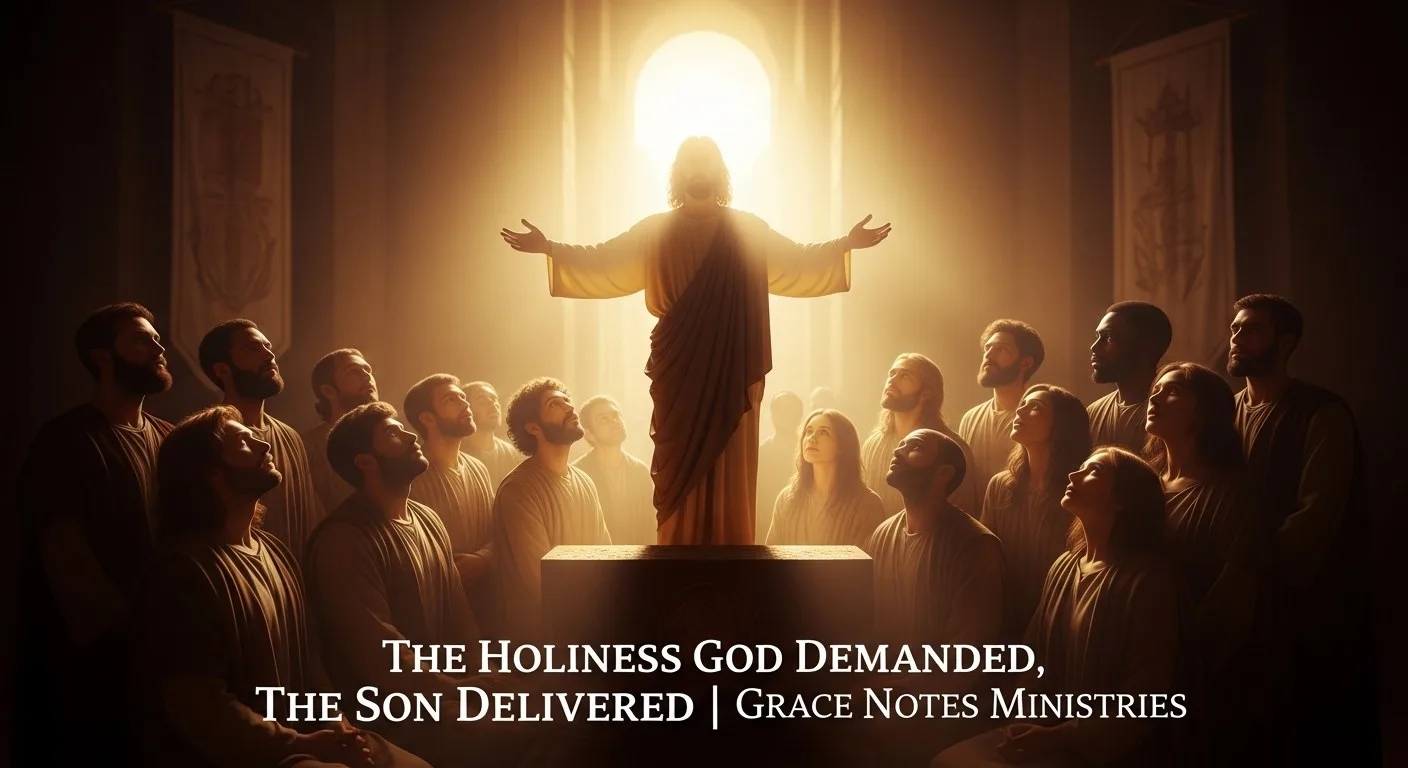
Biblical illustration — The Holiness God Demanded, The Son Delivered — The LORD is my shepherd; I shall not want — Psalm 23:1 KJV
✦ The LORD is my shepherd; I shall not want — Psalm 23:1 KJV
View Full Scripture Illustrated Gallery →

Living From the Inside Out

On a chaotic Tuesday morning—children's voices rising, coffee steaming, schedules colliding—the call to live from the inside out becomes practical. First, we begin with prayer, inviting the Holy Spirit (*ruach*—breath) to shape our attitudes before we step into the day's demands. Next, we let the truth of Christ's oneness with the Father shape our interactions: speaking gently, listening patiently, extending grace as a reflection of divine love. When challenges arise, we remember that our identity is secured in the robe of Christ's righteousness, so we respond with steadiness rather than frantic self‑effort. Throughout the day, moments of frustration become opportunities to demonstrate the unity Christ prayed for, allowing others to see the Father's love in us. In this way, holiness flows outward, not from our own strength, but from the life of Christ dwelling within us.

The Strait Gate of Grace

Jesus talked about a "strait gate" in Luke 13:24, saying, "Strive to enter in at the strait gate: for many, I say unto you, will seek to enter in, and shall not be able." This isn't a call to self-effort to *earn* our way in; it's a profound invitation to recognize the *narrowness* of the path, the singular way, which is Christ Himself, and to cling to Him alone. The striving isn't about our performance to gain entry, but about the urgency and singular focus required to turn from every other path of self-righteousness or worldly wisdom and cling solely to Him. It's a striving of faith, a determined acceptance of His finished work, not a striving of our own works.

So, let's be abundantly clear: God calls you holy not to burden you with an impossible standard, but to reveal the magnificent truth of your identity in Christ, His beloved. Don't let the whispers of religion or the echoes of past failures drag you back to that exhausting treadmill of trying to be 'good enough,' for that's the broad way, the way many seek to enter and cannot. The strait gate is Jesus, and He is your holiness. He is your perfection. He is the love wherewith the Father loved Him, now living gloriously in you, making you whole and complete.

Strive to enter in at the strait gate: for many, I say unto you, will seek to enter in, and shall not be able.— Luke 13:24, KJV

✨ What To Do Today

  1. Journal prompt: Reflect on a time you felt you weren't 'holy enough.' How does understanding your union with Christ, as spoken in John 17, change that feeling and bring you peace?
  2. Scripture meditation: Read John 17:21-23 and Luke 13:24 slowly and prayerfully. Ask God: 'What does it mean for me to truly rest in Your finished work and my identity as holy in Christ, rather than striving?'
  3. Practical step: Today, when you feel the pressure to perform or 'be good,' consciously pause and declare aloud, 'I am holy in Christ, not by my works, but by what He did for me.'
  4. One act of surrender: Identify one specific area where you still strive to earn God's approval. Name it, lay it down at the foot of the cross, and cling to John 17:23: 'I in them, and thou in me, that they may be made perfect in one.'
Heavenly Father, thank You for the profound gift of holiness, freely given through Your Son, Jesus. Help us to truly grasp our oneness with You, to rest in Your perfect love, and to live from the reality of Christ within us, our complete and sufficient righteousness. Amen.

So, dear friend, shed the heavy cloak of self-effort and embrace the radiant garments of Christ's righteousness, already draped over you, a gift beyond measure. His call to holiness isn't a demand for your performance; it's a declaration of your profound identity, a testament to the unstoppable love that has woven you into the very fabric of the Godhead, making you one with Him. Live today, not striving for what you lack, but rejoicing in the abundant, unmerited grace that has made you whole, complete, and eternally beloved in the eyes of your Father. Let His life be your life, His holiness your perfect peace, and His love your unending song.