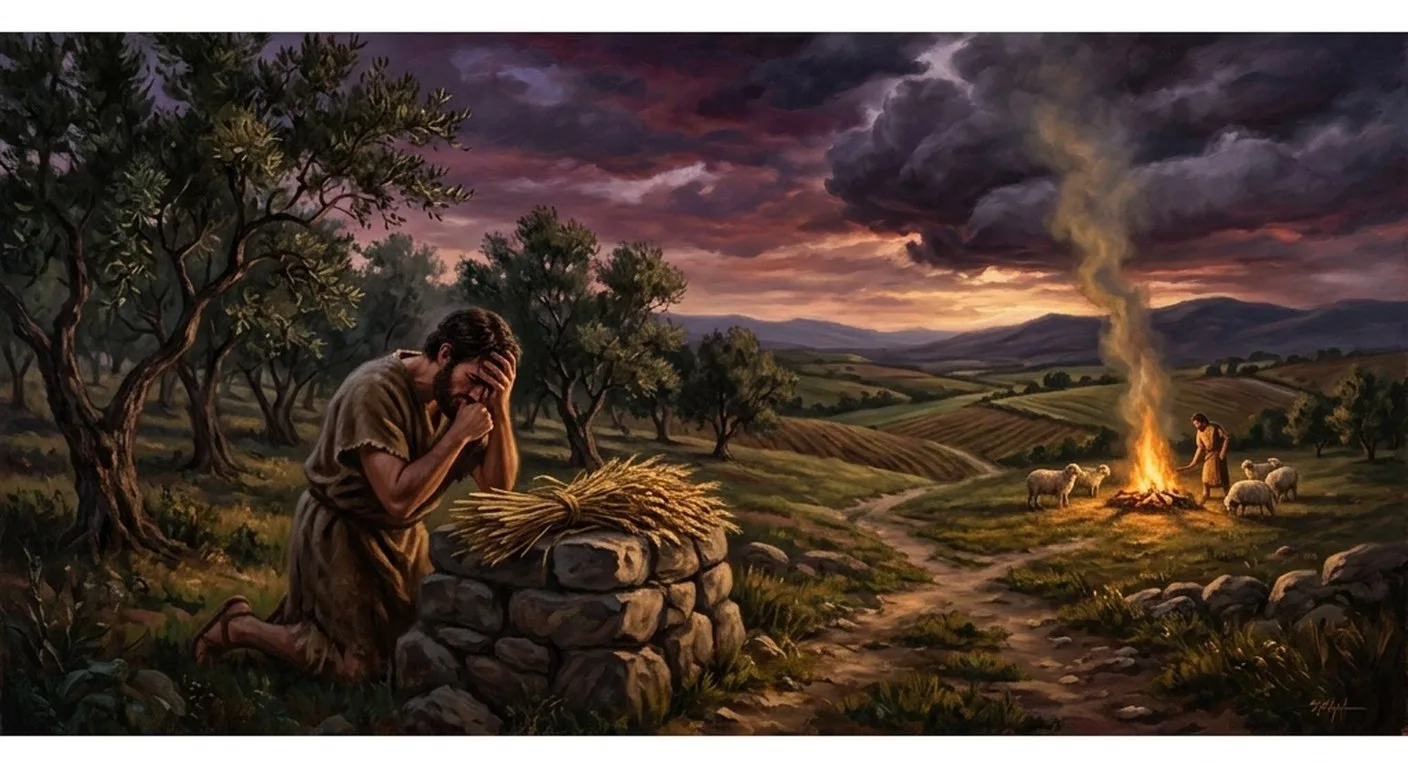
A restless night at the altar
It was three o'clock in the morning, and rain tapped against my windowpane, a quiet reminder of God's voice calling us to watchfulness. I rose from the creaking bed, the house hushed save for the low sigh of the furnace, and went to the kitchen where a half‑filled mug waited. As steam curled upward, I recalled the story of Cain and Abel, puzzling over why one sacrifice pleased the Maker while the other did not. The scent of fresh‑cut grain that Cain had brought should have satisfied any worshiper, yet Scripture tells us there is a deeper condition of heart beneath the surface. I knelt in prayer, asking the Lord to reveal the hidden posture that makes an offering acceptable.
Genesis records the event word for word: 'And in process of time it came to pass, that Cain brought of the fruit of the ground an offering unto the LORD. And Abel, he also brought ... of the firstlings of his flock, and of the fat thereof' (Genesis 4:3‑5 KJV). The text does not point to a procedural flaw; rather it hints at an inner posture that set the brothers apart. While Cain's offering of grain (קָרְבָן, *korban*, 'brought near') was outwardly proper, his heart (לֵב, *lev*) harbored resentment and self‑importance. When Jesus later warned, 'Judge not by appearances, but with righteous judgment' (John 7:24 KJV), He taught that external form cannot conceal internal motive. Thus, God favored Abel because his sacrifice flowed from a heart of genuine faith and gratitude, not merely from the quality of the animal.
The episode points beyond the altar to the covenant work of the Holy Spirit. After His resurrection, Jesus breathed on the disciples, saying, 'Receive the Holy Ghost' (John 20:22 KJV); that breath of the Spirit (πνεῦμα, *pneuma*) enabled believers to offer worship from a contrite heart. The Spirit now reveals the same truth that Genesis taught: true sacrifice is rooted in humility and trust, not in ritual perfection. As the psalmist declares, 'The LORD loveth righteousness and judgment; but the filthy and the crooked shall he cast away' (Psalm 11:7 KJV), we see that God's favor follows a heart aligned with His character. When the Spirit moves within us, our offerings become fragrant incense before Him, echoing Abel's faithful posture and fulfilling the New Covenant promise.
When self‑reliance meets divine standard
Many of us try to earn God's favor by stacking good deeds like bricks, believing that enough effort will shield us from divine rebuke. That mindset mirrors Cain's attempt to impress the Almighty with a harvest offering, assuming that quantity could outweigh quality. Yet Scripture warns that reliance on human achievement invites disappointment, for the Lord measures obedience by heart fidelity, not by external tally. The apostle Paul later taught that "by works of the law there is no flesh justified" (Romans 3:20, KJV), a truth that echoes the ancient warning against self‑righteousness. When we cling to performance, we become like a builder who forgets that the foundation must be rock, not sand. The gospel then appears as the antidote, offering a righteousness that is imputed, not earned.
The finished work of Christ changes the entire equation. When Jesus breathed on his disciples, saying, "Receive ye the Holy Ghost" (John 20:22, KJV), He transferred a power that nullifies the need for meritorious sacrifice. In Him, the blood of Abel is vindicated, while Cain's failed offering becomes a cautionary tale about pride. The cross declares that "God so loved the world, that he gave his only begotten Son" (John 3:16, KJV), providing a perfect offering that satisfies the Father's heart on our behalf. Thus, any attempt to fix ourselves apart from Christ is futile; the only true offering now is a life surrendered to Him. The believer, then, rests in the assurance that Christ's righteousness covers all deficiencies.
The exegesis of Genesis 4:7 sharpens this point: "If thou doest well, shalt thou not be accepted?" says the LORD. The verse is a divine invitation to repentance, followed by a warning that sin crouches at the door. Cain's response—silence and denial—sealed his fate, while Abel's humble gratitude secured his acceptance. The passage teaches that God's standard is relational fidelity, not ritual perfection. When we examine the narrative through the lens of John 7:24, it becomes clear that God judges the heart's orientation. The lesson, therefore, is that our worship must be rooted in a contrite spirit that seeks God's delight above human applause.
"Judge not according to the appearance, but judge righteous judgment"— John 7:24, KJV
Living out grace in daily moments
Imagine a mother stirring porridge for her children, humming a hymn while the pot bubbles on the stove. She offers the meal not to earn favor but out of love, her heart attuned to the needs of those before her. In that simple act, she mirrors the kind of worship God cherishes—a gift poured out of a heart aligned with His compassion. When we bring this posture into the workplace, the boss notices not the glossy report but the integrity that undergirds it. The same principle applies at home, in friendships, and even in the quiet moments when we kneel alone. As the Spirit works within us, ordinary tasks become fragrant offerings when motivated by love for God and neighbor.
Therefore, I invite you to lay aside the weight of performance and rest in Christ's finished work. The apostle John reminds us, "Peace be unto you: as my Father hath sent me, even so send I you" (John 20:21, KJV), a command that includes the ministry of grace. When we cease striving for acceptance and instead receive the Holy Ghost, our lives begin to reflect a righteousness that is not ours. This shift does not erase responsibility; rather, it frees us to serve joyfully, knowing that our worth rests on Christ's sacrifice. In this freedom, daily chores become opportunities to display gratitude, not attempts to earn merit.
Walking in this grace requires daily vigilance. Each sunrise offers a fresh chance to examine our motives: Are we offering to God because of fear, or because of love? The invitation to "receive ye the Holy Ghost" (John 20:22, KJV) is an invitation to let that Spirit examine and purify our intentions. When we surrender the desire for applause, we discover a deeper satisfaction that comes from pleasing Him alone. This journey is not without struggle; the heart often clings to old patterns of self‑justification. Yet, as we lean on Christ's righteousness, the weight of those patterns fades, leaving room for genuine worship that pleases the Father.
"Peace be unto you: as my Father hath sent me, even so send I you"— John 20:21, KJV
Standing on the rock of promise
The biblical narrative anchors us in a firm foundation: God’s word is unchanging, and His promises endure beyond human failure. When He warned Cain, "If thou doest well, shalt thou not be accepted?" (Genesis 4:7, KJV), He also offered a path to redemption. That promise resonates through the ages, culminating in Christ’s declaration that He did not come of Himself but was sent by the Father (John 7:28, KJV). The thread that runs from the garden to the cross assures us that God’s heart remains steadfast, even when our offerings falter. Therefore, believers can stand confidently on the assurance that Christ’s sacrifice satisfies the divine requirement that Cain missed.
Yet a warning remains: those who return to the mindset of earning favor will find themselves trapped in a cycle of guilt and frustration. The narrative ends with Cain fleeing, bearing a mark that set him apart as a warning to all who trust in works alone. When we revert to performance, we echo his mistake, believing that a better offering will erase the stain of pride. The Scripture exhorts us to avoid this trap, urging reliance on Christ’s atoning work instead of our own merit. In doing so, we escape the bondage that once condemned Cain, walking instead in the liberty granted by grace.
"If thou doest well, shalt thou not be accepted?"— Genesis 4:7, KJV
May the truth of Christ's completed work settle deep within your spirit, reminding you that God’s affection is not bought by the size of your offering but given through a heart surrendered to Him. As you go forward, let each act of service be colored by gratitude for the grace that already covers you, and may your life become a fragrant offering that pleases the Father. In the quiet of night or the bustle of day, remember that the true worship God seeks is a humble trust in His mercy. Walk each step with the confidence that Christ’s righteousness stands before Him on your behalf, and let that assurance shape every breath you take.