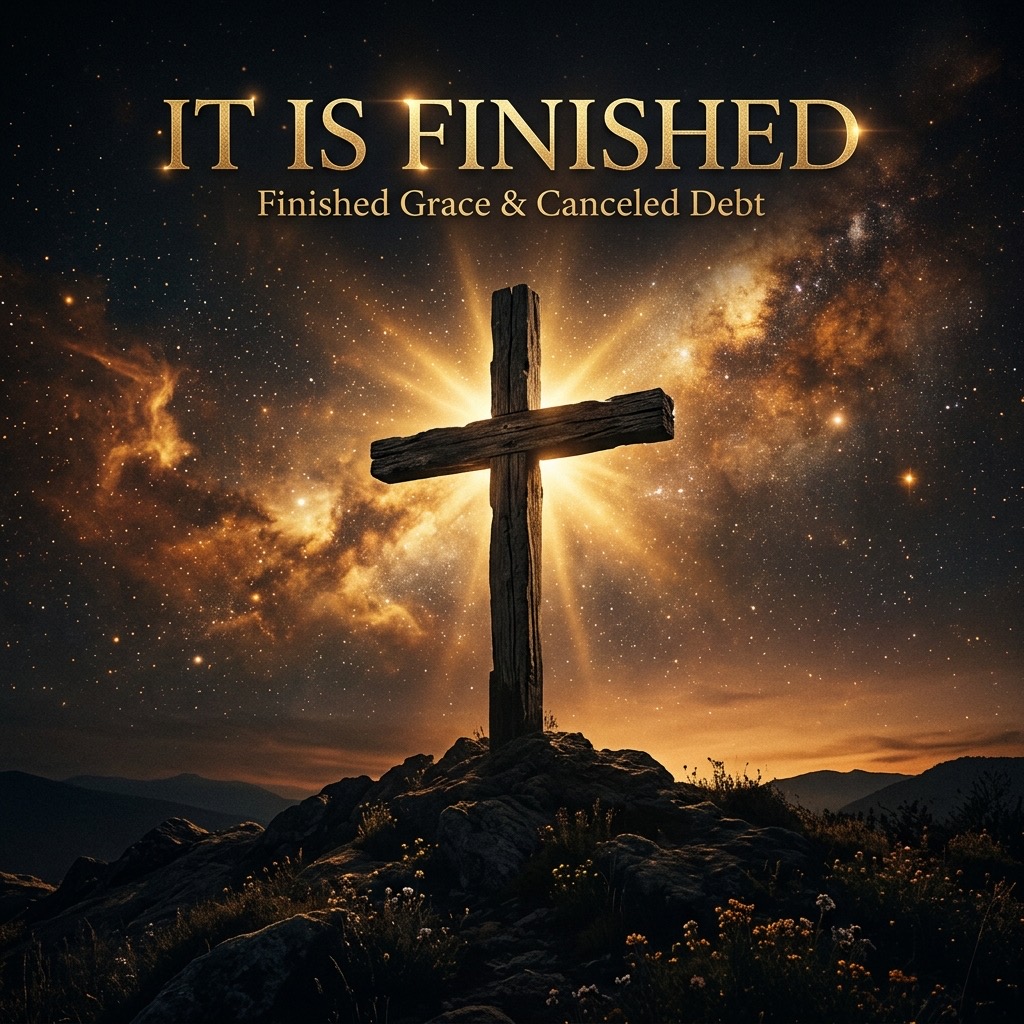
Do you ever feel the quiet, crushing weight of trying to stack your good deeds against a mountain of past failures? We live in a culture that constantly demands we prove our worth, and tragically, many of us have carried that same exhausting ledger into the sanctuary of our souls. We scrub at our conscience, hoping that one more prayer, one more act of service, or one more moment of perfect obedience might finally earn us the peace we desperately crave. But what if the very striving that leaves you breathless is actually keeping you from the rest that God has already purchased for you?
Do you ever feel the quiet, crushing weight of trying to stack your good deeds against a mountain of past failures? We live in a culture that constantly demands we prove our worth, and tragically, many of us have carried...
- The Weight of the Striving: Trusting God's Word through life's deepest trials and seasons of waiting.
- The Handwriting on the Wood: Trusting God's Word through life's deepest trials and seasons of waiting.
- Completed on the Timber: Trusting God's Word through life's deepest trials and seasons of waiting.
The Weight of the Striving
For years, I walked through the shadowed corridors of my own heart, convinced that grace was a fragile thing that could be lost if I blinked. I kept meticulous records of my shortcomings, measuring the distance between who I was and who I thought God required me to be. Every stumble felt like a fresh indictment, every whispered doubt a confirmation that I was merely one misstep away from divine disappointment. This legalistic treadmill does not lead to holiness; it leads only to depletion, leaving the seeker gasping for air beneath a yoke that was never meant to be borne.
We have been conditioned to believe that God’s favor operates on a merit-based economy, where His love must be earned through relentless performance. But this theology of striving is a thief that steals the very joy it claims to protect. When we try to maintain our standing before God through our own strength, we inevitably find ourselves trapped in a cycle of confession followed by condemnation. The enemy knows that a tired saint is an easy target, which is why he constantly whispers that you must do more, try harder, and fix yourself before you are worthy to approach the throne.
I remember nights spent staring at the ceiling, mentally rehearsing apologies for sins that had already been covered, wondering if my latest failure would finally tip the scales. I thought God was keeping a scorecard, tallying every thought and motive with cold precision. Yet in that profound exhaustion, I began to realize that a God who demands perfection to receive Him will inevitably drive us into despair. The quiet guilt of keeping score is not the voice of the Shepherd; it is the echo of a religion that has forgotten the heart of the Gospel.
The burden you feel is not a sign of spiritual immaturity, but rather the natural consequence of carrying a debt that was never yours to pay. You were never called to be your own savior, yet we so often try to haul ourselves up by the bootstraps of our willpower. We scrub our hands, polish our reputations, and perform religious routines, all while our souls ache for the simple assurance that we are loved not because of what we do, but because of who He is. This striving does not produce sanctification; it produces spiritual fatigue.
But there is a better way, a path that leads away from the courtroom of our own making and back into the arms of a Father who never had to earn His affection. The moment we stop trying to justify ourselves is the moment we finally see the cross for what it truly is: not a symbol of a failed execution, but a monument to a completed transaction. When we lay down the heavy ledger of our performance, we discover that God’s grace is not a reward for the righteous, but a rescue mission for the broken.
"Blotting out the handwriting of ordinances that was against us, which was contrary to us, and took it out of the way, nailing it to his cross;"— Colossians 2:14 (KJV)
The Handwriting on the Wood
To understand the staggering magnitude of this promise, we must first recognize exactly what was nailed to that ancient timber. The phrase "handwriting of ordinances" refers to a legal document, a bond or certificate of debt that stood against us. In the ancient world, this was akin to a public ledger recording every financial default and moral transgression. It was not merely a list of rules, but a binding indictment that spelled out our guilt and pronounced the inevitable sentence of separation from God. This document was written in the very language of our failures, detailing every broken promise and compromised conscience.
The Apostle Paul does not use gentle language when describing what happened to this record. He says it was "contrary to us," meaning it stood in opposition to our very existence before a holy God. It was an unpayable debt, a spiritual bankruptcy that no amount of good works, religious rituals, or moral improvement could ever settle. We tried to erase it with our own efforts, but like writing in sand with a finger, the tide of divine justice would only wash it deeper into our memory. The law demanded satisfaction, and we had nothing to offer but the very debt that condemned us.
Then came the cross, and in one breathtaking act of divine substitution, God did not merely overlook this document. He took it out of the way by nailing it to his cross. This was not a symbolic gesture; it was a legal execution of the indictment itself. Jesus did not just die for our sins in an abstract sense; He took the very certificate of our condemnation and made it obsolete. The handwriting that accused us was permanently affixed to the very wood bearing His body. The charges were not dismissed; they were satisfied.
When a debt is nailed to the cross, it ceases to be a burden carried by the debtor and becomes a memory of what has been paid. The law itself was not abolished, but its condemning power over those who are in Christ was utterly nullified. The same standard that once stood as a towering wall of accusation now points to the Lamb who took its wrath. You can no longer be judged by a ledger that has been destroyed, because the One who was accused in our place bore every single entry. The court records have been permanently sealed and closed.
This truth shatters the foundation of every religion that says, "God loves you, but He won't accept you until you clean up your act." The handwriting was not corrected; it was canceled. It was not moved to a new file; it was crucified alongside the Savior. When you look at your past, do not let your memory play back the accusations that were already adjudicated. The document was against you, but it is no longer against you, because the Cross stands as the eternal receipt of full payment.
Completed on the Timber
In his powerful teachings on the beauty of unmerited grace, Pastor Steven Furtick often reminds believers that we do not have to earn what has already been freely given. He speaks of how the enemy wants us to believe that grace is a cheap license, when in reality it is a costly purchase that we never financed. He encourages the church to stop trying to pay off a debt that the Savior already settled, reminding us that our standing before God rests entirely on His faithfulness rather than our fluctuating performance. He paints a vivid picture of heaven’s courtroom where the gavel falls, not on our merits, but on the finished work of Christ, declaring us righteous by grace alone.— A paraphrase of Pastor Steven Furtick's teaching, Elevation Church
This resonates deeply with the core message of Grace Notes Ministries, where we stand firmly on the unmerited grace that saves, sustains, and sanctifies. We do not preach cheap license, but the profound freedom of ceasing to add our own righteousness to Christ’s perfect sacrifice. The moment you realize that your good works are merely the fruit of salvation rather than its root, your entire relationship with God transforms from a transaction into a communion. We are not saved by works lest any man should boast, but we are created in Christ Jesus unto good works.
When we embrace this truth, the exhausting treadmill of spiritual performance suddenly comes to a halt. We no longer approach God with trembling hands, wondering if we have prayed enough or served long enough to be accepted. Instead, we come as children who know their inheritance is secure because it was purchased with a price far beyond our comprehension. The unmerited grace of God does not lower the standard of holiness; it elevates our confidence in the One who fulfilled it. We are free to pursue righteousness not out of fear, but out of overwhelming gratitude.
It is Finished
On that dark afternoon in Jerusalem, as the sky turned to black and the veil of the temple tore from top to bottom, Jesus spoke six words that would echo through eternity: "It is finished." The Greek word behind this phrase is tetelestai, a term used in ancient commercial records to mean "paid in full." It was not a cry of defeat uttered by a dying man, but the triumphant declaration of a victorious King who had successfully completed his mission. The debt was not merely reduced; it was extinguished. The work of redemption was not left as a half-finished project for humanity to complete; it was brought to absolute, unshakeable completion.
This declaration fundamentally changes everything about how we relate to God. If the work is truly finished, then nothing can be added to it without effectively declaring that Christ’s sacrifice was insufficient. Every time we try to add our own suffering, our own penance, or our own religious efforts to the cross, we are subtly questioning the sufficiency of His blood. The finished work means that salvation is a completed reality, not an ongoing process of earning what was freely given. We are saved by grace through faith, and this is not of ourselves; it is the gift of God.
The Pharisees wanted a Messiah who would help them keep the law; Jesus came to be the end of the law for righteousness to every one that believeth. He did not come to give us a checklist of requirements, but a finished work of redemption. When Christ cried out from the cross, He was not merely announcing the end of His physical suffering, but the conclusion of the legal battle for our souls. The tension between God's holiness and our sinfulness was not resolved by our effort, but by His substitution. He stepped into our place, took our debt, and nailed it to the very wood that would carry His body.
Therefore, we must stop treating the Gospel as a starting point for our own efforts and start seeing it as the final authority on our standing before God. We do not work for acceptance; we work from acceptance. The blood of Jesus has spoken a better word than the accusations of our past, and His finished work is the bedrock upon which we build a life of true, joyful obedience.
"When Jesus therefore had received the vinegar, he said, It is finished: and he bowed his head, and gave up the ghost."— John 19:30 (KJV)
Resting in the Verdict
What does it mean, practically, to live as one whose debt has been paid in full? It means that when you wake up tomorrow morning, the first thought of your soul should not be, "How much must I do today to stay in God's good graces?" but rather, "How great is the grace that has already made me His?" To rest in the verdict of the Cross is to walk through your day with a quiet, unshakable confidence that your identity is not found in your performance, but in His perfection. The courtroom is adjourned. The Judge has taken His seat, and the verdict stands: righteous.
This truth is the ultimate antidote to the poison of anxiety and fear. Much of our modern anxiety stems from a subconscious belief that we are responsible for maintaining our own security—spiritually, emotionally, and even morally. We fear that one misstep will undo everything. But when you realize that your salvation rests entirely on the finished work of Christ, the pressure to be perfect evaporates. You can face the uncertainties of life with peace because your most important standing—your standing before the Almighty—is settled forever.
Furthermore, this grace kills the spirit of shame. Shame thrives in the dark corners of our past, whispering that we are too broken to be useful or too sinful to be loved. But shame cannot survive in the light of a finished work. When the enemy brings up your old failures, you do not have to defend yourself; you simply point to the Cross. You can say, "That debt was nailed to the wood." When you live from this place of rest, your service to God becomes a celebration rather than a chore, and your life becomes a testimony of the beauty of unmerited grace.
Beloved, I invite you today to lay down your heavy ledger and simply rest in the arms of your Savior. You are more loved than you could ever imagine, not because of your striving, but because of His finished work. May the peace of God, which passeth all understanding, guard your heart and mind through Christ Jesus.
Grace and peace to you, your Sister Grace.
Let us pray: Heavenly Father, we thank Thee for the finished work of Thy Son. We thank Thee that our debt is paid and our names are written in the Lamb's Book of Life. Help us to walk this day not in the exhaustion of striving, but in the joy of Thy unmerited grace. Amen.