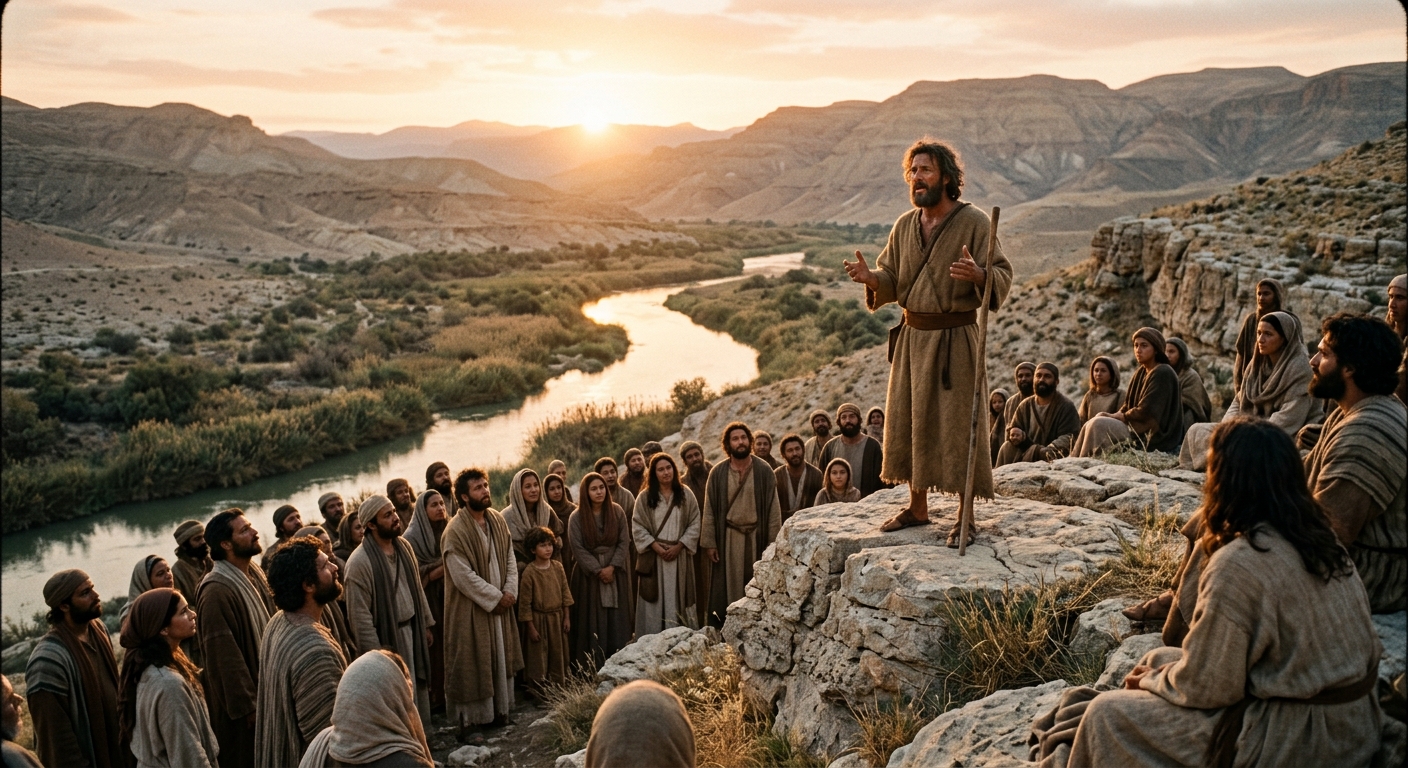
Illustration: A solemn sunrise over the Jordan River casts a golden, cinematic glow on rugged cliffs where John the Baptist stands in simple woolen robes, his weathered face illuminated by soft light as he passionately preaches repentance to a diverse crowd
🔊
Listen to Chapter
Grace Notes Journey Audio Narration
Author
Luke
Written
c. 60-62 AD
Key Theme
Repentance and Messiah's preparation
Setting
Jordan River region, Roman Judea
Key Verse
Luke 3:4
Total Verses
38
Chapter Introduction
*In the gentle flow of the Jordan River, God’s voice whispered a call to repentance. John, the humble prophet, reminded us that true transformation begins with a turning heart. As we read these verses, let the promise of forgiveness settle upon your soul like fresh water. May this chapter draw you closer to the One who fulfills all prophecy.*
Luke — Chapter 3 — KJV
1
Now in the fifteenth year of the reign of Tiberius Caesar, Pontius Pilate being governor of Judaea, and Herod being tetrarch of Galilee, and his brother Philip tetrarch of Ituraea and of the region of Trachonitis, and Lysanias the tetrarch of Abilene,
Simply PutThis verse pins down the exact historical moment of John’s ministry, grounding our faith in real time. The title "tetrarch" (Greek: tetrarches, G5062) marks these men as regional governors—leaders of limited provinces. Knowing exactly when this unfolded helps us trust that God's plan runs through specific, concrete history.
2
Annas and Caiaphas being the high priests, the word of God came unto John the son of Zacharias in the wilderness.
Simply PutHere we see "high priests" (Greek: archiereus, G73) and the "word of God" reaching John in the wilderness. The Hebrew root for priest (kohen, H3824) signifies one who mediates between God and people. For those in pain, this tells us that even the most powerful leaders can be humbled when God's voice speaks to a humble seeker.
3
And he came into all the country about Jordan, preaching the baptism of repentance for the remission of sins;
Simply PutJohn preached the "baptism of repentance" (Greek: baptizo, G907; metanoia, G3361) for the remission of sins. Baptism is a symbolic cleansing—an outer sign of an inner turning to God. If you’re weighed down by guilt, this verse promises that a sincere change of heart brings true forgiveness.
4
As it is written in the book of the words of Esaias the prophet, saying, The voice of one crying in the wilderness, Prepare ye the way of the Lord, make his paths straight.
Simply PutThe prophet Isaiah’s words are quoted, calling for the "voice of one crying in the wilderness." The Greek term "phono" (G5392) means a sound that demands attention. In the middle of life's desert, God still calls us to clear the path for Him—making space in our hearts for His arrival.
5
Every valley shall be filled, and every mountain and hill shall be brought low; and the crooked shall be made straight, and the rough ways shall be made smooth;
Simply PutGod promises to level valleys, flatten mountains, straighten crooked roads, and smooth rough ways (Greek: rhizoma, G4485). The image is of divine leveling—no obstacle too great. For anyone feeling stuck, this assures us that God will remove every barrier to bring us closer to Him.
6
And all flesh shall see the salvation of God.
Simply Put"All flesh shall see the salvation of God." The Greek word for salvation, soteria (G4982), denotes safety and deliverance. This is a promise that God's rescue reaches every person, not just the elite—offering hope to anyone yearning for a fresh start.
7
Then said he to the multitude that came forth to be baptized of him, O generation of vipers, who hath warned you to flee from the wrath to come?
Simply PutJohn rebukes the crowd as a "generation of vipers," warning them to flee from looming wrath. The word "vipers" (Greek: ophis, G3822) symbolizes deceitful, poisonous attitudes. If you feel trapped in sin, this verse jolts you to recognize the danger and step toward holiness.
8
Bring forth therefore fruits worthy of repentance, and begin not to say within yourselves, We have Abraham to our father: for I say unto you, That God is able of these stones to raise up children unto Abraham.
Simply PutJohn urges people to produce "fruits worthy of repentance." The Greek term for fruit, karpos (G2579), signifies visible evidence of inner change. He warns against relying on ancestry alone—God can raise children from any stone, showing that true worth comes from a heart transformed by Him.
9
And now also the axe is laid unto the root of the trees: every tree therefore which bringeth not forth good fruit is hewn down, and cast into the fire.
Simply PutHe warns that the "axe is laid to the root of the trees," and unfruitful trees will be cut down and thrown into fire. The Greek word for axe, topis (G5114), implies decisive judgment. This is a sobering reminder that empty religion without living obedience will be judged sharply.
10
And the people asked him, saying, What shall we do then?
Simply PutThe people ask, "What shall we do then?" Their question reflects genuine curiosity and uncertainty. It shows that even those who hear the warning still seek direction, reminding us that God welcomes sincere seekers to His plan.
11
He answereth and saith unto them, He that hath two coats, let him impart to him that hath none; and he that hath meat, let him do likewise.
Simply PutJohn answers with a practical command: share your coat and food. The Greek verb "metadidomi" (G3365) means to give or share. This illustrates that true repentance produces generosity—helping the needy is a visible fruit of a changed heart.
12
Then came also publicans to be baptized, and said unto him, Master, what shall we do?
Simply PutThe publicans (tax collectors) ask, "What shall we do?" Their question shows humility despite their reputation. By bringing them into the fold, John teaches that no one is too sinful to be instructed in righteousness.
13
And he said unto them, Exact no more than that which is appointed you.
Simply PutHe tells them to ask for no more than what is appointed. The Greek phrase "koinos" (G2825) refers to a common share. This teaches contentment—satisfaction with God's provision is part of living a repentant life.
14
And the soldiers likewise demanded of him, saying, And what shall we do? And he said unto them, Do violence to no man, neither accuse any falsely; and be content with your wages.
Simply PutTo the soldiers, John says, "Do no violence, accuse no one falsely, and be content with your wages." The Greek word for violence, "biotē" (G967), means to cause fear or harm. For those in power, this is a call to integrity and humility—true righteousness involves fair treatment of others.
15
And as the people were in expectation, and all men mused in their hearts of John, whether he were the Christ, or not;
Simply PutThe crowd wonders if John is the Christ, remaining in suspense. The Greek word for expectation, "sphēra" (G4775), conveys a state of eager anticipation. This shows that people are constantly searching for the promised Messiah—our hearts should remain open to God's unfolding revelation.
16
John answered, saying unto them all, I indeed baptize you with water; but one mightier than I cometh, the latchet of whose shoes I am not worthy to unloose: he shall baptize you with the Holy Ghost and with fire:
Simply PutJohn tells the crowd that he baptizes with water (baptizo, G907), but a mightier one—Jesus—who is so holy that John isn’t even worthy to loosen his sandal straps (meizon, G3175)—will baptize with the Holy Ghost and fire. This means that while John’s baptism cleanses the outside, Jesus brings a deep, inner renewal that sets hearts ablaze and fills them with God’s presence.
17
Whose fan is in his hand, and he will throughly purge his floor, and will gather the wheat into his garner; but the chaff he will burn with fire unquenchable.
Simply PutJohn speaks of the winnowing fork (ptuxis, G5714) and how it will thoroughly cleanse the floor (katharion, G2675), gathering wheat (prōtosporon, G4262) into the barn while burning chaff (hamartēma, G259) in unquenchable fire. In plain terms, God will separate what’s truly good from the worthless, rewarding faithful hearts and purging the sins that cling to our lives.
18
And many other things in his exhortation preached he unto the people.
Simply PutJohn preached many other things, urging people to repentance and righteousness. For those feeling lost or burdened, his message is a call to turn from empty ways and seek the true life that only God can give.
19
But Herod the tetrarch, being reproved by him for Herodias his brother Philip’s wife, and for all the evils which Herod had done,
Simply PutHerod the tetrarch was rebuked by John for taking his brother Philip’s wife, Herodias, and for the many evils he had done. This shows that when leaders misuse their power, they will be held accountable—encouraging those facing injustice to trust that God sees and will vindicate them.
20
Added yet this above all, that he shut up John in prison.
Simply PutYet Herod went a step further, imprisoning John. This reminds us that the price of truth can be high, but God’s plan never fails; He uses even suffering to bring about a greater purpose.
21
Now when all the people were baptized, it came to pass, that Jesus also being baptized, and praying, the heaven was opened,
Simply PutWhen everyone was baptized, Jesus also came forward. He went down into the water and prayed (prosēuxamenos, G4475), and at that moment heaven opened. This shows us that God honors those who seek Him earnestly, opening the heavens to reveal His glory.
22
And the Holy Ghost descended in a bodily shape like a dove upon him, and a voice came from heaven, which said, Thou art my beloved Son; in thee I am well pleased.
Simply PutThe Holy Ghost descended in a bodily shape like a dove (pneuma, G4151), and a voice from heaven said, “You are my beloved Son; in you I am well pleased.” This is the divine affirmation that Jesus was chosen, and it assures us that our own call from God can be heard when we are sincere.
23
And Jesus himself began to be about thirty years of age, being (as was supposed) the son of Joseph, which was the son of Heli,
Simply PutJesus was about thirty years of age, thought to be the son of Joseph, who in turn was the son of Heli. This lineage shows that God works through real families and ordinary people to fulfill His plan.
24
Which was the son of Matthat, which was the son of Levi, which was the son of Melchi, which was the son of Janna, which was the son of Joseph,
Simply PutHeli’s son was Matthat, whose son was Levi, whose son was Melchi, and so on. This chain of generations reminds us that God’s promises are kept across time, linking the past to our present.
25
Which was the son of Mattathias, which was the son of Amos, which was the son of Naum, which was the son of Esli, which was the son of Nagge,
Simply PutThe list continues through Mattathias, Amos, Naum, Esli, and Nagge. Each name represents a faithful ancestor who trusted God despite life’s challenges.
26
Which was the son of Maath, which was the son of Mattathias, which was the son of Semei, which was the son of Joseph, which was the son of Juda,
Simply PutThrough Maath, Mattathias, Semei, Joseph, Juda—these names trace a line of hope that culminates in the Messiah. It shows us that even when families falter, God can bring redemption.
27
Which was the son of Joanna, which was the son of Rhesa, which was the son of Zorobabel, which was the son of Salathiel, which was the son of Neri,
Simply PutFrom Joanna to Rhesa, Zorobabel, Salathiel, Neri—these forebears kept the covenant alive. Their lives encourage us to persevere in faith, trusting that God’s purpose endures.
28
Which was the son of Melchi, which was the son of Addi, which was the son of Cosam, which was the son of Elmodam, which was the son of Er,
Simply PutFrom Melchi to Addi, Cosam, Elmodam, and Er—this genealogy of ordinary people shows that God’s greatness is not limited to the elite but works through humble families.
29
Which was the son of Jose, which was the son of Eliezer, which was the son of Jorim, which was the son of Matthat, which was the son of Levi,
Simply PutThrough Jose, Eliezer, Jorim, Matthat, Levi—these ancestors were part of the grand story that God wove. Their stories remind us that we, too, can be part of a divine narrative.
30
Which was the son of Simeon, which was the son of Juda, which was the son of Joseph, which was the son of Jonan, which was the son of Eliakim,
Simply PutFrom Simeon to Juda, Joseph, Jonan, Eliakim—this final portion of the lineage confirms that Jesus’s heritage fulfills prophecy. For those in desperation, it assures us that God has a perfect plan that includes every generation.
31
Which was the son of Melea, which was the son of Menan, which was the son of Mattatha, which was the son of Nathan, which was the son of David,
Simply PutIn this verse the Greek word for “son,” huios (G5202), is used again and again. It shows that Jesus comes through a real family line, right back to David—the King of Israel (G1473). For someone hurting or doubting, this reminds us that God’s promises don’t float in the air; they are rooted in history and bloodlines. It tells us there’s a genuine, unbroken thread of God’s purpose running through the ages.
32
Which was the son of Jesse, which was the son of Obed, which was the son of Booz, which was the son of Salmon, which was the son of Naasson,
Simply PutThe word “son” (huios, G5202) repeats as the list climbs back from Jesse to Obed and beyond. This genealogy is more than a family tree; it ties Jesus to the covenant promises made through Abraham and Isaac. For those who hunger for hope, knowing that Jesus is connected to these patriarchs means He carries the weight of God’s ancient promises right into our present need.
33
Which was the son of Aminadab, which was the son of Aram, which was the son of Esrom, which was the son of Phares, which was the son of Juda,
Simply PutAgain, “son” (huios, G5202) links the generations from Aminadab to Judah. The name Judah (G2969) is significant—it’s the tribe from which the Messiah would arise. When we’re in pain, this verse whispers that God has been at work through families all the way to our own lives; He’s never idle, and He is faithful across each generation.
34
Which was the son of Jacob, which was the son of Isaac, which was the son of Abraham, which was the son of Thara, which was the son of Nachor,
Simply PutThis verse continues the chain of “sons” (huios, G5202) from Jacob to Abraham. The name Abraham (G11) is a cornerstone of faith, representing the birth of God’s covenant people. For someone wrestling with doubt, this genealogy shows that Jesus is the culmination of promises made centuries ago—a living fulfillment of what God has always spoken about.
35
Which was the son of Saruch, which was the son of Ragau, which was the son of Phalec, which was the son of Heber, which was the son of Sala,
Simply PutHere, “son” (huios, G5202) connects from Saruch to Heber. The repetition of this word underscores the legitimacy of Jesus’ human descent, even as He is also divine. In moments of real hunger, this reminds us that the One who satisfies our deepest longings is also a descendant of humble ancestors—He understands what it means to be human.
36
Which was the son of Cainan, which was the son of Arphaxad, which was the son of Sem, which was the son of Noe, which was the son of Lamech,
Simply Put“Son” (huios, G5202) once more links the lineage from Cainan to Noe. The name Noah (G5063) is associated with salvation amidst judgment. This shows that Jesus comes from a line of those who trusted God in times of turmoil, offering us a powerful reminder that He is our refuge when the world feels overwhelming.
37
Which was the son of Mathusala, which was the son of Enoch, which was the son of Jared, which was the son of Maleleel, which was the son of Cainan,
Simply PutThe word “son” (huios, G5202) continues through Enoch and beyond. Enoch is known for walking with God (Genesis 5:24). This suggests that Jesus’ ancestry includes people who lived in close fellowship with the Divine, reassuring those in doubt that our Savior walks alongside us every step of the way.
38
Which was the son of Enos, which was the son of Seth, which was the son of Adam, which was the son of God.
Simply PutThe final verse ends with “son” (huios, G5202) from Adam to God. The Greek word for “God,” theos (G2316), is used here, linking humanity’s origin directly back to its Creator. For anyone in pain or yearning for meaning, this verse declares that the One who created us is also our Redeemer—He has entered into our story to bring restoration and hope.
When have you felt that the 'prison' of daily responsibilities has delayed your desire to follow God's voice, and how did that experience shape your trust in His timing?