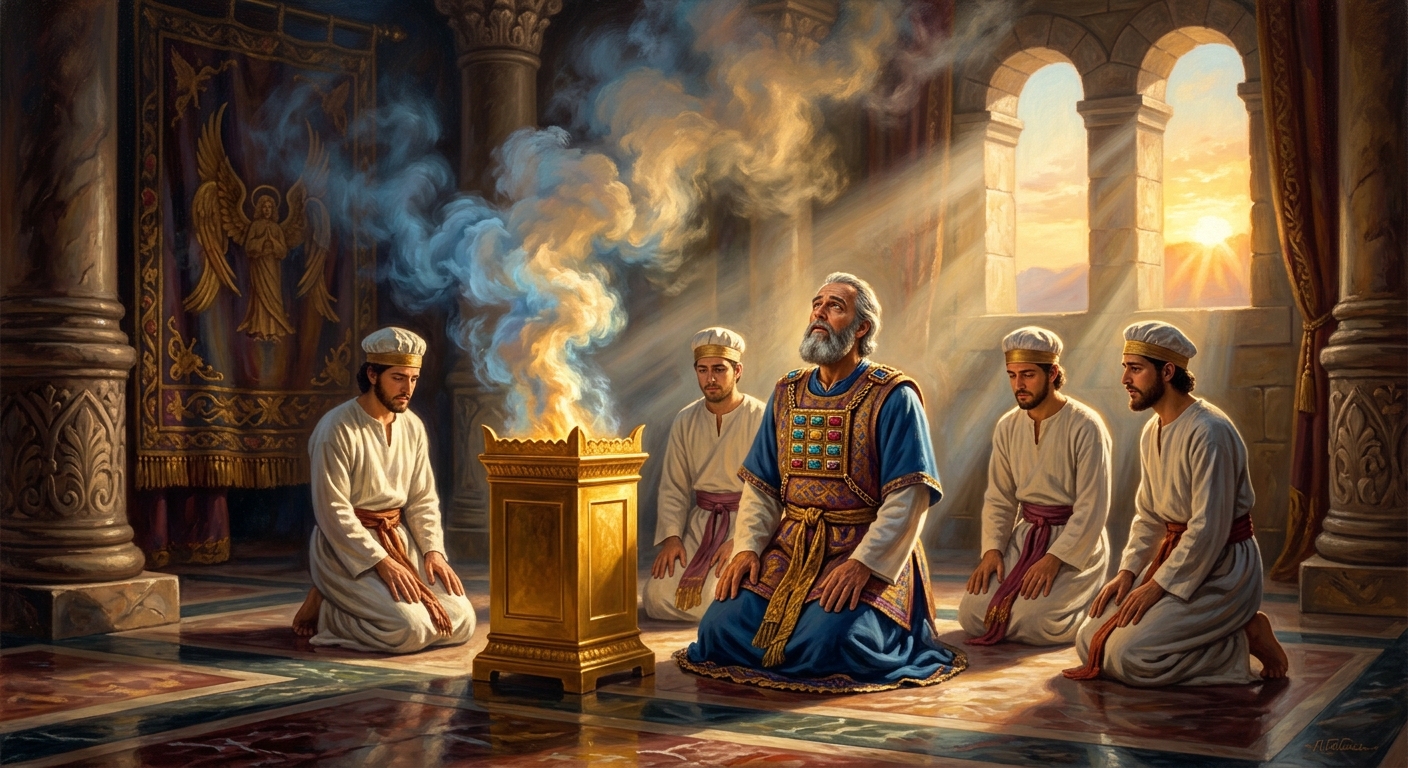
Illustration: A photorealistic oil painting of the consecration ceremony in Leviticus 8, with Aaron and his sons kneeling before a glowing altar of incense at sunrise, radiant light streaming through the temple's high windows and illuminating their elaborate golden priestly garments and sacred breastplate. The atmosphere is charged with solemn reverence as thick clouds of fragrant smoke rise, casting dramatic shadows across the marble floor, while Aaron's face reflects awe and humility under
🔊
Listen to Chapter
Grace Notes Journey Audio Narration
Author
Moses
Written
~1446-1406 BC
Key Theme
Consecration of the priesthood
Setting
Sinai Wilderness
Key Verse
Leviticus 8:12
Total Verses
36
Chapter Introduction
*In the quiet hush of the tabernacle's doorway, God calls Moses to set apart Aaron and his sons for holy service. With reverent hands, Moses follows the divine instructions, anointing them with oil and dressing them in sacred garments. This ceremony reminds us that God desires to be present among His people, guiding and sanctifying them for His purposes. As we read these verses, may our hearts be stirred to seek God's own anointing in our lives, trusting His grace to set us apart for Him.*
Leviticus — Chapter 8 — KJV
1
And the LORD spake unto Moses, saying,
Simply PutThe Hebrew word for “spake” here, dabar (H1695), means to speak or declare. Even in the desert’s silence, God is still saying something to His people—His voice never fades. For someone feeling unheard, this reminds us that the LORD’s promises are still being spoken over our lives.
2
Take Aaron and his sons with him, and the garments, and the anointing oil, and a bullock for the sin offering, and two rams, and a basket of unleavened bread;
Simply Put“Anointing oil” (shemen, H7956) was the holy fragrance that set apart Aaron and his sons for ministry. The “bullock for sin offering” (chatat, H2495) was the first step in dealing with our guilt. In real pain, this shows that God prepares both a sacred space and a sacrificial substitute for those who seek Him.
3
And gather thou all the congregation together unto the door of the tabernacle of the congregation.
Simply Put“Congregation” (qahal, H7021) means the gathered people of God, a community bound together. “Door” (delet, H1710) represents the threshold where the holy meets the ordinary. If you feel isolated, this verse invites you to come into God’s community at His sacred doorway.
4
And Moses did as the LORD commanded him; and the assembly was gathered together unto the door of the tabernacle of the congregation.
Simply Put“Commanded” (tsavah, H6637) is the divine authority that Moses obeys without hesitation. The gathering at the tabernacle’s door shows the people’s willingness to be present where God dwells. For anyone doubting their purpose, this demonstrates the power of obedience to bring unity.
5
And Moses said unto the congregation, This is the thing which the LORD commanded to be done.
Simply Put“Thing” (davar, H1695) is not just an object but a divine decree. Moses declares that the whole ceremony is God’s exact instruction. When you are unsure of what to do, remember that every step has a purpose set by the Almighty.
6
And Moses brought Aaron and his sons, and washed them with water.
Simply Put“Washed” (marar, H4759) with water symbolizes cleansing and renewal. Moses purifies Aaron and his sons before they can serve, showing that holiness begins with inner purification. For those carrying past stains, this verse offers the promise of fresh start.
7
And he put upon him the coat, and girded him with the girdle, and clothed him with the robe, and put the ephod upon him, and he girded him with the curious girdle of the ephod, and bound it unto him therewith.
Simply PutThe “ephod” (H622) was the priest’s sacred apron, a visible sign of his sacred role. Girding with the “curious girdle” (H3625) secured everything in place. This reminds us that true ministry requires both preparation and the willingness to be fully bound to God’s service.
8
And he put the breastplate upon him: also he put in the breastplate the Urim and the Thummim.
Simply PutThe “breastplate” held the Urim (H7360) and Thummim (H7361), divine tools for seeking God’s will. It was the priest’s heart of discernment. In times of doubt, this shows that God equips us with spiritual insight to navigate life’s decisions.
9
And he put the mitre upon his head; also upon the mitre, even upon his forefront, did he put the golden plate, the holy crown; as the LORD commanded Moses.
Simply PutThe “mitre” (H4623) and the golden plate, the “holy crown,” symbolize Aaron’s authority as priest. The crown is a reminder that God bestows honor upon those who faithfully serve Him. For anyone yearning for significance, this points to the divine approval that crowns true service.
10
And Moses took the anointing oil, and anointed the tabernacle and all that was therein, and sanctified them.
Simply Put“Anointed oil” (mashach, H4974) sanctifies the tabernacle and its furnishings. “Sanctified” (qadosh, H6918) means set apart as holy. This teaches that God’s presence requires consecration—His space becomes holy when we apply His oil of blessing.
11
And he sprinkled thereof upon the altar seven times, and anointed the altar and all his vessels, both the laver and his foot, to sanctify them.
Simply Put“Sprinkled” (zakar, H2195) the blood seven times on the altar signifies complete purification. The number seven reflects divine perfection. For those seeking cleansing, this verse emphasizes that God’s forgiveness is thorough and perfect.
12
And he poured of the anointing oil upon Aaron’s head, and anointed him, to sanctify him.
Simply Put“Anointed” (mashach, H4974) Aaron’s head with oil signifies his sanctification as priest. This act sets him apart for holy duties. If you feel unqualified, remember that God’s anointing can transform any ordinary head into a vessel for His work.
13
And Moses brought Aaron’s sons, and put coats upon them, and girded them with girdles, and put bonnets upon them; as the LORD commanded Moses.
Simply Put“Coats” (H5511) and “bonnets” (H4623) placed on Aaron’s sons prepared them for service. The binding of bonnets signifies commitment to the priestly line. In moments of doubt, this shows that God’s family is built through deliberate preparation.
14
And he brought the bullock for the sin offering: and Aaron and his sons laid their hands upon the head of the bullock for the sin offering.
Simply Put“Hands” (yad, H3085) laid on the bullock’s head transfer personal responsibility to the sacrifice. The “sin offering” (chatat, H2495) points to atonement for guilt. When you carry burden, this demonstrates that God invites you to place your hands on a substitute for your sins.
15
And he slew it; and Moses took the blood, and put it upon the horns of the altar round about with his finger, and purified the altar, and poured the blood at the bottom of the altar, and sanctified it, to make reconciliation upon it.
Simply Put“Blood” (dam, H3028) was poured on the altar’s horns, symbolizing purification. “Purify” (tahad, H8459) means to cleanse from impurity. This teaches that true reconciliation with God requires the blood of sacrifice, which cleanses our relationship.
16
And he took all the fat that was upon the inwards, and the caul above the liver, and the two kidneys, and their fat, and Moses burned it upon the altar.
Simply Put“Fat” (shachar, H7999) and the parts above the liver were burned as a pleasing aroma. The sacrifice’s fragrance rose to God, signifying acceptance. For those yearning for approval, this shows that offering the best of ourselves pleases God.
17
But the bullock, and his hide, his flesh, and his dung, he burnt with fire without the camp; as the LORD commanded Moses.
Simply PutThe “outside” (chatzot, H2820) of the camp signifies that waste was removed from holy space. The bullock’s hide and dung were burned elsewhere, maintaining purity within the tabernacle. This reminds us to keep our lives clean and separate from spiritual worship.
18
And he brought the ram for the burnt offering: and Aaron and his sons laid their hands upon the head of the ram.
Simply PutThe “ram” (H7265) for the burnt offering was a sacrifice entirely consumed by fire. The “burnt offering” (olah, H5960) symbolizes total surrender to God. In hunger for intimacy, this invites you to give your whole self in worship.
19
And he killed it; and Moses sprinkled the blood upon the altar round about.
Simply Put“Sprinkled” (zakar, H2195) the blood around the altar reinforces its sanctity. The act of sprinkling demonstrates that God’s presence is protected by blood. For those feeling unsafe, this assures that divine protection surrounds the sacred.
20
And he cut the ram into pieces; and Moses burnt the head, and the pieces, and the fat.
Simply Put“Cut” (katsar, H3680) into pieces and burning the head, pieces, and fat signifies total dedication
21
And he washed the inwards and the legs in water; and Moses burnt the whole ram upon the altar: it was a burnt sacrifice for a sweet savour, and an offering made by fire unto the LORD; as the LORD commanded Moses.
Simply PutThe word "sweet savour" (Strong's H5129) refers to the pleasing aroma of a burnt offering. In this moment, Moses is presenting the whole ram as an "atonement sacrifice," a fragrant offering that lifts our prayers to the LORD, reminding us that even in pain, we can bring our whole selves before God.
22
And he brought the other ram, the ram of consecration: and Aaron and his sons laid their hands upon the head of the ram.
Simply PutThe key word is "ram of consecration" (Strong's H6895), a symbol of dedication. Aaron and his sons lay their hands on the ram's head, signifying that they are transferring their sins onto it; it's like saying, "Take my guilt away," and trusting God to cleanse them.
23
And he slew it; and Moses took of the blood of it, and put it upon the tip of Aaron’s right ear, and upon the thumb of his right hand, and upon the great toe of his right foot.
24
And he brought Aaron’s sons, and Moses put of the blood upon the tip of their right ear, and upon the thumbs of their right hands, and upon the great toes of their right feet: and Moses sprinkled the blood upon the altar round about.
Simply PutHere the same blood is applied to Aaron’s sons, marking them as sanctified. By sprinkling it around the altar (Strong's H4379), they are enveloped in a protective veil, reminding us that God's covenant extends to our families and future generations.
25
And he took the fat, and the rump, and all the fat that was upon the inwards, and the caul above the liver, and the two kidneys, and their fat, and the right shoulder:
Simply PutThe "fat" (Strong's H2819) represents the best portion offered to God. Moses takes the fat, rump, and other parts as a perfect tribute; it shows that when we give God our finest, He receives us with delight and honor.
26
And out of the basket of unleavened bread, that was before the LORD, he took one unleavened cake, and a cake of oiled bread, and one wafer, and put them on the fat, and upon the right shoulder:
Simply PutThe "oiled bread" (Strong's H190) is a sacred provision. By placing these cakes on the fat and right shoulder, Moses is presenting the first fruits of labor—both grain and oil—symbolizing that God blesses our work when we offer it back to Him.
27
And he put all upon Aaron’s hands, and upon his sons’ hands, and waved them for a wave offering before the LORD.
Simply PutThe act of "waving" (Strong's H7224) is a visual presentation to God. Moses places the offerings in Aaron and his sons' hands, then waves them before the LORD, signifying that these gifts are being lifted up in gratitude and worship.
28
And Moses took them from off their hands, and burnt them on the altar upon the burnt offering: they were consecrations for a sweet savour: it is an offering made by fire unto the LORD.
Simply PutThe phrase "consecrations for a sweet savour" (Strong's H5129, H6895) emphasizes that the burnt offering is both holy and pleasing. By burning it on the altar, Moses shows that God delights in sacrifices that come from a sincere heart.
29
And Moses took the breast, and waved it for a wave offering before the LORD: for of the ram of consecration it was Moses’ part; as the LORD commanded Moses.
Simply PutThe "breast" (Strong's H1043) is taken as a wave offering. It belongs to the priest’s portion, reminding us that God provides for those who serve Him faithfully.
30
And Moses took of the anointing oil, and of the blood which was upon the altar, and sprinkled it upon Aaron, and upon his garments, and upon his sons, and upon his sons’ garments with him; and sanctified Aaron, and his garments, and his sons, and his sons’ garments with him.
Simply PutThe "anointing oil" (Strong's H358) is a symbol of sanctification. Moses sprinkles the blood on Aaron, his garments, and his sons, setting them apart as holy—like being wrapped in God’s presence.
31
And Moses said unto Aaron and to his sons, Boil the flesh at the door of the tabernacle of the congregation: and there eat it with the bread that is in the basket of consecrations, as I commanded, saying, Aaron and his sons shall eat it.
Simply PutThe command to "boil the flesh" at the tabernacle door signifies communal fellowship. Aaron and his sons share this meal, illustrating that worship is also about sharing the blessings of God with one another.
32
And that which remaineth of the flesh and of the bread shall ye burn with fire.
Simply PutThe remaining flesh and bread are to be burned, signifying that everything offered must be wholly devoted to God; nothing is left over for self-indulgence.
33
And ye shall not go out of the door of the tabernacle of the congregation in seven days, until the days of your consecration be at an end: for seven days shall he consecrate you.
Simply PutThe seven-day period of consecration is a time of dedication. Aaron and his sons must stay at the tabernacle’s door, learning to abide in God's presence without stepping away, until they are fully sanctified.
34
As he hath done this day, so the LORD hath commanded to do, to make an atonement for you.
Simply PutThe day’s rituals were performed to "make an atonement for you." Atonement (Strong's H618) means reconciling with God, showing that through these sacrifices, our brokenness is healed.
35
Therefore shall ye abide at the door of the tabernacle of the congregation day and night seven days, and keep the charge of the LORD, that ye die not: for so I am commanded.
Simply PutBy remaining at the tabernacle door day and night, Aaron and his sons keep God's charge (Strong's H1622). This obedience safeguards them, reminding us that faithful perseverance leads to divine protection.
36
So Aaron and his sons did all things which the LORD commanded by the hand of Moses.
Simply PutAaron and his sons carried out every single instruction that the LORD gave through Moses. The Hebrew root for “did” (Strong’s H6170) means to bring about or accomplish, and the verb for “commanded” (Strong’s H7580) carries the weight of divine authority. Even when we’re overwhelmed by life’s details, this verse reminds us that God’s directives are not vague—they’re meant to be faithfully followed. It shows the power of obedience: when we trust and act on God’s word, He accomplishes His purpose through us.
Exodus 29:1-9This passage outlines the detailed rites of consecrating Aaron and his sons, directly paralleling Leviticus 8's description of their ordination.
Exodus 30:22-33These verses prescribe the composition and use of the holy anointing oil, which Leviticus 8 employs to sanctify the priests.
Numbers 16:46-50After the rebellion of Korah, these verses affirm that Aaron and his sons alone were to serve as priests, underscoring the significance of their consecration in Leviticus 8.
Hebrews 5:1-4This New Testament passage explains the priestly order of Aaron, showing how Leviticus 8's consecration foreshadows the superior priesthood of Christ.
Reflect
Thinking of Moses sprinkling blood on the altar as a sign of dedication, what personal commitment or fresh start are you ready to make in your own life today?