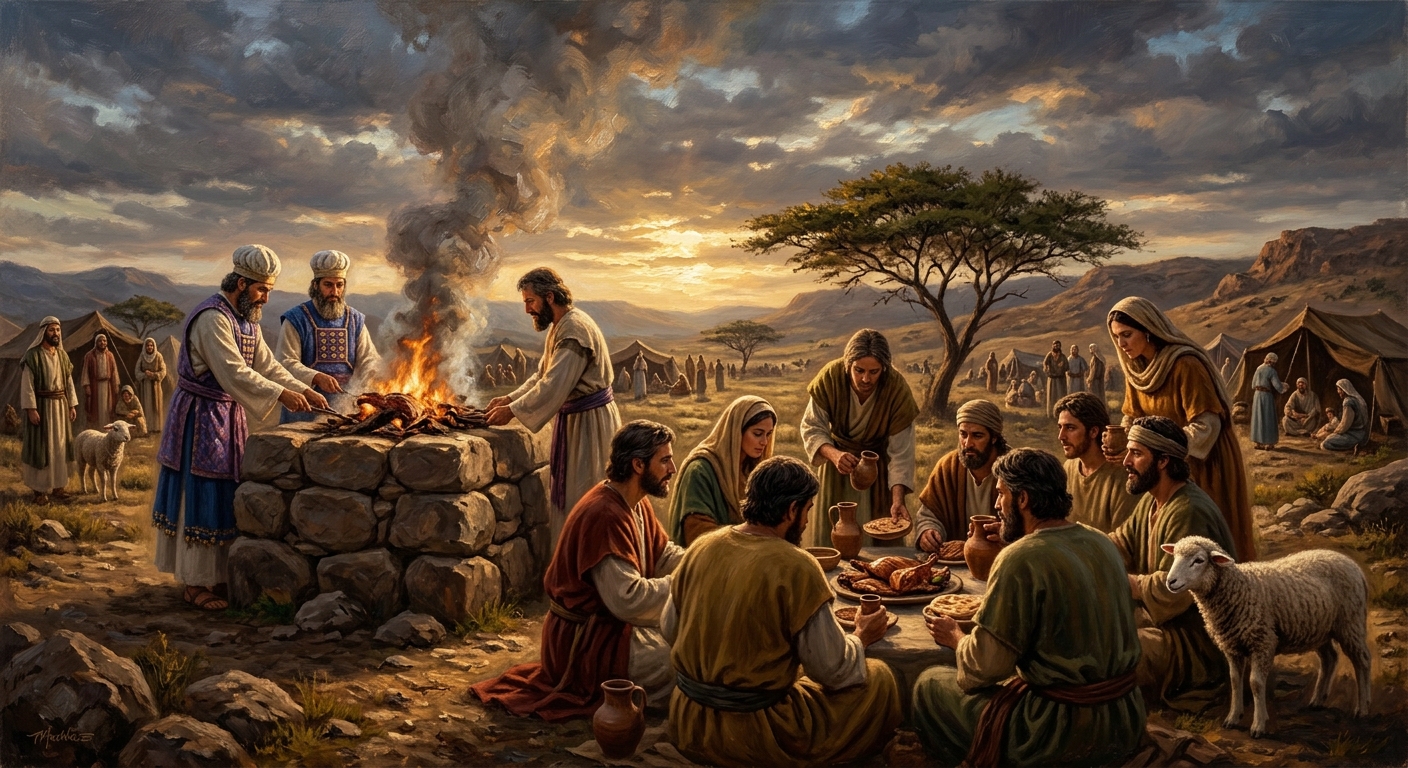
Illustration: Dramatic cinematic biblical illustration for Leviticus Chapter 3 showing Peace offering and communal fellowship, photorealistic oil painting style.
🔊
Listen to Chapter
Grace Notes Journey Audio Narration
Author
Moses
Written
~1446-1406 BC
Key Theme
Peace offering and communal fellowship
Setting
Wilderness Tabernacle Worship
Key Verse
Leviticus 3:1
Total Verses
17
Chapter Introduction
*Beloved, the peace offering invites us into a sacred communion with our Creator. It reminds us that worship is not merely about sacrifice, but also about gratitude and fellowship. As we lay our hands upon the offering, we join in a shared joy that reflects God's desire for peace and relationship. May this chapter stir your heart to offer thankfulness, knowing that God delights in our peaceful devotion.*
Leviticus — Chapter 3 — KJV
1
And if his oblation be a sacrifice of peace offering, if he offer it of the herd; whether it be a male or female, he shall offer it without blemish before the LORD.
Simply PutA peace offering—called an oblation in Hebrew (H609)—is a gift of fellowship, not atonement. It could be an ox, bull, cow, or sheep, male or female, but it must be without blemish (H3063) to show the giver’s sincere heart before God. In our brokenness, this reminds us that God desires a genuine offering of ourselves, not merely ritual.
2
And he shall lay his hand upon the head of his offering, and kill it at the door of the tabernacle of the congregation: and Aaron’s sons the priests shall sprinkle the blood upon the altar round about.
Simply PutTo “lay his hand upon the head” (H6030) means to transfer ownership and identity to the sacrifice. Killing it at the door of the tabernacle signals that the offering is presented directly to God’s presence. The priests then “sprinkle the blood” (H2927) around the altar, a vivid picture of covenant: our lives are marked by His blood for forgiveness and communion.
3
And he shall offer of the sacrifice of the peace offering an offering made by fire unto the LORD; the fat that covereth the inwards, and all the fat that is upon the inwards,
Simply PutThe “fat that covereth the inwards” (H3021) represents the best part of an animal—its most precious substance. Offering it “by fire” (H166) signifies total dedication; the flame consumes and refines. For those yearning for God, this shows that He desires our most valuable, heartfelt devotion.
4
And the two kidneys, and the fat that is on them, which is by the flanks, and the caul above the liver, with the kidneys, it shall he take away.
Simply PutThe “kidneys” (H4009) and the “caul above the liver” (H3102) are prized organs, chosen for sacrifice. Removing them signifies giving God the richest portions of our life. In moments of doubt, remember that He cherishes the finest parts of us, not merely the surface.
5
And Aaron’s sons shall burn it on the altar upon the burnt sacrifice, which is upon the wood that is on the fire: it is an offering made by fire, of a sweet savour unto the LORD.
Simply PutThe priests “burn it on the altar” (H259), turning the offering into a fragrant “sweet savour” (H2635) that pleases God. The fire transforms the sacrifice into a divine aroma, an invisible prayer of love. Even when we feel inadequate, God values the sincere intent behind our offerings.
6
And if his offering for a sacrifice of peace offering unto the LORD be of the flock; male or female, he shall offer it without blemish.
Simply PutThe flock—sheep or goats—must also be “without blemish” (H3063). The requirement is consistent across all livestock: a clean heart is essential for true communion with the Lord. When we come in our brokenness, He calls us to present a genuine self, free from hidden flaws.
7
If he offer a lamb for his offering, then shall he offer it before the LORD.
Simply PutOffering a lamb is an act of humility and innocence. Lambs were young, pure creatures, symbolizing the purity required for approaching God’s presence. In our weariness, this reminds us that a humble heart can still be welcomed by the Almighty.
8
And he shall lay his hand upon the head of his offering, and kill it before the tabernacle of the congregation: and Aaron’s sons shall sprinkle the blood thereof round about upon the altar.
9
And he shall offer of the sacrifice of the peace offering an offering made by fire unto the LORD; the fat thereof, and the whole rump, it shall he take off hard by the backbone; and the fat that covereth the inwards, and all the fat that is upon the inwards,
10
And the two kidneys, and the fat that is upon them, which is by the flanks, and the caul above the liver, with the kidneys, it shall he take away.
11
And the priest shall burn it upon the altar: it is the food of the offering made by fire unto the LORD.
Simply PutThe priest burns the offering, making it “the food of the offering made by fire.” This is not a mere ritual; it’s sustenance for those who serve in God’s house. It reminds us that when we give to God, He also provides for those who minister His Word.
12
And if his offering be a goat, then he shall offer it before the LORD.
Simply PutWhen the offering is a goat, it must be presented “before the LORD.” Goats were often used for sin offerings, yet here they serve as peace offerings—symbols of restored relationship. Even in our guilt, God offers paths to reconciliation and peace.
13
And he shall lay his hand upon the head of it, and kill it before the tabernacle of the congregation: and the sons of Aaron shall sprinkle the blood thereof upon the altar round about.
14
And he shall offer thereof his offering, even an offering made by fire unto the LORD; the fat that covereth the inwards, and all the fat that is upon the inwards,
Simply PutThe priest offers the “fat that covereth the inwards,” a prized portion of the sacrifice. This “sweet savour” (H2635) is meant to be a delightful fragrance to God. In our yearning for Him, we learn that He delights in the best we have to give.
15
And the two kidneys, and the fat that is upon them, which is by the flanks, and the caul above the liver, with the kidneys, it shall he take away.
16
And the priest shall burn them upon the altar: it is the food of the offering made by fire for a sweet savour: all the fat is the LORD’s.
Simply PutThe priest burns these parts, creating a “sweet savour” (H2635) that is wholly the LORD’S. The fat is declared as belonging to God, emphasizing His ownership of all we offer. In our spiritual thirst, this reminds us that everything we give ultimately returns to Him.
17
It shall be a perpetual statute for your generations throughout all your dwellings, that ye eat neither fat nor blood.
Simply PutThis is a “perpetual statute” (H8471) for all generations, instructing us never to eat “fat nor blood.” The command is a lasting reminder of the sanctity and separation required in worship. Even today, it calls us to respect the holiness of God’s covenant, keeping our hearts pure and obedient.
Exodus 29:38-42This passage outlines the daily burnt offering that Aaron's sons were to burn on the altar, directly paralleling Leviticus 3:5’s command that they burn the peace offering on the burnt sacrifice.
Numbers 28:3It pres
Reflect
In light of Leviticus 3’s call to offer “the fat thereof” and the whole rump, what personal talent, time, or relationship do you feel most grateful to share with others as a sign of peace today?