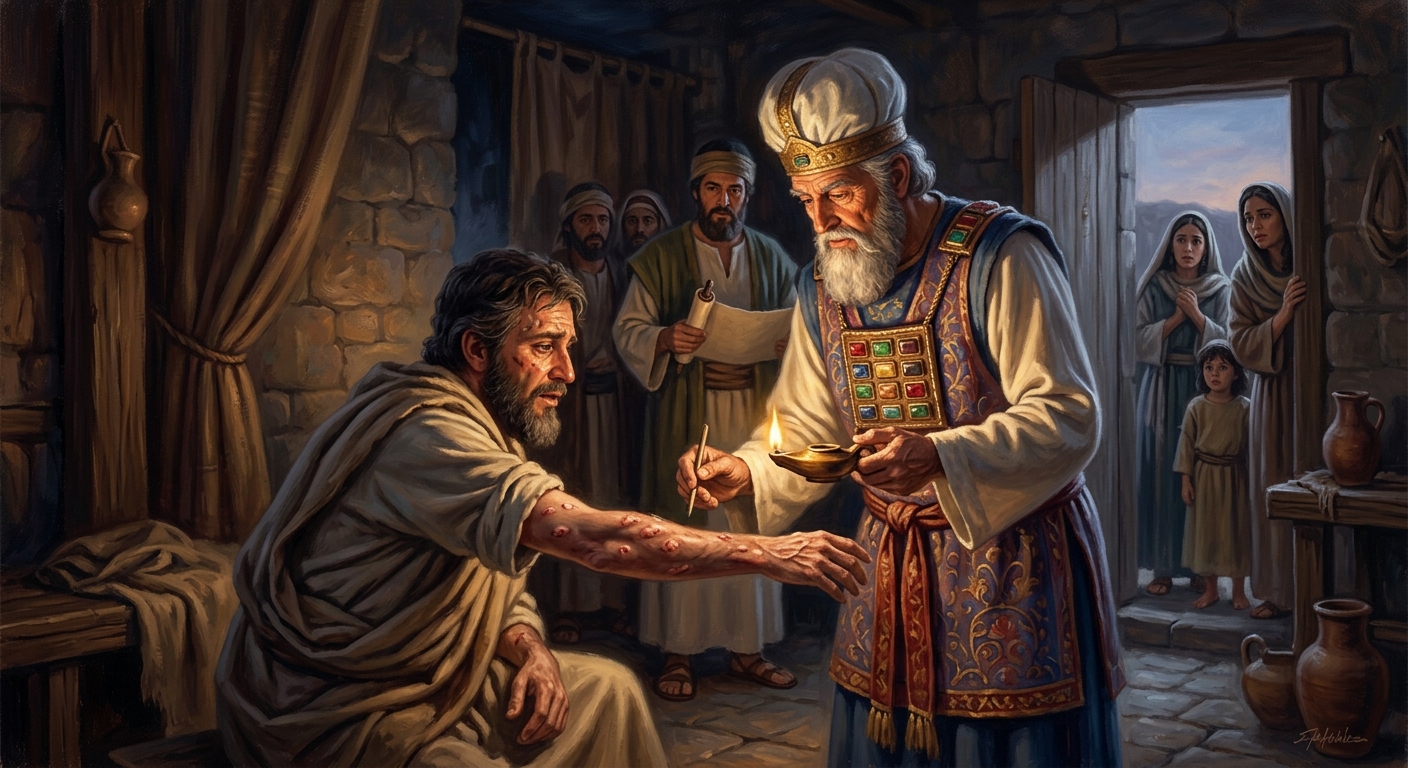
Illustration: Dramatic cinematic biblical illustration for Leviticus Chapter 13 showing Priestly Diagnosis of Purity, photorealistic oil painting style.
🔊
Listen to Chapter
Grace Notes Journey Audio Narration
Author
Moses
Written
~1446-1406 BC
Key Theme
Priestly Diagnosis of Purity
Setting
Sinai Wilderness
Key Verse
Leviticus 13:1
Total Verses
59
Chapter Introduction
*It is in the quiet moments of daily life that God whispers His care for our bodies and souls. In this chapter, the LORD calls Moses and Aaron to guide the people through the mysteries of skin disease, reminding us that physical health is intertwined with spiritual purity. Though the laws seem detailed and strict, they reflect a deep love for community well-being and God's desire to protect His people. As we read, let us trust that the same compassionate God who examined leprous skin also watches over our hearts.*
Leviticus — Chapter 13 — KJV
1
And the LORD spake unto Moses and Aaron, saying,
Simply PutThe Hebrew word for LORD here, YHWH (Strong’s H3068), is the personal Name of God—His living Presence. He speaks directly to Moses and Aaron, reminding us that even the most detailed laws come from a loving God who wants His people healthy and whole.
2
When a man shall have in the skin of his flesh a rising, a scab, or bright spot, and it be in the skin of his flesh like the plague of leprosy; then he shall be brought unto Aaron the priest, or unto one of his sons the priests:
Simply PutThe word “plague” (taba, Strong’s H8450) literally means a swelling or boil. When the skin shows something “like” leprosy (tzaraath, H7275), God commands the priest to examine it. This teaches us that when we feel something “off” in our bodies, we should seek wise counsel—God cares about both our spiritual and physical health.
3
And the priest shall look on the plague in the skin of the flesh: and when the hair in the plague is turned white, and the plague in sight be deeper than the skin of his flesh, it is a plague of leprosy: and the priest shall look on him, and pronounce him unclean.
Simply PutHere the priest looks for hair that has turned white (shafash, H7668) and a swelling deeper than the skin. If those signs appear, it’s declared “unclean” (tah). God uses these physical markers to protect the community from contagion, showing that holiness often involves practical care for one another.
4
If the bright spot be white in the skin of his flesh, and in sight be not deeper than the skin, and the hair thereof be not turned white; then the priest shall shut up him that hath the plague seven days:
Simply PutIf the bright spot is white but shallow, and no hair has turned white, the priest “shuts up” (sawom, H7161) the person for seven days. This pause allows time for healing—God’s law reminds us that sometimes we need a season of rest before moving forward.
5
And the priest shall look on him the seventh day: and, behold, if the plague in his sight be at a stay, and the plague spread not in the skin; then the priest shall shut him up seven days more:
Simply PutOn the seventh day, if the swelling has not spread (taba, H8450), the priest extends the quarantine another week. God’s patience is evident; He gives us multiple chances to heal before declaring a condition permanent.
6
And the priest shall look on him again the seventh day: and, behold, if the plague be somewhat dark, and the plague spread not in the skin, the priest shall pronounce him clean: it is but a scab: and he shall wash his clothes, and be clean.
Simply PutIf the swelling is dark but not spreading, the priest pronounces the person “clean” (tah). The Hebrew phrase “quick raw flesh” (chayyim, H2424) refers to living tissue. This shows that a healed wound is not just skin-deep; it’s about restored life and wholeness.
7
But if the scab spread much abroad in the skin, after that he hath been seen of the priest for his cleansing, he shall be seen of the priest again:
Simply PutIf the scab spreads after being declared clean, the priest must examine it again. God’s standards are consistent—once healed, it should stay healed. If not, the condition is still serious.
8
And if the priest see that, behold, the scab spreadeth in the skin, then the priest shall pronounce him unclean: it is a leprosy.
Simply PutWhen the scab spreads widely, the priest pronounces “unclean” (tah). The Hebrew word for leprosy (tzaraath, H7275) signifies a disease that isolates. God’s law teaches that uncleanliness isn’t about shame but about protecting the community.
9
When the plague of leprosy is in a man, then he shall be brought unto the priest;
Simply PutWhen a man has leprosy, he is brought to the priest. The priest’s role was both spiritual and medical—God provided a system where care and holiness intersect.
10
And the priest shall see him: and, behold, if the rising be white in the skin, and it have turned the hair white, and there be quick raw flesh in the rising;
Simply PutThe priest looks for hair turned white (shafash, H7668) and “quick raw flesh” (chayyim, H2424). The presence of living tissue indicates a deeper infection. God’s law is meticulous; He wants us to notice the subtle signs of disease.
11
It is an old leprosy in the skin of his flesh, and the priest shall pronounce him unclean, and shall not shut him up: for he is unclean.
Simply PutIf it’s an “old leprosy” (tzaraath, H7275), the priest declares the person unclean and does not “shut up” (sawom, H7161). Some conditions are chronic and require ongoing separation. God’s compassion includes long-term care for those afflicted.
12
And if a leprosy break out abroad in the skin, and the leprosy cover all the skin of him that hath the plague from his head even to his foot, wheresoever the priest looketh;
Simply PutIf leprosy spreads from head to foot, the priest looks everywhere (H7209). This total coverage shows the severity of widespread disease. God’s concern is comprehensive—nothing should be overlooked.
13
Then the priest shall consider: and, behold, if the leprosy have covered all his flesh, he shall pronounce him clean that hath the plague: it is all turned white: he is clean.
Simply PutIf the leprosy has covered all flesh and turned white (shafash, H7668), the priest pronounces the person clean. The whiteness symbolizes purification. God grants a fresh start when healing is complete.
14
But when raw flesh appeareth in him, he shall be unclean.
Simply PutWhen raw flesh appears, the person remains unclean. The Hebrew word for “raw” (chayyim, H2424) indicates living tissue still infected. God’s law emphasizes that true cleanliness requires complete healing.
15
And the priest shall see the raw flesh, and pronounce him to be unclean: for the raw flesh is unclean: it is a leprosy.
Simply PutThe priest sees the raw flesh and pronounces unclean. Again, “raw” (chayyim) signifies ongoing disease. God’s message is clear: partial healing isn’t enough; we need full restoration.
16
Or if the raw flesh turn again, and be changed unto white, he shall come unto the priest;
Simply PutIf the raw flesh turns white (shafash, H7668), the person returns to the priest. The transformation from raw to white is a sign of recovery.
17
And the priest shall see him: and, behold, if the plague be turned into white; then the priest shall pronounce him clean that hath the plague: he is clean.
18
The flesh also, in which, even in the skin thereof, was a boil, and is healed,
Simply PutThe flesh where a boil once was is now healed. Boils (taba, H8450) were common afflictions; healing them restores normalcy.
19
And in the place of the boil there be a white rising, or a bright spot, white, and somewhat reddish, and it be shewed to the priest;
Simply PutThe priest examines a bright spot that’s white or reddish. These colors can indicate disease; the priest’s eye is trained to see subtle differences.
20
And if, when the priest seeth it, behold, it be in sight lower than the skin, and the hair thereof be turned white; the priest shall pronounce him unclean: it is a plague of leprosy broken out of the boil.
Simply PutIf it’s deeper than the skin and hair has turned white, the priest pronounces unclean—a leprosy broken out of a boil. The deeper infection (taba) shows that old wounds can become new threats.
21
But if the priest look on it, and, behold, there be no white hairs therein, and if it be not lower than the skin, but be somewhat dark; then the priest shall shut him up seven days:
Simply PutIf there’s no white hair and it isn’t deeper, the priest “shuts up” (sawom) for seven days. The lack of deep infection suggests a chance for recovery.
22
And if it spread much abroad in the skin, then the priest shall pronounce him unclean: it is a plague.
Simply PutIf the spot spreads widely, the priest declares unclean. The spreading indicates that the infection is worsening.
23
But if the bright spot stay in his place, and spread not, it is a burning boil; and the priest shall pronounce him clean.
Simply PutIf the bright spot stays put and doesn’t spread, it’s a “burning boil” (taba), and the priest pronounces clean. The containment shows that a localized issue can be resolved.
24
Or if there be any flesh, in the skin whereof there is a hot burning, and the quick flesh that burneth have a white bright spot, somewhat reddish, or white;
Simply PutWhen there’s a hot burning spot, the Hebrew phrase “quick flesh” (chayyim) refers to living tissue. The redness and whiteness are signs the priest watches closely.
25
Then the priest shall look upon it: and, behold, if the hair in the bright spot be turned white, and it be in sight deeper than the skin; it is a leprosy broken out of the burning: wherefore the priest shall pronounce him unclean: it is the plague of leprosy.
Simply PutIf hair turns white and it’s deeper than the skin, it’s a leprosy broken out of the burning. The depth (taba) signals that the burn has become an infection.
26
But if the priest look on it, and, behold, there be no white hair in the bright spot, and it be no lower than the other skin, but be somewhat dark; then the priest shall shut him up seven days:
27
And the priest shall look upon him the seventh day: and if it be spread much abroad in the skin, then the priest shall pronounce him unclean: it is the plague of leprosy.
Simply PutOn the seventh day, if it has spread much, the priest pronounces unclean—a leprosy. The spreading indicates that the condition is not improving.
28
And if the bright spot stay in his place, and spread not in the skin, but it be somewhat dark; it is a rising of the burning, and the priest shall pronounce him clean: for it is an inflammation of the burning.
Simply PutIf the spot stays and doesn’t spread, it’s a rising of the burning—a clean inflammation. The limited nature suggests that the body is handling the irritation.
29
If a man or woman have a plague upon the head or the beard;
Simply PutIf a man or woman has a plague on their head or beard, the priest must examine it. The hair (shafash) is a key indicator.
30
Then the priest shall see the plague: and, behold, if it be in sight deeper than the skin; and there be in it a yellow thin hair; then the priest shall pronounce him unclean: it is a dry scall, even a leprosy upon the head or beard.
Simply PutIf the plague is deeper than the skin and has yellow thin hair, it’s a “dry scall” (tzaraath) on the head or beard. The yellow hair shows that the infection has penetrated deeply.
31
And if the priest look on the plague of the scall, and, behold, it be not in sight deeper than the skin, and that there is no black hair in it; then the priest shall shut up him that hath the plague of the scall seven days:
Simply PutIf the scall is not deeper and there’s no black hair, the priest shuts up the person for seven days. The superficial nature suggests a chance to heal.
32
And in the seventh day the priest shall look on the plague: and, behold, if the scall spread not, and there be in it no yellow hair, and the scall be not in sight deeper than the skin;
Simply PutOn the seventh day, if the scall hasn’t spread and there’s no yellow hair, the priest shaves it but does not shave the scall itself. This unique shaving ritual marks a stage of “awaiting” healing.
33
He shall be shaven, but the scall shall he not shave; and the priest shall shut up him that hath the scall seven days more:
Simply PutOn the seventh day, if the scall has not spread and isn’t deeper, the priest pronounces clean. The person must wash their clothes—a symbolic act of purification.
34
And in the seventh day the priest shall look on the scall: and, behold, if the scall be not spread in the skin, nor be in sight deeper than the skin; then the priest shall pronounce him clean: and he shall wash his clothes, and be clean.
35
But if the scall spread much in the skin after his cleansing;
Simply PutIf the scall remains stable and black hair has grown within it, the scall is healed—clean. The new growth shows that the disease has been overcome.
36
Then the priest shall look on him: and, behold, if the scall be spread in the skin, the priest shall not seek for yellow hair; he is unclean.
Simply PutIf a man or woman has bright spots—white spots—in their flesh, the priest must examine them. The brightness can be a sign of disease.
37
But if the scall be in his sight at a stay, and that there is black hair grown up therein; the scall is healed, he is clean: and the priest shall pronounce him clean.
Simply PutIf the bright spots are darkish white, they are “freckled” (tzaraath) that grow in the skin—clean. The color indicates a harmless condition.
38
If a man also or a woman have in the skin of their flesh bright spots, even white bright spots;
Simply PutIf a man’s hair has fallen off his head, he is called bald (H6405), but still clean. Physical appearance doesn’t affect one’s purity.
39
Then the priest shall look: and, behold, if the bright spots in the skin of their flesh be darkish white; it is a freckled spot that groweth in the skin; he is clean.
Simply PutIf hair falls off from the crown toward the face, he is “forehead bald” (H6405), yet clean. Again, outward looks are not the measure of holiness.
40
And the man whose hair is fallen off his head, he is bald; yet is he clean.
Simply PutIf there is a white reddish sore on a bald head or forehead, it’s a leprosy sprung up there. The color and location signal disease.
41
And he that hath his hair fallen off from the part of his head toward his face, he is forehead bald: yet is he clean.
Simply PutIf the sore is white reddish, as leprosy appears in flesh, he is a leprous man—unclean. The priest declares him utterly unclean; his plague is in his head.
42
And if there be in the bald head, or bald forehead, a white reddish sore; it is a leprosy sprung up in his bald head, or his bald forehead.
Simply PutThe leper’s clothes are to be torn, his head uncovered, and he wears a covering over his lip while crying “Unclean.” The Hebrew word for leper (tzaraath, H7275) signifies someone who must be isolated.
43
Then the priest shall look upon it: and, behold, if the rising of the sore be white reddish in his bald head, or in his bald forehead, as the leprosy appeareth in the skin of the flesh;
44
He is a leprous man, he is unclean: the priest shall pronounce him utterly unclean; his plague is in his head.
Simply PutWhether the garment is wool or linen, skin or any work of skin (H5930), the priest examines it. The material doesn’t matter; the disease is what matters.
45
And the leper in whom the plague is, his clothes shall be rent, and his head bare, and he shall put a covering upon his upper lip, and shall cry, Unclean, unclean.
Simply PutIf the plague in a garment is greenish or reddish, it’s a leprosy and must be shown to the priest. The color indicates an active infection.
46
All the days wherein the plague shall be in him he shall be defiled; he is unclean: he shall dwell alone; without the camp shall his habitation be.
Simply PutOn the seventh day, if the plague spreads in the garment—warp or woof—it is a fretting leprosy, unclean. The priest shuts it up for seven days.
47
The garment also that the plague of leprosy is in, whether it be a woollen garment, or a linen garment;
Simply PutThe priest then burns the garment—warp, woof, wool, or linen—because it is a fretting leprosy. Burning purifies and destroys the source of contagion.
48
Whether it be in the warp, or woof; of linen, or of woollen; whether in a skin, or in any thing made of skin;
Simply PutIf the priest sees that the plague has not spread in the garment, he commands it to be washed and shut up for seven more days. The washing offers a chance for the garment to become clean.
49
And if the plague be greenish or reddish in the garment, or in the skin, either in the warp, or in the woof, or in any thing of skin; it is a plague of leprosy, and shall be shewed unto the priest:
Simply PutAfter washing, if the plague has not changed color and hasn’t spread, it remains unclean and must be burnt. The stubbornness of the disease shows that some things need total removal.
50
And the priest shall look upon the plague, and shut up it that hath the plague seven days:
Simply PutIf after washing the plague appears somewhat dark, the priest rips it out of the garment. The darkness (tzaraath) indicates lingering impurity.
51
And he shall look on the plague on the seventh day: if the plague be spread in the garment, either in the warp, or in the woof, or in a skin, or in any work that is made of skin; the plague is a fretting leprosy; it is unclean.
Simply PutIf it still appears in the garment—warp, woof, or any skin thing—it is a spreading plague. The priest commands it to be burnt with fire.
52
He shall therefore burn that garment, whether warp or woof, in woollen or in linen, or any thing of skin, wherein the plague is: for it is a fretting leprosy; it shall be burnt in the fire.
Simply PutIf the garment is washed and the plague has departed, it’s washed a second time and becomes clean. The repeated washing shows that diligence can restore purity.
53
And if the priest shall look, and, behold, the plague be not spread in the garment, either in the warp, or in the woof, or in any thing of skin;
Simply PutThis is the law of leprosy in garments—to pronounce them clean or unclean. The detailed instructions underscore God’s care for communal health and holiness.
54
Then the priest shall command that they wash the thing wherein the plague is, and he shall shut it up seven days more:
Simply PutThe priest tells you to wash the item that’s been touched by the disease and then keep it shut for another seven days. Think of this as a period of waiting after cleaning, allowing the situation to settle before you move on.
55
And the priest shall look on the plague, after that it is washed: and, behold, if the plague have not changed his colour, and the plague be not spread; it is unclean; thou shalt burn it in the fire; it is fret inward, whether it be bare within or without.
Simply PutAfter washing, the priest looks at the disease. If its color hasn’t changed and it isn’t spreading, he declares it unclean and orders that it be burned. The Hebrew word for “plague” here, tzaraath (H7285), refers to a sickness that spreads outward; it reminds us that unchecked impurity must be removed.
56
And if the priest look, and, behold, the plague be somewhat dark after the washing of it; then he shall rend it out of the garment, or out of the skin, or out of the warp, or out of the woof:
Simply PutIf, after the wash, the disease appears darker, the priest must tear it out of the garment or skin. This visible darkening signals that the impurity is deeper and needs to be physically removed.
57
And if it appear still in the garment, either in the warp, or in the woof, or in any thing of skin; it is a spreading plague: thou shalt burn that wherein the plague is with fire.
Simply PutWhen the disease still persists in the fabric—whether in the warp or woof—it is called a spreading plague. The priest then commands that whatever has the disease be burned, showing that ongoing impurity must be completely eradicated.
58
And the garment, either warp, or woof, or whatsoever thing of skin it be, which thou shalt wash, if the plague be departed from them, then it shall be washed the second time, and shall be clean.
Simply PutIf the disease has left the garment after washing, a second wash is required. Only then is it declared clean, illustrating that true cleansing often requires a thorough, repeated process.
59
This is the law of the plague of leprosy in a garment of woollen or linen, either in the warp, or woof, or any thing of skins, to pronounce it clean, or to pronounce it unclean.
Simply PutThis is the rule for identifying leprosy in wool or linen garments, whether in the warp, woof, or any skin item. The priest’s verdict—clean or unclean—guides the community in dealing with disease and impurity.
Leviticus 14:2‑3This passage continues the priestly examination process, describing how a leper who has been healed must be inspected before being declared clean.
Numbers 5:1‑4These verses outline the priest's role in diagnosing skin disease (plague), mirroring the investigative procedures detailed in Leviticus 13.
Leviticus 15:2‑3The chapter on bodily discharges also requires priestly inspection of skin conditions, providing a parallel ritual framework to Leviticus 13.
Matthew 8:1‑4The New Testament account of Jesus healing a leper demonstrates the fulfillment and continuity of the Levitical skin disease laws.
Reflect
When you notice a subtle change in your skin, hair, or body—something that hints at an inner health issue—how do you choose to respond: by seeking honest help, or by masking it out of fear of being labeled "unclean"?