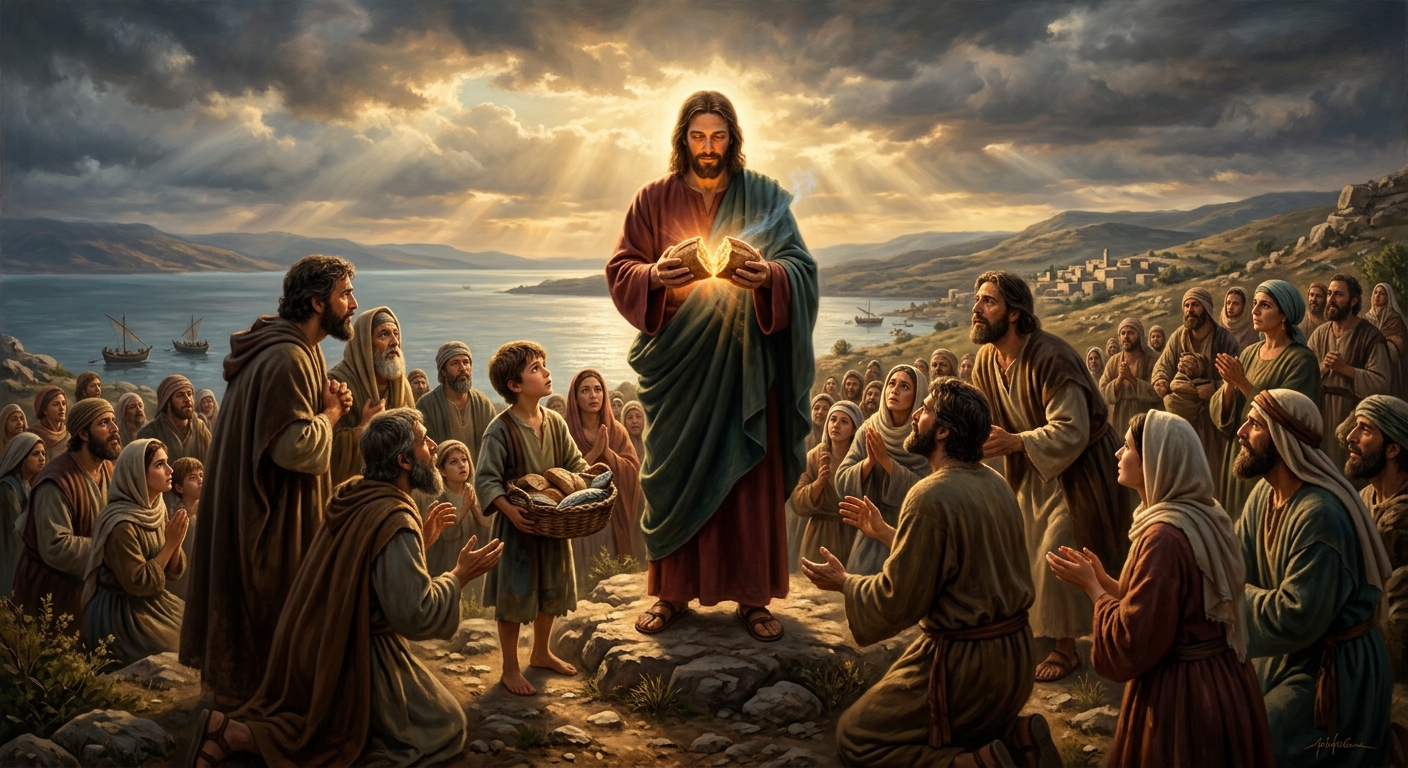
Illustration: Dramatic cinematic biblical illustration for John Chapter 6 showing Christ as the Bread of Eternal Life, photorealistic oil painting style.
🔊
Listen to Chapter
Grace Notes Journey Audio Narration
Author
John the Apostle
Written
~90-95 AD
Key Theme
Christ as the Bread of Eternal Life
Setting
Sea of Galilee, Passover Festival
Key Verse
John 6:35
Total Verses
71
Chapter Introduction
*In the gentle hush of a mountain, Jesus gathers his beloved disciples to reveal a profound mystery. He invites us to see beyond the miracles of bread and fish, pointing instead to the living Bread that satisfies every soul. This chapter invites each heart to trust in Christ's abundant provision, reminding us that true nourishment comes from His love. May we receive this gift with gratitude and faith.*
John — Chapter 6 — KJV
1
After these things Jesus went over the sea of Galilee, which is the sea of Tiberias.
Simply PutThe Greek word for "sea" (G1495) indicates a vast, tumultuous body of water. In this verse, Jesus steps across the Sea of Galilee—an everyday scene that becomes a backdrop for divine action. It reminds us that even in life's deepest waters, God is present and moving.
2
And a great multitude followed him, because they saw his miracles which he did on them that were diseased.
Simply PutThe crowd follows Jesus because of his "miracles" (G2453), especially his healing power over the diseased. To someone in pain, this shows that Jesus sees and cares for our brokenness. His compassion offers hope that we too can be made whole.
3
And Jesus went up into a mountain, and there he sat with his disciples.
Simply PutJesus climbs a "mountain" (G4522), a place of quiet and revelation. Sitting with his disciples there, He creates an intimate setting for teaching. It shows that God meets us in places of stillness to speak truth into our lives.
4
And the passover, a feast of the Jews, was nigh.
Simply PutThe "Passover" (Hebrew H4002) is the feast that commemorates Israel's deliverance from Egypt. Its nearness signals a time of remembrance and expectation, foreshadowing the ultimate deliverance Jesus would bring. For believers today, it points to God's faithfulness across generations.
5
When Jesus then lifted up his eyes, and saw a great company come unto him, he saith unto Philip, Whence shall we buy bread, that these may eat?
Simply PutThe word for "bread" (G846) represents the basic sustenance of life. When Jesus asks, "Whence shall we buy bread?" He is addressing the real hunger of those gathered. It reminds us that our deepest needs are known and cared for by God.
6
And this he said to prove him: for he himself knew what he would do.
Simply PutJesus says this to "prove" (Greek G1401) Philip, showing His foreknowledge of the miracle to come. It demonstrates that Jesus knows our doubts and uses them to teach deeper truths. He invites us into a larger story beyond immediate concerns.
7
Philip answered him, Two hundred pennyworth of bread is not sufficient for them, that every one of them may take a little.
Simply PutPhilip's answer highlights the "pennyworth" (Greek G416) of bread needed for a large crowd. It underscores the apparent insufficiency we often feel. Yet God shows that even the smallest amount can become abundant in His hands.
8
One of his disciples, Andrew, Simon Peter’s brother, saith unto him,
Simply PutAndrew, Simon Peter's brother, brings the observation that there is a lad with five barley loaves and two fish. His humble voice points out the scarcity that surrounds us, reminding us that we often overlook small gifts.
9
There is a lad here, which hath five barley loaves, and two small fishes: but what are they among so many?
Simply PutBarley loaves (Greek G4627) were a common, inexpensive grain in that era. The disciples wonder how such meager provisions could feed so many. It teaches us that God's miracles can start from the simplest, most modest offerings.
10
And Jesus said, Make the men sit down. Now there was much grass in the place. So the men sat down, in number about five thousand.
Simply PutThe "grass" (Greek G2621) covering the hillside provides a natural place for people to sit. The simple setting emphasizes that divine provision can occur in ordinary, everyday spaces.
11
And Jesus took the loaves; and when he had given thanks, he distributed to the disciples, and the disciples to them that were set down; and likewise of the fishes as much as they would.
Simply PutJesus "gave thanks" (Greek G2195) before distributing the loaves and fishes. This act of gratitude highlights that every blessing begins with a heart of thankfulness. It shows us the importance of acknowledging God’s gifts before sharing them.
12
When they were filled, he said unto his disciples, Gather up the fragments that remain, that nothing be lost.
Simply PutAfter everyone is satisfied, Jesus instructs His disciples to collect the "fragments" (Greek G4621) that remain. The care for leftovers demonstrates God’s concern for stewardship and completeness.
13
Therefore they gathered them together, and filled twelve baskets with the fragments of the five barley loaves, which remained over and above unto them that had eaten.
Simply PutThe twelve baskets filled with the leftover pieces illustrate that God's provision is not just sufficient but overflowing. Even after feeding five thousand, there was an abundance left—a powerful reminder of God's generosity.
14
Then those men, when they had seen the miracle that Jesus did, said, This is of a truth that prophet that should come into the world.
Simply PutThe crowd declares that this miracle must be the work of a "prophet" (Greek G5345) who would come into the world. Their recognition connects Jesus to Old Testament promises, showing that He fulfills long-awaited expectations of divine guidance.
15
When Jesus therefore perceived that they would come and take him by force, to make him a king, he departed again into a mountain himself alone.
Simply PutJesus perceives their intention to "take him by force" and make Him a king, so He retreats alone to the mountain. This reveals the tension between human expectations of power and Jesus’ desire for spiritual intimacy, reminding us that true worship requires personal reflection and solitude.
16
And when even was now come, his disciples went down unto the sea,
Simply PutIn the quiet evening, the disciples left the crowd and headed for the sea. The word “even” (Greek: nu, G562) signals not just a time of day but a turning point—a moment when the day's excitement fades into night. It's a reminder that even amid life's busyness, God often calls us to step away and seek Him in solitude.
17
And entered into a ship, and went over the sea toward Capernaum. And it was now dark, and Jesus was not come to them.
Simply PutAs darkness fell, they boarded a boat to cross over toward Capernaum. The Greek word “dark” (skotos, G4629) means more than lack of light; it can speak to the unknown depths we sometimes travel through when God seems distant. Though Jesus was not with them on that night, He was walking beside the shore of their journey.
18
And the sea arose by reason of a great wind that blew.
Simply PutA great wind rose up and whipped the sea into a frenzy. The term “great” (mega, G3144) captures how overwhelming earthly storms can become, yet it also hints at the powerful presence of God that stills them. In our own tempests, we can trust that He holds the wind in His palm.
19
So when they had rowed about five and twenty or thirty furlongs, they see Jesus walking on the sea, and drawing nigh unto the ship: and they were afraid.
Simply PutAfter rowing twenty or thirty furlongs, they saw Jesus walking on the sea and coming toward their boat. The vivid image of “walking” (peripatizomai, G3987) shows a divine authority over the chaos. Their fear is real, but it also marks the moment when ordinary doubts meet extraordinary grace.
20
But he saith unto them, It is I; be not afraid.
Simply Put“It is I; be not afraid,” He said. The phrase “I am” (ego eimi, G1473) is a personal claim that echoes the ancient name of God—He is present. This simple reassurance invites us to lay our worries aside and trust in His unchanging identity.
21
Then they willingly received him into the ship: and immediately the ship was at the land whither they went.
Simply PutThey welcomed Him into the boat, and instantly they reached the land they were headed for. Their willingness (theles, G5041) reflects a heart that trusts the Savior's direction. It reminds us that when we give Him space on our “boat,” He guides us swiftly to the places He knows we need.
22
The day following, when the people which stood on the other side of the sea saw that there was none other boat there, save that one whereinto his disciples were entered, and that Jesus went not with his disciples into the boat, but that his disciples were gone away alone;
Simply PutThe next day, those on the far shore noticed there was no other boat but the one with His disciples. The word “none” (ou, G376) underscores how exclusive and intimate the moment was—Jesus chose to be with His disciples alone. It reminds us that God sometimes withdraws the crowd to focus on the faithful.
23
(Howbeit there came other boats from Tiberias nigh unto the place where they did eat bread, after that the Lord had given thanks:)
Simply PutOther boats came from Tiberias, near where they had eaten after the Lord gave thanks. The act of “giving thanks” (eucharistia, G2175) highlights that Jesus began the miracle with gratitude. It teaches us that even in our need, a thankful heart can open doors for divine provision.
24
When the people therefore saw that Jesus was not there, neither his disciples, they also took shipping, and came to Capernaum, seeking for Jesus.
Simply PutSeeing Jesus and His disciples missing, they too set out to Capernaum, searching for Him. The word “sought” (zeteo, G2212) shows a deep longing that persists even when the obvious signs disappear. It encourages us to keep looking for God, especially when He seems hidden.
25
And when they had found him on the other side of the sea, they said unto him, Rabbi, when camest thou hither?
Simply PutWhen they found Him on the far side of the sea, they asked, “Rabbi, when did you come here?” The term “Rabbi” (rabban, G4481) reflects deep respect and the desire to know His timing. It reminds us that we often seek God’s moves without fully understanding His schedule.
26
Jesus answered them and said, Verily, verily, I say unto you, Ye seek me, not because ye saw the miracles, but because ye did eat of the loaves, and were filled.
Simply Put“Truly, truly,” He replied, “you seek me not for the miracles, but because you ate of the loaves and were filled.” The double “truly” (amen, G231) is a powerful seal of truth. He points out that our hearts often chase the afterglow of blessings, rather than the source of those blessings.
27
Labour not for the meat which perisheth, but for that meat which endureth unto everlasting life, which the Son of man shall give unto you: for him hath God the Father sealed.
Simply Put“Don’t labor for food that perishes, but for the food that lasts forever—what the Son of Man will give you.” The Greek “work” (ergazomai, G2045) here is about effort that yields eternal fruit. It urges us to set our sights on the spiritual nourishment that God promises, rather than fleeting comforts.
28
Then said they unto him, What shall we do, that we might work the works of God?
Simply Put“What must we do so we can work the works of God?” They asked. The phrase “what shall we do” (ti poieis, G5041) reveals a hunger to serve. It reminds us that the desire to do good must be rooted in understanding God’s will.
29
Jesus answered and said unto them, This is the work of God, that ye believe on him whom he hath sent.
Simply Put“The work of God,” He answered, “is to believe in Him whom the Father has sent.” The word “work” (ergon, G2045) is not about deeds alone but the faith that undergirds them. It tells us that genuine belief is the foundation of all true service.
30
They said therefore unto him, What sign shewest thou then, that we may see, and believe thee? what dost thou work?
Simply Put“What sign will you show us so that we may see and believe?” they asked. The term “sign” (sēma, G4590) reflects the human need for visible proof. It serves as a reminder that true belief isn’t just about seeing miracles, but hearing the voice of Christ within our hearts.
31
Our fathers did eat manna in the desert; as it is written, He gave them bread from heaven to eat.
Simply PutThe word “manna” (G3310) points to the miraculous food God gave Israel in the desert. Jesus reminds them that while their ancestors ate this heavenly bread, it was a temporary provision—just enough to survive the journey.
32
Then Jesus said unto them, Verily, verily, I say unto you, Moses gave you not that bread from heaven; but my Father giveth you the true bread from heaven.
Simply PutWhen Jesus says “Moses gave you not that bread from heaven,” the Greek phrase “the true bread” (G1903) signals a deeper reality than the physical manna. He’s saying that only God can give a bread that satisfies the deepest cravings of our soul.
33
For the bread of God is he which cometh down from heaven, and giveth life unto the world.
Simply Put“The bread of God” here is a metaphor for the one who descends from heaven to give life. For anyone feeling empty or lost, this verse promises that there is a divine source that can fill the void and bring true vitality.
34
Then said they unto him, Lord, evermore give us this bread.
Simply PutThe crowd’s cry for “evermore give us this bread” shows a hunger that goes beyond daily meals. It’s a cry for an enduring, spiritual sustenance that can satisfy their deepest needs.
35
And Jesus said unto them, I am the bread of life: he that cometh to me shall never hunger; and he that believeth on me shall never thirst.
Simply Put“I am the bread of life” (G1903) means that Jesus Himself is the source of spiritual nourishment. Those who come to Him will never be spiritually hungry or thirsty again, because He satisfies the heart’s deepest longings.
36
But I said unto you, That ye also have seen me, and believe not.
Simply PutJesus points out that even though they have seen Him, many still don’t believe. This challenges those who say they “know” God but haven’t truly trusted Him in the midst of their doubts.
37
All that the Father giveth me shall come to me; and him that cometh to me I will in no wise cast out.
Simply PutThe promise that “him that cometh to me I will in no wise cast out” (G156) assures anyone who approaches Jesus with sincerity that He won’t reject them; instead, He welcomes them into a place of safety.
38
For I came down from heaven, not to do mine own will, but the will of him that sent me.
Simply Put“I came down from heaven” (G168) emphasizes that Jesus’ mission is not about His own agenda but about fulfilling the Father’s will. For those feeling directionless, this shows that true purpose comes from aligning with God’s plan.
39
And this is the Father’s will which hath sent me, that of all which he hath given me I should lose nothing, but should raise it up again at the last day.
Simply PutThe Father’s will is that none of what He has given to Jesus—His people—will be lost, but will be raised up at the last day. This offers hope to those fearing loss or death, promising a future resurrection.
40
And this is the will of him that sent me, that every one which seeth the Son, and believeth on him, may have everlasting life: and I will raise him up at the last day.
Simply Put“Everlasting life” (G166) is the ultimate gift of believing in the Son. This assures anyone struggling with mortality that there is a permanent life beyond this world, secured by Jesus.
41
The Jews then murmured at him, because he said, I am the bread which came down from heaven.
Simply PutThe Jews “murmured” (G2450) because they couldn’t grasp how Jesus could be the bread from heaven. Their doubt reflects a common human struggle to accept profound spiritual truths.
42
And they said, Is not this Jesus, the son of Joseph, whose father and mother we know? how is it then that he saith, I came down from heaven?
Simply PutBy asking, “Is not this Jesus, the son of Joseph?” they highlight that His earthly origins seem to contradict His heavenly claim. This tension mirrors the inner conflict of those who see only what’s visible.
43
Jesus therefore answered and said unto them, Murmur not among yourselves.
Simply PutJesus tells them to stop “murmuring” (G2450), urging a shift from idle questioning to listening. It reminds us that true understanding often comes when we cease arguing and open our hearts.
44
No man can come to me, except the Father which hath sent me draw him: and I will raise him up at the last day.
Simply Put“The Father ... draw him” (G1220) indicates that only God can bring someone to Jesus. This comfortingly tells those who feel too weak or lost that they cannot be pulled toward God on their own; He will draw them.
45
It is written in the prophets, And they shall be all taught of God. Every man therefore that hath heard, and hath learned of the Father, cometh unto me.
Simply Put“They shall be all taught of God” (G1010) shows that those who hear and learn from the Father are drawn to Jesus. For anyone seeking guidance, this verse promises that divine instruction leads to a personal encounter with Christ.
46
Not that any man hath seen the Father, save he which is of God, he hath seen the Father.
Simply PutWhen Jesus says that only the one "of God" has seen the Father, He is pointing to the Greek word for Father (G3962) and God (G2316). It means that true spiritual sight comes only through a deep, divine relationship. If you feel blind in your life, know that this vision is granted to those who belong to God.
47
Verily, verily, I say unto you, He that believeth on me hath everlasting life.
Simply PutHere the Greek term for "everlasting life" (αἰώνιος, G164) tells us that this is not a short-lived promise but an unending reality. Believing in Jesus secures this forever life. In moments of doubt, cling to this truth: your faith anchors you in eternity.
48
I am that bread of life.
Simply PutJesus declares Himself as the bread (G746) that brings life (ζωή, G2222). He is saying He is the spiritual nourishment we truly need. Like hunger that gnaws at the soul, only His provision can satisfy and sustain us.
49
Your fathers did eat manna in the wilderness, and are dead.
Simply PutThe manna (μάννα, G3088) the fathers ate was a temporary miracle for survival in the wilderness. They are now dead, showing that such food cannot keep you alive forever. For those yearning for lasting sustenance, this points to something beyond mere physical provision.
50
This is the bread which cometh down from heaven, that a man may eat thereof, and not die.
Simply PutThis bread from heaven (G746) is a gift that keeps you alive forever. Unlike earthly food, it prevents death spiritually. If you're feeling spiritually dead, this is the promise that can revive you.
51
I am the living bread which came down from heaven: if any man eat of this bread, he shall live for ever: and the bread that I will give is my flesh, which I will give for the life of the world.
Simply PutThe "living bread" (ζῶν, G2222) that comes from heaven is Jesus Himself. He offers His flesh (σάρξ, G4565) as the true nourishment for the world. This is not a metaphor about eating food, but a call to embrace His sacrifice so we may receive life.
52
The Jews therefore strove among themselves, saying, How can this man give us his flesh to eat?
Simply PutThe Jews were confused because the word "flesh" (σάρξ, G4565) seemed literal—how could a man give his flesh to eat? Their struggle shows how hard it is to grasp the spiritual meaning. It's a reminder that divine truths often defy our natural expectations.
53
Then Jesus said unto them, Verily, verily, I say unto you, Except ye eat the flesh of the Son of man, and drink his blood, ye have no life in you.
54
Whoso eateth my flesh, and drinketh my blood, hath eternal life; and I will raise him up at the last day.
Simply PutWhoever eats His flesh and drinks His blood receives eternal life (αἰώνιος, G164) and will be raised up on the last day. This is a promise of resurrection and unending existence. Trust this assurance when you fear the finality of death.
55
For my flesh is meat indeed, and my blood is drink indeed.
Simply PutJesus clarifies that His flesh is indeed meat (κρέας, G2915) and His blood is drink (ποτόν, G4183). He speaks of a real consumption that signifies deep spiritual union. For those feeling hollow, this is the invitation to be filled through Him.
56
He that eateth my flesh, and drinketh my blood, dwelleth in me, and I in him.
Simply PutThose who eat His flesh and drink His blood dwell in Him, and He dwells in them (κατοικέω, G2699). This is a profound oneness—a living partnership with Christ. If your heart feels isolated, this union offers true companionship.
57
As the living Father hath sent me, and I live by the Father: so he that eateth me, even he shall live by me.
Simply PutJust as the living Father sent Jesus and He lives through the Father, those who eat Him will live by Him. This shows that our life source is Christ Himself (ζῆν, G2222). When you feel lifeless, remember that His life can become yours.
58
This is that bread which came down from heaven: not as your fathers did eat manna, and are dead: he that eateth of this bread shall live for ever.
Simply PutThis heavenly bread grants eternal life (αἰώνιος, G164), unlike the manna of old that left people dead. Eating this bread ensures everlasting living. For anyone searching for a lasting solution, Christ offers the ultimate fulfillment.
59
These things said he in the synagogue, as he taught in Capernaum.
Simply PutJesus spoke these truths in the synagogue (συναγωγή, G4846) and taught them in Capernaum. The setting underscores that these revelations were meant for an audience familiar with scripture. Even in ancient places, the message was radical.
60
Many therefore of his disciples, when they had heard this, said, This is an hard saying; who can hear it?
Simply PutMany disciples called His words "hard," asking who could hear or understand them. The Greek phrase for "hard saying" (δυσκόλοψ, G1488) reflects the difficulty of embracing this spiritual truth. If you're struggling to grasp it now, know you're among those who wrestle with deep divine mysteries.
61
When Jesus knew in himself that his disciples murmured at it, he said unto them, Doth this offend you?
Simply PutThe Greek word here, skandalizo (G4535), means to cause someone to stumble or be scandalized. Jesus sees his disciples grumbling and gently asks, “Does this offend you?” He’s not mocking them; He’s inviting them to confront their doubts head-on.
62
What and if ye shall see the Son of man ascend up where he was before?
Simply PutThe key word is “ascend” (anabaino, G511), meaning to rise up. Jesus warns them that if they cannot accept Him rising above His former glory, their understanding of God will remain limited. It’s a call to trust in the divine plan even when it surpasses human expectations.
63
It is the spirit that quickeneth; the flesh profiteth nothing: the words that I speak unto you, they are spirit, and they are life.
Simply PutThe Greek term spirit (pneuma, G4151) points to the breath of God that gives life. Jesus declares that flesh alone is useless, but His spoken words are spirit and life. In moments of emptiness, His promises become the living breath that sustains us.
64
But there are some of you that believe not. For Jesus knew from the beginning who they were that believed not, and who should betray him.
Simply PutThe loaded word is “believe” (pisteuo, G4100). Jesus already knows who doubts and who will betray Him. It’s a reminder that even when we feel uncertain, He sees our heart and knows the path each of us is on.
65
And he said, Therefore said I unto you, that no man can come unto me, except it were given unto him of my Father.
Simply Put“Father” (patēr, G3962) emphasizes the divine source of all gifts. Jesus explains that only those whom the Father gives can come to Him. Our spiritual journey begins with God’s grace, not by our own effort alone.
66
From that time many of his disciples went back, and walked no more with him.
Simply PutThe word “time” (chronos, G5549) marks a turning point. From that moment onward, many disciples chose to walk away from Jesus. It shows how a single encounter with truth can change the direction of our lives.
67
Then said Jesus unto the twelve, Will ye also go away?
Simply Put“Go away” (apollumi, G592) reflects the disciples’ reaction to the heavy teaching. Jesus asks the twelve if they will also turn their backs, challenging them to examine their commitment.
68
Then Simon Peter answered him, Lord, to whom shall we go? thou hast the words of eternal life.
Simply Put“Lord” (kyrie, G2962) and “eternal life” (aionios zoe, G166 & G2222) reveal the depth of Peter’s confession. He declares that Jesus holds the words of everlasting life, and they find their hope in Him.
69
And we believe and are sure that thou art that Christ, the Son of the living God.
Simply Put“Christ” (christos, G5547) identifies Jesus as the Anointed One. Peter believes and is confident that He is the Son of the living God, anchoring his faith in a divine reality beyond this world.
70
Jesus answered them, Have not I chosen you twelve, and one of you is a devil?
Simply PutThe word “devil” (diabolos, G1401) is a warning that not all chosen are faithful. Jesus tells the twelve that among them is one who will be a deceiver.
71
He spake of Judas Iscariot the son of Simon: for he it was that should betray him, being one of the twelve.
Simply PutThe key term “son” (huios, G5205) refers to Judas as the child of Simon. He is singled out as the one who would betray Jesus, even though he was counted among the twelve.
Exodus 16:4This verse describes God providing manna to the Israelites, prefiguring Jesus' miracle of feeding the five thousand with loaves and fishes in John 6.
Matthew 14:19This verse recounts the feeding of the five thousand, providing a parallel Synoptic account that illuminates John 6's miracle.
John 4:14This verse speaks of Jesus as the source of living water, thematically linked to John 6's declaration that He is the Bread of Life.
1 Corinthians 10:16This verse explains the symbolism of the bread and cup as participation in Christ's body, illuminating John 6:53‑58's teaching on eating His flesh and drinking His blood.
Reflect
When was the last time you sensed that God had spoken to you, yet you found yourself hesitating to fully trust and respond?