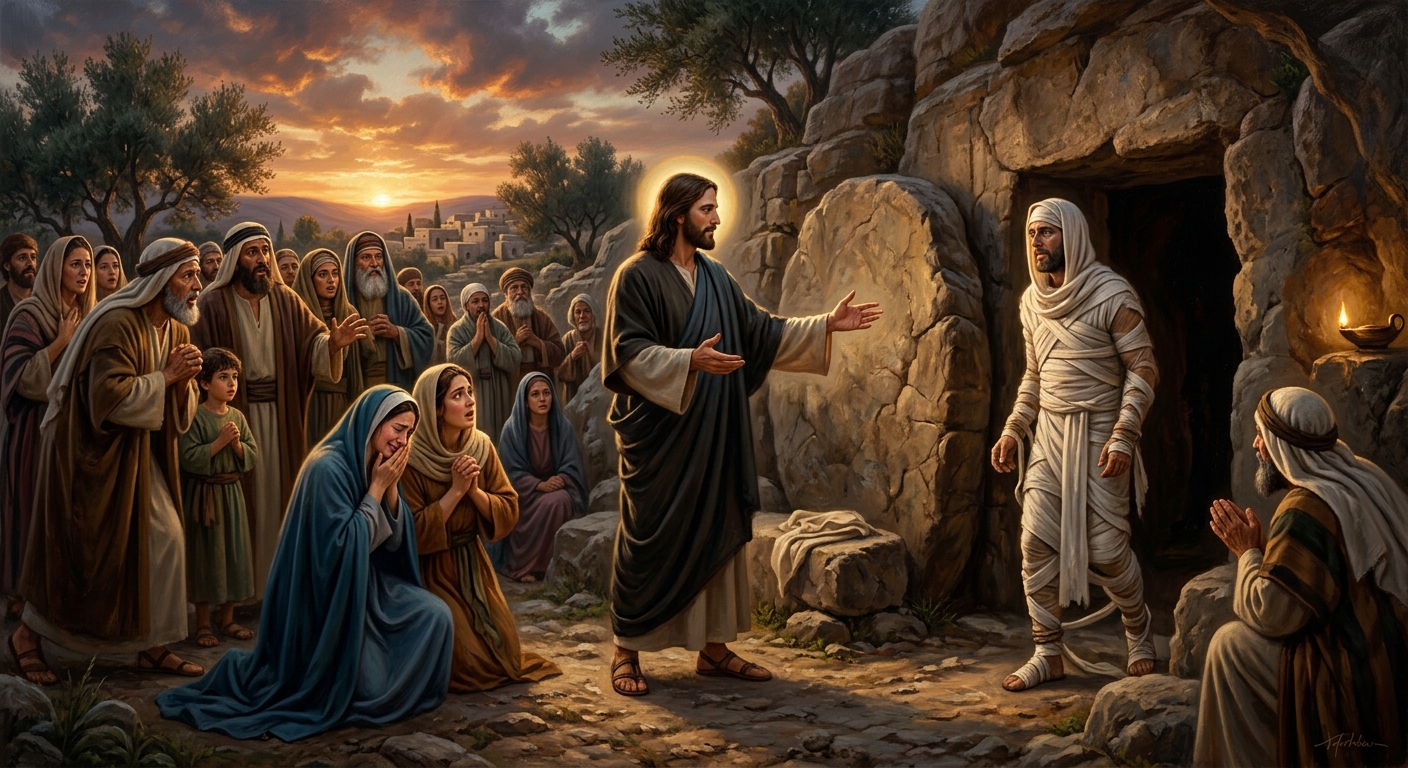
Illustration: Dramatic cinematic biblical illustration for John Chapter 11 showing Resurrection and Eternal Life, photorealistic oil painting style.
🔊
Listen to Chapter
Grace Notes Journey Audio Narration
Author
John the Apostle
Written
~90-95 AD
Key Theme
Resurrection and Eternal Life
Setting
Bethany, before Passover
Key Verse
John 11:25
Total Verses
57
Chapter Introduction
*Dear friend, in this tender narrative we see the deep love of our Savior for His friends. He invites us to trust that even in life's darkest valleys, God's glory shines brighter through our trials. Let the miracle of Lazarus remind us that Christ is always near, ready to breathe new life into our weary hearts. May we walk in the confidence of His promise: He is the Resurrection and the Life.*
John — Chapter 11 — KJV
1
Now a certain man was sick, named Lazarus, of Bethany, the town of Mary and her sister Martha.
Simply PutLazarus was a real person, a "man" (Greek anthropos, G444), who fell ill in Bethany—a small town where his sisters Mary and Martha lived. This verse sets the stage for a personal tragedy that will become a divine miracle.
2
(It was that Mary which anointed the Lord with ointment, and wiped his feet with her hair, whose brother Lazarus was sick.)
Simply PutMary, who later showed profound devotion by anointing Jesus with costly perfume, is highlighted here. The Greek word for "anointed" (spoudazo) means to honor someone with oil, indicating her deep love and respect for the Lord.
3
Therefore his sisters sent unto him, saying, Lord, behold, he whom thou lovest is sick.
Simply PutMartha and Mary sent a heartfelt message to Jesus, saying, "Lord, behold, he whom you love is sick." The word for "love" (agape, G26) reveals the deep, personal bond they had with Jesus, prompting them to call for his help.
4
When Jesus heard that, he said, This sickness is not unto death, but for the glory of God, that the Son of God might be glorified thereby.
Simply PutUpon hearing the news, Jesus said that this sickness was not meant for death but for God's glory (Greek doxa, G1391). He recognized that through this trial, the Son of God would be glorified, showing that even suffering can serve a higher purpose.
5
Now Jesus loved Martha, and her sister, and Lazarus.
Simply PutJesus loved Martha, Mary, and Lazarus deeply (again using agape, G26). This love wasn't just a feeling—it was an active care that would soon be shown through his miraculous work.
6
When he had heard therefore that he was sick, he abode two days still in the same place where he was.
Simply PutWhen Jesus learned of Lazarus's illness, he stayed where he was for two days (Greek meinein, G3303). This pause wasn't about neglect; it set the stage for a divine timing to unfold.
7
Then after that saith he to his disciples, Let us go into Judaea again.
Simply PutAfter those two days, Jesus told his disciples, "Let us go back into Judea." He was preparing to return to the very place where his friends lived, showing his willingness to be present in their pain.
8
His disciples say unto him, Master, the Jews of late sought to stone thee; and goest thou thither again?
Simply PutThe disciples warned him that the Jews had recently tried to stone him. They were concerned about safety, yet their love for Jesus kept them willing to journey where danger loomed.
9
Jesus answered, Are there not twelve hours in the day? If any man walk in the day, he stumbleth not, because he seeth the light of this world.
Simply PutJesus replied, "Are there not twelve hours in the day?" He used daylight (Greek hora, G2272) as a metaphor for clarity and presence. If someone walks in the light, he won't stumble because he sees where he's going.
10
But if a man walk in the night, he stumbleth, because there is no light in him.
Simply PutHe contrasted this with darkness (Greek nyx, G3588), saying that walking at night leads to stumbling because there is no light within. This illustrates how spiritual blindness can cause people to falter.
11
These things said he: and after that he saith unto them, Our friend Lazarus sleepeth; but I go, that I may awake him out of sleep.
Simply PutJesus told them that Lazarus was sleeping, but he intended to wake him. He used the Greek word for "sleep" (kathizō, G2682) as a gentle way to speak about death, indicating his power over both life and its end.
12
Then said his disciples, Lord, if he sleep, he shall do well.
Simply PutThe disciples assumed Lazarus was merely resting. They thought "sleep" meant peace, not realizing Jesus was speaking of death.
13
Howbeit Jesus spake of his death: but they thought that he had spoken of taking of rest in sleep.
Simply PutIn reality, Jesus referred to Lazarus’s death (Greek thanatos, G5049). The disciples simply did not understand the gravity of his words and thought he meant a literal sleep.
14
Then said Jesus unto them plainly, Lazarus is dead.
Simply PutJesus clarified, "Lazarus is dead." He used the Greek term for dead (nekros, G4220) to be clear that their friend had passed away.
15
And I am glad for your sakes that I was not there, to the intent ye may believe; nevertheless let us go unto him.
Simply PutHe expressed his gladness (Greek charizomai, G548) that they were not present, so their belief would be strengthened. He encouraged them to go with him and witness the miracle of life overcoming death.
16
Then said Thomas, which is called Didymus, unto his fellowdisciples, Let us also go, that we may die with him.
Simply PutThomas, also known as Didymus (meaning “twin”), says to his friends, “Let’s go too, so we can die with him.” The Greek word for “die” (apothnēskō) means to pass away completely. Thomas is saying that he wants to share in whatever is happening—whether it’s sorrow or something divine.
17
Then when Jesus came, he found that he had lain in the grave four days already.
Simply PutWhen Jesus arrives, He discovers that Lazarus has been lying (koptō) in the tomb for four days. The word “lain” here shows that Lazarus has been completely still, as if he were dead, yet Jesus finds him there.
18
Now Bethany was nigh unto Jerusalem, about fifteen furlongs off:
Simply PutBethany is close to Jerusalem—about fifteen furlongs, or roughly two miles away. The distance reminds us that this is a nearby place where daily life and community happen.
19
And many of the Jews came to Martha and Mary, to comfort them concerning their brother.
Simply PutMany Jews came to Martha and Mary “to comfort” (paraklēsei) them about their brother. The Greek word for comfort means to encourage and support, showing that the community gathered around them in their grief.
20
Then Martha, as soon as she heard that Jesus was coming, went and met him: but Mary sat still in the house.
Simply PutMartha went out to meet Jesus as soon as she heard He was coming, while Mary waited “still” (heōs) at home. The word still means “until now,” showing Mary’s quiet devotion and her expectation of Jesus’ arrival.
21
Then said Martha unto Jesus, Lord, if thou hadst been here, my brother had not died.
Simply PutMartha says, “Lord, if you had been here sooner, my brother wouldn’t have died.” The Greek word for “if” (ean) hints at a condition that was not met, but her words also show she trusts in God’s timing.
22
But I know, that even now, whatsoever thou wilt ask of God, God will give it thee.
Simply PutMartha says, “I know that whatever you ask of God now, He will give it to you.” The word for “ask” (aiteō) reflects a deep request, and it shows her confidence that God can meet any need.
23
Jesus saith unto her, Thy brother shall rise again.
Simply PutJesus tells her, “Your brother will rise again.” The Greek word for “rise” (anastasis) refers to a new beginning after death, pointing toward the hope of life beyond the tomb.
24
Martha saith unto him, I know that he shall rise again in the resurrection at the last day.
Simply PutMartha replies, “I know that he will rise again in the resurrection at the last day.” She uses the word “resurrection” (apokalypsis), meaning a future, ultimate restoration that God will bring at the end of time.
25
Jesus said unto her, I am the resurrection, and the life: he that believeth in me, though he were dead, yet shall he live:
Simply PutJesus declares, “I am the resurrection and the life.” The Greek word for “life” (zōē) indicates a deep, enduring existence. He tells her that anyone who believes in Him will live again, even if they have died.
26
And whosoever liveth and believeth in me shall never die. Believest thou this?
Simply PutHe adds, “Whoever lives and believes in me will never die.” The word “believe” (pisteō) means to trust fully. He asks her, “Do you believe this?” inviting a personal decision about eternal life.
27
She saith unto him, Yea, Lord: I believe that thou art the Christ, the Son of God, which should come into the world.
Simply PutMary says, “Yes, Lord. I believe you are the Christ and the Son of God who is to come into the world.” “Christ” (Christos) means anointed one, confirming her faith that Jesus is the promised Savior.
28
And when she had so said, she went her way, and called Mary her sister secretly, saying, The Master is come, and calleth for thee.
Simply PutAfter she says this, Mary goes quietly to her sister and tells her, “The Master is coming and calling for you.” The word “called” (kaleō) shows a personal invitation from Jesus to come and see Him.
29
As soon as she heard that, she arose quickly, and came unto him.
Simply PutWhen Mary hears this, she quickly rises up and comes to Jesus. The verb “arose” (emphē) conveys urgency, as she rushes to meet Him.
30
Now Jesus was not yet come into the town, but was in that place where Martha met him.
Simply PutJesus has not yet entered the town; He is still in the place where Martha met Him. The word “come into” (prosēgē) indicates that He is still on His way, moving toward the moment of their encounter.
31
The Jews then which were with her in the house, and comforted her, when they saw Mary, that she rose up hastily and went out, followed her, saying, She goeth unto the grave to weep there.
Simply PutThe Jews who were with her in the house, seeing Mary rise quickly and go out, said, “She is going to the tomb to weep there.” The Greek word for weeping, δακρύω (G2414), paints a picture of tears flowing freely. In real pain, this scene reminds us that grief can drive us to seek the source of our hope—the one who lives beyond the stone-cold reality of death.
32
Then when Mary was come where Jesus was, and saw him, she fell down at his feet, saying unto him, Lord, if thou hadst been here, my brother had not died.
Simply PutWhen Mary reached where Jesus was, she fell at his feet and said, “Lord, if you had been here, my brother would not have died.” The word Lord (κύριος, G2962) is more than a title; it’s an intimate acknowledgment of Jesus as Master over life and death. To someone in doubt, her words echo the longing for a Savior who could have prevented the loss we cherish.
33
When Jesus therefore saw her weeping, and the Jews also weeping which came with her, he groaned in the spirit, and was troubled,
Simply PutWhen Jesus saw her weeping, and also the Jews with her, he “groaned in spirit” and was troubled. The Greek verb μονολογέω (G3420) means “to speak alone,” a deep sigh from the heart. This shows that even the Son of God felt the weight of sorrow, a reminder to those in real pain that their grief touches even divine compassion.
34
And said, Where have ye laid him? They said unto him, Lord, come and see.
Simply PutHe asked, “Where have you laid him?” They replied, “Lord, come and see.” The verb θεωρέω (G2316) means to behold or view, inviting them into a deeper revelation. For those hungry for God, this is a call to witness the power that could change their understanding of death.
35
Jesus wept.
Simply PutJesus wept. The simple, profound word δακρύω (G2414) again reflects his humanity. Even the Messiah is moved by loss, offering comfort to those weeping that they are never alone in their sorrow.
36
Then said the Jews, Behold how he loved him!
Simply PutThe Jews said, “Behold how he loved him!” The Greek agape (G26) is a selfless, divine love that flows from the heart. In real pain, this shows that Jesus’ love is not abstract but tangible—he cares deeply for each of us.
37
And some of them said, Could not this man, which opened the eyes of the blind, have caused that even this man should not have died?
Simply PutSome asked, “Could this man who opened the eyes of the blind not have prevented his death?” The verb ἀνοίγω (G527) means to open, and τυφλός (G5116) is blind. This question reveals a hunger for redemption, hoping that the same power that healed could also restore life.
38
Jesus therefore again groaning in himself cometh to the grave. It was a cave, and a stone lay upon it.
Simply PutJesus groaned again in himself and came to the grave, which was a cave with a stone. The term μονολογέω (G3420) again underscores his inner turmoil, while σπηλαια (G4622) reminds us of the darkness that surrounds death.
39
Jesus said, Take ye away the stone. Martha, the sister of him that was dead, saith unto him, Lord, by this time he stinketh: for he hath been dead four days.
Simply PutJesus said, “Take away the stone.” Martha replied, “Lord, by now it smells—for he has been dead four days.” The Greek for stink (ὀσφραίνομαι, G3630) and dead (νεκρός, G3540) capture her practical concern. Even amidst doubt, she trusts enough to obey, showing that faith can grow even in the midst of a foul reality.
40
Jesus saith unto her, Said I not unto thee, that, if thou wouldest believe, thou shouldest see the glory of God?
Simply PutJesus said, “Did I not tell you that if you would believe, you would see the glory of God?” The word glory (δόξα, G1391) speaks of divine splendor revealed. For the hungry soul, belief unlocks a glimpse of God's power beyond the veil of death.
41
Then they took away the stone from the place where the dead was laid. And Jesus lifted up his eyes, and said, Father, I thank thee that thou hast heard me.
Simply PutThey took away the stone. Jesus lifted his eyes, thanked the Father for hearing him. The Greek πατήρ (G3962) is an intimate Father, and εὐχαριστέω (G209) means heartfelt gratitude. Even when surrounded by witnesses, Jesus seeks communion with the Father—a model for us to thank God in trials.
42
And I knew that thou hearest me always: but because of the people which stand by I said it, that they may believe that thou hast sent me.
Simply PutHe said, “I knew you hear me always; but because of the people standing by, I said it so they may believe you sent me.” The verb ἀκούω (G511) is to hear, and πέμπω (G4225) means to send. Jesus’ purpose was communal—our doubts become testimonies for others when we see God’s action.
43
And when he thus had spoken, he cried with a loud voice, Lazarus, come forth.
Simply PutHe cried with a loud voice, “Lazarus, come forth.” The adjective κραταιός (G2905) means powerful or strong, indicating the authority behind his call. The command echoes a promise to those in need: if you hear His voice, he will bring the dead back to life.
44
And he that was dead came forth, bound hand and foot with graveclothes: and his face was bound about with a napkin. Jesus saith unto them, Loose him, and let him go.
Simply PutThe man who was dead came forth, bound hand and foot with graveclothes; his face wrapped in a napkin. The verb δήσσω (G1314) means to bind, and σινδών (G5400) is a linen cloth. Even in death’s grip, the power of Christ loosens every bond, offering freedom to those shackled by sin.
45
Then many of the Jews which came to Mary, and had seen the things which Jesus did, believed on him.
Simply PutMany of the Jews who came to Mary, having seen what Jesus did, believed in him. The word πιστεύω (G4100) means to trust or have faith. Witnessing a miracle turned doubt into belief, reminding us that seeing God’s work can ignite a lasting trust in Him.
46
But some of them went their ways to the Pharisees, and told them what things Jesus had done.
Simply PutThe Pharisees were the religious elite of their day, and they loved to keep a tight grip on what people believed about God. When the news of Jesus' miracles reached them, it sparked both curiosity and caution—like hearing about a new doctor who could heal the sick but might also threaten their authority.
47
Then gathered the chief priests and the Pharisees a council, and said, What do we? for this man doeth many miracles.
Simply PutThe chief priests and Pharisees gathered in council, fearing that Jesus' miracles (Greek: ποιέω, G4160—meaning "to do" or "to act") would draw crowds and undermine their control. Their whispered question, “What do we?” shows a heart in turmoil—balancing fear of Jesus with the desire to maintain their own power.
48
If we let him thus alone, all men will believe on him: and the Romans shall come and take away both our place and nation.
Simply PutThe Greek word for “believe” (πιστεύω, G4100) means to place trust or reliance in someone. They feared that if Jesus was left unchecked, everyone would turn to Him and the Roman empire might strip away their nation’s very identity—showing how spiritual belief can ripple into political stability.
49
And one of them, named Caiaphas, being the high priest that same year, said unto them, Ye know nothing at all,
Simply PutCaiaphas, the high priest that year, declared “You know nothing at all.” The Greek verb for “know” (γινώσκω, G1097) isn’t just about facts; it’s seeing the deeper purpose of God’s plan. He wanted to keep the people blind to the salvation that was about to unfold.
50
Nor consider that it is expedient for us, that one man should die for the people, and that the whole nation perish not.
Simply PutThe term “expedient” (συμφέρω, G4975) means what is appropriate or convenient for a specific purpose. Caiaphas suggested that it would be fitting for one man to die so the nation could survive—a concept that hints at a sacrificial substitute, though he didn’t yet realize it would be Jesus.
51
And this spake he not of himself: but being high priest that year, he prophesied that Jesus should die for that nation;
Simply PutHe wasn’t speaking on his own; as the high priest, Caiaphas “prophesied” (προφητεύω, G4255) that Jesus would die for the nation. This shows that even those who opposed Him could unwittingly be instruments in God’s divine foretelling of the Savior’s sacrifice.
52
And not for that nation only, but that also he should gather together in one the children of God that were scattered abroad.
Simply PutThe Greek verb “gather” (συνάγω, G4939) means to bring together into one. The prophecy went beyond a single nation—it spoke of gathering the scattered children of God worldwide, hinting at the universal reach of the Gospel that would later unfold.
53
Then from that day forth they took counsel together for to put him to death.
Simply PutFrom that day forward, they plotted together to put Him to death. The verb “counsel” (συνβουλεύω, G4975) reflects a coordinated effort—a political conspiracy that would set the stage for the greatest act of love in history.
54
Jesus therefore walked no more openly among the Jews; but went thence unto a country near to the wilderness, into a city called Ephraim, and there continued with his disciples.
Simply PutJesus stopped wandering openly among the Jews and withdrew to a town near the wilderness called Ephraim. This isn’t just a retreat; it’s a season of preparation, where He spent time with His disciples—like a shepherd gathering his flock before the storm.
55
And the Jews’ passover was nigh at hand: and many went out of the country up to Jerusalem before the passover, to purify themselves.
Simply PutThe Passover was near, and many left their homes to go to Jerusalem for purification. Passover (Πάσχα) is the celebration of God’s deliverance, and the Jews were seeking a fresh start—perhaps hoping that Jesus would be the one to fulfill this ancient promise.
56
Then sought they for Jesus, and spake among themselves, as they stood in the temple, What think ye, that he will not come to the feast?
Simply PutThey searched for Jesus while standing in the temple and wondered, “Do you think He will not come to the feast?” Their question (Greek: ζητέω, G2248) shows a mix of expectation and doubt—wondering if He would appear at the sacred gathering.
57
Now both the chief priests and the Pharisees had given a commandment, that, if any man knew where he were, he should shew it, that they might take him.
Simply PutThe chief priests and Pharisees set a command for anyone who might know Jesus’ whereabouts to reveal it, so they could seize Him. The verb “show” (δείκνυμι, G1165) wasn’t just about location; it was a trap to capture the Son of God.
Luke 10:38-42This passage contrasts Martha's service with Mary's devotion, echoing the sisters' roles in John 11 and Jesus' commendation of Mary’s love.
John 5:21-24Jesus declares that He has power over life and death, foreshadowing His raising of Lazarus in John 11.
Exodus 15:2The declaration that the Lord's glory is revealed in His strength parallels Jesus' statement that Lazarus' sickness serves to display the glory of God.
1 Kings 17:21-22Elijah's resurrection of the widow's son prefigures Jesus' miracle of raising Lazarus, highlighting divine authority over death.
Reflect
When you hear a prompt that stirs your heart, how quickly do you rise and move toward the One who brings life?