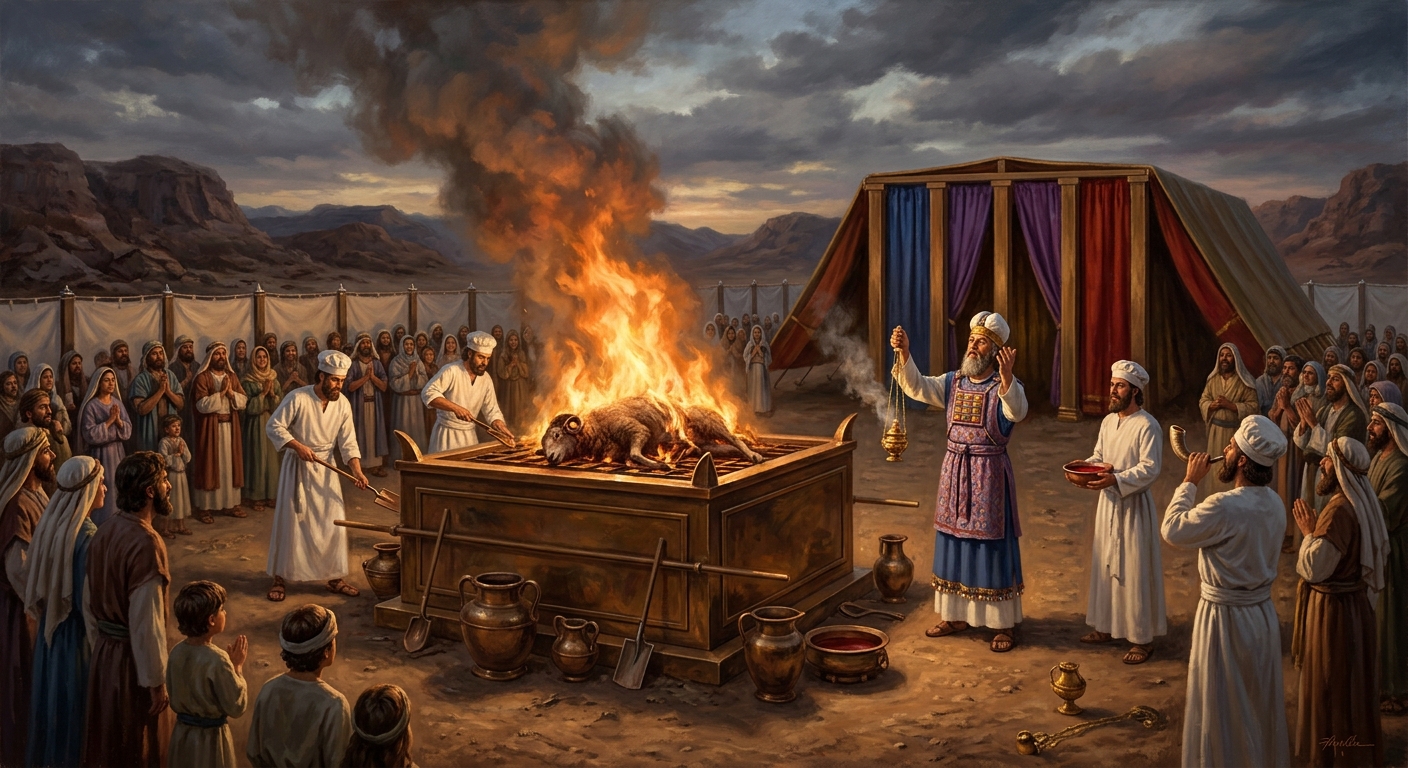
Illustration: Dramatic cinematic biblical illustration for Exodus Chapter 38 showing Divine Worship through the Altar, photorealistic oil painting style.
🔊
Listen to Chapter
Grace Notes Journey Audio Narration
Author
Moses
Written
~1446-1406 BC
Key Theme
Divine Worship through the Altar
Setting
Sinai Wilderness
Key Verse
Exodus 38:2
Total Verses
31
Chapter Introduction
*In the quiet of the wilderness, God prepared a sacred space for us—a place where our hearts could meet His. The altar of burnt offering, carefully crafted from shittim wood and adorned with bronze rings, stands as a symbol of our devotion. Each detail, from the horns to the grate beneath, reflects God's desire for intimate communion through sacrifice. As we approach this altar today, may our worship be as sincere and heartfelt as the ancient offerings of Israel.*
Exodus — Chapter 38 — KJV
1
And he made the altar of burnt offering of shittim wood: five cubits was the length thereof, and five cubits the breadth thereof; it was foursquare; and three cubits the height thereof.
Simply PutThe altar (mizbeach, H4192) of burnt offering (olah, H5955) is a square platform—five cubits long and wide, three high. In God's presence, this sacred altar is where we bring our whole selves as a fragrant sacrifice to Him. Its size reminds us that God's love for us is vast and His holiness requires a dedicated space.
2
And he made the horns thereof on the four corners of it; the horns thereof were of the same: and he overlaid it with brass.
Simply PutThe four horns (qeren, H7143) on each corner of the altar symbolize power and stability. Overlaid with brass, these horns point upward, reminding us that our worship should lift us toward God's throne. They also remind the Israelites of the altar’s strength, a refuge in times of trouble.
3
And he made all the vessels of the altar, the pots, and the shovels, and the basons, and the fleshhooks, and the firepans: all the vessels thereof made he of brass.
Simply PutEvery tool—pots, shovels, basins, fleshhooks, firepans—is made of brass (neḥoshet, H5119). These vessels are the hands of worship, each serving a purpose in the sacrificial system. They teach us that God values every detail of our service, no matter how small or seemingly mundane.
4
And he made for the altar a brasen grate of network under the compass thereof beneath unto the midst of it.
Simply PutA brasen grate of network (merhab, H4871) sits beneath the altar’s edge. This opening allows the fire to breathe and the smoke to rise, symbolizing how our prayers ascend through the altar of Christ. The grate reminds us that God’s presence is both a fire and a refuge.
5
And he cast four rings for the four ends of the grate of brass, to be places for the staves.
Simply PutFour sturdy rings (taḥab, H8462) are cast for the grate. These rings are like anchors that hold the altar together, just as God’s covenant holds our lives steady. They remind us of the importance of being firmly attached to His promises.
6
And he made the staves of shittim wood, and overlaid them with brass.
Simply PutThe staves (matseph, H4732) of shittim wood are overlaid with brass. These wooden poles allow the priests to carry the heavy altar, illustrating that God provides support for our burdens. Just as the wood is reinforced with metal, He strengthens us when we are weak.
7
And he put the staves into the rings on the sides of the altar, to bear it withal; he made the altar hollow with boards.
Simply PutThe staves are placed into the rings, making the altar hollow with boards. This design lets the altar be moved when needed—symbolic of how God can relocate His worship to wherever we need Him. It shows that the holiness of worship isn’t confined by walls; it’s carried in our hearts.
8
And he made the laver of brass, and the foot of it of brass, of the lookingglasses of the women assembling, which assembled at the door of the tabernacle of the congregation.
Simply PutThe laver of brass, built from the women’s lookingglasses, stands at the door of the assembly. The laver is where priests wash before entering God's presence—a reminder that we must cleanse ourselves of sin before worship. Its origin from the women’s contributions shows how every member can bring something precious to God's house.
9
And he made the court: on the south side southward the hangings of the court were of fine twined linen, an hundred cubits:
Simply PutOn the south side, a hundred cubits of fine twined linen hang as the court’s curtains. The linen (mispar, H5114) is a symbol of purity and dignity. This covering creates a sacred space where God’s people can gather in reverence.
10
Their pillars were twenty, and their brasen sockets twenty; the hooks of the pillars and their fillets were of silver.
Simply PutTwenty pillars and twenty brass sockets support the south curtains, their hooks and fillets of silver. The silver (kesef, H3545) highlights the value placed on this holy area. These sturdy supports illustrate how God’s covenant is built upon firm foundations.
11
And for the north side the hangings were an hundred cubits, their pillars were twenty, and their sockets of brass twenty; the hooks of the pillars and their fillets of silver.
Simply PutThe north side mirrors the south—another hundred cubits of linen, twenty pillars, twenty brass sockets, and silver hardware. The symmetry reflects God’s perfect order in worship. It reminds the faithful that His laws are consistent and reliable.
12
And for the west side were hangings of fifty cubits, their pillars ten, and their sockets ten; the hooks of the pillars and their fillets of silver.
Simply PutThe west side has fifty cubits of linen, ten pillars, ten brass sockets. Its silver hooks and fillets tie it to the rest of the sanctuary. This side, like the others, shows how God’s glory fills every direction.
13
And for the east side eastward fifty cubits.
Simply PutThe east side also has fifty cubits of linen. Together, these sides enclose the holy courtyard where worshipers gather. The uniformity emphasizes that God’s presence is not limited to one place but surrounds all.
14
The hangings of the one side of the gate were fifteen cubits; their pillars three, and their sockets three.
Simply PutThe gate side hangs fifteen cubits of linen, with three pillars and sockets. This entrance is the portal into God's holy space, crafted with care. It reminds us that entering worship requires preparation and reverence.
15
And for the other side of the court gate, on this hand and that hand, were hangings of fifteen cubits; their pillars three, and their sockets three.
Simply PutThe opposite side of the gate also has fifteen cubits of linen, three pillars and sockets. This symmetry ensures that both sides of the entrance are equally sanctified. It shows that God’s protection extends to all entry points.
16
All the hangings of the court round about were of fine twined linen.
Simply PutAll the hangings of the court are made from fine twined linen. This beautiful fabric represents the purity and holiness required for God's presence. It reminds believers that worship should be clothed in righteousness.
17
And the sockets for the pillars were of brass; the hooks of the pillars and their fillets of silver; and the overlaying of their chapiters of silver; and all the pillars of the court were filleted with silver.
Simply PutThe pillars’ sockets are of brass, but their hooks, fillets, and the overlay on their chapiters (patah, H6583) are of silver. The shining metal reflects the divine glory that crowns every support structure. It symbolizes how God’s light shines on those who uphold His worship.
18
And the hanging for the gate of the court was needlework, of blue, and purple, and scarlet, and fine twined linen: and twenty cubits was the length, and the height in the breadth was five cubits, answerable to the hangings of the court.
Simply PutThe gate’s hanging is needlework in blue, purple, scarlet, and fine twined linen—twenty cubits long and five wide. These colors represent royalty, sacrifice, and the richness of worship. They remind us that approaching God is a beautiful, purposeful act.
19
And their pillars were four, and their sockets of brass four; their hooks of silver, and the overlaying of their chapiters and their fillets of silver.
Simply PutFour pillars and four brass sockets support the gate’s hanging, with silver hooks and fittings. The combination of sturdy brass and shining silver shows a balance between strength and beauty. It reminds believers that God’s covenant is both reliable and glorious.
20
And all the pins of the tabernacle, and of the court round about, were of brass.
Simply PutAll the pins (qatsar, H7342) of the tabernacle and court are made of brass. These pins hold everything together, just as Christ holds the Church in unity. They remind us that every piece of worship is connected by God’s divine design.
21
This is the sum of the tabernacle, even of the tabernacle of testimony, as it was counted, according to the commandment of Moses, for the service of the Levites, by the hand of Ithamar, son to Aaron the priest.
Simply PutThis is the total sum of the tabernacle, counted according to Moses’ commandment (mitzvah, H4180), for the Levites’ service. It shows that God’s worship requires careful obedience and precise craftsmanship. The meticulous accounting reflects the value He places on holiness.
22
And Bezaleel the son of Uri, the son of Hur, of the tribe of Judah, made all that the LORD commanded Moses.
Simply PutBezaleel, son of Uri, made everything the Lord commanded Moses. Bezaleel’s name means “in the shadow of God,” indicating his divine approval. His faithful work reminds us that when we listen to God's voice, He equips us for the task.
23
And with him was Aholiab, son of Ahisamach, of the tribe of Dan, an engraver, and a cunning workman, and an embroiderer in blue, and in purple, and in scarlet, and fine linen.
Simply PutAholiab, a skilled engraver and embroiderer from Dan, worked alongside Bezaleel. His expertise in blue, purple, scarlet, and fine linen shows the beauty of worship. It reminds us that God values both skill and devotion.
24
All the gold that was occupied for the work in all the work of the holy place, even the gold of the offering, was twenty and nine talents, and seven hundred and thirty shekels, after the shekel of the sanctuary.
Simply PutThe gold used for the holy place totaled twenty-nine talents and seven hundred thirty shekels after the sanctuary’s shekel (zahab, H2135). This wealth represents the congregation's heartfelt contribution to worship. It shows that when we give our best, God’s glory is magnified.
25
And the silver of them that were numbered of the congregation was an hundred talents, and a thousand seven hundred and threescore and fifteen shekels, after the shekel of the sanctuary:
Simply PutThe silver contributed by the people amounted to one hundred talents and a thousand seven hundred and fifteen shekels. Silver (kesef, H3545) symbolizes purity and dedication. This collective contribution highlights the unity of God's people in worship.
26
A bekah for every man, that is, half a shekel, after the shekel of the sanctuary, for every one that went to be numbered, from twenty years old and upward, for six hundred thousand and three thousand and five hundred and fifty men.
Simply PutA half-shekel (bekah, chatzi, H2821) was taken from every man twenty years old and up—six hundred thousand three hundred and five hundred fifty men. This half-shekel was a token of the covenant, marking each person’s inclusion in God’s family. It reminds us that every individual matters before the Lord.
27
And of the hundred talents of silver were cast the sockets of the sanctuary, and the sockets of the vail; an hundred sockets of the hundred talents, a talent for a socket.
Simply PutFrom the hundred talents of silver, one talent per socket was cast for the sanctuary and veil. These sockets (qesem, H7120) anchor the holy structures firmly in place. They symbolize how God’s covenantal promises are steadfast.
28
And of the thousand seven hundred seventy and five shekels he made hooks for the pillars, and overlaid their chapiters, and filleted them.
Simply PutOne thousand seven hundred seventy-five shekels were used to make hooks for the pillars, and their chapiters were overlaid with silver. The hooks (qetsar, H7342) tie everything together, showing how God’s wisdom interlocks every part of worship. It reminds believers that each role is essential.
29
And the brass of the offering was seventy talents, and two thousand and four hundred shekels.
Simply PutThe brass for offerings totaled seventy talents and two thousand four hundred shekels (neḥoshet, H5119). This material was used for the altar’s vessels. It reflects how God uses even common metals to create sacred spaces.
30
And therewith he made the sockets to the door of the tabernacle of the congregation, and the brasen altar, and the brasen grate for it, and all the vessels of the altar,
Simply PutWith this brass, the sockets for the tabernacle door, altar, grate, and all altar vessels were made. The craftsmanship ensures that the service area is secure and functional. It shows that integrity in construction reflects integrity in worship.
31
And the sockets of the court round about, and the sockets of the court gate, and all the pins of the tabernacle, and all the pins of the court round about.
Simply PutThe same brass also fashioned the sockets for the court’s perimeter, its gate, and all the pins throughout. These connections hold the whole sanctuary together, just as Christ holds the Church. They remind us that every detail of worship is ordered by God’s divine hand.
Reflect on the fine twined linen that covered the ancient court—what are the “hangings” in your daily life, and how do they reflect the quality of care you invest in the spaces where you gather with others?
✦ Cross-References
Exodus 27:6This verse provides the original divine specification for the altar of burnt offering, directly mirroring the construction details in Exodus 38.
Numbers 7:15It records the completion of the altar made of brass, confirming the materials and dimensions described in Exodus 38.
Hebrews 9:2The New Testament author references the earthly altar of brass, highlighting its typological significance in relation to Exodus 38's description.
1 Kings 8:13Solomon’s temple altar follows the same dimensions and materials as the Exodus 38 altar, showing continuity of worship across generations.