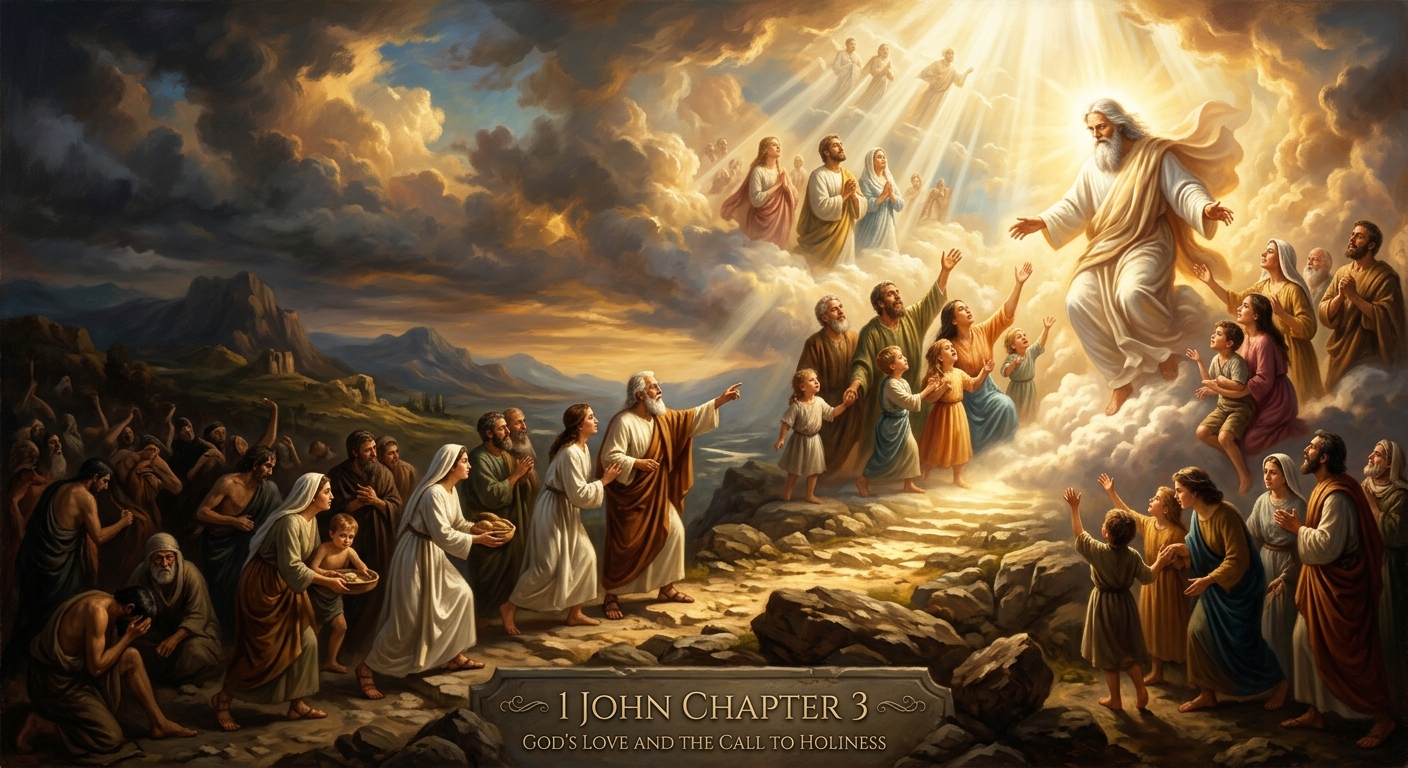
Illustration: Dramatic cinematic biblical illustration for 1 John Chapter 3 showing God’s love and the call to holiness, photorealistic oil painting style.
🔊
Listen to Chapter
Grace Notes Journey Audio Narration
Author
John the Apostle
Written
~90-95 AD
Key Theme
God’s love and the call to holiness
Setting
Ephesus - early church community
Key Verse
1 John 3:1
Total Verses
24
Chapter Introduction
*Beloved, the Father’s love has poured into us so richly that we are called His children. Though we have not yet seen the full glory of what we will become, this hope purifies us and calls us to live in love. When we walk in the light of Christ, sin loses its power over us. Let this glorious love be the foundation of your daily walk, leading you to a life that reflects God’s pure heart.*
1 John — Chapter 3 — KJV
1
Behold, what manner of love the Father hath bestowed upon us, that we should be called the sons of God: therefore the world knoweth us not, because it knew him not.
Simply PutThe word "love" here is the Greek agape (G26), a pure, self‑sacrificial love that comes from God Himself. He has poured this love into us so we can be called His children, a status the world can't grasp because it never knew Him. In real pain, this reminds us that we are loved beyond measure and known intimately by the Father.
2
Beloved, now are we the sons of God, and it doth not yet appear what we shall be: but we know that, when he shall appear, we shall be like him; for we shall see him as he is.
Simply PutIn this verse, "sons" (G5200) points to an intimate relationship with God that is already true now, even though we haven't yet seen what we'll become. The promise is that when He appears, we will be like Him—seeing Him in His true nature. For someone doubting their future, this is a hopeful glimpse of the transformation awaiting us.
3
And every man that hath this hope in him purifieth himself, even as he is pure.
Simply PutThe key word "hope" (G1655) is a confident expectation that comes from God. Those who hold onto this hope purify themselves, reflecting the purity of Christ Himself. If you're hungry for God, this verse says your desire should lead you to daily cleanse your heart and mind.
4
Whosoever committeth sin transgresseth also the law: for sin is the transgression of the law.
Simply Put"Sin" (G266) is described as a transgression—breaking the divine law. When you sin, you're stepping beyond God's boundaries. This truth helps us recognize that wrongdoing is not just a mistake but a breach of God's perfect order.
5
And ye know that he was manifested to take away our sins; and in him is no sin.
Simply Put"Manifested" (G358) means He was made visible to us, specifically Jesus Christ, who came to carry away our sins. The Greek word for "sin" (G266) is absent in Him, showing He was completely pure. In the midst of guilt, this assures us that Jesus is the source of forgiveness and purity.
6
Whosoever abideth in him sinneth not: whosoever sinneth hath not seen him, neither known him.
Simply Put"Abides" (G2257) means to remain or stay in Him. If we truly abide, sin has no power over us; if we're sinning, we haven't really seen or known Him. For those wrestling with ongoing sin, this challenges them to examine whether they are truly living in Christ.
7
Little children, let no man deceive you: he that doeth righteousness is righteous, even as he is righteous.
Simply PutThe phrase "doeth righteousness" (G1340) reflects the character of God Himself. He is righteous, and anyone who acts righteously mirrors that divine nature. This invites believers to see themselves as children learning the ways of a righteous Father.
8
He that committeth sin is of the devil; for the devil sinneth from the beginning. For this purpose the Son of God was manifested, that he might destroy the works of the devil.
Simply Put"Deceive" (G120) warns against being led astray. The devil has been sinning from the very beginning, and Jesus came to crush his works. For anyone feeling trapped by the devil's influence, this verse declares that Christ has already won the battle.
9
Whosoever is born of God doth not commit sin; for his seed remaineth in him: and he cannot sin, because he is born of God.
Simply Put"Born of God" (G311) means being spiritually reborn through the Holy Spirit. Those who are truly born have God's seed within them, making it impossible for them to continue in sin. This assures believers that a new life has been stamped upon them, breaking the chain of old patterns.
10
In this the children of God are manifest, and the children of the devil: whosoever doeth not righteousness is not of God, neither he that loveth not his brother.
Simply Put"Righteousness" (G1340) is the litmus test—those who don't practice it aren't walking in the light of God. Loving one's brother is evidence of being a child of God; neglecting love shows the devil's sway. In real hunger, this emphasizes that love for others is the heartbeat of true faith.
11
For this is the message that ye heard from the beginning, that we should love one another.
Simply PutThe "message" (G305) John refers to is the commandment of love, known from the beginning. This timeless instruction calls us to love one another as a reflection of God's own love. For those feeling isolated, this reminds them that love is the core identity of Christian community.
12
Not as Cain, who was of that wicked one, and slew his brother. And wherefore slew he him? Because his own works were evil, and his brother’s righteous.
Simply PutCain (G2604) represents those who are aligned with the devil, acting out of jealousy and evil. He killed his brother because he was consumed by wicked deeds, while his brother's works were righteous. This warns us that the motive behind actions—love or hate—determines our spiritual standing.
13
Marvel not, my brethren, if the world hate you.
Simply PutJohn tells us not to be surprised when the world rejects or hates us. The world's hostility is a confirmation that we belong to God, not the world. In times of persecution, this verse offers comfort: God's children are often misunderstood by those outside the faith.
14
We know that we have passed from death unto life, because we love the brethren. He that loveth not his brother abideth in death.
Simply PutWe have moved from death (spiritual separation) to life because we love our fellow believers. The Greek "abides" (G2257) in death means staying spiritually dead; love brings us into vibrant life. If you feel stagnant, this urges you to rekindle love for the community as a pathway to revival.
15
Whosoever hateth his brother is a murderer: and ye know that no murderer hath eternal life abiding in him.
Simply PutHatred toward one's brother is equated with murder (G2774)—a spiritual killing. No murderer can claim eternal life; the heart of love is essential for the promise of eternity. For those struggling with bitterness, this verse calls them to let love be the defining mark of their eternal hope.
16
Hereby perceive we the love of God, because he laid down his life for us: and we ought to lay down our lives for the brethren.
Simply PutHere we see the true measure of God's love, agape (G26), a deep, selfless love that led Him to give His life for us. Because He made this ultimate sacrifice, we are called to lay down our own lives—our time, resources, and even our hearts—for the brothers and sisters around us.
17
But whoso hath this world’s good, and seeth his brother have need, and shutteth up his bowels of compassion from him, how dwelleth the love of God in him?
Simply PutIf someone enjoys what this world offers yet ignores a brother in need, closing off the bowels of compassion (G362), how can they truly claim to have God's love? Real love means opening our innermost selves and reaching out when others are hurting.
18
My little children, let us not love in word, neither in tongue; but in deed and in truth.
Simply PutDon't settle for love that lives only in your words or on your lips; let it be evident through what you actually do, and keep it pure and honest. True love is more than saying "I care"—it's doing what those words promise.
19
And hereby we know that we are of the truth, and shall assure our hearts before him.
Simply PutBy living in truth and action, we can persuade (Greek: παρακαλεσω) our hearts that we belong to God. This assurance comes not from feeling good about ourselves, but from aligning our deeds with His truth.
20
For if our heart condemn us, God is greater than our heart, and knoweth all things.
Simply PutEven when we feel guilt or condemnation in our hearts (Greek: καρδία), remember God is larger than any sense of failure we hold. He knows everything about us and can lift the weight off our hearts.
21
Beloved, if our heart condemn us not, then have we confidence toward God.
Simply PutIf your heart does not condemn you, then walk with confidence toward God. That peace comes from trusting that He has forgiven you and set your life on a right footing.
22
And whatsoever we ask, we receive of him, because we keep his commandments, and do those things that are pleasing in his sight.
Simply PutEverything we ask for—when it's in line with God's will—is granted because we obey His commandments and live to please Him. Our prayers are answered when our lives reflect that obedience.
23
And this is his commandment, That we should believe on the name of his Son Jesus Christ, and love one another, as he gave us commandment.
Simply PutThis command is simple yet vital: trust in the name of His Son, Jesus Christ, and love one another as He taught us. Our belief is proven out by the love we show each other.
24
And he that keepeth his commandments dwelleth in him, and he in him. And hereby we know that he abideth in us, by the Spirit which he hath given us.
Simply PutWhoever keeps God's commandments lives within Him, and He lives in them through the Spirit (Greek: πνευμα). This mutual indwelling shows that God truly abides in our hearts.
John 1:12This verse explains that those who receive Christ are granted the right to become children of God, directly illuminating 1 John 3:1’s declaration that we are called the sons of God.
Romans 8:15Paul describes believers receiving the spirit of adoption, confirming the familial relationship highlighted in 1 John 3:2 and 1 John 3:6.
Romans 5:12This passage explains that sin entered through one man and spread to all, providing a theological backdrop for 1 John 3:8’s statement that the devil has been sinning from the beginning.
Reflect
When you’ve recently felt judged or rejected by friends, family, or coworkers, how does the promise that “the world hates you” shape your response to that hurt?