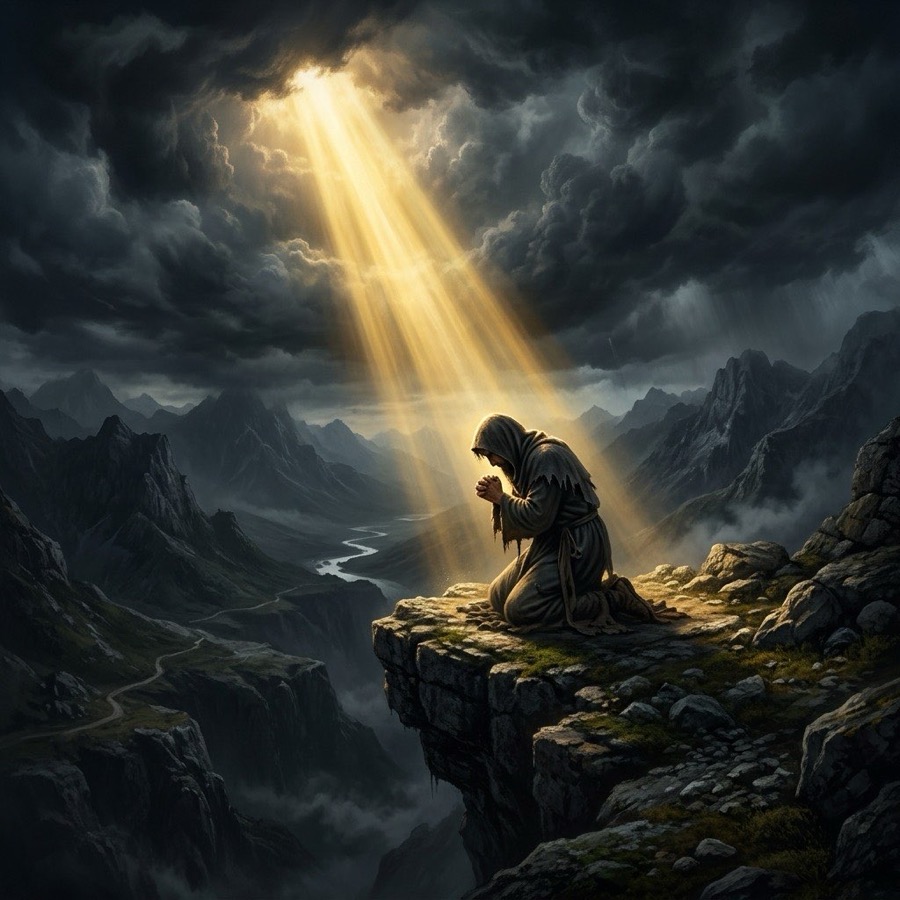
When you ask what the Bible says about free will, you are often wrestling with the heavy, sometimes crushing burden of human responsibility. It is a natural human instinct to feel that we must orchestrate our own salvati...
- The Weight of Our Choices: Trusting God's Word through life's deepest trials and seasons of waiting.
- The Reality of Human Choice: Trusting God's Word through life's deepest trials and seasons of waiting.
- The Fallen Will and Divine Initiative: Trusting God's Word through life's deepest trials and seasons of waiting.
The Weight of Our Choices
When you ask what the Bible says about free will, you are often wrestling with the heavy, sometimes crushing burden of human responsibility. It is a natural human instinct to feel that we must orchestrate our own salvation, secure our own healing, or force open doors that God in His infinite wisdom has closed. We strive, we plan, and we despair over paths we think we have lost.
Yet, the Scriptures remind us that our anxious striving cannot add a single cubit to our stature. True freedom does not begin when we assert our absolute independence; rather, it begins when we stop trying to be the sovereign authors of our own stories and start trusting the One who wrote them from before the foundation of the world.
In our natural state, we often view free will as the ultimate badge of human autonomy. We want to believe we are the masters of our fate. But a deep dive into the Word of God reveals a far more beautiful, albeit humbling, reality. Our will is not an isolated island; it is constantly influenced by our spiritual condition. To understand free will biblically, we must look beyond modern philosophical definitions and anchor our hearts in the unchanging truth of the Authorized King James Version.
The Reality of Human Choice
Let us first establish that God has indeed endowed humanity with moral agency. The Bible does not present us as mindless automatons or passive spectators in a cosmic play. From the very beginning in the Garden of Eden, God presented choices to mankind, holding them accountable for their decisions. In the Old Testament, God explicitly placed a choice before His covenant people, demanding a response of the heart:
I call heaven and earth to record this day against you, that I have set before you life and death, blessing and cursing: therefore choose life, that both thou and thy seed may live:— Deuteronomy 30:19, KJV
Here, the command to "choose life" implies a genuine, volitional selection. God holds humanity accountable for the choices they make. This is not a cold, legalistic demand, but a loving appeal to enter into a vibrant, born-again relationship with Him. To choose life is to choose Him. However, this raises a profound theological question: if we are commanded to choose, do we possess the inherent spiritual capacity to choose God apart from His grace?
The Fallen Will and Divine Initiative
To understand the biblical balance of free will, we must confront the reality of the Fall. Scripture teaches that sin has fractured the human will. While we retain the freedom to choose our daily actions—what we wear, what we eat, and how we behave—our spiritual compass is naturally oriented away from God. Left to ourselves, we do not seek Him. The Lord Jesus Christ made this truth unmistakably clear:
No man can come to me, except the Father which hath sent me draw him: and I will raise him up at the last day.— John 6:44, KJV
The Greek word for "draw" (*helkuo*) suggests a powerful, loving attraction—a divine pull without which we would remain dead in our trespasses and sins. Our free will is not completely autonomous; it is bound by our fallen nature. Apart from the regenerating work of the Holy Spirit, the natural man cannot choose Christ because he has no spiritual desire for Him. This truth is further amplified by the Apostle Paul in his deep theological treatise to the Romans:
So then it is not of him that willeth, nor of him that runneth, but of God that sheweth mercy.— Romans 9:16, KJV
This verse strikes a death blow to human pride. Salvation is not initiated by human willpower ("him that willeth") or human effort ("him that runneth"). It originates entirely in the sovereign mercy of God. We do not choose God first; rather, He chooses us, and His sovereign grace enables our bound wills to freely respond to His call.
Resolving the Tension: Sovereignty and Responsibility
How do we reconcile the command to "choose life" with the truth that "it is not of him that willeth"? This is the great tension of Christian doctrine: divine sovereignty and human responsibility. They are not enemies, but two sides of the same biblical coin. God's sovereignty does not violate human free will; it rescues it.
When the Holy Spirit convicts a sinner, He does not drag them kicking and screaming into the kingdom against their will. Instead, He changes the desires of their heart. He opens blind eyes to see the beauty of the Gospel, making the once-rebellious heart willing to receive Christ.
Thus, we choose Him because He first chose us. Our response of faith is entirely free, yet it is entirely a gift of His grace. This is the essence of a true relationship with Jesus—not a legalistic religion of self-effort, but a heart captured by His love.
Guided by the Spirit of Truth
What the Bible teaches is not that we are robots, but that we are sheep who desperately need a Shepherd. We cannot bear the weight of total independence because we do not know the end from the beginning. When we try to walk in absolute autonomy, we inevitably wander into the dry deserts of anxiety and despair. Instead of leaving us to our own fragile devices, God has promised us a Helper:
Howbeit when he, the Spirit of truth, is come, he will guide you into all truth: for he shall not speak of himself; but whatsoever he shall hear, that shall he speak: and he will shew you things to come.— John 16:13, KJV
The Holy Spirit does not override our will; He guides it. This divine guidance is not a restriction on our freedom, but the very path to our joy. True freedom is not the liberty to do whatever our fallen flesh desires, but the power to live as God designed us to live. When we yield our will to His direction, our sorrow is transformed into a joy that the world can neither give nor take away. As Christ comforted His disciples:
Verily, verily, I say unto you, That ye shall weep and lament, but the world shall rejoice: and ye shall be sorrowful, but your sorrow shall be turned into joy.— John 16:20, KJV
Our sorrow over our own weakness and failures is turned into joy when we realize that our eternal security does not rest on our ability to hold onto Him, but on His ability to hold onto us. Our free will finds its ultimate rest when it surrenders to His perfect will.
Resting in His Glory
All things that the Father hath are Christ's, and He shares this glorious inheritance with those who love Him. We do not need to manufacture our own righteousness or secure our own future through sheer willpower. The Gospel is a message of rest, not of relentless striving.
He shall glorify me: for he shall receive of mine, and shall shew it unto you.— John 16:14, KJV
To truly understand what the Bible says about free will is to realize that our will is most free when it is fully aligned with His. We are not left in the dark about our future, because He has shown us things to come through the lens of His perfect love. When we stop trying to force our own way and instead yield to the Holy Spirit, we find that His yoke is easy and His burden is light.
Let go of the exhausting need to control every outcome. Lay down the heavy yoke of self-redemption. You are not alone in your confusion or your pain. Christ knows your desire to understand, and He invites you to step out of legalistic religion and into a living, breathing relationship with Him. Let the Spirit guide you today, not into anxiety, but into the perfect peace that comes from trusting His sovereign heart. You are safe in His hands.