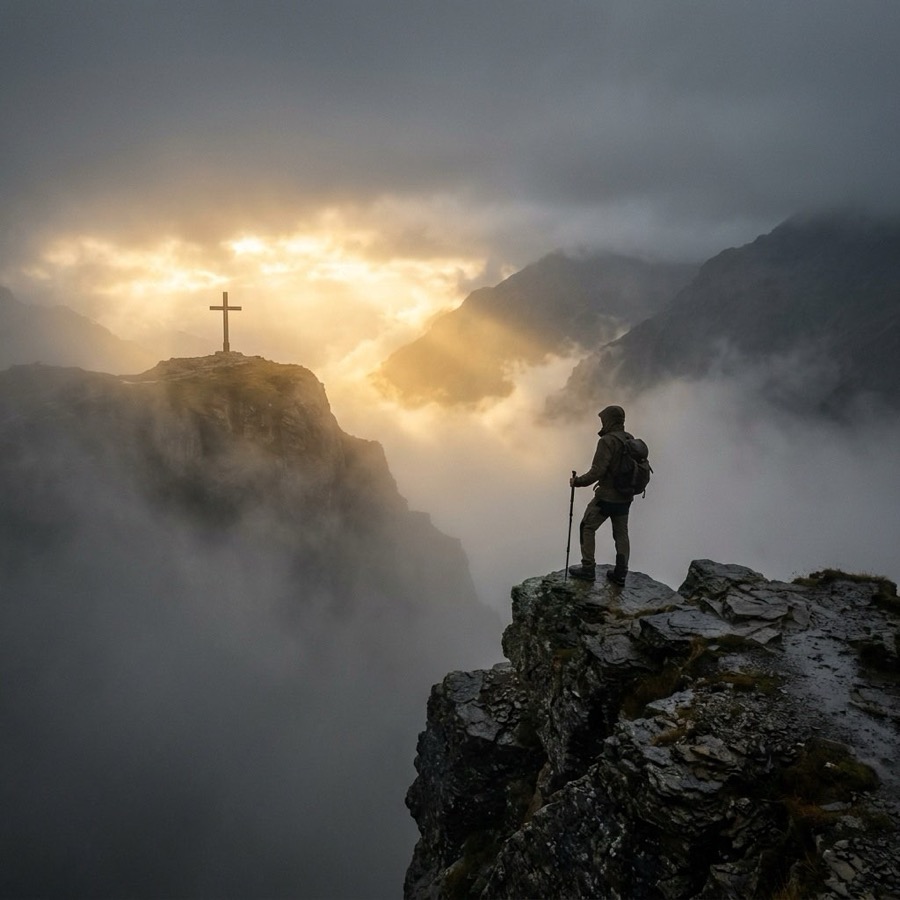
We often find ourselves standing on the shore of our own confusion, watching the waves of uncertainty crash against our resolve. It is natural to murmur when the map disappears and the destination seems impossible to rea...
- The Murmuring Heart: Trusting God's Word through life's deepest trials and seasons of waiting.
- The Anchor in the Tempest: Trusting God's Word through life's deepest trials and seasons of waiting.
- Choosing the Only Way: Trusting God's Word through life's deepest trials and seasons of waiting.
The Murmuring Heart
We often find ourselves standing on the shore of our own confusion, watching the waves of uncertainty crash against our resolve. It is natural to murmur when the map disappears and the destination seems impossible to reach. In those moments, the flesh desperately clamors for control, but the spirit needs absolute surrender.
The human heart, prone to wander and quick to fear, naturally seeks tangible guarantees. Yet, the walk of the believer is not one of sight, but of faith. When we demand that God reveal the entire path before we take the first step, we misunderstand the very nature of Christian discipleship.
Jesus noticed this deep-seated tension in His followers. In the sixth chapter of John, after delivering some of His most profound and challenging doctrines, He confronted the rising tide of skepticism among those who followed Him. He did not scold them for their human weakness, but He pointed them directly toward the source of their strength.
"—inviting them to look past their immediate intellectual and physical discomfort to the greater, eternal reality of His presence. The offense of the cross and the difficulty of the narrow way will always clash with the desires of the flesh.
When you feel overwhelmed by the unknown, remember that your feelings are real, but they are not the final truth. The flesh profits nothing in the economy of God; it cannot produce the faith required to survive the storm. The words He spoke are not mere moral instructions or historical information; they are the very breath of life sustaining you through the darkest valley. To trust God in uncertainty is to recognize that our human understanding is a broken reed, while His Word is an immovable rock.
It is the spirit that quickeneth; the flesh profiteth nothing: the words that I speak unto you, they are spirit, and they are life.— John 6:63, KJV
The Anchor in the Tempest: Biblical Examples of Trust
To understand how to navigate the fog of uncertainty, we must look to the cloud of witnesses who walked this path before us. Scripture does not present faith as an abstract theory, but as a lived reality forged in the furnace of affliction. Consider the patriarch Abraham. When God called him out of Ur of the Chaldees, He did not provide a detailed itinerary or a map of the Promised Land. Abraham was called to abandon everything familiar and step into the absolute unknown.
By faith Abraham, when he was called to go out into a place which he should after receive for an inheritance, obeyed; and he went out, not knowing whither he went.— Hebrews 11:8, KJV
Abraham’s obedience was not contingent upon clarity. He went out, "not knowing whither he went," because he knew with whom he went. His anchor was not the stability of the destination, but the character of the One who promised. True biblical trust does not demand a clear view of the horizon; it rests entirely on the integrity of God.
Similarly, we see this truth illustrated in the lives of the disciples during their tempestuous crossing of the Sea of Galilee. As a violent storm threatened to capsize their ship, Jesus lay asleep on a pillow. In their terror, the disciples woke Him, crying out in panic. They were consumed by the immediate threat of the wind and the waves, forgetting that the Creator of the universe was in the stern of their vessel.
And he arose, and rebuked the wind, and said unto the sea, Peace, be still. And the wind ceased, and there was a great calm.— Mark 4:39, KJV
The disciples learned a vital lesson that night: the presence of Christ does not guarantee a storm-free voyage, but it guarantees a safe landing. The uncertainty of the storm was real, but the authority of Christ was absolute. When the winds of life howl around you, the solution is not to focus on the severity of the gale, but to look to the One who commands the wind and the sea.
Choosing the Only Way
In the wake of Christ's hard sayings in John 6, a tragic sifting occurred. Many of His disciples walked away when the path became too steep and the doctrines too demanding. They sought easier ways, quieter crowds, and a more comfortable religion that did not require the death of self.
", Simon Peter looked at the emptiness of leaving and found only one viable alternative. He recognized that without Christ, there is no other source of hope, no other anchor for the soul, and no other path to life.
Trusting God in uncertainty requires a deliberate, daily choice to stay when every carnal instinct urges you to flee. It is an act of saving faith to declare that His words hold more weight than your current, shifting circumstances. Faith in hard times is not the absence of fear, but the presence of a better Anchor.
This is the difference between a cold, legalistic religion and a vibrant, born-again relationship with Jesus Christ. Religion demands a visible sign and a guaranteed earthly reward; relationship rests quietly in the character of the Savior.
Peter’s confession was not based on his own emotional strength or intellectual superiority, but on the revealed identity of Jesus. We can stand firm in the midst of chaos only when we are absolutely sure of who holds us. The living God is not a distant spectator; He is the foundation of our next step. When we realize that He is the Christ, the Son of the living God, our perspective shifts from the temporal to the eternal.
Then Simon Peter answered him, Lord, to whom shall we go? thou hast the words of eternal life. And we believe and are sure that thou art that Christ, the Son of the living God.— John 6:68-69, KJV
A Practical Three-Step Application for the Uncertain Soul
How do we translate these deep theological truths into daily practice when the future is uncertain? The Scriptures provide a clear, actionable framework for anchoring our souls when the foundations of our lives seem to shake.
1. Cast Down Carnal Reasonings (Lean Not). The first step in trusting God through uncertainty is to actively reject the urge to rely on our own limited understanding. We must bring our thoughts into captivity to the obedience of Christ. When we try to figure out every detail of the future on our own, we set ourselves up for anxiety and despair.
Trust in the LORD with all thine heart; and lean not unto thine own understanding. In all thy ways acknowledge him, and he shall direct thy paths.— Proverbs 3:5-6, KJV
2. Saturate Your Mind in the Scriptures (Faith by Hearing). Faith is not something we must manufacture out of our own willpower. It is a gift that is nourished and strengthened through constant exposure to the pure, preserved Word of God. When uncertainty breeds fear, we must drown out the voices of the world with the promises of Scripture.
So then faith cometh by hearing, and hearing by the word of God.— Romans 10:17, KJV
3. Surrender the Outcome in Prayerful Obedience. Finally, we must lay our anxieties at the feet of the Savior. Through prayer and supplication, we hand over the pen of our lives to God, allowing Him to write the story as He sees fit. When we surrender our desire for control, the supernatural peace of God guards our hearts.
Be careful for nothing; but in every thing by prayer and supplication with thanksgiving let your requests be made known unto God. And the peace of God, which passeth all understanding, shall keep your hearts and minds through Christ Jesus.— Philippians 4:6-7, KJV
Resting in the Eternal Word
Uncertainty may surround you, but it does not define you. The world demands a guarantee, a contract, and a visible sign before it will take a step. But Christ offers Himself as the ultimate guarantee. You do not need to see the entire staircase; you only need to trust the One who holds your hand and guides your next step.
When the future is hidden from your eyes, rest in the assurance that it is fully known to Him. Your born-again relationship with Jesus Christ is an anchor that enters into that within the veil. Let the winds blow and the waves crash; your soul is secure in the hands of the living God. Rest in His words today, for they are not empty breath—they are spirit, and they are life.