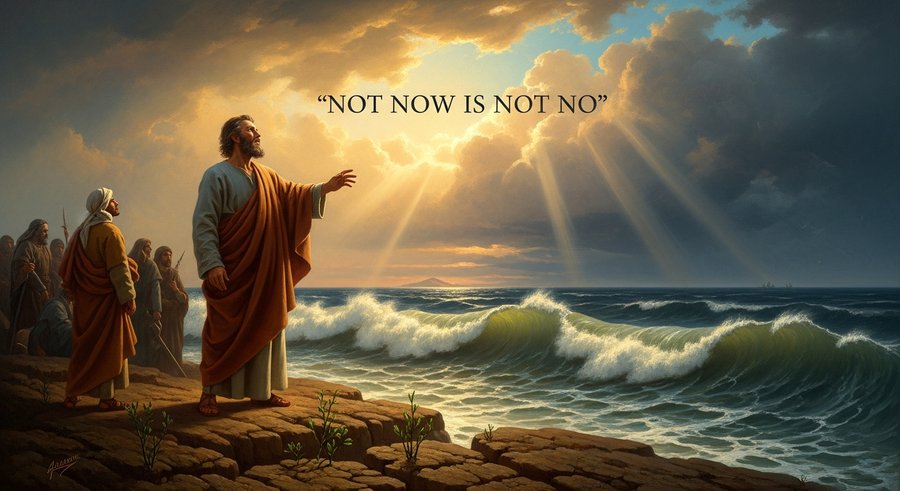
You have been reading "not yet" as "never." That is the mistake. And if you are not careful, it might be the most spiritually costly mistake you make in your walk with the Lord. When the heavens seem like brass and the horizon remains unchanged, the enemy of your soul whispers that God has closed the book on your prayers. But we must learn to distinguish between a closed door and a delayed step in God's sovereign itinerary.
When God does not move on your timeline, it does not mean He has forgotten His covenant. When the prayer has not yet materialized into a tangible answer, it does not mean His ear is heavy that it cannot hear. When the promise you have been believing for is still on the other side of a Jordan that has not yet parted—it does not mean the Jordan is your permanent address. The wilderness is a passage, not a destination. To understand this, we must anchor our hearts in the immutable truth of Holy Writ, recognizing that God's delays are never God's denials.
"To every thing there is a season, and a time to every purpose under the heaven:"— Ecclesiastes 3:1 (KJV)
You have been reading "not yet" as "never." That is the mistake. And if you are not careful, it might be the most spiritually costly mistake you make in your walk with the Lord. When the heavens seem like brass and the h...
- God Does Not Work On Demand: Trusting God's Word through life's deepest trials and seasons of waiting.
- God Meets Us in the Midst of the Wait: Trusting God's Word through life's deepest trials and seasons of waiting.
- How to Respond to God's "Not Yet": Trusting God's Word through life's deepest trials and seasons of waiting.
God Does Not Work On Demand
We live in a modern world meticulously engineered around instant gratification. With a swipe of a finger, dinner is delivered to your door, movies are streamed instantly, and global information is accessed in milliseconds. We have been conditioned to believe that delay is a sign of systemic failure.
Sadly, we often import this transactional, on-demand expectation into our relationship with the Creator of the universe. We treat the throne of grace like a spiritual drive-thru, and when the answer is not immediate, our faith begins to waver.
But God does not operate on human demand; He operates according to His eternal, sovereign purpose. When we study the broader principles of God's perfect timing, we discover that His delays are actually acts of merciful preparation. Salvation itself is not a legalistic, transactional religion where we pull the lever of prayer to receive an instant blessing; it is a living, breathing, born-again relationship with Jesus Christ. In a relationship, the process of waiting is just as vital as the destination.
Consider the biblical pattern of preparation. There is a reason David waited roughly fifteen years after being anointed by Samuel before he finally took the throne of Judah. There is a reason Joseph spent years in a pit and an Egyptian prison before he was elevated to stand before Pharaoh. There is a reason the disciples were commanded to tarry in Jerusalem before they were endued with power from on high. The waiting was not wasted time. The waiting was God working. God must do a work in you before He can do a work through you. If the blessing is given before the character is ready to sustain it, the blessing will ultimately destroy you.
God Meets Us in the Midst of the Wait
A profound shift occurs in our spiritual walk when we realize that the Psalms were not written from the comfort of the palace, but from the dust of the Judean wilderness. David did not write his most intimate cries of faith after the trial had passed; he penned them while he was actively fleeing for his life from King Saul. He was not reflecting on despair from a safe, historical distance. He was crying out from the very depths of it.
"How long wilt thou forget me, O LORD? for ever? how long wilt thou hide thy face from me? How long shall I take counsel in my soul, having sorrow in my heart daily? how long shall his enemy be exalted over me?"— Psalm 13:1-2 (KJV)
This was not a cold, academic exercise in theology. This was a man at the end of his physical and emotional rope, crying out to a God whose presence he could not tangibly feel. Yet, notice the transition in David's heart. He did not wait for the circumstances to change before he chose to trust. In the very next verses, he declares, "But I have trusted in thy mercy; my heart shall rejoice in thy salvation" (Psalm 13:5).
God met David during the wait, not just after it. The cave of Adullam became a sanctuary of intimacy. This is the true purpose of the waiting season. It is not a period of divine abandonment or punitive silence. It is the sacred space where your faith is refined, where the dross of self-sufficiency is consumed, and where your relationship with Jesus Christ is anchored solely upon His character rather than His immediate handiwork. You are not forgotten; you are being prepared.
How to Respond to God's "Not Yet"
When you find yourself suspended in the tension between God's promise and His performance, how should you respond? The scriptures provide a clear, actionable blueprint for navigating these seasons of divine delay without losing your faith.
1. Commit Your Way Unto the Lord
The first step in responding to a "not yet" is the active, daily surrender of your personal timeline. You must roll the burden of your expectations onto the sovereign shoulders of Christ. As the Psalmist writes:
"Commit thy way unto the LORD; trust also in him; and he shall bring it to pass."— Psalm 37:5 (KJV)
To commit your way means to hand over the pen of your life and allow God to write the chapters on His schedule. It is an act of active trust, believing that He who began a good work in you is faithful to perform it in His perfect time.
2. Stand Still in Faith and Refuse to Murmur
When the children of Israel stood before the Red Sea with Pharaoh's army pressing hard behind them, their natural inclination was to panic and complain. But the word of the Lord through Moses was clear:
"And Moses said unto the people, Fear ye not, stand still, and see the salvation of the LORD, which he will shew to you to day..."— Exodus 14:13 (KJV)
Standing still is not passive resignation; it is a position of spiritual authority. It means refusing to take matters into your own hands through carnal manipulation. When we try to force a "now" when God has said "not yet," we end up creating an Ishmael instead of waiting for Isaac. For a deeper look at maintaining peace during these seasons, read our guide on waiting on the Lord with patience.
3. Occupy Diligently Until He Moves
Waiting is not an excuse for spiritual laziness. In the parable of the ten pounds, the nobleman gave a direct command to his servants:
"And he called his ten servants, and delivered them ten pounds, and said unto them, Occupy till I come."— Luke 19:13 (KJV)
While you are waiting for God to open the next door, you must be faithful to occupy the space He has currently placed you in. Serve where you are. Pray where you are. Study the Word where you are. Be a good steward of the "little" so that when the "much" arrives, you will be found faithful.
The Promise of Renewed Strength
The Christian life is not a sprint; it is a marathon of endurance. The writer of Hebrews reminds us, "For ye have need of patience, that, after ye have done the will of God, ye might receive the promise" (Hebrews 10:36). The patience required to endure the "not yet" is not a human virtue; it is a fruit of the Holy Spirit wrought within the believer through deep, abiding fellowship with Jesus.
"But they that wait upon the LORD shall renew their strength; they shall mount up with wings like eagles; they shall run, and not be weary; and they shall walk, and not faint."— Isaiah 40:31 (KJV)
In the original Hebrew context, the word "wait" (qavah) carries the meaning of binding together by twisting. It is the image of a multi-stranded rope. When you wait upon the Lord, you are not sitting idly by; you are weaving your weakness into His strength, twisting your fragile life around His indestructible grace. The result is a supernatural exchange of strength. Your human energy will fail, but His divine strength is inexhaustible.
If you are in the middle of a long, silent wait today, do not cast away your confidence. The God who kept His covenant with Abraham, the God who brought Joseph out of the dungeon, and the God who raised our Lord Jesus Christ from the dead is the very same God who holds your life in His hands. "Not now" is not "no." Trust the process, trust the Savior, and trust the timing.
Pray this today: Heavenly Father, I confess that my flesh grows weary in the waiting. I have allowed my timeline to dictate my peace, and I have mistaken Your silence for Your absence. Today, I repent of my impatience. I commit my way entirely unto Thee, trusting that Thy timing is perfect. Give me the grace to stand still, to occupy faithfully, and to wait upon Thee with a quiet and trusting heart. I believe that what Thou hast promised, Thou art also able to perform. In the precious name of my Lord and Savior, Jesus Christ, Amen.