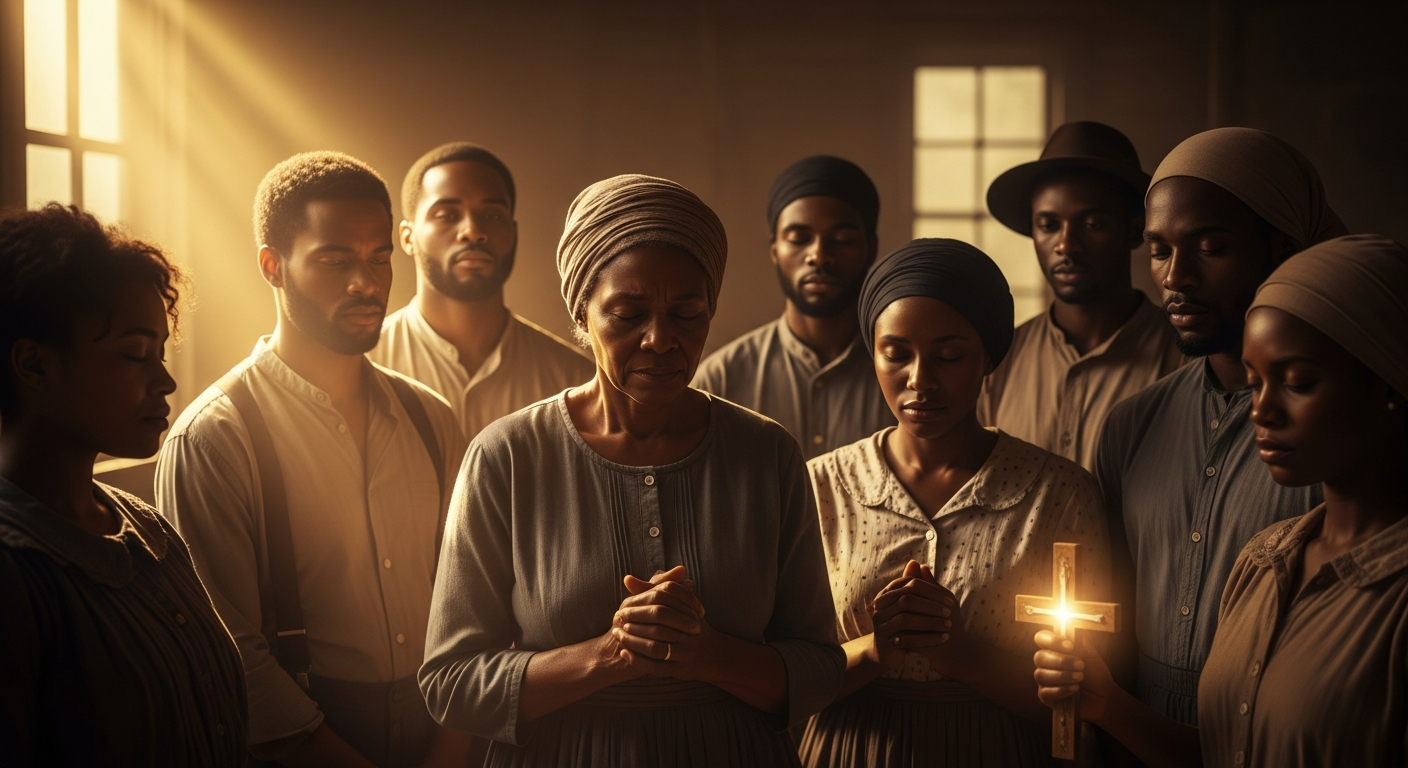
When we approach the difficult and deeply emotional question of what the Bible says about slavery, we must look past the surface of historical systems of control and gaze directly into the redemptive heart of God. Throug...
- The Weight of Bondage and the Whisper of Mercy: Trusting God's Word through life's deepest trials and seasons of waiting.
- Restoration Over Condemnation: Trusting God's Word through life's deepest trials and seasons of waiting.
- The Ultimate Liberation in Christ: Trusting God's Word through life's deepest trials and seasons of waiting.
The Weight of Bondage and the Whisper of Mercy
When we approach the difficult and deeply emotional question of what the Bible says about slavery, we must look past the surface of historical systems of control and gaze directly into the redemptive heart of God. Throughout human history, fallen mankind has sought to dominate, possess, and exploit his fellow man. This is the tragic consequence of the Fall recorded in Genesis. However, the Holy Scriptures reveal a God who does not stand aloof from the suffering of the bound, but rather one who hears their groaning, sees their affliction, and steps down into the miry clay of human history to bring deliverance.
To understand the biblical perspective on servitude, we must distinguish between the harsh, race-based chattel slavery of the modern era—which the Bible roundly condemns under the sin of "menstealing" in 1 Timothy 1:10—and the economic bondservice of the ancient Near East, which functioned more like a bankruptcy or labor contract. Yet, even within those ancient social structures, God’s law introduced unprecedented protections, dignity, and pathways to absolute freedom. The ultimate trajectory of Scripture is not the preservation of earthly hierarchies, but the total liberation of the human soul. Jesus Christ did not come to merely legislate social structures or reform the Roman Empire from the top down; He came to strike at the very root of all oppression by liberating the captive spirit from the ultimate taskmaster: sin and death.
In the Gospel of Matthew, we witness the Lord Jesus moving through a world marked by Roman occupation, systemic cruelty, and social degradation. He did not bypass those whom society had discarded or deemed "unclean." Instead, He drew near to them, demonstrating that before any earthly title, status, or condition of bondage, every single soul is of infinite value to the Creator. Consider the woman who had suffered for twelve long years under a physical bondage that stripped her of her wealth, her health, and her social standing:
For she said within herself, If I may but touch his garment, I shall be whole. But Jesus turned him about, and when he saw her, he said, Daughter, be of good comfort; thy faith hath made thee whole. And the woman was made whole from that hour.— Matthew 9:21-22, KJV
This woman was a slave to her infirmity, isolated and bankrupt. Yet, her faith bypassed the crowd and touched the hem of the Savior's garment. Christ’s response to her was not one of irritation or condemnation, but of tender adoption: "Daughter, be of good comfort." If you are carrying the heavy weight of past trauma, systemic limitation, or spiritual bondage today, hear this: you are not defined by your chains, but by your Redeemer. The God who saw her pain is the same yesterday, today, and forever. He offers you a personal, born-again relationship that transcends every earthly limitation.
Restoration Over Condemnation: From Servitude to Sonship
The Scriptures teach us that our true identity is never found in what we possess, nor is it defined by who claims ownership over us in this passing world. Our identity is anchored solely in *whose* we are. When the world seeks to diminish, categorize, or enslave, Christ steps in to restore.
In the ancient world, a slave was often viewed as a mere tool, a piece of living property without a voice. But in the economy of God, the last shall be first, and the servant is elevated to the status of a beloved child.
We see this divine pattern of restoration beautifully illustrated when Jesus entered the house of the ruler of the synagogue, whose daughter had died. The world had already given up; the professional mourners were weeping and wailing, and the crowd laughed the Savior to scorn when He declared that the maid was only sleeping. The world’s systems always mock the promise of deliverance, viewing those who are broken or spiritually dead as beyond hope.
But when the people were put forth, he went in, and took her by the hand, and the maid arose.— Matthew 9:25, KJV
" He did not stand at a distance; He touched the dead, cold hand of the young girl and raised her up. This is a vivid picture of regeneration. We who were dead in our trespasses and sins, bound by the shackles of our fallen nature, are touched by the living hand of Jesus Christ.
True freedom does not begin with political reformation, but with spiritual resurrection. It is a transition from death unto life, and from the status of a helpless servant to that of an heir of the Kingdom.
The Apostle Paul, writing under the inspiration of the Holy Ghost, expounds upon this glorious transition in his epistle to the Galatians. He reminds us that through the redeeming work of Christ, the believer is completely set free from the legalistic bondage of the law and the slavery of sin:
Wherefore thou art no more a servant, but a son; and if a son, then an heir of God through Christ.— Galatians 4:7, KJV
This is the heart of the Gospel. Salvation is not a cold, legalistic religion of rules and regulations; it is a vibrant, living relationship with the Lord Jesus Christ. He does not mock your struggles or leave you to rot in your chains. He puts forth the mockers, takes you by the hand, and bids you to arise into a life of dignity, purpose, and eternal security.
The Ultimate Liberation in Christ
While historical biblical texts address the reality of ancient servitude—providing laws to mitigate its harshness and pointing toward the ultimate release of the Jubilee—the overarching message of the Bible is that Christ came to break every spiritual chain. The physical bondages of this world are but a shadow of the far more terrifying reality of spiritual slavery. Jesus Himself declared the universal condition of humanity apart from grace:
Jesus answered them, Verily, verily, I say unto you, Whosoever committeth sin is the servant of sin.— John 8:34, KJV
Left to ourselves, we are completely unable to break the chains of our own pride, lust, bitterness, and rebellion. We cannot "make the team" or earn our way into God's favor through human effort or religious performance. But where human strength fails, sovereign grace triumphs. When we cry out to Him in simple, child-like faith, He opens our eyes and shatters the power of darkness.
Then touched he their eyes, saying, According to your faith be it unto you. And their eyes were opened; and Jesus straitly charged them, saying, See that no man know it.— Matthew 9:29-30, KJV
Just as He touched the eyes of the blind men, Christ touches our spiritually blinded eyes so that we might behold the glorious liberty of the children of God. This is the ultimate liberation. When your eyes are opened by the Holy Spirit, you realize that your past does not dictate your future, nor does your current earthly struggle define your eternal destiny. You are made free indeed.
This freedom, however, is not a license to walk in licentiousness or self-indulgence. Rather, the paradox of Christian liberty is that when we are set free from the cruel tyranny of sin, we willingly yield ourselves to the sweet, life-giving lordship of Jesus Christ. As the Apostle Paul writes:
Being then made free from sin, ye became the servants of righteousness.— Romans 6:18, KJV
To be a "servant of righteousness" is to find perfect freedom. It is to serve a Master whose yoke is easy and whose burden is light. He does not exploit you; He empowers you. He does not diminish you; He conforms you to His own glorious image. The Lord lifts you up in due time, not because of your own perfection, but because of His absolute faithfulness.
If you are struggling today under the weight of any bondage—whether it be the bondage of addiction, the chains of past trauma, the weight of legalistic religion, or the fear of death—look to the Cross of Calvary. There, Jesus Christ paid the ultimate ransom price for your soul. He did not pay it with corruptible things like silver and gold, but with His own precious blood.
Step out of the slave quarters of fear and into the household of faith. You are no longer a slave; in Christ Jesus, you are a beloved child, fully known, deeply loved, and eternally free.