The Grammar of Grace
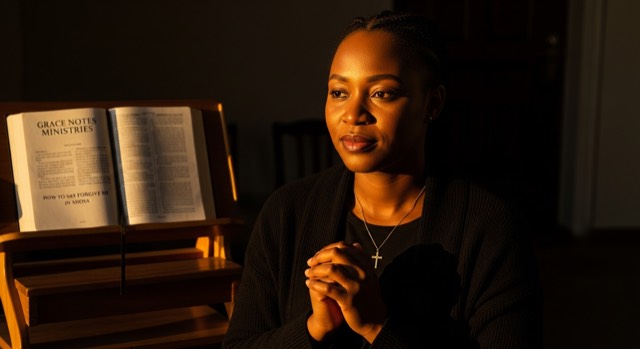
It’s three in the morning. The house is still, a tomb of quiet where every sound is amplified: the hum of the refrigerator, the creak of the floorboards, the frantic pounding of your own heart against your ribs. You’re wide awake because of a conversation that ended hours ago with a slammed door, or maybe worse, with a silence that felt heavier than any shout. The words you said, or the words said to you, are replaying in a merciless loop, and the spiritual air is so thick with accusation you can barely breathe. You've tried praying, but the words feel like stones dropping into a deep, dry well. This is the place where religion dies, right here in the dark, when you realize your own efforts to be 'good' have produced nothing but a ledger of debts you can't pay and offenses you can't erase.
Into this profound darkness, Jesus teaches us to pray with a child's simplicity, linking our most basic physical need to our deepest spiritual one. He says, first, 'Give us this day our daily bread.' Sustenance. Survival. And in the very next breath, 'And forgive us our debts, as we forgive our debtors.' He puts pardon on the same level as bread. It’s not a luxury item for the spiritually advanced; it's daily food for the spiritually starving. Notice the sequence. The provision and the pardon come together. The forgiveness we need from the Father and the forgiveness we extend to our brother are part of the same divine economy, the same circulation of grace that keeps a soul alive, day by day, moment by moment.
And here's the thing that changes everything. Our human grammar is transactional: you hurt me, so you owe me. But God’s grammar is rooted in amnesty. The forgiveness we are called to give isn't the *cause* of our being forgiven, but the undeniable, resounding *evidence* of it. Christ isn't setting up a quid pro quo. He is describing the anatomy of a saved heart. A heart that has been flooded with the unmerited, scandalous grace of God cannot, for long, remain a dam holding back grace from others. When you truly understand the Everest of debt He cancelled for you at the cross, the anthills of debt others owe you are put in their proper, vanishing perspective.
For if ye forgive men their trespasses, your heavenly Father will also forgive you: But if ye forgive not men their trespasses, neither will your Father forgive your trespasses.— Matthew 6:14-15, KJV
The Unpayable Debt
We spend so much of our lives trying to balance the books. We carry a little black book in our souls, noting every slight, every wound, every promise broken. We think if we can just perform well enough, be sorry enough, or make others sorry enough, we can get the balance back to zero. But the spiritual ledger doesn't work that way. The debt of sin isn't a loan you can eventually pay off with good behavior; it's a bankruptcy of the soul that requires a total bailout from an outside source. Your self-reliance is a broken tool. Your attempts to 'make it right' are like trying to fill the ocean with a thimble. The hypocrites Jesus speaks of tried to pay their way with public piety, with sad faces during a fast, but their reward was only the fleeting approval of men, not the deep, soul-settling pardon of the Father.
But see the beauty of the Gospel. While you were still trying to figure out a payment plan, Jesus stepped in and declared, 'Paid in full.' He didn't restructure your debt; He annihilated it. He took your spiritual bankruptcy upon His own shoulders at Calvary and credited His perfect righteousness to your account. This is why He could say with such breathtaking authority, 'All manner of sin and blasphemy shall be forgiven unto men.' He wasn't being flippant about sin. He was being audacious about the power of His own blood. He knows exactly what you're caught in, the shame that keeps you up at night, the relational wreckage you've caused, and His answer isn't 'Try harder,' but 'It is finished.'
When Jesus teaches us to pray, He isn't giving us a formula to manipulate God. He's giving us the family language. 'Give us,' 'forgive us,' 'lead us,' 'deliver us'—it’s plural. We are in this together. This prayer lifts us out of our isolated prisons of personal grievance and places us in a community of the pardoned. The forgiveness spoken of here is not a one-time event at conversion but a daily washing of the feet, a continual application of grace to the grime we pick up walking through this broken world. It's the lifeblood of fellowship with God and with one another, as essential as the bread we eat and the air we breathe.
Wherefore I say unto you, All manner of sin and blasphemy shall be forgiven unto men: but the blasphemy against the Holy Ghost shall not be forgiven unto men.— Matthew 12:31, KJV
Living in the Pardon
So what does this look like on a Tuesday afternoon when your teenager speaks to you with that tone of voice that just shatters your peace? What does it look like when a coworker takes credit for your work? Forgiveness isn't a feeling you conjure up; it's a decision you make, an act of the will empowered by the Spirit of God. It's looking at the person who wounded you and, instead of seeing the debt they owe you, seeing the cross where your infinitely greater debt was paid. It's the quiet, gut-wrenching choice to release them to God, to stop replaying the offense in your mind, and to refuse to let bitterness build a fortress around your heart. It’s messy. It’s not a clean, one-and-done transaction. It is a moment-by-moment surrender.
Friend, stop trying to fix the broken relationship by yourself. Stop trying to muster up the strength to forgive. You can't. But Christ in you can. Your job is not to produce the forgiveness, but to yield to the Forgiver who lives inside you. Rest in Him. Let His grace do the heavy lifting. When the memory of the hurt surfaces, don't fight it in your own strength; run to the Father and say, 'Abba, this hurts, but because you have forgiven me, I choose to forgive them. Cover this wound with the blood of your Son.' Let the prayer Jesus taught you become the rhythm of your heart, a constant reminder that you are a recipient of a grace so profound that it must, inevitably, overflow.
Walking in this grace day by day means you stop keeping score. You throw away the ledger. You begin to understand that laying up treasures in heaven has less to do with financial giving and more to do with releasing relational debts on earth. Every act of forgiveness is a deposit into your heavenly account, a treasure that 'neither moth nor rust doth corrupt.' It’s an investment in eternal realities over temporary hurts. This isn't weakness; it is the most profound strength, the strength of a soul so secure in its own pardon that it can afford to be lavish with mercy toward others. It is the freedom of living unburdened.
And forgive us our debts, as we forgive our debtors.— Matthew 6:12, KJV
The Unshakeable Kingdom
The bedrock of our faith is not the consistency of our ability to forgive, but the unshakeable reality of God's promise to forgive us. The prayer Jesus taught us ends with a declaration of absolute truth: 'For thine is the kingdom, and the power, and the glory, for ever. Amen.' The kingdom is His, not ours. The power to forgive originates with Him, not us. The glory for every reconciled relationship belongs to Him, not us. This is our solid ground. When your feelings are a storm of resentment and pain, you can stand on the fact that you belong to a kingdom of grace, ruled by a King of mercy, and powered by a Spirit of reconciliation. His forgiveness of you is a past-tense, completed action, secured by the resurrection.
Therefore, be vigilant. The enemy of your soul wants nothing more than to lure you back into the prison of unforgiveness, to convince you that your anger is justified and your bitterness is your right. He wants you to pick that ledger back up and start keeping score again. To return to that way of thinking is to forget the Gospel. It is to act like a pardoned prisoner who voluntarily walks back into his cell and locks the door from the inside. Don't do it. Refuse to be enslaved by a debt that Jesus has already paid. The freedom He bought for you is too precious to trade for the fleeting, bitter satisfaction of holding a grudge.
But lay up for yourselves treasures in heaven, where neither moth nor rust doth corrupt, and where thieves do not break through nor steal:— Matthew 6:20, KJV
Learning to say 'forgive me'—in Xhosa, in English, in the silent language of a surrendered heart—is about learning to breathe the atmosphere of heaven. It is a daily dependence on the Bread of Life and the Wellspring of Mercy. May you cease striving to earn what has been freely given and simply learn to receive. Receive His pardon for you so fully, so deeply, that it becomes the very source from which you offer pardon to others. Live like you are what you are: completely, eternally, and irrevocably forgiven. For His is the kingdom, and the power, and the glory. Forever. Amen.