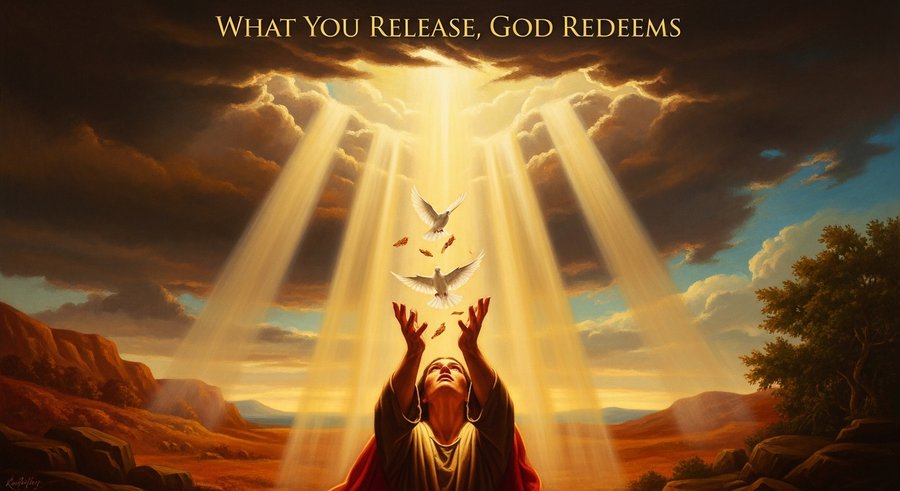
There are things we grip that quietly rob us of the very future we are desperate for. We hold onto the version of ourselves from ten years ago — the one who got hurt, who made the mistake, who missed the window — and we carry that version forward into every new room we enter, even when it no longer belongs there. We hold onto outcomes we were never designed to control.
We hold onto timelines that God never agreed to. And the tighter the grip, the less room our hands have to receive anything new.
There are things we grip that quietly rob us of the very future we are desperate for. We hold onto the version of ourselves from ten years ago — the one who got hurt, who made the mistake, who missed the window — and we...
- The Test Abraham Almost Didn't Pass: Trusting God's Word through life's deepest trials and seasons of waiting.
- Opening the Hand Is the Hardest Act of Faith: Trusting God's Word through life's deepest trials and seasons of waiting.
- What God Does With What You Let Go: Trusting God's Word through life's deepest trials and seasons of waiting.
The Test Abraham Almost Didn't Pass
The story of Abraham and Isaac in Genesis 22 is one of the most theologically dense and emotionally shattering passages in the Bible. God tells Abraham to take his son — the child of promise, the one he had waited twenty-five years for, the one the whole covenant rested on — and offer him as a sacrifice. And Abraham goes. He doesn't understand. He cannot possibly understand. But he goes.
What I want you to notice is not just Abraham's obedience. I want you to notice what God was actually testing. He wasn't testing Abraham's willingness to perform a sacrifice. He was testing Abraham's relationship with the gift.
Because Abraham had been given a miracle — and somewhere between the miracle and the moment, the miracle had become a potential idol. Not intentionally. It rarely is. But the thing we love most, the thing we need most, can quietly become the thing we trust more than the Giver who gave it.
"Do not lay a hand on the boy," he said. "Do not do anything to him. Now I know that you fear God, because you have not withheld from me your son, your only son."— Genesis 22:12 (NIV)
Opening the Hand Is the Hardest Act of Faith
The thing you have been holding with a white-knuckle grip — whether it is a relationship, a career trajectory, a version of your future you have been planning for years, a reputation you have been protecting, or even a wound you have been nursing — that thing cannot be fully redeemed while you are holding it closed. God cannot fill a fist. He fills open hands.
Surrender is not passive. It is not weakness. It is not the resigned shrug of someone who has given up. Surrender is the most active, most courageous, most faith-filled thing you can do. Because it says, I trust you more than I trust my own grip on this. It says, I believe you can do more with my open hands than I can do with my closed ones. That is not weakness. That is the highest expression of faith.
Abraham raised the knife. And the moment he did — the moment his surrender was complete — God provided. From within the test itself. Not before. Not from a distance. He provided from within the hardest moment of release.
"And Abraham called the name of that place The-LORD-Will-Provide; as it is said to this day, 'In the Mount of the LORD it shall be provided.'"— Genesis 22:14 (KJV)
What God Does With What You Let Go
I have watched this pattern play out more times than I can count. The person who released the toxic relationship and found that their capacity for love expanded in the space that followed. The person who surrendered the job they were afraid to leave and discovered a calling they never would have found while holding on. The person who finally stopped white-knuckling the outcome of a prayer and found peace that made no logical sense in the circumstances.
What you release — what you lay on the altar with open hands — God takes and makes something from that you could not have manufactured with closed ones. He is the God who provides in the mount. He is the God who meets the act of surrender with the provision of grace. And what He returns to you — whether it is the same thing transformed, or something altogether new — it will carry a quality of freedom that what you were gripping never had.
What are you still holding that God is asking you to release today? Not because He wants to take it from you, but because He wants to redeem it for you. Open your hands. He is ready.
"Casting all your care upon Him, for He cares for you."— 1 Peter 5:7 (KJV)