There is a place we all know, even if we’ve never bought a ticket there. ' It is a landscape of profound isolation, built brick by brick with our own choices. ' It wasn’t just a request for an advance on his inheritance...
- The Echo of the Far Country: Trusting God's Word through life's deepest trials and seasons of waiting.
- The Turning Point in the Pig Pen: Trusting God's Word through life's deepest trials and seasons of waiting.
- A Love That Outpaces Your Shame: Trusting God's Word through life's deepest trials and seasons of waiting.
The Echo of the Far Country
There is a place we all know, even if we’ve never bought a ticket there. ' It is a landscape of profound isolation, built brick by brick with our own choices. ' It wasn’t just a request for an advance on his inheritance; it was a declaration of severance.
In essence, he was saying, 'Father, your presence is an obstacle to my happiness. I want your blessings, but I don't want you.
Perhaps you know the bitter taste of that sentiment. Maybe you haven't said it so bluntly, but you've lived it. You've taken the gifts God gave you—your intellect, your talents, your time, your heart—and you journeyed to a place where you could be your own god. You wanted control.
You wanted freedom from the perceived constraints of the Father's house. And for a season, it might have even felt like freedom. The world calls it 'riotous living,' but it often just looks like trying to fill a God-shaped void with things that will never fit.
But the far country always has a hidden cost. It promises fullness and delivers famine. It’s the land where your resources eventually run dry, your friends disappear when the money is gone, and you find yourself utterly alone, spiritually and emotionally starving. The prodigal son learned this truth in the mud of a pigsty.
This wasn’t just a bad job; for a Jewish boy, it was the absolute depth of shame and uncleanness. He hit a bottom so low he could taste the dirt. And it is often there, in the famine of our own making, that we finally begin to hear the faint, familiar call of home.
And not many days after the younger son gathered all together, and took his journey into a far country, and there wasted his substance with riotous living. And when he had spent all, there arose a mighty famine in that land; and he began to be in want.— Luke 15:13-14, KJV
The Turning Point in the Pig Pen
Rock bottom has a certain brutal clarity. When everything you’ve built your life on has crumbled, you can finally see the foundation for what it is. In the stench and filth of that pig pen, with his stomach screaming and his dignity gone, the Bible says the young man 'came to himself.' This is one of the most powerful phrases in all of Scripture. It is the moment the fog of pride and self-deception lifts. It is the dawn of repentance.
Notice what this repentance looked like. It wasn't a promise to be perfect. It wasn't a vow to earn his way back. ' He remembered the character of his father.
Even the lowest person in his father’s house was better off than he was on his own. That memory of the Father's goodness is the spark that lights the path home. Coming back to God doesn't start with you getting your act together; it starts with remembering that He is good, even when you have not been.
So he rehearses a speech. ' He couldn't even fathom being a son again. He was aiming for the servant’s quarters, not a seat at the family table. He believed his sin had permanently altered his identity.
He was ready to settle for employment because he assumed sonship was off the table. How many of us do the same? We come back to God hoping for probation, when He is waiting with a proclamation of pardon and position.
I will arise and go to my father, and will say unto him, Father, I have sinned against heaven, and before thee, And am no more worthy to be called thy son: make me as one of thy hired servants.— Luke 15:18-19, KJV
A Love That Outpaces Your Shame
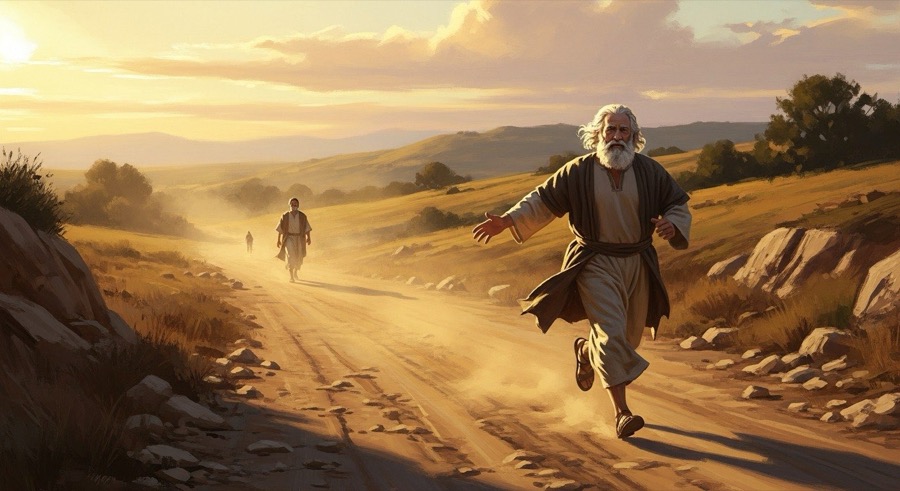
The son began his long, shameful walk home, practicing his speech, bracing for rejection, preparing for a life of servitude. He was walking toward his father, but he had no idea his Father was already running toward him. This is the part of the story that should shatter our every preconceived notion about God. 'But when he was yet a great way off, his father saw him, and had compassion, and ran, and fell on his neck, and kissed him.'
Do not read those words too quickly. In that culture, an elder patriarch, a man of honor and standing, did not run. To do so, he would have to pull up his robes, exposing his legs in a way that was considered utterly undignified and shameful. But the father’s compassion for his lost son overwhelmed his concern for his own dignity. His love was louder than the whispers of the neighbors.
His mercy moved faster than his son’s sin. He wasn't waiting on the porch with folded arms and a stern lecture. He was scanning the horizon, longing for a familiar silhouette. The moment he saw his son, he abandoned all decorum and ran.
The son starts his prepared speech, but the father isn't listening to the conditions. He cuts him off with a cascade of commands that scream restoration, not probation. 'Bring forth the best robe'—this covered his filth and restored his honor. 'Put a ring on his hand'—this restored his authority and identity as a son. 'Put shoes on his feet'—slaves were barefoot; sons wore shoes.
This was a complete and total reinstatement. ' Why? ' This is the Gospel. This is the story of our redemption. It is not about a sinner who cleaned himself up; it's about a Father whose love washes away all the filth.
But the father said to his servants, Bring forth the best robe, and put it on him; and put a ring on his hand, and shoes on his feet: And bring hither the fatted calf, and kill it; and let us eat, and be merry: For this my son was dead, and is alive again; he was lost, and is found. And they began to be merry.— Luke 15:22-24, KJV
' You can see the Father’s house on the horizon, but the road between here and there is littered with the wreckage of your choices. The shame is heavy. The fear of rejection is real. Please hear this truth today, rooted in the very words of Jesus Christ: you may be walking, but your Father is running. His grace will close the distance.
Your journey of coming back to God does not end with a handshake and a list of rules. It ends in the arms of a Father who saw you, had compassion, and ran to bring you home. The party isn't for someone else. It's for you.