
Our Daily Bread, Our Daily Debt
It’s three in the morning. The house is still, but your mind is a courtroom, and you're the one on trial. A harsh word you spoke yesterday echoes in the silence, a selfish decision plays on a loop, a quiet failure looms larger in the dark than it ever did in the light of day. There's a weight to it, isn't there? A spiritual debt that feels like it’s accruing interest with every tick of the clock, a heaviness in your soul that a morning cup of coffee simply can't lift. This is the human condition, this secret ledger of wrongs we keep against ourselves, feeling like we have to do something, anything, to balance the books before we can dare to face God or even our own reflection in the mirror.
Then you remember the prayer. The one Jesus taught His friends to pray, right there on the mountainside. He tells them to ask, “Give us this day our daily bread.” And in the very next breath, “And forgive us our debts, as we forgive our debtors.” Notice how close they are. Bread and debts. Physical sustenance and spiritual release, sought with the same daily, desperate urgency. This isn't a once-a-year confession or a grand gesture of penance; it's a moment-by-moment dependence. Christ isn't teaching a transactional formula to earn forgiveness, but a humble posture of absolute reliance on the Father's provision for both the body that hungers and the soul that aches under a debt it can never repay on its own.
And here's the thing that turns our whole religious economy upside down. He immediately follows the prayer with a condition that sounds like a command: “For if ye forgive men their trespasses, your heavenly Father will also forgive you.” This isn't a quid pro quo where our act of forgiving somehow purchases God's forgiveness. You can’t buy a priceless gift. No, this is a diagnostic test for the heart. A heart that truly comprehends the staggering, scandalous, unmerited cancellation of its own infinite debt to a holy God cannot remain a cramped, cold prison of bitterness toward others. The forgiveness we extend isn't the payment for the grace we receive; it's the irrefutable evidence that we've received it at all. It's the natural, beautiful, liberating overflow of a soul that has been set free.
And forgive us our debts, as we forgive our debtors.— Matthew 6:12, KJV
A Line in the Sand
We love our systems of self-reliance, even in our spiritual lives. We try to manage our sin, to categorize it on a sliding scale of severity. This one was a small mistake, easily fixed with a few extra prayers or a generous act. That one was bigger; it might require a week of diligent Bible reading and being exceptionally kind to everyone we meet. We construct these intricate ladders of penance, these personal rules of religion, believing we can climb our way back into God's good graces through sheer effort. But this whole fragile system shatters into a million pieces when we hear the raw, unfiltered words of Jesus Himself, who speaks of a particular sin that simply will not be forgiven. Suddenly, our neat little ledgers look like kindling for a holy fire, and our best efforts are exposed as child's play in the face of absolute righteousness.
But don't miss the thunderclap of grace that precedes the warning. Before He mentions the one exception, Jesus makes an astonishingly broad proclamation: “Wherefore I say unto you, All manner of sin and blasphemy shall be forgiven unto men.” All manner of it. Every kind. The secret thought you're ashamed to admit even to yourself, the corrosive envy you harbor for a friend's success, the public failure that still burns with humiliation, the lie you swore you'd carry to the grave. It's all covered, all of it, by the blood of the Lamb. The blasphemy against the Holy Ghost isn't a careless word or a moment of doubt; it's the final, settled, persistent rejection of the Spirit's clear testimony about Jesus Christ. It is looking at the manifest power of God and calling it the work of the devil. The very fact that you might worry you've committed it is the surest sign you have not, for a heart in that state wouldn't care at all.
To understand this, you must see the scene. The Pharisees, the religious experts of the day, had just witnessed Jesus perform an undeniable miracle, a clear act of God's liberating power. And their response was to attribute this work of the Holy Spirit to Beelzebub, the prince of devils. This is the context. The unforgivable sin is not a slip of the tongue; it is a calloused, determined state of heart that looks directly at the divine light of Christ and declares it to be darkness. For every other sin, for every other failure, for every debt that haunts you in the quiet hours, Christ's proclamation is not a new barrier, but a declaration of just how vast and all-encompassing His forgiveness is for anyone who will simply turn and receive it.
Wherefore I say unto you, All manner of sin and blasphemy shall be forgiven unto men: but the blasphemy against the Holy Ghost shall not be forgiven unto men.— Matthew 12:31, KJV
Living Forgiven
So what does this freedom look like on a frantic Tuesday afternoon, when the pressures of life are squeezing you? It looks like your child spilling something all over the floor for the third time, and just as the hot words of frustration rise in your throat, you remember the bottomless patience of your Father in heaven. It looks like a coworker taking credit for your work, and instead of plotting your revenge or stewing in bitterness, a quiet strength allows you to release them from the debt, because you remember the infinite debt that was cancelled for you. Forgiveness isn't some ethereal feeling you have to conjure up; it's a gritty, conscious decision, an act of the will to cancel a debt in your own heart because your name has been cleared on heaven's ledger. It's messy, it's often unseen, and it is the hardest, most beautiful work of the Christian life.
My friend, please hear me. Stop trying to fix yourself enough to be forgiven. You can't. That is the entire point of the gospel. You can't scrub the stain clean, you can't pay back the deficit, you can't make yourself worthy. Jesus did not come for the healthy; He came for the sick. He did not enter the world to applaud the righteous, but to seek and to save the lost, to call sinners to repentance. I'm urging you today to lay down the heavy tools of self-improvement and cast off the impossible yoke of religious performance. His yoke is easy and His burden is light, not because the standard is lower, but because He carried the crushing weight of it all for you. Your part is not to achieve; it is to receive. It is to simply open your empty, trembling hands and accept the gift that cost God everything He had.
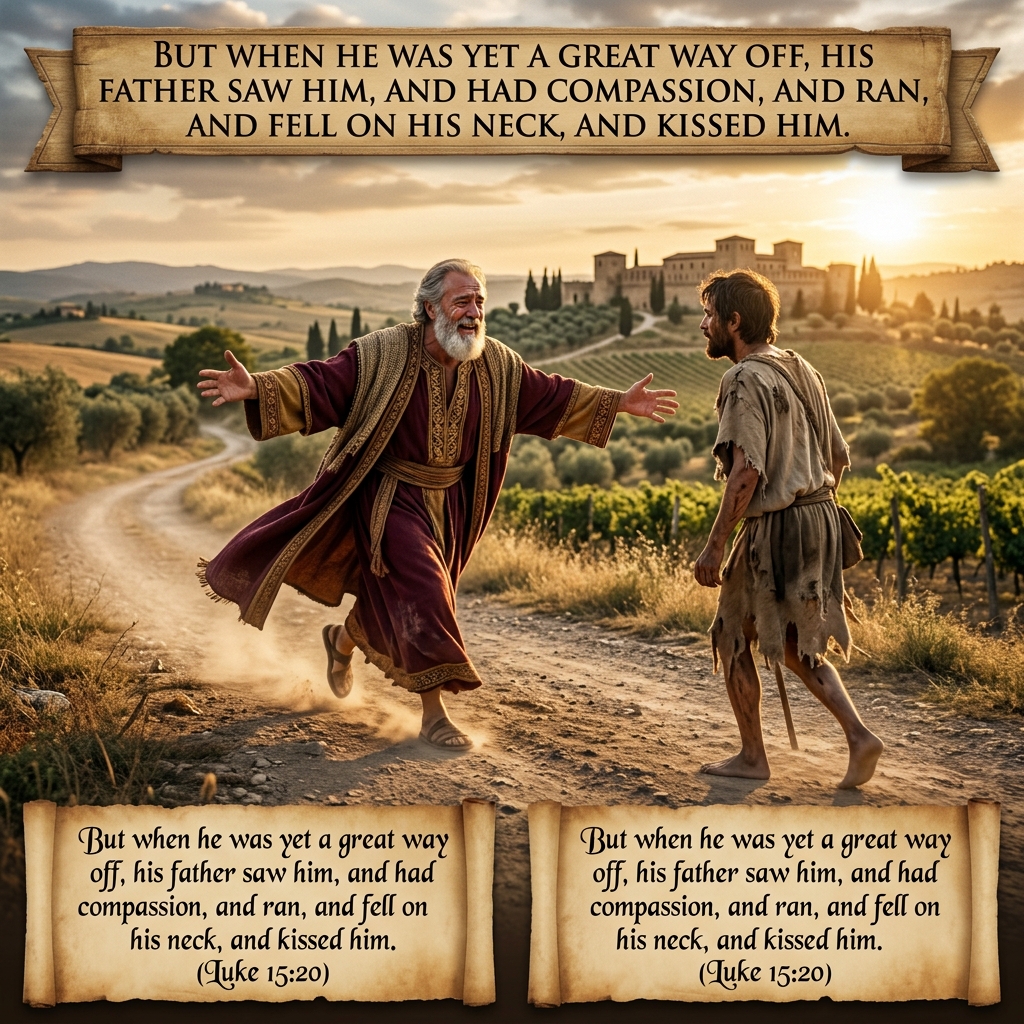
To truly walk in this grace day by day means your morning begins not with a frantic to-do list for God, but with a profound and grateful 'thank you' for what He has already done. It means that when you inevitably fail—and you will—your instinct is to run *to* your Father, not hide from Him in shame like Adam among the trees. You'll start to see the people around you not as a collection of debtors and adversaries, but as fellow souls who are just as desperate for the same grace you've received. This is the treasure Jesus spoke of, the kind we are to lay up for ourselves in heaven. It’s not a stockpile of our good deeds, but a heart so thoroughly transformed by forgiveness that it becomes a conduit of that same forgiveness to others, a wealth that moth and rust cannot corrupt because its value is eternal.
But if ye forgive not men their trespasses, neither will your Father forgive your trespasses.— Matthew 6:15, KJV
Standing on Solid Ground
The promise of forgiveness is absolute bedrock, not shifting sand. It is not founded on the inconsistency of our feelings, the imperfection of our performance, or our fluctuating ability to be good. It is built entirely upon the unchanging character of God and the finished, perfect work of His Son. Jesus Himself gives the assurance: “your heavenly Father will also forgive you.” That is not a hopeful suggestion; it is a covenant promise sealed in blood. The ultimate foundation for your forgiveness is not your fragile capacity to forgive those who have wronged you, but His unshakeable, eternal act of forgiving you at the cross. Our forgiveness of others, then, becomes the fruit, not the root; it is the living, breathing, undeniable proof that we have truly understood and received the treasure of His grace.
The most profound danger after receiving such an impossibly extravagant gift is to immediately start trying to pay for it. It is the temptation to walk out of the throne room of grace and head straight back to the debtor's prison, to willingly pick up the old, familiar chains of guilt and shame and fasten them around your own ankles. This is the dead-end street of religion without relationship. It puts you right back on the exhausting treadmill of trying to earn what has already been freely and fully given. Don't do it. Don't let the accuser, or even your own conscience, whisper the lie that you must add your own works to the finished work of the cross. To do so is to cheapen the very blood that purchased your eternal freedom. Stand fast, therefore, in the liberty wherewith Christ hath made you free.
But lay up for yourselves treasures in heaven, where neither moth nor rust doth corrupt, and where thieves do not break through nor steal:— Matthew 6:20, KJV
So breathe deep tonight, friend. Rest in this truth. The cosmic ledger has been cleared, not by your frantic accounting, but by His precious blood. The debt is cancelled, paid in full. The forgiveness you so desperately seek is not something you have to wrestle from a reluctant God's hands; it is the very gift He is extending to you right now with nail-scarred hands. It comes in the morning, fresh with the dew, alongside the manna, the daily bread for the daily need. It is a constant, unending stream flowing from the very throne of grace. Receive it. Walk in it. And then, from the astonishing, liberating overflow of a heart set completely free, be “kind one to another, tenderhearted, forgiving one another, even as God for Christ's sake hath forgiven you.” This is not a new law to crush you; it is the very pulse of the new life He has given you.