
The Debt You Can't Un-Owe
It’s three in the morning. The house is quiet, the world is asleep, but your soul is screaming. You're replaying the tape again, that conversation, that decision, that moment of weakness that now feels like a permanent stain on your spirit. You feel the weight of it, a physical pressure in your chest, a debt that feels impossible to pay back. We've all been there, staring at the ceiling, wondering if there's enough good we can do to cancel out the bad, if there's a prayer, a ritual, a transaction that can make us clean. The search for forgiveness is a universal human cry, a desperate need to have the slate wiped clean and the crushing weight of our own failures lifted off our backs for good.
And right into that sleepless night, Jesus speaks. He teaches his closest friends how to talk to God, and the words are simple, almost shockingly so. He doesn't give them a complicated list of sacrifices or a long penance to perform. He tells them to ask for their daily bread, for their essential provision, and in the very same breath, to ask for pardon. Look at the language He uses: “And forgive us our debts, as we forgive our debtors.” He calls our sin a debt, an account that's in the red, a staggering bill we simply cannot pay on our own. It’s not a mistake to be corrected or a flaw to be managed; it is a profound obligation owed to a holy God, and we are utterly bankrupt.
This changes everything. If you're trying to figure out the right formula to get forgiveness from a distant, transactional god, you'll spend your life on a treadmill of performance, never knowing if you've done enough. But Jesus introduces us to a Father. He ties our own release to our willingness to release others, not as a way to earn His pardon, but as evidence that we understand what His pardon cost. The logic is upside down from the world's way of thinking; you don't forgive others in order to get God to forgive you. You are able to forgive others because you have been forgiven a debt so massive, so astronomical, that the offenses of others against you look like pocket change in comparison.
For if ye forgive men their trespasses, your heavenly Father will also forgive you: But if ye forgive not men their trespasses, neither will your Father forgive your trespasses.— Matthew 6:14-15, KJV
The Open Reward of a Secret God
So much of religion becomes about the outward show, doesn't it? It's about being seen doing the right thing. Jesus saw it clear as day with the hypocrites of his time. He watched them disfigure their faces when they fasted, putting on a public performance of piety to win the approval of men. And He says, point-blank, that’s all the reward they’ll ever get. Their account is paid in full with human applause. They tried to turn a spiritual discipline into a transaction, a way to build up religious credit, and in doing so, they missed the entire point. Self-reliance in the spiritual life always leads to this kind of public posturing because it has no private substance; it needs an audience because it has no real connection to the Father who sees in secret.
But the forgiveness Jesus offers isn't a reward for our piety; it's the very foundation of it. You don't fast to be forgiven; you can fast because you *are* forgiven. You don't pray to earn God's attention; you pray because in Christ, you already have it. The work is finished. The debt is canceled. Nailed to a cross. Paid in full by the blood of the Lamb. This is the beautiful, scandalous truth of the Gospel that separates it from every other religious system on earth. It’s not about what you do for God; it’s about what God has done for you in the person of His Son. This is why the Apostle Paul could later write to the church in Ephesus and command them, “And be ye kind one to another, tenderhearted, forgiving one another, even as God for Christ's sake hath forgiven you” (Ephesians 4:32). The pattern is set: His forgiveness of us is the cause, our forgiveness of others is the effect.
Jesus himself underscores the sheer breadth of this gift when he confronts the Pharisees. Think about the gravity of His statement: “Wherefore I say unto you, All manner of sin and blasphemy shall be forgiven unto men.” Every kind. Every category. Every secret shame and public rebellion that keeps you up at night is covered, except for one: the ultimate, final, persistent rejection of the very Spirit who brings this forgiveness to you. The blasphemy against the Holy Ghost isn't a slip of the tongue; it's the settled state of a heart that looks at the rescue offered in Christ and says, “I don't want it.” Forgiveness isn't a cosmic vending machine where you insert good deeds; it is a person, Jesus Christ, and to receive His pardon, you must receive Him.
Wherefore I say unto you, All manner of sin and blasphemy shall be forgiven unto men: but the blasphemy against the Holy Ghost shall not be forgiven unto men.— Matthew 12:31, KJV
Daily Bread, Daily Pardon
So how does this work itself out when the dishes are piled in the sink and your child has just defied you for the tenth time? How does it apply when a coworker takes credit for your work and you feel that hot flash of injustice? It works out by breathing a simple prayer. Give us this day our daily bread. And forgive us this day our daily debts. You see, the forgiveness isn't a one-time transaction that you put in your spiritual wallet and forget about. It's a daily provision, just like the manna in the wilderness. You can't store it up. You can't rely on yesterday's experience of grace to fuel today's challenges. You live in a moment-by-moment dependence on the Father's supply, both for your body and for your soul.
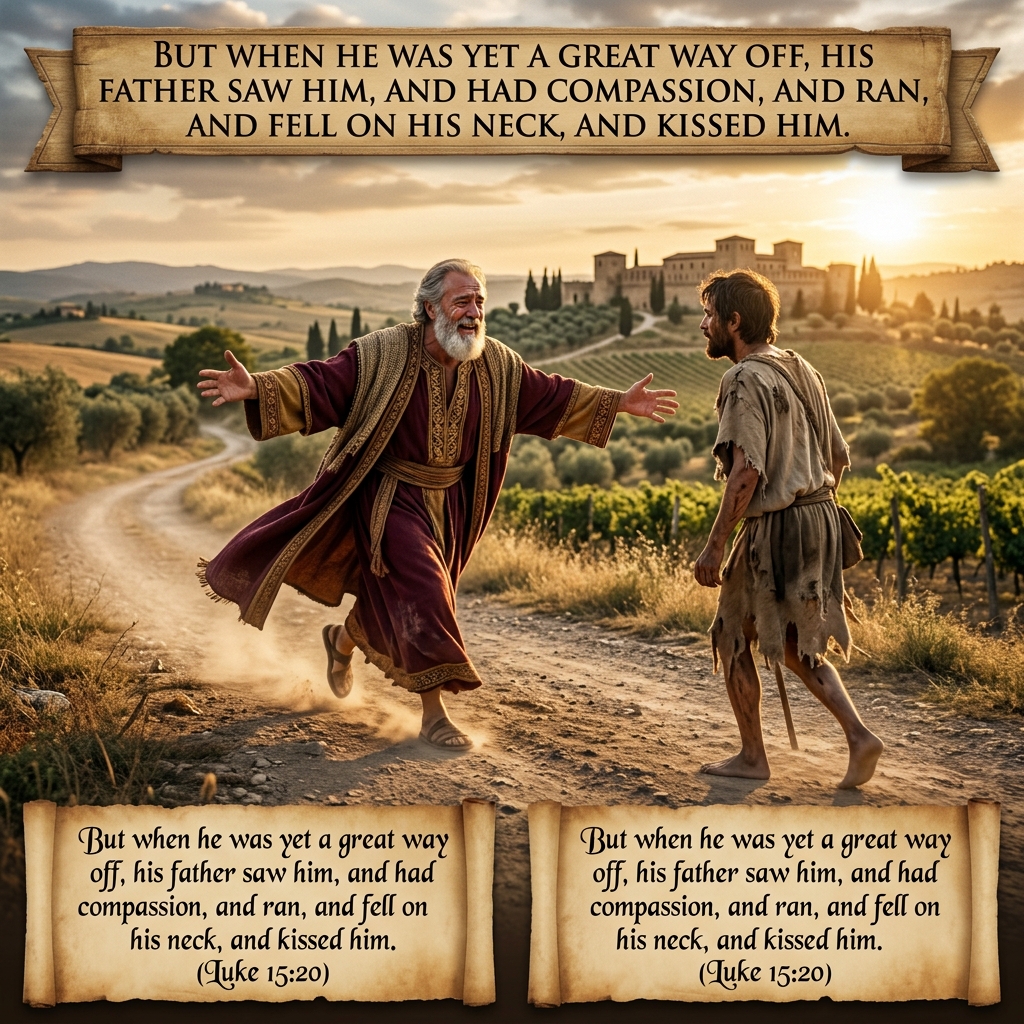
Please hear me on this. Stop trying to fix yourself. Stop trying to make yourself worthy of the forgiveness you've already been given. Your attempts to clean yourself up before you come to God are like a child covered in mud trying to wash himself in a puddle before coming inside to his father's clean, warm bath. It's a futile effort that just makes a bigger mess. Rest. Cease your striving. The Father isn't waiting for you to get it right; He is waiting for you to come to Him right where you are, with all your failures and frustrations, and to receive the pardon He already secured for you. His arms are not crossed in judgment; they are open in welcome because of His Son.
Walking in this grace day by day means you start to see the world differently. You start to see other people not as adversaries or competitors, but as fellow debtors who need the same grace you do. When someone offends you, your first thought is no longer, “How could they?” but rather, “How much have I been forgiven?” This posture of humility, born from an honest look at your own soul and a grateful look at the cross, is what allows you to release others from the debts they owe you. It's not about pretending they didn't hurt you; it's about canceling their debt because your own infinite debt has been miraculously, gloriously canceled by the King.
And be ye kind one to another, tenderhearted, forgiving one another, even as God for Christ's sake hath forgiven you.— Ephesians 4:32, KJV
Treasures Moths Can't Touch
The bedrock of our faith is not our ability to hold on, but His unbreakable promise to hold us. Jesus commands us, “Lay not up for yourselves treasures upon earth, where moth and rust doth corrupt.” Our performance, our good deeds, our religious efforts—these are all earthly treasures that rust and decay. They can be stolen by pride or corrupted by wrong motives. But the forgiveness you have in Christ is a treasure in heaven. It is incorruptible. It is secure. It is not dependent on your feelings, your faithfulness, or your ability to forgive others perfectly. It is dependent entirely on the finished work of Jesus Christ, a treasure that is eternally safe and eternally yours.
So let me warn you, friend. The temptation will always be to go back. To pick up the chains of performance. To start keeping score again with God and with others. The enemy of your soul loves nothing more than to see a forgiven child of God living like an indebted slave, constantly trying to earn what is already freely given. You must refuse to go back to that prison. You must preach the gospel to yourself every single morning. The debt is paid. The verdict is righteous. The Father's love is secure. You are not defined by your trespasses, but by His pardon.
But lay up for yourselves treasures in heaven, where neither moth nor rust doth corrupt, and where thieves do not break through nor steal:— Matthew 6:20, KJV
So if you came here asking how to get forgiveness, the answer is you can't. You cannot earn it, you cannot achieve it, and you cannot perform your way into it. But the glorious news of the Gospel of Jesus Christ is that you don't have to. Forgiveness isn't something you get; it's someone you receive. His name is Jesus. He taught us to pray to a Father, not a judge. He lived the perfect life you couldn't live, died the death you deserved to die, and cancelled a debt you could never pay. The path to forgiveness is not a set of steps but a single step of faith into the open arms of the Son of God, who stands ready, right now, to make you clean.