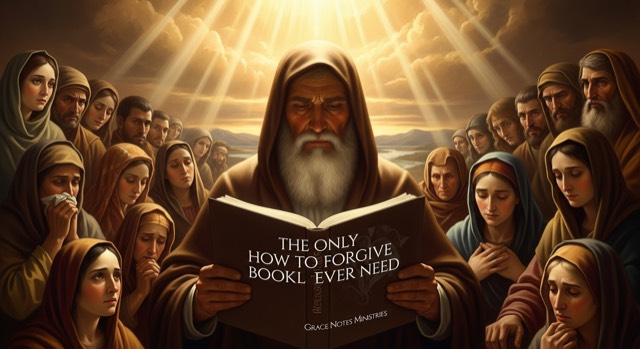
The Ledger We Keep in the Dark
It's three in the morning, and the house is dead quiet. But your mind is a courtroom, and you are the judge, the prosecutor, and the star witness all at once. You're replaying the scene again, aren't you? The words that were said, the trust that was shattered, the wound that still feels as fresh as the moment it was inflicted. It feels like a physical weight, a hot stone in the pit of your stomach, and you carry it everywhere you go. This is the heavy, dog-eared book of debts we all carry, the one we pull out in the darkness to read ourselves the story of our own pain, convincing ourselves that our anger is righteous, that our grudge is justified, that holding on is the only way to honor the injury.
And right there, in that quiet, desperate moment, the words of Jesus cut through the noise with terrifying clarity. He's teaching his closest friends how to speak to the Father, and He weaves this staggering condition right into the fabric of their daily conversation with God. After asking for bread, for simple sustenance, He says, 'And forgive us our debts, as we forgive our debtors.' Notice the sequence. Food for the body, then freedom for the soul. He ties the forgiveness we need to the forgiveness we give, not as a transaction, but as a reflection. The word 'as' is a mirror. It means 'in the same way that.' We are asking God to treat our cosmic, soul-crushing debt to Him in the exact same manner that we treat the comparatively tiny debts others owe us.
This isn't a spiritual self-help guide with five easy steps. It's a divine diagnosis of the human heart. If you're clutching that book of wrongs, unable to release someone from the prison of your resentment, Christ's prayer reveals a deeper issue: you may not have truly grasped the sheer, scandalous scale of your own pardon. Paul understood this when he wrote to the church at Ephesus, pleading with them to be 'kind one to another, tenderhearted, forgiving one another, even as God for Christ's sake hath forgiven you.' The power to forgive doesn't come from our own moral strength or a desire to be the bigger person; it flows directly from a heart that has been shattered and remade by the unmerited, unbelievable forgiveness of God, received through Jesus Christ.
For if ye forgive men their trespasses, your heavenly Father will also forgive you: But if ye forgive not men their trespasses, neither will your Father forgive your trespasses.— Matthew 6:14-15, KJV
The Failed Math of Self-Reliance
We try so hard, don't we? We think forgiveness is an act of sheer will, a mountain we must climb through gritted teeth. We say the words, 'I forgive you,' but the bitterness clings to our spirit like grave dust. We attempt to balance the scales, to make sure the other person feels the weight of what they've done before we grant them our magnanimous pardon. This is the exhausting arithmetic of religion, a performance-based system where grace is earned and forgiveness is a reward for good behavior or sufficient remorse. But it always fails. It fails because our hearts don't have the capacity to manufacture the kind of absolution that truly sets a prisoner free, and the prisoner we're most concerned with is usually ourselves.
But the Gospel isn't about balancing the books; it's about God throwing the entire ledger into the fire. The work is finished. Your debt, which was so immense that it would take you an eternity of bankruptcies to even begin to address, was nailed to a cross with Jesus Christ. It wasn't just covered; it was cancelled. Annihilated. Wiped from the record forever by the crimson ink of His own blood. When God looks at you, if you are in Christ, He doesn't see a debtor scrambling to make payments. He sees the perfect righteousness of His Son. True forgiveness of others, then, isn't something you do to get right with God; it's what you do because you are already right with God.
So when Jesus says, 'if ye forgive not men their trespasses, neither will your Father forgive your trespasses,' He's not laying down a new law or a cruel condition. He's describing a spiritual reality. He's holding up a diagnostic mirror. A heart that stubbornly refuses to forgive is a heart that is not living in the reality of its own forgiveness. It's like a man pardoned from a life sentence who refuses to leave his cell because he's too busy nursing a grudge against the guard who was rude to him. The door is wide open, but he chooses the prison of his own bitterness. Your refusal to forgive doesn't chain God's hands; it reveals that you are still living in chains yourself.
And be ye kind one to another, tenderhearted, forgiving one another, even as God for Christ's sake hath forgiven you.— Ephesians 4:32, KJV
Daily Bread, Daily Pardon
Think of the friction in your own home. The sharp word from your spouse over breakfast, the sullen silence of a teenager, the forgotten promise that stings more than you want to admit. Forgiveness isn't always a grand, cinematic event following a dramatic betrayal; most often, it's a daily, gritty discipline. It's the small, constant choice to not keep a record of wrongs. It is the conscious decision to tear out the page from today's entry in that ledger of hurts before the ink even has a chance to dry. This is precisely why Jesus places the petition for forgiveness right next to the petition for daily bread. We need both every single day, in equal measure, fresh from the Father's hand.
So what do you do when the feeling just isn't there? When your heart is hard and the wound still aches? Stop trying to fix yourself. Stop trying to muster up a feeling of forgiveness. You can't. Instead, turn your gaze away from the person who hurt you and fix it upon the cross where you were forgiven. Meditate on the forgiveness you have received. Dwell on the magnitude of your own debt that was paid without your help or permission. Ask the Holy Spirit to make the reality of your pardon more real to you than the reality of your pain. True forgiveness isn't a feeling you conjure; it's a reality you inhabit, and it is the settled, peaceful reality of grace.
Walking in this grace means you start your day with empty hands. You come to the Father for your daily bread, acknowledging your complete dependence on Him for physical life. And in the very next breath, you come to Him for your daily pardon, acknowledging your complete dependence on Him for spiritual life. This posture of humility keeps the ground level at the foot of the cross. There are no hierarchies of sin, no scales of offense. There are only debtors, all of whom have been forgiven an impossible sum. From that place, and only from that place, can we look at our brother or sister and say, from the depths of a liberated heart, 'I forgive you, as I have been forgiven.'
And forgive us our debts, as we forgive our debtors.— Matthew 6:12, KJV
The Treasure of a Clean Slate
The words of Jesus are not shifting sand; they are bedrock. He makes a direct, unbreakable link between the way we handle forgiveness and the way we experience our Father's forgiveness. This is the constitution of His Kingdom. When you choose to release someone, you are stepping into the flow of grace that has already been poured out on you. You are agreeing with God about the finished work of His Son. You are affirming that the pardon you received is powerful enough to flow through you to others. This isn't a burden; it is our magnificent privilege as children of God, to be agents of the very reconciliation that saved our own souls.
But there's a sober warning here we can't afford to ignore. To refuse to forgive is to hoard a corruptible treasure. It is to 'lay up for yourselves treasures upon earth, where moth and rust doth corrupt.' The satisfaction of a grudge, the feeling of moral superiority, the secret pleasure of holding someone's debt over their head—these are rusty, moth-eaten treasures. They poison the soul. They block our fellowship with the Father. To cling to unforgiveness is to choose the fleeting, bitter currency of earth over the eternal, liberating riches of heaven. It is to willingly walk back into the debtor's prison and lock the door from the inside, all while the King is calling your name from the sunlit courtyard of freedom.
Lay not up for yourselves treasures upon earth, where moth and rust doth corrupt... But lay up for yourselves treasures in heaven, where neither moth nor rust doth corrupt...— Matthew 6:19-20, KJV
So tonight, when the house is quiet and the old wounds begin to speak, don't open that familiar, heavy book of wrongs. You don't need another 'how to forgive book' filled with human strategies. Instead, lay it down. Lay it down at the foot of the cross, and see the One who hangs there for you, bearing the full weight of every debt you ever owed. See His hands, pierced for your transgressions. Hear His voice, crying out, 'It is finished.' The only condition for your pardon was His blood, and it has been met. Let the reality of that finished work wash over you, and in its cleansing tide, let go of the debts others owe you. This isn't a task to be completed, but a gift to be received and then freely given away. Walk out of the courtroom of your mind and into the Father's embrace. That is the only treasure that will never fade.