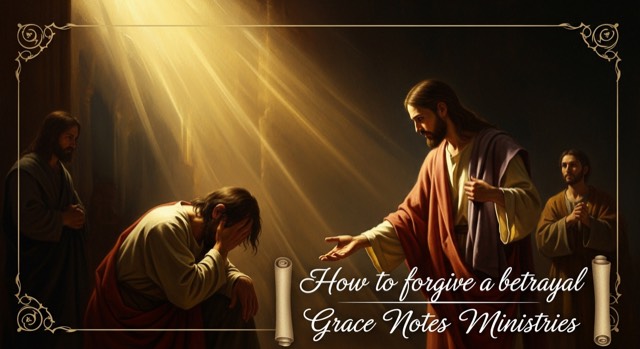
Give Us This Day Our Daily Bread
It’s three in the morning. Again. The house is quiet, the world is asleep, but your mind is a courtroom where you are the prosecutor, the judge, and the jury. You replay the scene, the words that cut like glass, the look on their face when the trust shattered into a million pieces you can never put back together. It’s a debt. A real one. You can feel its weight in the hollow of your chest, a cold, hard stone of injustice that demands to be paid back in full. Friends tell you to let it go, to move on, but their words are empty because they don't understand the sheer gravity of the offense. This wasn't a mistake; it was a choice, and it left a wound that bleeds every time you remember.
And right there, in that moment of profound spiritual hunger, Jesus teaches us to pray. It’s a strange sequence, isn't it? He tells us to ask for our provision first: “Give us this day our daily bread.” Food for the body. Life for the day. And then, in the very next breath, He links our sustenance to our soul’s deepest need and most difficult command: “And forgive us our debts, as we forgive our debtors.” He doesn't separate them. He braids them together. The bread that keeps you alive and the grace that sets you free are requested in the same conversation, with the same Father. That little word, *as*, is the hinge upon which your entire relationship with God swings, a terrifying and beautiful parallel where we ask God to mirror the mercy we show to others.
But notice the flow of grace here, because it's everything. This isn't a transactional contract where your forgiveness of others somehow earns God's forgiveness for you, as if you could ever build a ladder of good works tall enough to reach heaven. No, that would make you your own savior. Instead, Christ’s words are a diagnostic, a spiritual stethoscope on the heart. An inability to forgive is a symptom of a heart that has not yet been crushed and remade by the staggering reality of its own forgiven debt. So when Jesus says, “For if ye forgive men their trespasses, your heavenly Father will also forgive you: But if ye forgive not men their trespasses, neither will your Father forgive your trespasses,” it’s not a threat. It’s a revelation. He’s showing you that a heart clinging to bitterness is a heart that's forgotten the ten thousand talents it owed and had wiped clean by the blood of the Lamb.
And forgive us our debts, as we forgive our debtors.— Matthew 6:12, KJV
Where Moth and Rust Doth Corrupt
So we try to do it ourselves. We clench our fists and our jaw and decide we'll be the bigger person, which is often just a pious way of holding onto our moral superiority. We build elaborate systems of self-protection, declaring, “I’ll forgive, but I’ll never forget,” which really means we’re keeping the ledger open, the wound on display. This is nothing more than religious performance, an attempt to manage a spiritual cancer with a fleshly bandage. And it's precisely the kind of treasure Jesus warns us about: “Lay not up for yourselves treasures upon earth, where moth and rust doth corrupt.” Unforgiveness is that earthly treasure. It feels valuable, like a weapon we hold against our offender, but all the while it sits in the vault of our hearts, rusting, corroding everything it touches until our whole inner world is eaten away by bitterness.
The Gospel’s glorious relief is not that you become strong enough to forgive, but that you finally become weak enough to admit that you can’t. It’s in that moment of surrender, when you confess your powerlessness, that you can truly see the cross for what it is. It is the place of the great exchange, the divine cancellation of a debt so cosmic you couldn’t pay it off in a billion lifetimes. This is why Paul can write with such authority in Ephesians, “Be ye kind one to another, tenderhearted, forgiving one another, even as God for Christ's sake hath forgiven you.” The command to forgive is built entirely on a reality that has already happened. You are not forgiving *in order to be* forgiven; you are forgiving *because you already are*. It's not a struggle up a hill; it's a living water flowing from a well that has already been dug deep within you.
Let the scope of this sink into your soul. Jesus Himself declares, “Wherefore I say unto you, All manner of sin and blasphemy shall be forgiven unto men.” All manner. Every kind. Every shade. Every depth of betrayal that has ever left you breathless and broken on the floor, it falls under the category of “all manner.” The calculated deception from a business partner, the quiet betrayal of a spouse, the careless words of a friend that severed a bond—it’s all covered by the blood. The only thing Jesus puts outside this boundless ocean of grace is the blasphemy against the Holy Ghost, a final, hardened, settled rejection of the Spirit's testimony about the Son. The fact that this is the one and only exception should shatter our pride and demolish the prisons we build for others, proving His grace is infinitely more potent than their sin against us.
But if ye forgive not men their trespasses, neither will your Father forgive your trespasses.— Matthew 6:15, KJV
As We Forgive Our Debtors
And here's the thing. Forgiveness isn't a one-time spiritual transaction that leaves you with a warm feeling and a clean slate forever. No, it’s a daily choice, a gritty, moment-by-moment decision, just like asking for your daily bread. It's waking up and the first thing that hits you is the memory of the hurt, and in that instant, you have to choose to consciously hand that person and their debt back to the Father. It’s seeing their car in the parking lot of the grocery store and feeling that familiar knot tighten in your stomach, and right there, between the produce and the dairy aisle, whispering under your breath, “Lord, you forgave me. I choose to forgive them.” It's messy and it's hard, and it feels more like a limp than a victory lap, but it is the walk of faith. It is refusing to host the same old argument in your mind and choosing instead to rehearse the Gospel to your own soul.
So please, hear me. Stop trying so hard to fix this. You can't. You cannot manufacture the feeling of forgiveness any more than you can manufacture your own salvation. All you can do is agree with God. Agree that the wound is real and the pain is legitimate, but then agree that you are placing that entire, ugly debt onto the strong shoulders of Jesus Christ, who carried a far greater weight for you. Just rest there. Let His finished work be your only plea and your only power. When Christ tells you to “lay up for yourselves treasures in heaven,” He is inviting you into a divine economy where the currency is grace. Releasing the debt someone owes you is a profound act of faith, an investment in that heavenly account where nothing can be corrupted or stolen, and where your true wealth lies.
Walking this out day by day means you learn to treat the memory of the betrayal differently. When it surfaces, and it will, you don't offer it a chair and a cup of coffee. You don't sit with it and listen to its old, poisonous stories. You acknowledge its presence, and then you deliberately pivot your attention to the cross, to the empty tomb, to the King on the throne. It means your prayers begin to change. You stop asking God to bring justice down on their head and you start asking Him, however shakily at first, to extend His mercy into their life. I know that sounds impossible. It feels like the last thing you want to do. But it is the very act that breaks the chains of bitterness and sets you, the prisoner, free.
Be ye kind one to another, tenderhearted, forgiving one another, even as God for Christ's sake hath forgiven you.— Ephesians 4:32, KJV
For Thine is the Kingdom
Ultimately, this whole struggle rests not on the shifting sands of our emotions but on the solid rock of God's reality. The unshakeable baseline is this: you have been forgiven a debt so astronomical that, by comparison, any debt owed to you is a pittance. This truth from Matthew 6 is not a conditional threat from a petty God; it is a loving diagnosis from the Great Physician, showing us that an unforgiving spirit is a sign of a heart that has lost sight of its own miraculous rescue. To stand on this ground is to let your identity be redefined. You are no longer “the one who was betrayed.” You are “the one who has been forgiven.” You are a child of a King, and as the prayer concludes, it is His kingdom, His power, and His glory forever. Your job is not to run the universe or balance the books of justice; your job is to live like a son, like a daughter, reflecting the scandalous mercy of your Father.
So be warned. The enemy of your soul will constantly tempt you to pick that debt back up off the ground where you laid it. He'll whisper in your ear, reminding you of the pain, urging you to nurse the grievance because there is a dark, bitter satisfaction in being the wronged party. But to do so is to willingly walk back into the prison from which Christ has already freed you. It is choosing the rotting, earthly treasure of resentment over the incorruptible, heavenly treasure of peace with God. When we refuse to forgive, we are not keeping our offender in chains. We are fastening them to our own ankles. Jesus came to proclaim liberty to the captives, and that liberty is for you, right now, from the tyranny of what was done to you. Don't go back into that cell.
For if ye forgive men their trespasses, your heavenly Father will also forgive you:— Matthew 6:14, KJV
This isn't a simple formula; it's a deep, abiding relationship with the God of all grace. True forgiveness isn't a feeling you conjure up; it's a river that flows directly from His throne, and by faith, you have full access to it. The goal isn't just to feel better; it's to be made free. And freedom isn't found in forgetting the betrayal, but in remembering your deliverance with such clarity that the offense shrinks in the light of God's glory. The power you need will never come from within you. It comes from Him whose kingdom cannot be shaken, whose power emptied the grave, and whose glory will one day wipe every tear and make all things new. Until that glorious day, we keep asking for our bread, we keep extending His forgiveness, and we keep trusting the Father who sees in secret and will reward us openly with a treasure that will never, ever fade.