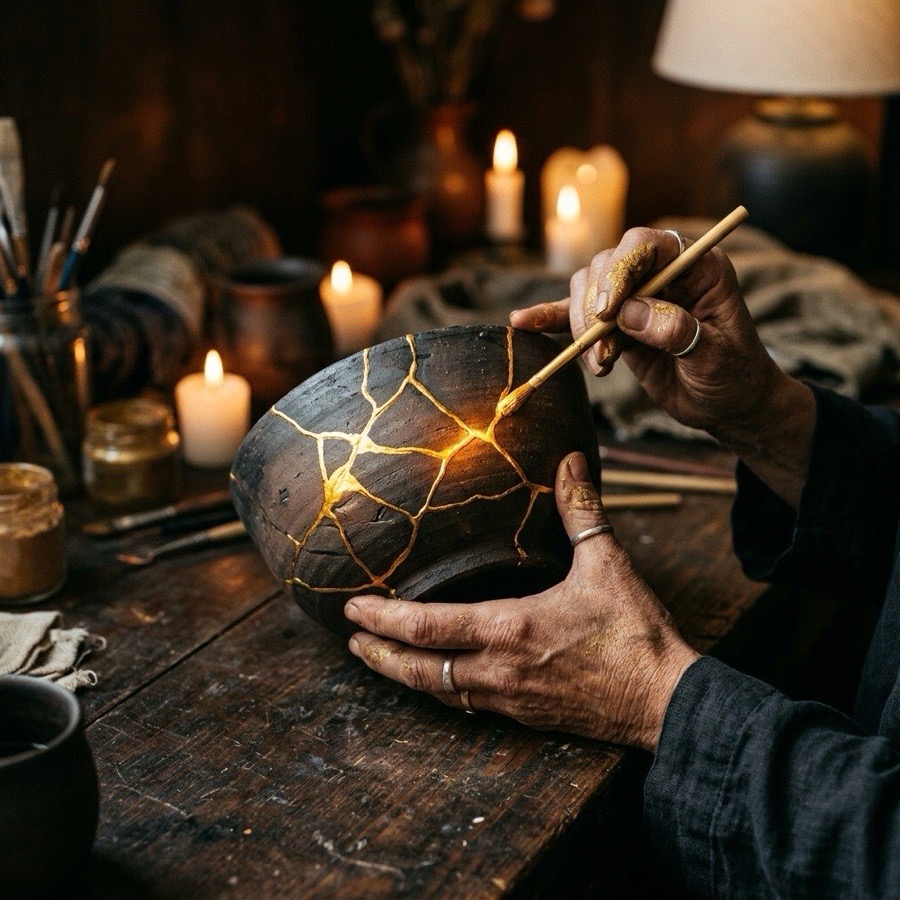
There is a Japanese art form called kintsugi. When a piece of pottery breaks, instead of discarding it or hiding the repairs, the artisan uses lacquer dusted with gold powder to mend the cracks. The fractures become part of the piece's beauty — more visible, not less. More valuable, not less. The vessel that has been broken and repaired with gold is considered more beautiful than one that was never broken at all.
The moment I first encountered this practice, I thought: this is exactly how God works.
There is a Japanese art form called kintsugi. When a piece of pottery breaks, instead of discarding it or hiding the repairs, the artisan uses lacquer dusted with gold powder to mend the cracks. The fractures become part...
- The Theology of the Cracked Vessel: Trusting God's Word through life's deepest trials and seasons of waiting.
- The People God Uses Most Are Often the Most Broken: Trusting God's Word through life's deepest trials and seasons of waiting.
- Beauty From Ashes Is Not a Figure of Speech: Trusting God's Word through life's deepest trials and seasons of waiting.
The Theology of the Cracked Vessel
Paul understood this. He wrote from experience — a man who had been a persecutor of the church, who watched Stephen die for a faith he was then trying to destroy, who later described himself as the "chief of sinners" (1 Timothy 1:15). A man who had his own breaking. And then this:
"But we have this treasure in earthen vessels, that the excellence of the power may be of God and not of us."— 2 Corinthians 4:7 (KJV)
Earthen vessels. Clay pots. Cracked, imperfect containers that were never supposed to be the point. The treasure is inside. The power is from God. The cracked clay is actually the evidence that it's real — because if we were perfect, polished vessels, someone might mistake the excellence for ours. The cracks make clear: whatever is glowing through here is not coming from the vessel itself.
The People God Uses Most Are Often the Most Broken
Moses had a speech impediment and a murder on his record. Gideon was the youngest son in the weakest clan in the smallest tribe in Israel. Rahab was a prostitute in Jericho. David was an adulterer and a murderer — and still called a man after God's own heart. Peter denied Jesus three times in one night. Paul tried to destroy the church before he helped build it.
God does not wait for intact vessels. He deliberately works through fractured ones — because a fractured vessel, repaired with His gold, tells a story that an intact one cannot. An unbroken person can tell you God is good. A broken-and-restored person can show you what that looks like when the ground has been completely cut out from under you.
Your testimony is not diminished by your breaking. Your testimony is your breaking, and what happened in it and after it.
Beauty From Ashes Is Not a Figure of Speech
"To console those who mourn in Zion, to give them beauty for ashes, the oil of joy for mourning, the garment of praise for the spirit of heaviness; that they may be called trees of righteousness, the planting of the Lord, that He may be glorified."— Isaiah 61:3 (KJV)
Beauty for ashes. Joy for mourning. Praise for heaviness. This is not a therapeutic metaphor. This is a transaction that God performs in real life, in real time, with real people who have been through real devastation. He takes the ash — what is left when the fire has burned through what you thought was permanent — and He makes something beautiful from it.
But you have to bring Him the ashes. You have to hand over the broken pieces rather than hiding them. God is not in the business of pretending the breaking didn't happen. He is in the business of using it. And He needs it in His hands to work with.
You Are Not Too Broken
Whatever you are holding right now — whatever broke in you or was broken over you, whatever you did or had done to you, whatever is cracked or fractured or feels too far gone to repair — you are not outside the reach of a God who does kintsugi on human souls.
He does not see your fractures as disqualifying. He sees them as the places where the gold can go. The places where, when the repair is complete, the light shines through most brightly. The places where a watching world can see, unmistakably, that what is glowing inside you did not originate with you — that you have been worked on by Someone whose expertise is precisely this kind of thing.
Broken is not the end of your story. In God's hands, it is often the beginning of the most important chapter.