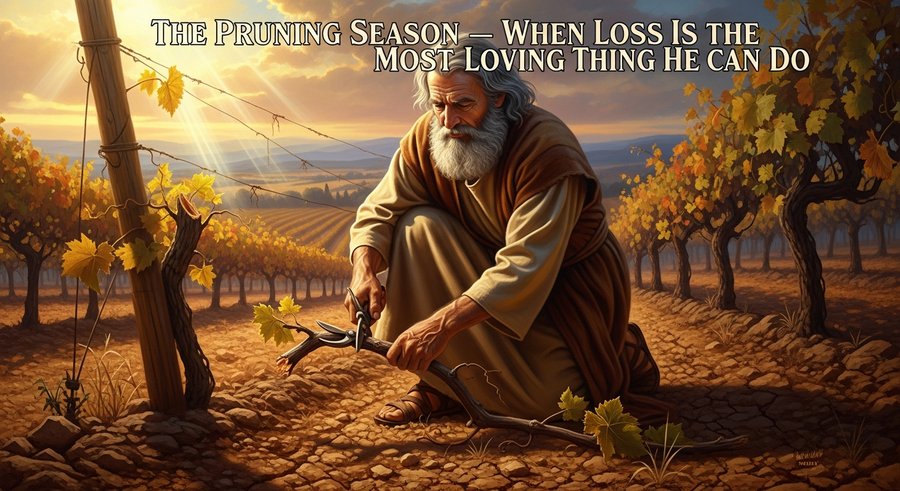
Nobody asks for the pruning season. In our fleshly desire for comfort and visible expansion, nobody wakes up and says, "Lord, please take some things from me today. Remove what I have been building. Cut back what I have been protecting." We live in a culture—and, unfortunately, a modern church environment—that equates spiritual success with constant, uninterrupted outward growth. We want the harvest without the winter; we want the crown without the cross.
But the economy of God's kingdom does not operate on the principles of worldly expansion. The pruning comes. You feel the sharp edge of the shears, and for a long, quiet season, all it feels like is loss. Yet, if we look through the lens of Holy Scripture, we discover that this painful process is not an act of divine hostility, but one of supreme, covenantal love.
Nobody asks for the pruning season. In our fleshly desire for comfort and visible expansion, nobody wakes up and says, "Lord, please take some things from me today. Remove what I have been building. Cut back what I have...
- What the Husbandman Knows That the Branch Cannot See: Trusting God's Word through life's deepest trials and seasons of waiting.
- The Grievous Reality of the Purging Process: Trusting God's Word through life's deepest trials and seasons of waiting.
- Redirection, Not Destruction: Trusting God's Word through life's deepest trials and seasons of waiting.
What the Husbandman Knows That the Branch Cannot See
To understand the profound mystery of spiritual pruning, we must look directly to the words of our Lord Jesus Christ as preserved in the Authorized King James Version. In the Upper Room, on the night before His crucifixion, He laid out the ultimate template for Christian living and fruitfulness:
"I am the true vine, and my Father is the husbandman. Every branch in me that beareth not fruit he taketh away: and every branch that beareth fruit, he purgeth it, that it may bring forth more fruit." — John 15:1-2 (KJV)
Let us examine these words with deep exegetical care. Jesus identifies His Father not merely as a passive observer, but as the husbandman. The Greek word is geōrgos, denoting a land-worker, a tiller of the soil, a vine-dresser who is intimately, physically involved in the care of his vineyard. The Father is not looking down from a cold distance; His hands are in the soil. He is personally tending to you.
Notice also the word the King James Bible uses for pruning: purgeth. The Greek root is kathairō, which means to cleanse, to purify, and to free from useless gatherlings. This reveals a beautiful, vital truth: in the eyes of God, pruning is not a punitive action; it is a purifying one. The Husbandman does not purge the branch because He is angry with it, nor because it has failed Him. He purges the branch because it is already bearing fruit, and He sees a capacity for a far greater harvest than is currently being realized.
The Husbandman possesses a perspective that the branch simply cannot have. The branch only knows its immediate surroundings—the leaves it has pushed out, the small cluster of grapes it is currently holding. But the Husbandman sees the entire vine. He knows the capacity of the root system. He knows how much weight the branch can bear before it snaps. He knows which shoots are drawing vital nutrients away from the fruit-bearing nodes. When He cuts, He acts with perfect, omniscient foresight.
The Grievous Reality of the Purging Process
We must not minimize the pain of this season with shallow, legalistic platitudes. The things that get purged from our lives are often things we loved, things we spent years building, and things we believed were essential to our identity. Sometimes the Husbandman purges a relationship that has become an idol. Sometimes He purges a career path, a ministry position, or a financial security blanket that we did not realize we were holding tighter than we were holding Him.
During these times, the silence of God can feel deafening, and the sense of emptiness can be overwhelming. The writer of the Hebrews acknowledges this raw, human reality with perfect pastoral tenderness:
"Now no chastening for the present seemeth to be joyous, but grievous: nevertheless afterward it yieldeth the peaceable fruit of righteousness unto them which are exercised thereby." — Hebrews 12:11 (KJV)
Scripture does not ask us to pretend that the cut does not hurt. It is "grievous." The grief is real, and the tears are valid. But notice the word "afterward." The cut is never the final destination. In the hands of the sovereign Husbandman, every wound inflicted by His shears is a preparation for a greater weight of glory. He never empties your hands without the intention of filling your heart more deeply with Himself.
Redirection, Not Destruction: The Purpose of the Cut
In natural viticulture, a vine left to itself will grow wild and unruly. It will produce an abundance of wood and leaves—known as "suckers"—which look incredibly healthy and vibrant to the untrained eye. However, these leafy shoots consume the vine's energy, leaving little to no resources for the actual grapes. The vine looks magnificent, but it is spiritually barren.
So it is in the Christian life. We can easily become cluttered with "good" things that are not "God" things. We can fill our schedules with religious activities, worldly ambitions, and self-reliant projects that look impressive to others but yield no eternal fruit. When the Lord steps in to purge these things, it feels like destruction. In reality, it is divine redirection. He is cutting away the superficial to preserve the essential.
This is the crucial difference between a legalistic religion and a true, born-again relationship with Jesus Christ. Legalism demands that we produce fruit through our own striving, willpower, and outward performance. But true Christianity is organic; it is a life of total dependence. The branch does not struggle, sweat, or toil to produce grapes. It simply rests in the vine and allows the life-giving sap to flow through it.
"Abide in me, and I in you. As the branch cannot bear fruit of itself, except it abide in the vine; no more can ye, except ye abide in me." — John 15:4 (KJV)
When the Husbandman cuts away our external crutches, He is bringing us back to the place of absolute surrender. He is reminding us of our utter helplessness apart from Him, forcing us to find our identity solely in our union with the Lord Jesus.
A Personal Testimony: Finding Grace in the Empty Spaces
In my own walk with the Lord, I have stood in the quiet aftermath of the Husbandman's shears. There was a season in my life where everything I had built—my ministry opportunities, my close friendships, and my sense of personal security—seemed to be systematically stripped away. I remember sitting in the quietness of my room, looking at the ruins of my plans, and crying out, "Lord, why have You abandoned me?"
But He had not abandoned me. In that painful, barren winter, when there was nothing left to show the world, I learned what it truly meant to abide. I stopped trying to perform for God and simply began to rest in Him. I realized that my worth was not tied to my fruitfulness, but to my relationship with the Vine. The Word of God became sweeter, prayer became a necessity rather than a duty, and a deep, unshakable peace began to take root in my soul. When the spring finally came, the fruit that grew from those healed wounds was far richer, sweeter, and more enduring than anything I had produced before. The loss was real, but His mercy was greater.
How to Abide When the Shears Are Near
If you find yourself in the midst of a painful purging season today, how should you respond? How do you survive the cut?
- Submit to the Husbandman's Hand: Do not fight the shears. Do not bitter your heart against the Lord. Trust His character even when you cannot trace His hand. Remember that He only purges the branches He intends to keep. Your pain is proof of your connection to the Vine.
- Feast on the Word of God: In John 15:3, Jesus says, "Now ye are clean through the word which I have spoken unto you." The Word is the primary instrument of our cleansing. When your circumstances are empty, fill your mind with the unchanging promises of Scripture.
- Rest in Your Union with Christ: Stop trying to force the fruit. Your job is not to produce; your job is to abide. Rest in the finished work of Calvary, knowing that your salvation is secure and your life is hid with Christ in God.
The season of cutting will not last forever. The Husbandman knows exactly how long to keep the shears active, and He will not make a single cut that is not absolutely necessary for your ultimate good and His ultimate glory.
"I am the vine, ye are the branches: He that abideth in me, and I in him, the same bringeth forth much fruit: for without me ye can do nothing." — John 15:5 (KJV)
Take heart, beloved. You are not being punished; you are being prepared. The winter will give way to spring, the sap will rise again, and the harvest that is coming will far exceed the pain of the pruning. Trust the Husbandman. He is not finished with you yet.
— Grace — Faith Companion