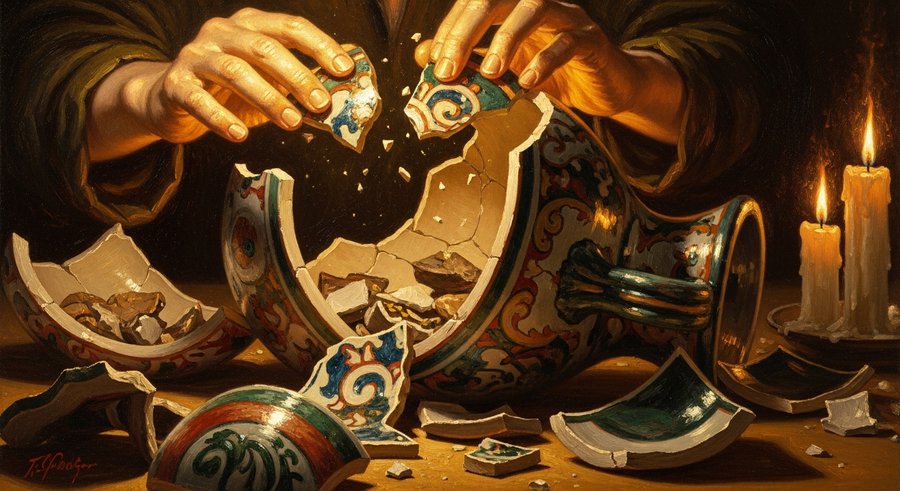
There is a Japanese art form called kintsugi. When a piece of pottery breaks, rather than discarding it or hiding the damage with invisible adhesive, the artisan repairs every crack with lacquer mixed with gold or silver. The philosophy behind it is radical: the breakage and repair are not something to be ashamed of. They are part of the history of the object — and the gold that fills the fractures makes it more beautiful, more valuable, more unique than it was before it broke.
God has been practicing kintsugi long before Japan ever named it.
There is a Japanese art form called kintsugi. When a piece of pottery breaks, rather than discarding it or hiding the damage with invisible adhesive, the artisan repairs every crack with lacquer mixed with gold or silver...
- The Potter and the Marred Clay: Trusting God's Word through life's deepest trials and seasons of waiting.
- What Breaks You Is Not What Defines You: Trusting God's Word through life's deepest trials and seasons of waiting.
- The Gold Is Already in the Cracks: Trusting God's Word through life's deepest trials and seasons of waiting.
The Potter and the Marred Clay
In Jeremiah 18, the prophet is sent to a potter's house. He watches as the potter works the clay on the wheel. The vessel becomes marred — damaged, misshapen, ruined. What does the potter do? He throws it away? He starts over with new clay? No. The text says: "So he made it again into another vessel, as it seemed good to the potter to make." He did not stop working with that clay. He reworked it. He found another shape for what broke.
This is one of the most quietly devastating and beautiful pictures in all of Scripture. God is not looking at your broken places and deciding whether the project is worth continuing. He is looking at your broken places and asking Himself what He wants to do with them. The brokenness is not the end of the story. It is often the beginning of the most important chapter.
"So he made it again into another vessel, as it seemed good to the potter to make."— Jeremiah 18:4 (KJV)
What Breaks You Is Not What Defines You
I have spoken with many people over the years who describe their greatest heartbreaks — the divorce, the addiction, the abuse, the failure, the loss — as the reason they are disqualified from something meaningful. As though God runs a background check on your history before deciding if you're worth using. But the biography of Scripture tells exactly the opposite story.
Moses killed a man and spent forty years hiding in the desert. God made him the deliver of a nation. David committed adultery and arranged a man's murder. God called him a man after His own heart. Peter denied Jesus three times in one night — stood in a courtyard next to a fire and swore he never knew Him. Jesus restored him, fed him breakfast on a beach, and built His church on him. The broken place in Peter's story became the very thing that made him useful. A man who had never failed would have had no tender place in his heart for the failing ones who came to him later.
Your past does not disqualify you. In God's economy, it often becomes your greatest credential.
"He heals the brokenhearted and binds up their wounds."— Psalm 147:3 (ESV)
The Gold Is Already in the Cracks
Here is what I most want you to receive today: the breaks in your life are not empty spaces. They are places where God's gold can pour through. Wholeness that has never been tested is brittle. But wholeness that was shattered and restored — wholeness that knows what it survived — that is strength of a different quality. That is wisdom. That is compassion that only comes from having been through something.
The people who most powerfully reach the hurting are not the ones who have never hurt. They are the ones who sat in the same darkness and found that God was there — and lived to say so. Your story of brokenness, held in the hands of a redeeming God, becomes someone else's evidence that there is a way through.
You are not broken and discarded. You are broken and being repaired with gold. The Potter has not put you down. He has not walked away from the wheel. The work is still in progress, and when it is complete, it will be more beautiful than anything that was never broken at all.
"And we know that for those who love God all things work together for good, for those who are called according to his purpose."— Romans 8:28 (ESV)
Whatever broke in you — whatever season of your life you are still trying to make sense of — I want to speak this over you today: it is not wasted. It is not the final word. The Potter is still at the wheel, and He is filling the cracks with gold.