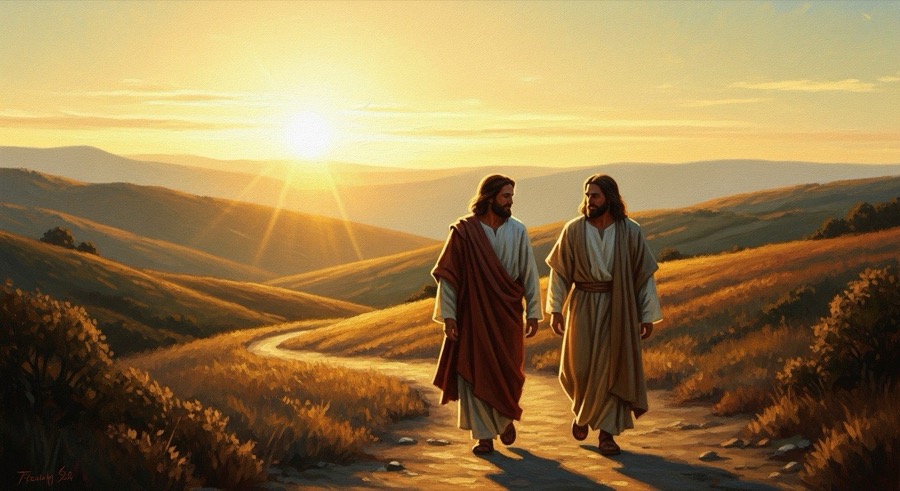
There are moments when life feels like a blurred landscape, where clarity is lost and hope seems to retreat into the horizon. You or a loved one may be walking through a dark valley where friends see only fragments of th...
- The Isolation of the Unseen in a Blind World: Trusting God's Word through life's deepest trials and seasons of waiting.
- The Intimacy of the Saviour's Touch: Trusting God's Word through life's deepest trials and seasons of waiting.
- The Beauty of the Progressive Process: Trusting God's Word through life's deepest trials and seasons of waiting.
The Isolation of the Unseen in a Blind World
There are moments when life feels like a blurred landscape, where clarity is lost and hope seems to retreat into the horizon. You or a loved one may be walking through a dark valley where friends see only fragments of the pain, or worse, they look right through it. In these quiet, desperate hours, it is easy to feel like the blind man at Bethsaida—struggling to make sense of a world that no longer makes sense. Spiritual, emotional, and physical blindness can leave us feeling entirely isolated from the very people who are meant to support us. We often carry the heavy weight of being misunderstood, longing for someone to truly see us and comprehend the depth of our suffering.
To understand this isolation, we must look at the setting of the miracle. Bethsaida was a town characterized by spiritual blindness and stubborn unbelief. It was a place where the miraculous had become mundane, and the hearts of the people had grown callous to the movement of God. In fact, Jesus had previously pronounced a solemn judgment upon the city, reminding them that their privilege was tied to their responsibility:
Woe unto thee, Chorazin! woe unto thee, Bethsaida! for if the mighty works, which were done in you, had been done in Tyre and Sidon, they would have repented long ago in sackcloth and ashes. — Matthew 11:21, KJV
To be physically blind in a town that is itself spiritually blind is a profound picture of absolute isolation. When searching for a comforting Bible verse for a friend, we must recognize that their pain is often compounded by the spiritual apathy of the world around them. They do not just need generic well-wishes or superficial encouragement; they need the life-giving, sight-restoring truth of God's Word to break through the fog of their circumstances.
The Intimacy of the Saviour's Touch
When we look for scripture to share with a hurting brother or sister, we must remember that God’s compassion is never generic; it is deeply personal. In the account of the blind man, we see that Jesus did not merely observe the man's distress from a distance, nor did He shout a command from afar to heal him. Instead, the Creator of the universe stepped into the man's darkness and took him by the hand.
This act of taking the man "by the hand" is a beautiful representation of the born-again relationship we are invited into with Jesus Christ. Salvation and healing are not found in cold, legalistic religion or the rigid adherence to a set of rules; they are found in the warm, guiding hand of the Saviour. He does not expect you to find your way to Him by sight; He finds you in your darkness and guides you by His grace. As the prophet Isaiah declared:
For I the LORD thy God will hold thy right hand, saying unto thee, Fear not; I will help thee. — Isaiah 41:13, KJV
Sometimes, the greatest act of friendship we can offer someone is to gently lead them away from the chaotic noise of the world and into the quiet presence of God, reminding them that they are currently being held by the hand of the One who knows every tear and every hidden ache.
The Beauty of the Progressive Process
One of the most profound aspects of this miracle is that it did not happen all at once. This is the only recorded miracle in the Gospels where Jesus healed someone in stages. Why would the omnipotent Son of God, who spoke the universe into existence, require two touches to heal a blind man? It was certainly not due to a lack of power or a failure in the first application. Rather, it was a deliberate, deeply theological lesson in grace for the blind man, for the disciples, and for us today.
Consider the sequence of events as recorded in Mark:
And he took the blind man by the hand, and led him out of the town; and when he had spit on his eyes, and put his hands upon him, he asked him if he saw ought. And he looked up, and said, I see men as trees, walking. — Mark 8:23-24, KJV
Jesus walks with us in the "gray areas" of life. He asks gently, "Doest thou see ought?" waiting for us to acknowledge our current state. The man was honest; he did not pretend to have perfect vision just because the Messiah had touched him. He admitted his vision was still distorted: "I see men as trees, walking." This is the essence of sanctification—the process of being made holy and whole. It is rarely an instantaneous leap from darkness to dazzling light, but rather a progressive journey of clarity.
When you share a Bible verse for a friend, remind them that it is perfectly acceptable to be in the middle of the process. Being "half-healed" is not a sign of failure; it is a sign of growth. It proves that the hand of God is still upon them, refining their vision and steadying their steps. Grace does not demand immediate perfection; it provides a patient process of restoration.
The Completion of the Vision
The miracle concludes with a second, confirming touch that brings total clarity. Jesus did not leave the man in a state of blurred perception; He completed the work He had begun. This reflects the overarching theme of the New Testament: that He who began a good work in us will perform it until the day of Jesus Christ.
After that he put his hands again upon his eyes, and made him look up: and he was restored, and saw every man clearly.— Mark 8:25, KJV
The transition from seeing "men as trees" to seeing "every man clearly" is the transition from revelation to realization. The first touch gave him a glimpse of hope; the second touch gave him the fullness of sight. This is the beauty of the finished work of Christ. We are not left to struggle in our own strength to "see better"; rather, we rely on the repeated, tender touches of the Saviour who restores our sight according to His perfect timing.
For your friend who feels unseen or misunderstood, this narrative is a powerful reminder that their current "blurred vision" is merely a stepping stone to a greater revelation. Whether they are in the first stage of healing or waiting for the second touch, they can rest in the assurance that the hand of Jesus is still upon them, guiding them toward a day of perfect clarity.
God's Omnipresent Presence in Our Blindness
The psalmist beautifully captures the all-encompassing nature of God's presence, even in our darkest moments:
Whither shall I go from thy spirit? or whither shall I flee from thy presence? If I ascend up into heaven, thou art there: if I make my bed in hell, behold, thou art there. If I take the wings of the morning, and dwell in the uttermost parts of the sea; Even there shall thy hand lead me, and thy right hand shall hold me.— Psalm 139:7-10, KJV
This passage reminds us that no matter how unseen or isolated we feel, God's presence surrounds us. He is the ultimate source of sight and understanding, and His grace leads us out of every darkness.
A Prayer of Sight for Your Friend
As you seek to encourage a friend with the Word of God, remember that the goal is not simply to provide comfort, but to point them toward the Person of Grace. The blind man's healing was not just about his eyes; it was about his relationship with the Healer. When we bring a friend before the Lord in prayer, we are asking the Great Physician to lead them out of their "Bethsaida"—their place of isolation—and into the light of His presence.
You might pray for them thusly:
Heavenly Father, we thank Thee that Thou art the God who takes us by the hand when the world feels blurred and distant. We lift up our dear friend to Thee, asking that Thou wouldst lead them out of the noise and unbelief of their circumstances. Touch their eyes with Thy grace, O Lord. Even if they see "men as trees" today, we trust in Thy progressive work of restoration. Bring them to that place of full sight where they may behold Thy glory and the clarity of Thy promises. In the precious name of Jesus Christ, Amen.
May this truth remain a beacon for your friend: that the same hand which led the blind man out of Bethsaida is currently holding their right hand, whispering, "Fear not; I will help thee."